Skip to content
DevMeme
1052 of 7435
FBI Fitness App: A Masterclass in Invasive Permissions
Security Post #1184, on Mar 26, 2020 in TG

FBI Fitness App: A Masterclass in Invasive Permissions

Why is this Security meme funny?

Level 1: Not What It Seems

Imagine a friendly police officer comes to your school and says, “Hey kids, let’s do a fun exercise class so you can be as strong as an agent!” That sounds cool and harmless – who wouldn’t want to learn push-ups from the FBI, right? But then, as you start, the officer adds, “Oh, by the way, I’ll need the keys to your house so I can walk in any time, and permission to read your diary and look through your phone while you exercise.” Wait, what?! Suddenly that offer doesn’t sound so friendly anymore. You’d probably laugh nervously or back away, because why would teaching push-ups require all that personal intrusion? That’s exactly the feeling this meme gives. The FBI’s app was presented like a helpful gym coach for your phone, but it asked for way more access than a workout coach should ever need. The last part with the “Directed by ROBERT B. WEIDE” text is like the funny ending of a cartoon episode when the characters realize they fell for something silly. It’s the meme’s way of saying, “Oops, this turned out to be a sneaky trick!” In simple terms, the joke is that the FBI’s “cool fitness app” wasn’t as innocent as it seemed – and everyone saw the irony and had a good laugh about it.

Level 2: Permission Overload

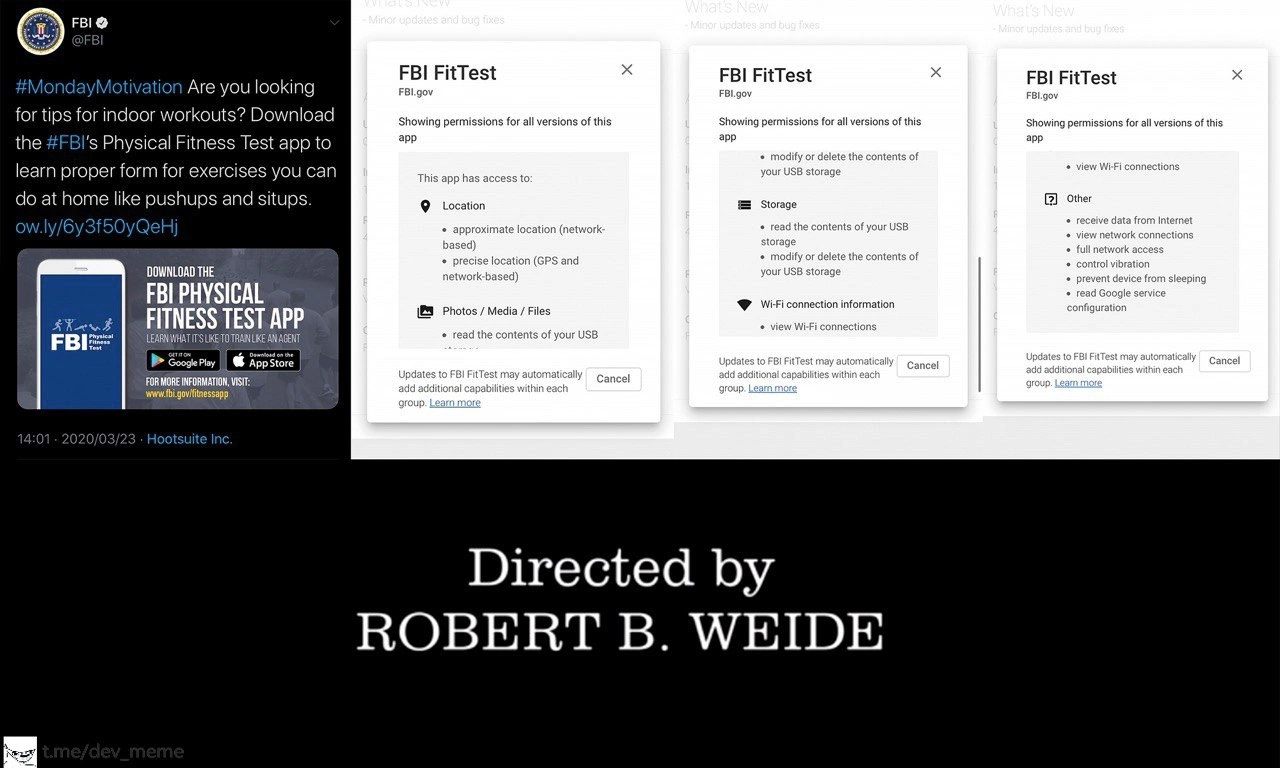
Let’s break down what’s happening here for those newer to Mobile Development or not as familiar with Android apps. On the top left, the FBI’s official Twitter account is promoting their “FBI Physical Fitness Test” app – basically a mobile app to help people exercise and “train like an agent.” They even hash-tagged it #MondayMotivation, trying to sound upbeat and trendy. On the right (top row) are screenshots from the Google Play Store (the app store for Android phones) showing the permissions that the app requires. Whenever you install an Android app, you have to grant it specific permissions so it can access sensitive parts of your phone like your location, storage, camera, etc. This is Android’s way of asking “Hey, is it okay if this app does X?” for things that could affect your Privacy or Security. The joke here is that the FBI fitness app is asking for a ton of permissions – much more than you’d expect for a simple exercise guide. Let’s list a few shown in the meme and what they mean:

  • Location – approximate & precise: This means the app can use your phone’s GPS and network info to know where you are. Maybe they intended to include running workouts or find “nearby FBI training events”? But it also means the app (and by extension, the FBI) could track your exact location. That’s a big PrivacyConcern for something as simple as doing pushups at home.
  • Photos / Media / Files and Storage (read and modify your USB storage): In Android, “USB storage” refers to your phone’s internal or external storage (like an SD card). Granting this lets the app read, change, or delete files on your device. Possibly the app could save workout videos or download exercise guides to your phone – that’s the benign explanation. The scary part is it technically could peek at personal files or media not related to the app. Most users don’t expect a sit-up training app to need full access to their files.
  • Wi-Fi connection information – view Wi-Fi connections: This lets the app see if you’re on Wi-Fi and what the network name is. Usually apps want this to choose high-quality video downloads only on Wi-Fi or check connectivity. It’s not uncommon, but in context it adds to the feeling of “Why do you need to know my network?” Since Wi-Fi info can sometimes be used to guess your location (Wi-Fi network names can be tied to places), it feeds the surveillance vibe of the joke.
  • Other – full network access, view network connections, receive data from internet, control vibration, prevent phone from sleeping, read Google service configuration: This is a bundle of miscellaneous capabilities. “Full network access” and “receive data from internet” are standard for any app that connects online (to download workout content or report progress). “View network connections” means the app checks if you’re on mobile data or Wi-Fi – again standard. “Control vibration” lets the app make your phone buzz (maybe for notifications like “Time for your next set!”). “Prevent device from sleeping” means it can keep your screen on, say during a workout tutorial so the phone doesn’t lock. “Read Google service configuration” often relates to Google Play services (like handling push notifications or analytics). Individually, each of these can be quite normal for a modern app. But seeing them all together on a long list makes it feel like the app pretty much wants full control of your phone. And the meme even notes: “Updates to FBI FitTest may automatically add additional capabilities within each group.” That line (standard on Google Play) humorously suggests even more could be coming.

In mobile app development, developers must declare these permissions in an AndroidManifest.xml file when building the app. For example, if the app uses GPS, the code might include:

<!-- Hypothetical excerpt from FBI FitTest AndroidManifest.xml -->
<uses-permission android:name="android.permission.ACCESS_FINE_LOCATION"/>
<uses-permission android:name="android.permission.ACCESS_COARSE_LOCATION"/>
<uses-permission android:name="android.permission.WRITE_EXTERNAL_STORAGE"/>
<uses-permission android:name="android.permission.READ_EXTERNAL_STORAGE"/>
<!-- ...and so on for network access, vibration, etc. -->

Each of those lines corresponds to one of the permissions in the list you see. Modern Android versions (since Android 6.0) make many of these “dangerous” permissions requestable at runtime, meaning the app might ask you during use “Allow FBI FitTest to access your location while using the app?” in a pop-up. But the Play Store still shows the full set of permissions an app can use, so users are informed before install. Seeing such a broad set can definitely raise eyebrows. As a junior dev or user, it’s good to know that a well-behaved app should only ask for what it truly needs. If a simple app asks for extras, it’s worth questioning. This meme captures exactly that feeling – it’s like an aha! moment of “Hold on, why does a workout app need all that?”

Finally, the entire bottom half of the meme – the black screen with “Directed by ROBERT B. WEIDE” – is a reference to a comedic device. Robert B. Weide directed episodes of the comedy show “Curb Your Enthusiasm.” In that show (and in many internet memes since), when something super ironic or disastrous-but-funny happens, they freeze the frame and display “Directed by Robert B. Weide” with the show’s goofy theme music. It’s a meme way of saying “Cue the comedy credits, this situation turned into a joke.” Here it implies that the FBI’s nice little fitness motivation turned into a comedy sketch because of the unexpected privacy invasion vibe. Essentially, the meme-maker is saying: Gotcha! The FBI tried to get people to download a fitness app, but everyone sees the sneaky permissions and it’s a comedic fail – roll credits! This ties together Security and Privacy awareness with a pop culture reference. So if you didn’t recognize that text, now you know: it’s poking fun at the FBI app situation as if it were a scene in a comedy show where everything went humorously wrong at the end.

Level 3: Big Brother Bootcamp

At first glance, this meme is a masterclass in ironic contrast that any seasoned dev or security nerd will appreciate. The FBI’s chirpy #MondayMotivation tweet cheerfully advertises a Physical Fitness Test app“learn what it’s like to train like an agent!” – complete with pushups, situps, and slick graphics. Harmless, right? But the accompanying screenshots of the app’s Android permissions read like a laundry list for a spy tool. We’re talking Location access (both coarse and precise GPS), full Storage read/write, Wi-Fi info, and a grab bag of network and device controls. In other words, the app wants to know where you are, what you’ve stored on your phone, who you’re connected to – basically everything but your blood type. This jarring mismatch between feel-good fitness marketing and an ominous permissions list is exactly why developers are smirking. It’s the classic “Sure, it’s a workout app… and I’m the Tooth Fairy” moment. In security lingo, someone clearly forgot about the principle of least privilege – the idea that an app should only ask for the minimum access it truly needs. Instead, the FBI FitTest app is grabbing all the things, prompting devs to quip that the only thing getting a workout here is your personal data plan.

From an experienced developer’s perspective, the humor digs into DataPrivacy and Security in a big way. We’ve all seen permission overreach before – like a simple flashlight app inexplicably demanding your contacts and microphone. It’s an instant red flag, a pattern so notorious that it’s practically a meme by itself. Here, it’s turned up to 11 by the fact that the app bearer is literally the FBI. That adds an extra layer of “you’ve got to be kidding me” to the mix. After years of headlines about government surveillance programs and backdoors, a lot of tech folks operate with an implicit skepticism toward Uncle Sam’s software. The meme plays right into that: government surveillance joke meets MobileDev misstep. The FBI’s attempt at a helpful fitness app instead feels like a Trojan horse for snooping. Seasoned engineers recall how earlier Android versions would show all required permissions upfront – an all-or-nothing deal. Many of us sat in meetings warning, “Ask for too much and users won’t install your app.” It’s Security vs Usability writ large: the devs or stakeholders likely piled on every permission “just in case” (maybe to log workout routes or cache video tutorials), but in doing so, they torpedoed the app’s credibility. Any senior dev knows that requesting access to, say, external storage and fine location for a simple exercise guide is how you end up the butt of privacy jokes on Twitter. And sure enough, the FBI’s tweet became a twitter_marketing_backfire. You can almost hear the collective facepalm and laughter from the infosec crowd as they screenshot those permission dialogs.

What really sells the meme is the Robert B. Weide credit in the bottom half – the famous “Directed by ROBERT B. WEIDE” freeze-frame ending from Curb Your Enthusiasm. In meme culture, that freeze-frame is the calling card of a comedic fail or ironic twist. It’s basically a way of saying “Welp… that escalated quickly in the wrong direction.” Here, it perfectly punctuates the FBI’s situation: one moment they’re encouraging home workouts, next moment everyone realizes the FBI FitTest app might be doing a lot more than counting your sit-ups. Cue the Curb Your Enthusiasm theme. For veteran developers, this is hilarious and painfully on-point. It’s a government_surveillance_joke packaged in familiar tech imagery – the kind of dark humor that comes from years of seeing PrivacyConcerns dismissed and then come back to bite. The meme is essentially shouting what every jaded engineer is thinking: “Nice try, FBI. We see those permissions – and we’re not fooled.” The directed-by freeze-frame is the mic drop, confirming that this benign-looking fitness app venture has turned into a classic ironic fail. In the end, Data Privacy won out over dumbbells – and we’re all left cackling in 1080p.

Description

A multi-part meme that starts with a screenshot of a tweet from the official FBI Twitter account. The tweet, posted for '#MondayMotivation', promotes an 'FBI Physical Fitness Test app' for indoor workouts. Juxtaposed next to this are three screenshots of the Android app's permission requests, which are alarmingly extensive. The permissions include precise location (GPS), access to read, modify, and delete USB storage, view Wi-Fi connections, and a host of 'Other' permissions like full network access and reading Google service configuration. The entire image culminates at the bottom with the iconic black screen credit 'Directed by ROBERT B. WEIDE', a meme format used to signify a comically disastrous or awkward outcome. The humor lies in the stark irony of the FBI, an intelligence and surveillance agency, offering a seemingly innocuous fitness app that requests permissions tantamount to full-scale personal data surveillance, a spectacular failure of public relations
Comments

7
Anonymous ★ Top Pick I downloaded the FBI fitness app. My phone's battery now dies in 30 minutes, the camera light is always on, and I keep getting targeted ads for plea bargain lawyers. But my push-up form is impeccable
  1. Anonymous ★ Top Pick

    I downloaded the FBI fitness app. My phone's battery now dies in 30 minutes, the camera light is always on, and I keep getting targeted ads for plea bargain lawyers. But my push-up form is impeccable

  2. Anonymous

    FBI FitTest PRD: functional requirement - count push-ups; non-functional requirement - replicate your GPS, photo roll, and Wi-Fi graph to the Bureau’s Kafka cluster in real time

  3. Anonymous

    When the FBI's fitness app needs more permissions than your CI/CD pipeline needs to deploy to production, you know it's time to implement zero-trust architecture... starting with government apps that somehow need to prevent your phone from sleeping just to count pushups

  4. Anonymous

    When your fitness app asks for more permissions than your CI/CD pipeline has to production, you know someone confused 'physical security' with 'application security.' The real workout here is the mental gymnastics required to justify why tracking your push-ups needs full network access, device sleep prevention, and the ability to read Google service configuration. At least they're transparent about automatically expanding capabilities - most apps just bury that in a 47-page EULA update. The 'Directed by Robert B. Weide' ending is chef's kiss perfect: nothing says 'comedic inevitability' quite like watching permission scope creep from 'approximate location' to 'prevent device from sleeping' faster than your sprint backlog grows during stakeholder demos

  5. Anonymous

    Nothing like a push‑up tutorial that needs precise GPS and full network access - the real workout is your threat model doing burpees while least‑privilege pulls a hamstring

  6. Anonymous

    FBI FitTest: a push-up counter that demands precise GPS, storage, and Wi‑Fi introspection. That’s not a fitness app; it’s a telemetry agent - burpees are just the sample data

  7. Anonymous

    Indoor workouts needing GPS and SMS? Peak mobile dev: justifying surveillance as a 'user benefit' in Play Store reviews

Use J and K for navigation