Manager penguin regrets letting dev choose the tech stack freely
Why is this Languages meme funny?
Level 1: Ice Cream for Dinner
Imagine your mom or dad says to you, “You can have *anything you want for dinner tonight.” That sounds awesome, right? So you think really big and say, “Okay, I want a huge bowl of ice cream for dinner!” Now, in your mind, ice cream is totally on the menu because they said anything. But as soon as you say it, your parent’s face changes and they reply, “No, no, obviously I didn’t mean ice cream. You have to choose real food.” Suddenly you feel a bit upset or embarrassed, because you weren’t trying to be bad – you just took their words literally. They’re annoyed because they assumed you’d pick, you know, normal dinner food. This is funny and a little confusing: why say “anything” if there are secret exceptions?
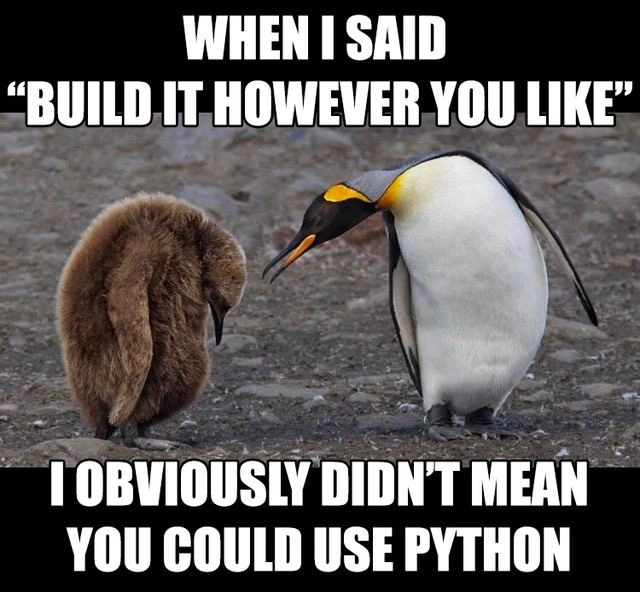
In the meme, the boss is like that parent and the programmer is like the kid. The boss said, “build it however you like,” which is like saying do whatever you want. The programmer (like the kid choosing ice cream) chose a programming language that the boss didn’t expect – he chose Python, because that’s what he liked. But the boss really meant “anything except that.” The picture of the big penguin scolding the little penguin is just like a parent scolding a child who picked the “wrong” dessert-for-dinner. It’s amusing because we can all relate to being told we had free choice, then finding out there were unspoken rules. The humor comes from that misunderstanding: one person thought “any choice is fine,” but the other person secretly thought “well, not that choice!”. It highlights how sometimes people don’t say exactly what they mean, and the result is a funny, slightly unfair situation that makes us grin.
Level 2: Anything but Python
In this meme, a boss (the big penguin) tells a programmer (the little penguin chick), "build it however you like." That sounds like total freedom to choose any tools or any tech stack. (A “tech stack” means all the technologies you use for a project – for example, the programming language, plus any frameworks or libraries, and even databases or platforms. It's like the ingredients list for software.) The junior developer takes this to heart and decides to build the project using the Python programming language, which they presumably like or find suitable. The twist is, the boss actually never wanted Python to be used. The bottom caption reveals the boss saying, "I obviously didn’t mean you could use Python." In other words: “Yes I said ‘however you like’ – but duh, I didn’t think you’d pick that!”
So, the joke here is about a confusing message from manager to developer. The manager’s first statement sounds like complete autonomy – like being told “do whatever you think is best.” But it turns out there were unwritten limits. The manager_disapproval comes from the manager’s bias against Python. This is reflecting something we see in real life: sometimes bosses or companies say they’re open-minded about technology, but when a developer actually chooses something outside the old familiar choices, suddenly it’s “not okay.” It’s a mixed message. The young penguin (the dev) looks ashamed and sad because he unknowingly broke a rule that wasn’t explicitly stated. The boss penguin looks upset or disappointed because they now have a project in Python, a language they really didn’t want in their ecosystem. The meme is funny to developers because many of us have experienced this kind of scenario or at least seen it happen. It’s a form of DeveloperHumor that highlights honesty (or lack thereof) in management communication.
Let’s break down a few terms and why this situation arises:
Python: Python is a very popular programming language known for being easy to read and write. It’s used for all sorts of things – web development, data analysis, automation scripts, scientific computing, you name it. One reason a developer might choose Python is because you can often build something quickly with it. It has a huge collection of pre-built libraries (for example, if you need to do web stuff, there’s Django or Flask; for data, there’s pandas or NumPy). Writing something in Python can take a lot fewer lines of code than in some other languages. So a junior programmer told “use whatever you like” might think, “Great, I’ll use Python and get this done fast!”
Why would a manager not want Python? This gets into language_bias – basically a preference (sometimes unfair) for one programming language over others. There are a few reasons a manager might be biased against Python in a corporate setting:
- Company Standards: Many companies have standard languages they use for most projects. For example, a company might primarily be a “Java shop” or a “C#/.NET shop.” That means all their systems are built with that one main language. It makes collaboration easier since every developer there is an expert in that stack. If someone suddenly uses Python, it breaks the norm. The manager might worry others on the team won’t be able to understand or maintain the Python code. It’s like if everyone in a kitchen knows how to cook Italian food, and one day someone starts making sushi – the head chef might worry no one else can step in and help with that dish.
- Maintainability: Related to standards, maintainability means how easy it is to keep the software running correctly over time. If only one person knows the new thing (Python, in this case), what happens if that person goes on vacation or quits? The manager might be thinking ahead: “Will we have Python experts around to fix bugs in this next year?” If the answer is no, they see it as a risk.
- Performance and Suitability: Python is often called a “scripting language.” It’s powerful, but it’s generally slower at raw number-crunching than languages like C++ or Java because it doesn’t run directly on the hardware – it runs in an interpreter. For most applications today that’s fine (computers are fast and Python has ways to manage heavy loads, like using multiple machines or optimized libraries). But some old-school managers remember times when using a slower language could be a real problem (like programs taking too long to respond). They might have a bit of lingering distrust: “Is Python going to handle thousands of users? Is it going to use too much memory?” Often these concerns are more about perception than reality, but they can be strong. It’s like how someone might prefer a pickup truck over a sports car to haul goods not because they tried the sports car and it failed, but just because the sports car seems less suited for heavy lifting. In the same way, to a conservative tech lead, Python might seem like the wrong tool for a heavy-duty job even if it could do it.
- Bias and Personal Preference: Sometimes it’s as simple as the boss just doesn’t like Python. Maybe they never learned it and feel uncomfortable around it, or they had a bad experience once. TechTribalism is a term that captures how developers can become like tribes, each loyal to their programming language. There have historically been playful rivalries, like LanguageWars between, say, Java people vs. Python people, or C++ vs. Java, or more recently maybe JavaScript vs. everybody else (since JavaScript started running on servers via Node.js, some back-end developers had strong opinions). These “wars” aren’t literal wars, of course, just debates, jokes, and a bit of one-upmanship. In our case, the manager is basically saying “Not Python,” which suggests they belong to a different “tribe” (maybe the Java tribe, or C# tribe, etc.). It’s a tongue-in-cheek way the meme points out that bias. In a healthy team, the best tool for the job should win out; in reality, sometimes the boss’s favorite tool always wins out.
“Build it however you like” – but not really: This phrase is a trap in the meme. For a junior developer or someone new to a team, hearing that is like a dream come true. It implies trust and freedom: you get to choose the architecture, language, libraries, whatever you think will work best. It’s the boss saying, “I trust your judgment.” But in many workplaces, especially more traditional ones, there’s an expectation that you’ll still stay within known boundaries. The manager might have meant “choose the approach you like” (like design the modules as you see fit, or use any library in our approved list), but not “go pick an entirely different programming language than the rest of the company uses.” It’s a misunderstanding. The junior took it as literally anything goes. The manager actually had an implied context: any method as long as it’s one I’m already comfortable with. This kind of miscommunication happens outside of tech too, but in developer culture it’s a common joke: being told one thing and then later getting in trouble because there were unspoken rules.
The reason this meme is funny (especially to developers) is because it exaggerates a truth we recognize. The manager’s reaction “I obviously didn’t mean you could use Python” is over-the-top in wording – “obviously” – because to the poor developer it was not obvious at all! If you’ve ever been in a situation where you followed instructions to the letter and then got scolded for it, this will resonate. The use of Impact font with all-caps text is the standard meme style to make the message loud and clear, as if the manager is almost yelling in outrage about the Python choice. Meanwhile, the visual of the baby penguin’s guilty posture is cute and funny, making the whole thing lighthearted instead of just painful. It’s a form of CodingHumor that also pokes at a real issue: sometimes innovation or choices in tech are constrained by people’s biases, even when you’re told they’re not.
For a junior developer reading this meme, the takeaway (besides the chuckle) might be: “If my boss tells me ‘any technology is fine’, maybe I should double-check if they really mean any.” It highlights the importance of clarifying expectations. And if you’re the boss, the lesson hiding in the humor is, “Don’t say any if you don’t mean any!” because you might end up surprised (and regretful) just like this manager penguin.
Level 3: Fine Print of Freedom
This meme nails a classic software team irony: a manager gives a developer seemingly unlimited freedom, only to yank the leash when that freedom is exercised in an unapproved way. The top caption – “WHEN I SAID ‘BUILD IT HOWEVER YOU LIKE’” – sets us up with the manager’s generous promise of autonomy. Any seasoned developer reading that line might already smirk and think, “Uh oh, there’s going to be a catch…” And sure enough, the bottom caption delivers the punch: “I OBVIOUSLY DIDN’T MEAN YOU COULD USE PYTHON.” Boom – the trap springs. The poor developer (represented by the downy penguin chick with its head hung low) just got a harsh lesson in the unwritten fine print of workplace freedom. It’s as if the manager is saying, “I gave you creative control, but I never imagined you’d go that far off-script!” This contradiction is the heart of the humor and the pain: the dev took the phrase at face value, and the manager is practically facepalming that they now have a Python project on their hands.
The image choice amplifies the manager-to-junior dynamic perfectly. A tall, authoritative king penguin leans over a much smaller, scruffy chick. You don’t need any labels to tell who’s who: the adult’s posture and beak angle scream “What were you thinking?!” while the chick looks utterly chastened, staring down at its flippers like a kid who knows they messed up. It’s a funny and adorable way to depict a manager’s disapproval toward a junior developer. The stark contrast in their appearance (sleek and colorful adult vs. fluffy brown baby) also mirrors the typical gap in seniority and power. Developer humor often anthropomorphizes or uses animals to represent roles (like the well-known “socially awesome awkward penguin” meme templates), and here the penguin_meme format delivers the message without needing any extra explanation in the image itself. We instantly recognize the boss vs. newbie scenario before we even read the text.
Now, why is the manager so upset about Python specifically? This touches on some deep-seated tech tribalism and internal company politics. In many organizations, there’s an established tech stack – the set of programming languages, frameworks, and tools that everyone has agreed (officially or tacitly) to use. It might be something like “Our backend services are all Java and our frontends are JavaScript” or “we build everything in C# on .NET”. These norms exist for valid reasons: consistency, ease of maintenance, leveraging team expertise, etc. When a manager says “build it however you like,” they usually assume a baseline of expected technologies. The unwritten expectation is “use our standard tools – whichever of those you think is best.” The junior in the meme either didn’t realize there was a hidden menu of acceptable options or boldly went outside it, depending on how you read the story. In choosing Python (which, let’s assume in this workplace is not a common choice), the dev triggered the manager’s stack_preference_conflict alarm. It’s a gatekeeping moment: “We don’t do that here.”
Realistically, a manager’s reaction like “not Python!” comes from a mix of practical concerns and personal bias:
- Team Familiarity: If none of the other developers on the team know Python, the manager is picturing a future nightmare where only this one person can fix or update the code. It’s a bus factor issue – what if the Python-proficient dev leaves? Managers worry about having code nobody else understands. In a multi-developer team, bus factor (morbid as it sounds) measures how many people can “get hit by a bus” before a project becomes unmanageable. A lone Python component in a sea of Java could effectively have a bus factor of one.
- Maintainability & Support: Companies often invest heavily in tooling and infrastructure around a primary language. Perhaps they have automated tests, continuous integration pipelines, monitoring agents, deployment scripts – all tailored for, say, a JVM ecosystem. Dropping a Python service into that mix means extra work: setting up new CI pipelines, possibly containerizing the app differently, handling Python-specific dependency management (virtual envs, requirements files), etc. The manager might be visualizing the DevOps team groaning at having to accommodate a new runtime environment. There’s also the question of long-term support: “Who’s going to update the Python libraries, apply security patches, and ensure this new piece doesn’t become an oddball we can’t troubleshoot at 3 AM?”
- Performance Concerns: Perhaps this project was performance-sensitive (lots of processing or heavy web traffic). Managers who cut their teeth on systems programming or high-load enterprise apps might reflexively think Python’s slower execution speed and single-threaded nature (due to that infamous Global Interpreter Lock) will bottleneck the system. They might be picturing latency spikes or high memory usage compared to a lean C++ service. This can be a misconception or a valid concern depending on context, but the key is the manager believes it. There’s a long-standing saying: “Python is great for prototyping, but you’ve gotta rewrite in something faster for production.” That’s not universally true (plenty of Python runs in production powering huge systems), but such maxims linger in the engineering zeitgeist and influence personal biases.
- Personal Bias & Image: Let’s face it, sometimes bias isn’t logical. Maybe this manager had a bad experience years ago with a messy Python codebase (perhaps a legacy script that became a maintenance nightmare), so now they cringe at the very word Python. Or they’ve bought into stereotypes like “Python can’t scale” or “dynamic languages lead to buggy code.” There’s also a bit of image and pride: some old-school devs in managerial roles see their primary language as the mark of “serious” programming. You’ll encounter managers who think anything not C++/Java is a toy for scripts. It’s an elitism that feeds into the LanguageWars – those endless debates about what language is “best.” This meme is one battle in that larger war: Python vs. The Establishment.
Notice how the meme singles out Python. It could have been any tech the manager disapproves of (JavaScript, Ruby, PHP, you name it) and the humor would still land for developers who have seen similar disapproval. Python was likely chosen by the meme creator because it’s a bit ironic – Python is extremely popular and widely taught (so a junior might naturally reach for it), yet it still sometimes gets frowned upon in traditional enterprise circles that favor something like Java. That contrast makes it funnier: it’s not a niche obscure language, it’s one of the big ones, and yet the manager reacts like it was a crazy choice. It highlights the absurdity of rigid tech biases. In developer culture, these LanguageComparison squabbles are common. You’ll hear jokes like “Java is enterprise, Python is for scripting,” or the reverse from Python fans: “Python is modern, Java is legacy.” Each camp pokes fun at the other – that’s classic DeveloperHumor. The meme taps into that vein: a manager implicitly treating Python as second-class, and we laugh because we either agree (“I’d never use Python for that, what was the dev thinking?”) or we roll our eyes (“Ugh, another suit who underestimates Python.”). Either reaction recognizes the tech tribalism.
On a social level, there’s a bit of a workplace lesson here wrapped in comedy. The manager clearly regrets saying “do whatever” because now they have to be the bad guy and crush the dev’s enthusiasm for Python. The junior likely feels embarrassed – they thought they were being innovative or just doing what was comfortable, and now they’re getting scolded. This scenario is painfully relatable. Many of us have been that junior developer who eagerly suggests a new library or language we just learned, only to get a reaction like, “We don’t have time for that” or “That’s not what we use here.” Alternatively, some of us have been the manager who thought we were encouraging creativity, and then had a heart attack when the newbie went and used, say, an unsupported database or a funky framework that no one else knows. The phrase “build it however you like” turned out to have an unspoken clause: “...within the bounds of what I, your manager, silently consider acceptable.” It’s a communication failure as much as anything.
The humor, ultimately, is a coping mechanism. DeveloperCulture laughs at these situations because if we didn’t, we’d cry at how often they occur. We joke about tech stack choices and language wars because almost every dev has sat through a meeting where someone said “Why on earth did you use X? We only use Y here!” The meme’s popularity (lots of folks sharing and upvoting it) suggests that this manager disapproval over a tech choice is extremely common. It’s a gentle form of calling out the hypocrisy: don’t promise a blank check if you’re gonna bounce it. And it’s warning fellow devs with a wink: “If your boss says ‘any tech stack is fine’, maybe double-check what they really mean before you spin up that Python (or Rust/Elixir/insert-new-hotness) project.” In short, build_it_however_you_like_quote is almost never absolute – there’s always a footnote. The laugh comes from recognizing that truth in an exaggerated, cute penguin scenario instead of the frustrating meeting room where it usually happens.
Level 4: Polyglot Paradox
From a theoretical computer science standpoint, letting a developer choose Python shouldn’t be a problem at all. After all, any general-purpose programming language that’s Turing complete (which Python, Java, C++, etc. all are) can compute the same set of solvable problems given enough time and memory. In theory, telling someone “build it however you like” is like saying “any of these tools is fine, they’re all equivalent in power ultimately.” The Church-Turing thesis underpins this notion: if it’s computable, it’s computable in Python just as it would be in C or Java. In theory there’s no such thing as a "wrong" programming language for a given problem – one could even build a web server in Assembly or a video game in SQL (with enough contortions) because of this universality. But here’s the paradox: theory != practice in software engineering. Just because all these languages can solve the same tasks doesn’t mean they do so equally well, or that they fit seamlessly into an existing ecosystem.
In practice, programming languages differ widely in their runtime characteristics and the ecosystems around them. Python is an interpreted, dynamically-typed language, whereas many enterprise-favored languages (Java, C#, C++) are compiled, statically-typed languages. This distinction has deep implications:
- Performance: Python’s interpreted nature and dynamic typing mean each line of code does a lot more work at runtime (resolving types, managing memory dynamically) compared to a compiled language where that work is done ahead of time. For CPU-bound tasks, Python often runs slower. A manager worrying about response times or CPU utilization might cringe at the thought of Python’s interpreter overhead. They might cite things like Python’s Global Interpreter Lock (
GIL) – a mechanism in CPython that allows only one thread to execute Python bytecode at a time – as a deal-breaker for multi-threaded performance. In a language wars context, someone biased against Python will gladly bring up the GIL as “proof” that Python can’t handle high concurrency, even if the real bottlenecks might lie elsewhere. - Type Safety: In Python, you don’t declare variable types; a variable can be an
intone moment and astrthe next. This dynamic typing makes Python very flexible and quick for development, but it shifts error detection to runtime. In a statically-typed language, a whole class of bugs (type mismatches, calling methods that don’t exist on an object, etc.) are caught by the compiler before the program ever runs. There’s a rich body of computer science research on type systems – terms like soundness, gradual typing, and type inference come up – all revolving around the trade-offs between flexibility and safety. A manager who cut their teeth on, say, Java or C++ might have a gut-level distrust of dynamic languages, believing that without the compiler as a safety net, the code is more error-prone. It’s a philosophical divide: one school relies on rigorous compile-time guarantees (even if it means writing more code up front), the other embraces rapid iteration and relies on tests and discipline for correctness. Neither approach is objectively “wrong,” but if the manager belongs firmly to the static-typing camp, Python can feel like a wild-west where anything could go wrong at runtime. - Ecosystem & Integration: Then there’s the fact that a programming language doesn’t exist in isolation – it comes with its build tools, libraries, deployment patterns, and cultural norms. Introducing Python into a stack that’s dominated by another language isn’t just a one-line change. It means new build pipelines (you’ll need a way to
pip installdependencies, manage virtual environments or containers, etc.), possibly new servers or runtime environments configured for Python, new linters or formatters (flake8,black, etc.) to enforce style, and new testing frameworks (pytest) alongside existing ones. On an abstract level, this is a question of heterogeneity vs. homogeneity in an architecture. There’s a known complexity cost when you increase the number of different technologies: it’s easier to maintain N systems that are uniformly Java than N systems where some are Java, some are Python, some are Ruby, because each one demands different expertise and tooling. In theoretical terms, you could model it as an N-dimensional optimization problem: maximize developer productivity and happiness by letting them use “the best tool for the job,” but minimize long-term maintenance cost by reusing knowledge and tooling. Those objectives conflict, and finding the right balance is hard – that’s the polyglot paradox. A mathematically minded person might even frame it in terms of set cover or complexity theory, but the gist is: each new language added to the mix can have exponential ripple effects on process and infrastructure complexity.
Finally, there’s the human factor which can be analyzed through a more cognitive or even anthropological lens. The manager’s strong reaction hints at something known as the Blub Paradox, a concept from programmer Paul Graham. In essence, the paradox says: developers can be blind to the value of languages more powerful (or just different) than what they are used to. If a language has concepts outside their familiarity (say, Python’s duck typing or concise lambda functions) those unfamiliar concepts might just seem like “weird magic” or unnecessary complexity. Conversely, a feature absent in their favored language (like manual memory management in C) might be seen as essential even if other languages handle it differently. In our scenario, the manager possibly doesn’t grok why a developer would pick Python – perhaps to the manager, Python is “just a scripting language” for small tasks, not a serious application development tool. This mindset is partially rooted in exposure and comfort: we tend to overestimate the risks of what we don’t know and overvalue the familiar. There’s a rich irony here: all Turing-complete languages are equally capable on paper, but in a manager’s mind they’re certainly not equal. Psychology and perception trump computability theory in daily life. As a result, we get situations like this meme: the technical universality of “build it in any language” crashes against the practical biases and constraints of real-world software projects.
In summary, the polyglot paradox of software development is that giving engineers freedom to choose different programming languages can lead to innovative, optimized solutions for each piece of a system (each language excelling at its niche), but it simultaneously introduces challenges in integration, performance tuning, and collective understanding. The meme humorously exposes this paradox: the manager offered full choice (embracing theoretical flexibility), but recoiled when the choice fell outside the narrow band of what’s conventionally acceptable (pragmatic constraints). It’s a collision of idealism (“use the best tool for the job!”) with realism (“we have to maintain and run this thing, so maybe not that tool”). The freedom had an invisible fence around it, and the junior developer inadvertently touched that fence by choosing Python.
Description
Meme shows a photo of two penguins on a grey, rocky shoreline: a tall adult king penguin leans over a small, brown-fluffed chick that hangs its head in apparent shame. White, bold Impact font caption at the top reads: “WHEN I SAID ‘BUILD IT HOWEVER YOU LIKE’”. Matching bottom caption says: “I OBVIOUSLY DIDN’T MEAN YOU COULD USE PYTHON”. The visual joke conveys a manager-to-junior dynamic where ‘build it however you like’ turns out to exclude the junior’s chosen programming language, highlighting real-world tech-stack gatekeeping, language bias, and the contradictions engineers face when autonomy collides with managerial preferences

Comments
6Comment deleted
“Use whatever language you like,” they said - then the architecture board rejected my Python service for failing to produce a WAR file for the decade-old WebSphere cluster
"Build it however you like" always comes with an invisible appendix of acceptable technologies that's longer than the actual requirements doc, and somehow Python is never on it despite running half the Fortune 500's data infrastructure
The classic architect's dilemma: give developers freedom to choose their tools, then act surprised when they don't telepathically divine your unstated preference for Go. Next time, maybe add 'tech stack: anything but Python' to the acceptance criteria - or better yet, admit that 'build it however you like' really meant 'build it exactly how I would, but let me pretend I'm empowering you.'
“Build it however you like” translates to “anything our JVM-only observability stack supports”; ship one Flask app and you inherit the PyPI mirror, new CI image, and pager duty forever
'Build however you like' - fine print: excludes dynamic typing until the perf audit demands a Rust rewrite
‘Polyglot microservices’ is fun until SRE, security, and finance do the math - then ‘any stack’ quietly becomes ‘Java 17 on the golden path,’ because the last Python service shipped with a 1GB image, three package managers, and its own SBOM waiver