When your pair-programmer turns out to be a null pointer
Why is this LowLevelProgramming meme funny?
Level 1: Invisible Partner
Imagine you’re about to do a three-legged race with a friend. You’re all pumped, you tie your leg to your partner’s… but when the race starts, you look over and realize your partner isn’t actually there – you’ve been hopping along with your leg tied to thin air! The friend turned out to be invisible (or imaginary). Pretty absurd, right? You’d probably faceplant into the ground because you were counting on someone to lean on. That’s essentially the joke here, but in programmer terms. One character proudly says, “I’m ready to work together, what about you?” and the other responds, “I’m nobody!” It’s funny in a silly way: the poor unicorn thought it had a buddy, but it was talking to an empty space. The humor comes from expecting a partner to be there and then realizing there’s nothing – just like setting up a two-player game and finding the second player’s controller isn’t plugged in. Even if you’re not a coder, you can laugh at the situation: it’s the classic “buddy cop with an imaginary friend” scenario. In simple terms, the unicorn tried to team up with a partner, but that partner turned out to be zero – literally not there – leading to a comically futile situation.
Level 2: Pointing at Nothing
Let’s break down the core idea for someone newer to C programming or general CS fundamentals. In languages like C and C++, a pointer is a variable that holds a memory address. Think of memory like a huge numbered grid of lockers where data is stored. A pointer is like a slip of paper that tells you which locker number to go to in order to find some value. For example, you might have a pointer that points to an integer stored somewhere in memory. If ptr is that pointer, *ptr means “go to the locker number stored in ptr and retrieve what’s inside.” Pretty cool, right? It’s a powerful mechanism in low-level programming for manual memory management. However, with great power comes great responsibility: you must ensure that a pointer actually points to a valid locker. If the slip of paper (pointer) has a nonsense number or a number that doesn’t correspond to something safe, you’re in trouble.
A null pointer is essentially a pointer that doesn’t point to any valid memory at all. By convention, we often use NULL (or 0) to represent this “nowhere” address. It’s like having a special address that means “no locker” or “nothing here.” If you have a pointer set to NULL and you try to use it (dereference it), you’re effectively saying “go to locker number 0 and get what’s inside.” But locker #0 isn’t a valid place for us to store data – the system keeps that off-limits. So when a program tries to access memory at address 0, the operating system intervenes and says “Error: you’re not allowed to go there!” The program then crashes with a segmentation fault. A segmentation fault (often shortened to “segfault”) is a common error when a program tries to access memory it shouldn’t – like an invalid pointer address. It’s the computing equivalent of hitting a brick wall: the OS immediately stops the program to prevent it from messing up other processes’ memory. If you’ve ever seen an error like “Segmentation Fault (core dumped)” or just “Segmentation Fault”, that’s the result of doing something bad with memory, often a null or wild pointer access.
In code, it looks like this: imagine we have a pointer meant to point to an integer. We might accidentally do something like:
int *partner = NULL; // partner is a pointer, but it's initialized to NULL (nothing)
*partner = 42; // attempt to write to the address in 'partner'
// Boom! This dereference *partner tries to write to address 0 -> segmentation fault
In the snippet above, partner is declared as a pointer to int (int *) but we set it to NULL meaning it points nowhere. The next line tries to do *partner = 42, which translates to “go to the memory address stored in partner and put the value 42 there.” But since partner is null, the address it holds is 0. The CPU goes “write 42 to memory at address 0” and the operating system immediately yells “No way!” and crashes the program. That’s a null pointer dereference in action. It’s a classic bug in C programs. If we had checked if (partner != NULL) before using it, we’d have realized it wasn’t pointing to a valid spot and could avoid the crash (or handle it gracefully). Forgetting that check, however, is an easy mistake – and thus rookie C programmers quickly become familiar with the dreaded segfault.
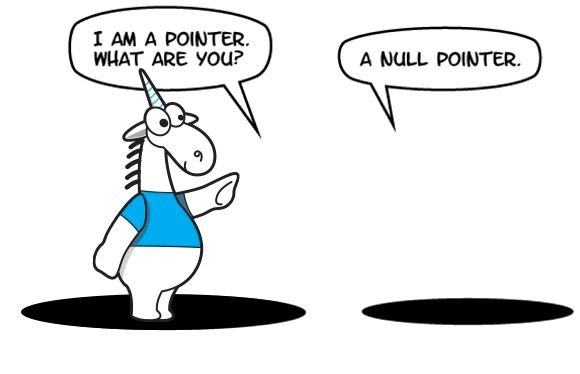
Now let’s connect this back to the meme’s little story. The title says, “When your pair-programmer turns out to be a null pointer.” Pair programming is a practice where two programmers team up at one computer to solve a problem together. Ideally, both are engaged, reviewing each other’s code, and catching mistakes in real-time. If one person “turns out to be a null pointer,” it humorously means that person ended up contributing nothing – as if they weren’t even there. In the cartoon, the unicorn on the left is like one programmer saying, “I’m a pointer, ready to point to some solutions! What are you?” The right side has only an empty shadow and a speech bubble that says “a null pointer,” implying the second programmer is basically nonexistent or empty. It’s a geeky double meaning: in code, dereferencing that “null” partner would crash the program; in real life, relying on a totally absent partner would crash your collaborative effort. The visual gag of the cartoon unicorn confidently addressing empty space makes the concept clear – you can’t pair up with “nothing” without things going awry. It’s a lighthearted way to remind us of a key rule: whether in code or teamwork, make sure you’re not dealing with null where something real is expected!
Level 3: Undefined Behaviorland
Every seasoned C/C++ developer has taken an unwilling trip to Undefined Behaviorland, often thanks to a stray or null pointer. The meme’s scenario – a smug unicorn pointer asking “What are you?” only to find out his partner is literally NULL – hits home because it’s a classic developer nightmare symbol presented as a cute cartoon. It’s a playful nod to all those debugging sessions where your program mysteriously crashes or acts bizarrely, and after hours of hair-pulling you discover the cause: someone dereferenced a null pointer. Of course it was a null pointer! It’s always the null pointer (or its equally mischievous cousin, the uninitialized pointer). The joke here is that the second “pair programmer” isn’t there at all – just like how a null pointer in code isn’t pointing to any real data. Visually, the empty shadow in the second panel reinforces the ‘null’ concept: there’s literally no entity there. It’s the comic’s way of showing a segmentation fault waiting to happen – the unicorn’s hopeful attempt to interact with a partner is about to go up in smoke because that partner is a ghost.
This meme brilliantly captures an inside joke about memory management bugs. The unicorn in the blue shirt proudly declares “I am a pointer!” – essentially saying “I know where to find some data.” Any fellow C programmer would chuckle at this anthropomorphic pointer. In response, the invisible partner responds “a null pointer,” meaning “I point to nothing.” For a senior developer, a conversation between a pointer and a null pointer is comedy gold because it’s like watching a train wreck in slow motion: you know if that unicorn tries to use the null partner (dereference it, in tech-speak), the result will be a crash. It’s a bit of gallows humor from countless real-life bugs: we’ve seen innocent lines of code like int length = strlen(myString); blow up because myString was NULL – and boom, segfault. Seasoned engineers have the equivalent of battle scars from these incidents (countless core dumps and “segfault at address 0x0” logs). The phrase “a land every systems engineer has reluctantly visited” in the description isn’t hyperbole – if you’ve written C or C++ long enough, you will eventually wander into that wasteland of bizarre program behavior caused by a bad pointer.
The humor also touches on the dynamic of pair programming. Typically, two programmers work together at one workstation, collaboratively coding – two brains pointing at the same problem. Now imagine one of those brains is effectively not there at all. “When your pair-programmer turns out to be a null pointer” is a tongue-in-cheek way to say “my coding partner was useless or absent”. In human terms, maybe your partner fell asleep, got distracted, or had no idea what was going on – they became a non-participant, a “null” in terms of contribution. In code terms, trying to work with a null pointer is as fruitful as trying to brainstorm with an empty chair: you’ll get no feedback and might even crash and burn. For the experienced dev, this analogy lands perfectly: it merges a software bug scenario with a real-world teamwork fail in a hilarious way. The unicorn’s bespectacled, authoritative look is like an expert programmer ready to tackle a problem, and the lack of a second unicorn paints the picture of that expert suddenly realizing they’re coding solo. We find it funny because we’ve been there – both with unpredictable C pointers and with those pair programming sessions that felt one-sided. And in both cases, the outcome is usually a mix of frustration and a story to tell later.
Level 4: The Billion-Dollar Mistake
In the realm of low-level programming, the concept of a null pointer is infamous – so much so that its very inventor, Sir Tony Hoare, once apologetically dubbed it “the billion-dollar mistake.” In the 1960s, programming languages like ALGOL and later C introduced the idea of a special pointer value that points to nothing (often represented as NULL or address 0). This seemed convenient at the time – a way to indicate “no object here” – but it inadvertently opened Pandora’s box of memory safety bugs and crashes. Decades of bugs in software, system vulnerabilities, and unexpected crashes can trace their lineage back to this humble null reference. The joke in the meme leans on that rich history: a pointer that turns out to be null is literally the embodiment of a long-standing headache in computer science.
Under the hood, a pointer is essentially a memory address – like a numbered GPS coordinate to a data value in memory. A “null” pointer is a special reserved address (typically 0) that by agreement does not map to any valid memory. Dereferencing such a pointer (trying to access the memory it points to) leads to undefined behavior. Undefined behavior is a notorious concept from the C/C++ world meaning the language spec gives absolutely no guarantees about what happens next. In practice, what usually happens on modern operating systems is a segmentation fault – the processor and OS detect that our pointer’s address is invalid (for example, accessing memory at address 0, which the OS intentionally marks as off-limits) and they halt the program for safety. That “Segmentation Fault (core dumped)” error is essentially the computer saying “Whoa there, you tried to use a null pointer – I’m stopping this before something really crazy happens.” This mechanism is by design: early operating systems established that the lowest memory addresses (including 0) should be non-accessible precisely to catch null pointer dereferences quickly instead of silently corrupting data. It’s a fundamental safeguard in system architecture – a guardrail for when we inevitably make the “billion-dollar mistake” in our code.
Over the years, entire disciplines and tools have grown around avoiding or catching the traps of null and dangling pointers. Compilers at high warning levels (think -Wall -Wextra in GCC or /Wp64 /Wall on MSVC) will often warn you if they can prove a pointer might be used while NULL. Advanced static analyzers (many with quirky mascots – yes, even unicorns!) scour code for potential null dereferences to prevent bugs before the code runs. In academia and language design, null pointers inspired research into safer alternatives: modern high-level languages like Java, C# or Python throw exceptions if you try to use a null reference (rather than soldiering on with undefined behavior), and newer system languages like Rust eliminate null references entirely in favor of option types to force developers to handle the “nothing here” case explicitly. From lambda calculus formulations of memory safety to formal proofs in systems verification, null pointers have been a classic example of what can go wrong when “anything goes” in a program’s execution. So when a pair-programming buddy turns out to be a null pointer, it’s invoking all that deep lore – a tongue-in-cheek reminder that even a CS fundamental like pointer semantics carries decades of lessons (and errors) behind its seemingly simple punchline.
Description
A simple two-panel cartoon shows a white, bespectacled unicorn wearing a blue t-shirt, standing on a black oval shadow. In the left panel the unicorn points forward and says, “I AM A POINTER. WHAT ARE YOU?”. The right panel contains only an empty shadow with a speech bubble replying, “A NULL POINTER.” No character occupies the second shadow, visually reinforcing the ‘null’ concept. The gag plays on C/C++ pointer semantics, where dereferencing an uninitialized or null pointer leads to segmentation faults and undefined behavior, a land every systems engineer has reluctantly visited. Senior developers will immediately recognise the subtle nod to memory-safety bugs so common in low-level codebases
Comments
6Comment deleted
Great, another stand-up where half the team doesn’t actually materialize - classic NULL culture fit
After 20 years in this industry, I've finally seen the perfect visualization of every junior developer's first PR review comment: "This could be null."
The null pointer's response perfectly captures every senior engineer's experience debugging a segfault at 2 AM - you know something should be there, the stack trace insists it's there, but when you finally inspect it, there's just... nothing. At least the null pointer has the courtesy to announce itself; in production, they usually just crash silently and leave you questioning your life choices and whether that pointer was ever initialized in the first place
In C++ it's nullptr; the kernel calls it SIGSEGV, and the PM calls it 'not a blocker'
Pointers promise indirection magic; null ones deliver segfaults that make valgrind your new best friend at 3AM
Architectural diagram in one panel: plenty of pointers on the slide; in production, half of them are null - the billion‑dollar mistake with an SLA