Skip to content
DevMeme
204 of 7435
The Corporate Echo Chamber of Big Data
BigData Post #247, on Mar 20, 2019 in TG

The Corporate Echo Chamber of Big Data

Why is this BigData meme funny?

Level 1: Bigger is Better?

Imagine you’re at school and the principal bursts into your classroom saying, “From now on, we need the biggest notebooks for everyone, because big notebooks are the new trend!” All the teachers nod seriously. But you and your classmates are confused – your regular notebooks were just fine for taking notes. Why do you suddenly need a gigantic notebook? One of your friends might roll their eyes and repeat in a silly voice, “We NeEd BiG nOtEbOoKs,” making everyone giggle. You all know the principal only said that because they heard some fancy idea somewhere, not because it actually helps you learn better.

This meme is just like that. The “boss” (or the company) is the principal demanding something just because it sounds impressive – “Big Data” is like saying “big notebooks” or “the biggest new thing” without a clear reason. The programmers are like the students who know it’s probably unnecessary or at least not explained well. When they copy the phrase in a funny, mixed-up way (big and little letters alternating), it’s like when you mimic your friend or sibling to tease them for saying something silly. It’s a playful way to show, “Hey, what you said doesn’t quite make sense, and we’re not taking it seriously.”

So, the meme is funny on a simple level because it’s a grown-up version of that classroom scene. Someone in charge is excitedly saying a buzzword they think is super important (“Big Data!” – which just means a lot of information in fancy terms), and the people who actually have to do the work respond by jokingly parroting the phrase. It’s basically the tech equivalent of a kid saying, “Sure, we really need that new toy to do our homework, right?” with a big smirk. Everyone who sees the meme laughs because they’ve been in that situation where a leader asks for something trendy without explaining why – and sometimes the only thing you can do is chuckle and mock it a little when their back is turned. In short, it’s pointing out the silliness of doing something just because it’s the “big, popular thing,” rather than because it’s actually needed.

Level 2: Decoding Big Data

Stepping down to a more straightforward view, let’s unpack what’s going on in this meme for a junior developer or someone new to the industry. First, Big Data is a term used to describe extremely large and complex datasets, and the methods to process them. We’re talking about data sizes that are so big regular databases and single servers struggle to handle them efficiently. For example, think of companies like Google or Facebook dealing with billions of search queries or posts – that’s Big Data. They use special tools like Apache Hadoop (which breaks big jobs into smaller tasks across many computers) or Apache Spark (which processes huge data in-memory at high speed) to handle that load. Big Data often involves the “3 Vs”:

  • Volume – a huge amount of data (imagine terabytes or petabytes of information, far beyond a single computer’s memory).
  • Velocity – data coming in very fast (thousands of events per second, like all the clicks on a popular website streaming in live).
  • Variety – data of many different types (database tables, text logs, images, video, sensor data all mixed together).

Not every company has Big Data in this technical sense. But around the 2010s, “Big Data” became a tech buzzword. A buzzword is a trendy term that people in business start using a lot, sometimes without fully understanding it, because it sounds advanced or promising. Other examples have been “IoT” (Internet of Things), “Cloud”, or “Blockchain”. In meetings, managers or clients might say these words to sound cutting-edge or because they’ve heard competitors are doing it. This leads to what developers jokingly call “Buzzword Bingo”. That’s a game where you secretly mark off a bingo card of popular buzzwords during a meeting – if the boss says “synergy”, “disruptive”, and “Big Data”, you might whisper “Bingo!” as a snarky aside. It’s a way to cope with hearing a lot of fancy terms with little substance behind them.

In the meme, the top caption “Companies: We need Big Data” is showing that companies (or bosses/executives – essentially stakeholders who decide what projects to pursue) are declaring Big Data as a necessity. This could happen because they attended a tech conference, read an article about success through data analytics, or heard that “data is the new oil” in some keynote speech. So, they come back to the office and tell the tech team, “We need to do Big Data.” Notice how that statement is super broad: it’s not saying what specifically to do with data, just that “Big Data” is required.

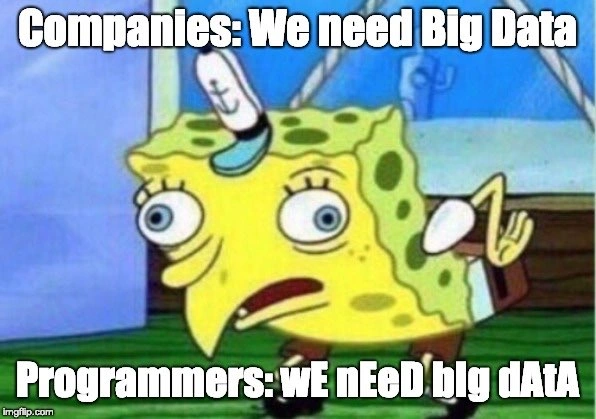
Now, the developers’ reaction, shown in the meme’s bottom text, is written in a funky alternating upper-case/lower-case style: “wE nEeD bIg dAtA”. This alternating-case text is the internet’s way of indicating a mocking or sarcastic tone. It’s meant to read like a silly, exaggerated voice – as if the developers are repeating the company’s line in a childish, mocking way. The image behind the text is Mocking SpongeBob, a famous meme picture from the cartoon SpongeBob SquarePants where SpongeBob is bent over with a goofy look (cross-eyed, sticking out his tongue a bit). People use that image to visually imply “This is what you sound like, and it’s ridiculous.” By combining that image with the alternating text, the meme format loudly signals, “Here’s a dumb statement being parroted back.”

So why would programmers mock the statement “We need Big Data”? Because from a developer’s angle, it’s frustratingly unclear and often untrue. Imagine you’re a junior developer at a mid-sized company. You know your data – say user records or sales logs – fits easily in a normal database and is maybe a few gigabytes in size. Then one day the CEO returns from a seminar and insists the company must “implement Big Data”. You’re left scratching your head: what does that even entail? Are they asking for better analytics? Do they want to store years of detailed logs? Or do they think there’s a magic tool that automatically makes data valuable just by calling it “Big”? It’s confusing because “Big Data” isn’t a specific product or solution – it’s a broad idea.

If you’re new, you might initially be excited – Big Data sounds cool, after all. But then you realize the boss hasn’t provided any concrete goal, like “We want to analyze customer behavior to improve our product”. They just said the buzzword. This is a classic example of stakeholder-developer miscommunication. The stakeholder (boss) speaks in hype language (“big data will save us!”), while the developer expects a clear task (“please process this much data in this way”). There’s a gap between those two, and it can cause real frustration on engineering teams.

Let’s decode it further: When a company truly needs Big Data solutions, it means their data demands have outgrown traditional tools. For instance, if you were logging billions of web clicks per day, a single SQL database might crash or be too slow; you’d need to distribute that workload across many servers. But if the company is just dealing with thousands or even a few million records (which is large but still manageable with normal databases or even an Excel spreadsheet), jumping to Big Data tech could be overkill. Developers are aware of the effort and complexity that Big Data tech brings – setting up clusters of servers, learning new frameworks, dealing with data that doesn’t fit neatly into tables, etc. It’s non-trivial work. So if a higher-up decrees “use Big Data” without evidence that it’s necessary, engineers can tell it’s more about chasing a trend than solving a problem. That can be demoralizing or even comical.

This meme’s popularity comes from that shared feeling among tech folks: “Here we go, management wants the new buzzword du jour.” It’s a form of tech humor and coping mechanism. By mocking the phrase, developers bond over their common experiences of absurd requests. You might have even heard colleagues do the SpongeBob mocking voice in the office after a meeting: one person jokes, “We NeEd BiG dAtA”, and everyone laughs, understanding exactly the eye-roll behind it. It’s light-hearted but also a little cathartic – a way to say “that was a silly request” without directly offending the boss.

In summary, the meme uses the Mocking SpongeBob format to show how programmers feel when companies throw around the term Big Data as a buzzword. The alternating-case text is the clue that the second line is a direct mockery of the first. It’s highlighting a common scenario in tech workplaces: stakeholders get excited by an IndustryTrend (like the Big Data hype), and the engineering team, having seen such hype cycles before, responds with good-natured sarcasm. If you’re a junior dev, take note – you’ll likely encounter some flavor of this communication gap in your career. The key lesson (besides enjoying the humor) is to always seek clarity: if someone upstairs says “We need X”, don’t be afraid to ask why and what exactly do you mean. And maybe keep a few memes handy in your group chat for when the buzzwords get too deep!

Level 3: All Buzz, No Byte

At the highest technical insight, this meme highlights the communication gap between stakeholders obsessed with industry hype and the engineers tasked with implementation. The top text “Companies: We need Big Data” encapsulates a familiar corporate edict: executives latch onto tech buzzwords like Big Data as a silver bullet. In the bottom text, the developers respond with alternating-case mockery: “wE nEeD bIg dAtA” – an internet-fueled way to mimic someone in a derisive, parrot-like tone. The humor lands because any seasoned developer recognizes the scenario: a non-technical boss has heard that “Big Data” is the next game-changing trend, and now it’s an urgent mandate – never mind that it’s vague and overhyped.

From a senior developer’s perspective, the phrase “We need Big Data” is practically devoid of technical meaning. It’s a Buzzword Bingo staple – management might as well say “We need synergy” or “We need innovation”. The dev’s mocking retort reflects frustration: you can’t just order up Big Data like it’s a package deal. In reality, Big Data refers to handling datasets so large or complex that traditional database systems struggle. It involves specialized distributed systems (think Apache Hadoop clusters storing petabytes, or Apache Spark crunching data across dozens of machines). Yet here is the company, possibly with data still small enough to fit in an Excel sheet, insisting it needs Big Data. This mismatch is comedic gold for engineers who have sat through strategy meetings that decree adoption of trendy tech without understanding it.

The Mocking SpongeBob image perfectly conveys the dev team’s internal response. SpongeBob’s goofy, bent-over posture with crossed eyes is the visual meme shorthand for “repeating something dumb in a silly voice.” By alternating upper and lower case letters, the meme text mimics how a sarcastic tone sounds. Essentially, the developers are repeating the company’s request right back at them, “Oh suRe, wE so nEeD bIg dAtA,” implying the request is naive. It’s a light-hearted way to call out the absurdity without directly confronting the boss. Every experienced engineer has felt this: when a higher-up excitedly demands a BigData initiative because they read a magazine article or a competitor’s press release, all while the engineering team rolls their eyes because they know it’s more complicated than that.

Why is it more complicated? True Big Data projects require a clear goal (e.g. “process a billion user events per day to improve recommendations”), the right infrastructure, and expertise in data engineering. You don’t just sprinkle Big Data on a project like magic dust. Companies often underestimate this. They might say “data is the new oil,” expecting riches just by hoarding data. But seasoned devs know raw data isn’t useful without refining (analysis, algorithms) – just like crude oil needs refining into fuel. We’ve seen buzzword-driven projects spin up costly data lakes or Hadoop clusters that end up underutilized because leadership had no concrete plan beyond the hype. It’s an industry trend pattern: yesterday it was “We need a mobile app,” then “We need cloud,” then “We need Big Data,” (today it might be “We need AI”). The meme calls out this buzzword fatigue – devs have heard grandiose mandates come and go, and the phrase “We need X” now triggers skepticism (and dark humor) more than excitement.

There’s also an underlying commentary on scale: the term Big Data implies volume, velocity, and variety of data beyond ordinary systems’ handling capacity. But when a small or mid-size company parrots “We need Big Data,” devs often discover the data in question is nowhere near that scale or complexity. It’s the classic disconnect between tech reality and corporate vision. An experienced dev might sarcastically think, “If you can still open it in Excel, it’s not Big Data, Bob.” They know that adopting big-data tech for a trivial dataset is like using a rocket engine to drive to the grocery store – overkill and misaligned. Yet the boss might measure success by buzzword compliance rather than actual utility. This systemic issue – chasing trends for clout or fear of missing out – is exactly what the mocking tone emphasizes.

In practice, this kind of top-down mandate can lead to engineers scrambling to implement a Hadoop pipeline or a fancy NoSQL database without a real problem to solve. It’s like being told to dig a giant hole “just in case”, burning time and money. The humor has a touch of pain: many developers have lived through projects where leadership was enamored with a buzzword (Big Data, Blockchain, microservices, you name it) and demanded it be shoehorned in. The result? Weeks of work, new complex systems to maintain, and often no clear benefit – all while the higher-ups proudly announce “We’re leveraging Big Data” to stakeholders. Internally, the engineering team is left sarcastically echoing those words and hoping the next trend will take a little longer to reach the boardroom.

To a senior engineer, the Mocking SpongeBob Big Data meme is a knowing grin and a sigh. It captures that “here we go again” feeling when corporate enthusiasm collides with technical reality. The alternating-case text is the perfect flourish – an meme-speak eye-roll. We laugh because it’s true: we’ve all had a meeting where someone with power insists on a buzzword solution without understanding it, and all we can do (at least, if we value our jobs) is nod… and maybe send a SpongeBob meme to the team Slack later to vent.

Description

A meme using the 'Mocking SpongeBob' or 'SpongeGar' format to satirize corporate buzzword adoption. The top text, in a clear font, says "Companies: We need Big Data". Below it is an image of a primitive, distorted SpongeBob SquarePants, looking vacant and unintelligent. The bottom text, attributed to "Programmers", mockingly repeats the phrase in alternating upper and lower case: "wE nEeD bIg dAtA". This meme humorously captures the cynicism developers feel when management or business leaders latch onto a trending technical term like 'Big Data' without a clear understanding of its application or whether the company's data scale even justifies the need. The programmers' sarcastic parroting implies that the request is seen as a hollow, cargo-cult trend rather than a genuine technical requirement


Comments

8
Anonymous ★ Top Pick The fastest way to get a multi-million dollar budget is to tell executives you need 'Big Data' to power an 'AI-driven synergy platform'. The second fastest way is to show them the 10GB CSV file you're planning to use it on
  1. Anonymous ★ Top Pick

    The fastest way to get a multi-million dollar budget is to tell executives you need 'Big Data' to power an 'AI-driven synergy platform'. The second fastest way is to show them the 10GB CSV file you're planning to use it on

  2. Anonymous

    C-suite: “We need Big Data.” Devs: “Copy - spinning up a Kafka→Flink→Snowflake pipeline so the CEO can filter six rows in Excel and call it ‘insights.’”

  3. Anonymous

    "We need Big Data" says the exec who's been running the same 50-row Excel report for three years and just discovered VLOOKUP last week

  4. Anonymous

    The company needed Big Data; the data was 40MB of CSVs. The Spark cluster's YARN logs, however, were genuinely big data

  5. Anonymous

    When the VP says 'we need Big Data' but your entire dataset fits comfortably in a Postgres table with proper indexing - yet somehow you're now evaluating Spark clusters, Kafka streams, and a data lake architecture that costs more per month than your actual revenue. Classic case of confusing 'we have 10GB of customer records' with 'we're processing petabytes at Google scale.'

  6. Anonymous

    Big Data: Scaling storage costs to justify problems that fit in a Pandas dataframe

  7. Anonymous

    “We need Big Data” is the roadmap to a highly available, horizontally scalable pipeline that delivers the same incorrect KPI with five nines

  8. Anonymous

    Nothing says “strategy” like spinning up a Kafka-Spark-K8s stack to filter 80MB of CSVs because an exec saw a Gartner slide

Use J and K for navigation