Skip to content
DevMeme
7261 of 7435
Me Designing Data-Intensive Applications: Monkey Riding a Pig Into Ruin
DistributedSystems Post #7961, on May 2, 2026 in TG

Me Designing Data-Intensive Applications: Monkey Riding a Pig Into Ruin

Why is this DistributedSystems meme funny?

Level 1: Holding On for Dear Life

Picture a tiny monkey that decided to ride a pig. The pig takes off across the yard at full speed, completely doing its own thing, and the monkey just grips on with both hands, eyes wide, going wherever the pig goes. It looks like the monkey is in charge. It is absolutely not in charge. That's exactly what it feels like to build big, complicated software that juggles tons of data: you plan it all out feeling like the hero, then the thing takes off on its own and your real job becomes not falling off while you both head somewhere neither of you fully controls.

Level 2: What DDIA and "Data-Intensive" Mean

For anyone earlier on the trail:

  • Data-intensive application: software whose hard problems are about data — its volume, its complexity, the speed it changes — rather than raw CPU crunching. Think databases, search indexes, stream processors, analytics pipelines.
  • DDIA: the nickname for Kleppmann's book, basically the rite-of-passage text for learning how databases, replication, partitioning, and consistency actually work under the hood.
  • Distributed system: software running across many machines that must cooperate over a network. The catch: networks drop messages, machines crash independently, and clocks disagree — so "simple" operations become genuinely hard.
  • Consistency / availability: roughly, "does everyone see the same data right now?" versus "does the system always answer?" You constantly trade one against the other.
  • Quote tweet: posting someone else's tweet with your own caption on top — here, layering a system-design punchline over a Lord of the Rings battle cry over a chaotic animal video. Three unrelated things fused into one joke.

The early-career insight: the gap between the clean architecture diagram and the live system is the entire discipline. The diagram is the calm before the pig moves.

Level 3: Ride for Ruin (a.k.a. the Architecture Review)

Strip the theory and you still have the cultural truth that makes senior engineers nod. You start a data-intensive project with a clean architecture diagram — neat boxes, tidy arrows, a confident Théoden-at-the-whiteboard energy. Then requirements arrive: it must be real-time and analytical, strongly consistent and always available, cheap and infinitely scalable. Each demand is reasonable in isolation; together they're a pig already at a sprint. You bolt on a cache (now you have invalidation problems), add a message queue (now you have ordering and exactly-once-delivery problems), shard the database (now you have cross-shard transaction problems), and somewhere in there you stopped designing and started holding on.

The Ride for ruin and the world's ending! quote nails the specific gallows euphoria of committing to an architecture you suspect is doomed but is now too far in motion to stop. Everyone on the team can see the wall coming — the eventual rewrite, the consistency bug that'll surface under load, the "temporary" Kafka topic that becomes load-bearing — and there's a dark joy in just riding it. The systemic reason this keeps happening: distributed systems make every easy thing hard, the failure modes are invisible until production traffic finds them, and the people who could slow the pig down (architects, staff engineers) are usually the ones who already left for the next horse.

Level 4: Eventually Consistent With the Wall

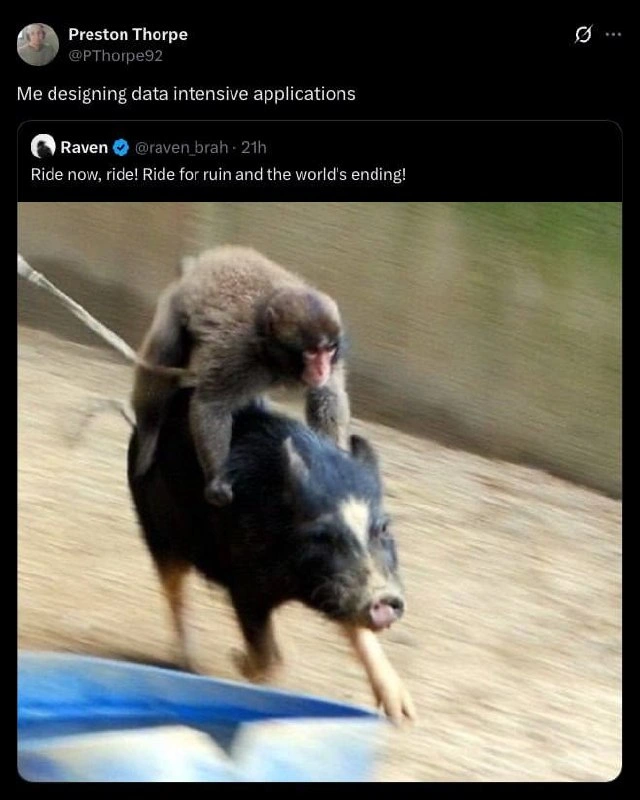
The caption Me designing data intensive applications is a direct nod to DDIA — Martin Kleppmann's Designing Data-Intensive Applications, the book that is to distributed systems what the dictionary is to spelling. And the image — a small macaque clinging to the back of a motion-blurred pot-bellied pig sprinting across dirt, rope leash trailing, quote-tweeted over Théoden's "Ride now, ride! Ride for ruin and the world's ending!" — is a startlingly accurate emotional model of what designing such systems actually feels like. The joke gets funnier the more theory you know, which is why this level exists.

DDIA's opening chapters frame everything around three properties: reliability, scalability, and maintainability. The monkey believes it is steering. It is not. The pig — your data layer, your replication topology, your consensus protocol — has its own momentum, and the rider's job is mostly to not fall off while the system goes where physics and partial failure send it. This is the lived reality of the CAP theorem: in the presence of a network partition you may have Consistency or Availability, not both, and you do not get to opt out of partitions — they're the dirt the pig is already running on. You chose a tradeoff at design time, at the calm whiteboard; you experience that tradeoff at 3 AM, at a full gallop, with the world ending.

Consider what the meme compresses. Consensus algorithms like Paxos and Raft exist precisely because getting a handful of machines to agree on a single value, in the presence of crashes and message delays, is genuinely hard — provably so, per the FLP impossibility result, which says no deterministic consensus protocol can guarantee termination in an asynchronous network with even one faulty process. Eventual consistency is the engineering shrug at that wall: we relax the guarantee from "everyone agrees now" to "everyone agrees... eventually... if the writes stop." The tech-savvy read on this image is exactly that — the pig (the system) eventually becomes consistent with the wall. Linearizability, quorum reads with R + W > N, vector clocks for detecting concurrent writes, conflict-free replicated data types (CRDTs) that merge divergent state without coordination — these are all sophisticated tack and reins. None of them change the fundamental truth that you are a small primate on a large animal that outweighs your intentions.

The beauty, and the reason experienced people love this meme rather than just laughing at it, is that the ride is inevitable, not stupid. You can't build a globally-distributed, fault-tolerant data system without surrendering some control to asynchrony, replication lag, and partial failure. The monkey isn't an idiot for riding the pig; the pig is the only vehicle that goes fast enough to matter. The mathematics — FLP, CAP, the impossibility of distinguishing a slow node from a dead one over an unreliable network — guarantee that even a perfectly-designed system retains an irreducible element of "hold on and pray." That's not a failure of engineering. It's the shape of the problem.

Description

A screenshot of a tweet by Preston Thorpe (@PThorpe92) captioned 'Me designing data intensive applications', quote-tweeting Raven (@raven_brah) who wrote 'Ride now, ride! Ride for ruin and the world's ending!' (Theoden's charge from The Lord of the Rings). The quoted photo shows a small monkey gripping the back of a black pot-bellied pig as it sprints at full speed across dirt ground, motion-blurred, with a rope leash trailing behind. The meme riffs on the famous book 'Designing Data-Intensive Applications' (DDIA by Martin Kleppmann): the chaotic, barely-controlled animal ride stands in for architecting distributed data systems - committed at full gallop, holding on for dear life, ruin imminent

Comments

1
Anonymous ★ Top Pick Chapter 1 of DDIA covers reliability, scalability, and maintainability; chapter 2 is apparently a monkey screaming 'death!' while the pig eventually becomes consistent with the wall
  1. Anonymous ★ Top Pick

    Chapter 1 of DDIA covers reliability, scalability, and maintainability; chapter 2 is apparently a monkey screaming 'death!' while the pig eventually becomes consistent with the wall

Use J and K for navigation