Llama 4 AI Model Suite Announcement Highlighting Specs and Availability
Why is this AI ML meme funny?
Level 1: Bigger Isn't Always Better
Imagine you have a friend who comes to school bragging about a gigantic robot they built. They say, “My robot is the best – it has a trillion parts and can read ten million pages of a book in one go!” That sounds super impressive, right? But then you realize: to have a trillion parts, the robot must be unbelievably huge and complicated. In fact, it’s so big that your friend can’t even bring it to school or power it on properly because it needs a whole power plant just to run! And reading ten million pages at once? That’s like trying to cram an entire library into its brain in a single moment. It sounds cool, but would that really be useful? Probably not, because no one actually needs to read ten million pages at the same time — and if they tried, it would take forever and be really hard to handle. In the end, everyone kind of smiles because your friend’s boast is obviously more about showing off than practical use. It’s like someone claiming they have the world’s biggest sandwich — sure, it’s huge, but you can’t realistically eat it and you don’t really need that much. In simple terms, the joke here is that making something ridiculously big and complex (just to say it’s the biggest) is a bit silly, because bigger isn’t always better. Sometimes people (or companies) do that to impress others, even if it’s not very practical. That’s why this big robot — or in the case of the meme, a super enormous AI model — is kind of funny. It’s over-the-top and feels like it’s just made to win a bragging contest, not to solve an everyday problem.
Level 2: Beneath the Buzzwords
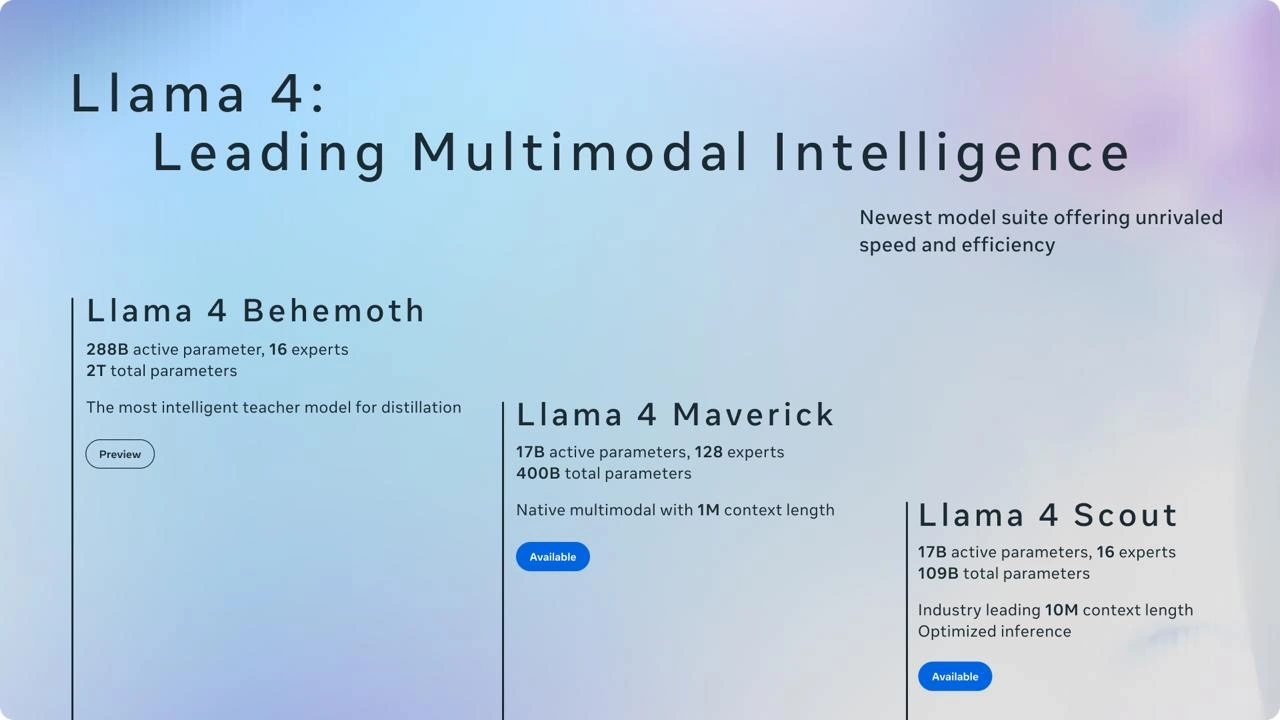
So, what exactly is going on with all these fancy terms and gigantic numbers on the Llama 4 slide? Let’s break down the “spec sheet” in plain language. First, parameters: in machine learning, parameters are basically the internal weights the model has learned – you can think of them as the “knowledge” or the “brains” of the model. When they say a model has 17B parameters, that means it has 17 billion little knobs it tuned during training. More parameters usually let a model capture more complex patterns (imagine a bigger brain with more neurons), though it also means more computation to use it. Now, those insane figures like 288B active / 2T total parameters for Llama 4 Behemoth hint at a special design. The key phrase is “16 experts” (or “128 experts” for Maverick). This refers to a technique called Mixture-of-Experts (MoE). Instead of one humongous neural network, MoE is like having a collection of smaller expert models inside the big model. For example, Llama 4 Maverick has 128 experts – think of it as 128 specialized sub-models. When you input something (say a question or a sentence), the model uses a gating system to pick a few of those experts that are most relevant to that input. Only those chosen experts actually get used (that’s the active parameters part). So Maverick might only use ~17B worth of parameters out of its much larger pool for any given query. The total parameter count (400B for Maverick, 109B for Scout, a jaw-dropping 2 trillion for Behemoth) is counting all the weights across all experts. It’s a bit like saying “our model has 128 brains, but it only uses 1 or 2 brains at a time for a task.” This design allows the model to appear extremely large (lots of knowledge potentially in there), without always having to crank through every single weight for each input. It’s an advanced way to have your cake and eat it: many parameters, but not all used simultaneously, which can be more efficient than one mega-monolithic network. The trade-off is it’s much more complex to build and coordinate – like managing a team of 128 specialists instead of one jack-of-all-trades.
Next up, context length. This is basically how much input text the model can consider in one go, measured in tokens (where 1 token is roughly ¾ of a word, so 4 tokens ~ 3 words, as an approximation). Think of it as the model’s reading attention span or memory for a single prompt. If a model has a context length of 2048 tokens (about what GPT-3 had), it can handle a few pages of text before it starts forgetting or can’t take more input. Now, Llama 4 Maverick says 1M context length – that’s 1,000,000 tokens – and Llama 4 Scout boasts 10M context length – ten million tokens! To visualize: 1 million tokens might be around 800,000 words, which is like reading multiple novels worth of text at once. Ten million tokens is like trying to feed in an entire library or a stack of encyclopedias into the model in one shot. Basically, these context windows are huge. They’re claiming the model can pay attention to incredibly long documents or conversations. For example, with a 1M context, you could (in theory) input every log of a lengthy software project or all the chapters of a textbook series, and the model would still remember the beginning by the time it’s at the end. This is far beyond typical models today, where even 100,000 tokens was cutting-edge. Achieving 1M or more likely requires special handling (like breaking the text into chunks internally, or doing some fancy summarization on the fly) because it’s very taxing on memory and speed. But as a feature, it means “you won’t hit the limit, no matter how long your prompt is.” It’s catering to use cases like analyzing huge codebases, long transcripts, or multi-document queries in one go.
Now, multimodal: The slide headline says “Leading Multimodal Intelligence”. Multimodal means the AI model isn’t limited to just text; it can take in or output different types of data – for example, images, audio, maybe video, along with text. When they say “native multimodal” for Maverick, it suggests that model can probably analyze not just text but also images or other media as input (similar to how some versions of GPT-4 can interpret images). It’s a trendy feature, since human-like intelligence should ideally handle multiple modes (vision, language, audio) together. So Maverick might be the model you’d use if you want to feed it an image and ask for a description, or give it a chart and have it analyze it alongside text. In contrast, Scout might be more text-focused but with that giant context window as its superpower.
Another term: distillation – the slide calls Behemoth “the most intelligent teacher model for distillation.” This is referring to knowledge distillation, a process in machine learning where a very large model (teacher) is used to train a smaller model (student) to behave similarly. It’s like having a genius professor (the Behemoth, with 2 trillion parameters of wisdom) generate a ton of answers or insights, and then training a smart but smaller student (say Scout with “only” 109B total params) to mimic those answers. The idea is the student model learns from the teacher’s outputs and hopefully ends up almost as good, but far more efficient to run. This is a common technique to make practical versions of models that would otherwise be too slow or expensive to use. So, reading between the lines: Behemoth is probably not meant for everyday use – it’s there to distill its intelligence into the more usable Maverick and Scout models. It’s like a parent model raising its kids to carry on the knowledge.
Finally, those little details: “Preview” vs “Available”. When the slide marks Llama 4 Behemoth as Preview, it implies it’s not generally available yet (likely because it’s experimental or requires special access – possibly because running something that big is not feasible for most). Maverick and Scout being “Available” suggests those models are either released or soon to be released for use (maybe via an API or open-source download if this were real). They’re still huge (note the listed 210GB and 788GB next to them in the meme text – that’s roughly how much memory you need to just load these models!). That gives a sense of scale: hundreds of gigabytes of VRAM or RAM to load the full models. For context (pun intended), a typical modern PC might have 16GB of RAM – so 210GB is like 13 times that. These models aren’t something you’d run on your laptop; they live on beefy servers, likely with multiple GPUs each having 40GB or more of memory, working in tandem. The mention of “optimized inference” for Scout likely means the engineers spent effort to make it run as fast as possible despite its size – for example, using faster matrix math kernels or quantizing the model (reducing precision of numbers to shrink memory use). And “industry leading 10M context length – optimized inference” together suggest Scout is the one you’d use if you truly need to process extremely long input, and they’ve tailored it to do that efficiently (maybe by streaming the input through or using some retrieval method under the hood).
In simpler terms, this slide is saying: Llama 4 is a new AI model lineup with three versions:
- Behemoth: a gigantic model (2 trillion params total) mostly serving as a wise teacher for the others – cutting-edge but not actually practical to deploy.
- Maverick: a still huge model (400B total params) that is multimodal, so it can handle images and such, with a very large text window (1 million tokens). It’s like the advanced generalist.
- Scout: a slightly smaller total (109B params) focused on being super-efficient in reading long texts (10 million tokens context). It’s the one optimized for long documents and speedy inference.
All of them are part of the “Llama 4” family, and the slide is hyping their speed, efficiency, and sheer scale. It’s highlighting trends in AI where models are getting not just bigger, but also more specialized (using experts) and more capable of handling varied inputs and longer information. The humorous angle, of course, is that these specs are so extreme that it comes off almost like parody – but it also reflects real trends (each year AI models shatter previous records in size). For a newcomer, the takeaway is: the meme is poking fun at how AI companies market their latest super-sized models, and it’s filled with buzzwords and numbers that signal “this is cutting edge, but also kind of overkill.” Now that you know what those buzzwords mean, you can see both why the slide would be impressive on the surface and why developers find it a bit amusing.
Level 3: To 10M and Beyond
For seasoned developers and ML engineers, this slide hits on the absurd escalation in AI model specs that’s been taking place in recent years. It’s the classic “bigger is better” flex: each new model family (especially in the large-language-model arena) tries to one-up the last in sheer size and scope. We’re looking at model names like Behemoth, Maverick, Scout – even the naming screams “product lineup”, as if we’re shopping for trucks or fighter jets. Behemoth is “Preview” (i.e., too wild to unleash fully), while the others are “Available” – a tongue-in-cheek way to say only slightly less monstrous and you still probably can’t run them on anything you own. The humor is that this marketing slide is dressed up with a soft gradient background and slick layout, just like a real tech product launch, but the content is ridiculously over-the-top for anyone who knows the domain. It’s parodying how AI companies parade their biggest numbers to impress investors, headlines, and yes, developers too. In the AI_ML industry, we’ve seen an arms race: first it was model parameters (GPT-2 had 1.5B, GPT-3 jumped to 175B, then talk of 500B, 1T... now here we are at 2 trillion in a “preview”). When raw parameter counts started to sound passé, the race shifted to context window lengths, which became the new hot spec – “our model can read an entire book in one go!” One model boasts 32K tokens, another then offers 100K, and now Llama 4’s slide satirically cranks it to 1,000,000 and 10,000,000 tokens. It’s to infinity and beyond in terms of bragging, hence the meme-worthy incredulity. Experienced folks chuckle because they know these numbers are mostly for show; in real life, hardly anyone has a use case for shoving 10 million tokens into a single query (and even if they did, the latency and cost would be astronomical). It reminds us of the gigahertz wars in CPUs or the megapixel wars in digital cameras — quantitative one-upmanship that looks good on slides but offers diminishing practical returns.
The meme’s caption nails this sentiment: “Ok, I get it, reading screenshots is hard + now nobody really cares about benchmarks.” This is pointing out that these promotional slides used to be filled with benchmark graphs (like accuracy on some leaderboard, or an impressive win on MMLU or other tasks), but the audience has grown jaded. Now, to grab attention, marketers pivot to raw stats like parameter counts and context lengths, because those are easy to splash in big font. The truth is, benchmarks in AI have proliferated and many are now seen as cherry-picked or gamed; a savvy crowd no longer blindly believes “state-of-the-art on X” claims. So here, instead of showing how Llama 4 performs on say, reasoning or coding tasks, the slide just thrusts the massive specs in your face. It’s basically saying “Forget the fine print, just look how HUGE and cutting-edge this is!” The meme creator wryly notes no one wants to squint at detailed benchmark bars in a screenshot, and we’re all a bit cynical about those anyway. So what’s left? Spec sheet flexing — giant numbers that are supposed to make us say “whoa.” But to the seasoned eye, it’s half impressive, half comedic. We know that such leaps usually come with trade-offs. For instance, mixture-of-experts models (implied by the “experts” counts) are notoriously hard to serve in production; coordinating 128 experts for each request can cause loads of network traffic between nodes if the model is sharded. There’s also the question: Does a 400B parameter MoE actually perform markedly better than a well-tuned 100B dense model? Not always, as past research has shown diminishing returns and sometimes even regressions on quality if the gating isn’t perfect. So the hype might outpace real gains. But hype is partly the point – it’s IndustryTrends_Hype incarnate. This slide deftly skewers that trend by rolling every buzzword into one: “Leading Multimodal Intelligence”, “unrivaled speed and efficiency” (sure, we’ll believe that when we see the inference latency on 10 million tokens…), and product tier names that imply a solution for every niche. It reads like a satire of AI product announcements where each model is bigger, longer context, or more specialized than the last, just to have something shiny to announce.
Let’s talk context length from a real-world perspective. A 10 million token context window is, frankly, beyond impractical with today’s hardware. If you tried to feed a whole codebase or every page of Wikipedia into a single prompt, you’d be waiting ages for a response and likely bankrupt yourself on cloud compute. In fact, current real models boasting 100K contexts already warn users that stuffing them to the max will be slow and costly. So a 10M context being “industry leading” is poking fun at how marketing will take an extreme, almost hypothetical capability and brand it as a leading feature. It’s reminiscent of spec sheets that advertise a maximum value that almost no normal user will hit – like a car saying it can tow 20 tons (technically true, but outside any normal scenario). The “Optimized inference” claim for Scout is a cheeky one too; from a seasoned dev angle, it implies that enormous effort went into making this behemoth barely runnable. One can almost hear the GPU fans spinning. Optimized here is code for “we’ve done everything possible so it doesn’t outright time out or melt down”. There’s a tongue-in-cheek recognition that calling a 109B-param model with 10 million context “optimized” is like calling an elephant “diet-conscious” because it managed to lose a little weight.
The mixture-of-experts architecture also introduces a classic trade-off that industry veterans know: yes, you can brag about 2T total parameters, but only a fraction are used at once. That means you’re carrying a ton of dead weight if the input doesn’t utilize those experts. It’s like bragging you have a 16-cylinder engine in your car – cool, but if you’re mostly driving to the grocery store, 12 of those cylinders are just along for the ride. There’s an implicit joke here: calling the 2T Behemoth “the most intelligent teacher model for distillation” is basically admitting “don’t worry, we won’t actually deploy this thing directly to production either.” It exists so that smaller siblings can learn from it and do a passable job more efficiently. That’s actually a smart strategy (knowledge distillation is widely used to compress models), but it’s funny in a wry way – the pinnacle of their achievement is immediately used to make much smaller models, because only those are practical. It’s a bit like building a gigantic, luxurious concept car that will never hit the road, but its design influences mass-market models later. The meme-savvy crowd recognizes this pattern from the likes of GPT-3 (which was huge and mostly a proof of concept) to distilled models like DistilGPT.
In terms of AI industry trends, this meme underscores the current AI hype cycle. Every company is racing to show they have the biggest, baddest model on the block. We’ve moved from “our AI can chat” to “our AI can compose images and read videos” (hence “Multimodal” buzzword), and now apparently to “our AI has virtually infinite memory and godlike parameter counts.” It’s both exciting and faintly ridiculous. Developers with some mileage will recall similar hype cycles in tech (think Big Data hype where every database suddenly was “web scale”, or the Blockchain era where everything needed a ledger). Here, it’s LLM supremacy race – the meme lampoons it by turning the dial up to 11. The result is almost a caricature of a leaked BigCorp slide: by combining mixture-of-experts (to inflate parameter count), multimodality (to tick the image/audio support box), and crazy-long context windows, it’s creating the ultimate buzzword bingo card.
What really sells the humor is how earnest and polished the slide looks, while presenting what any experienced engineer would recognize as borderline absurd specs. The gradient background, the neatly separated columns with rounded corners, the little status pills (“Preview” in gray for the unreal 2T model, “Available” in blue for the others) – it’s a perfect parody of a corporate announcement at, say, an AI conference or on a blog post. One can imagine a presenter in a crisp shirt saying, “And one more thing: Llama 4 Scout, with an industry-leading 10 million token context window,” expecting applause – while the audience exchanges knowing glances about how impractical that sounds. It’s funny because it’s plausible: this could be a real slide from 2025 given how things are trending. And the fact we can believe it, yet also recognize the slight ridiculousness, is what makes it comedic gold for those in the field. In short, this meme is a mirror to the current AI landscape: massive models, massive claims, and a healthy dose of skepticism from those who have to actually deal with these “behemoths” in practice.
Level 4: Monster Model Mechanics
At the bleeding edge of LLM architecture, Llama 4 flaunts some truly gargantuan specs that only make sense if you understand the mechanics under the hood. The slide’s mention of “288B active parameters, 16 experts, 2T total parameters” is a dead giveaway of a Mixture-of-Experts (MoE) design taken to the extreme. In a standard transformer model (like the original GPTs or Llama 2), every layer has a fixed set of weights that all input tokens go through. But MoE changes the game by having multiple sets of weights (the "experts") and a gating network that dynamically routes each token or input to only a subset of those experts. This means at any given time, only a fraction of the model’s parameters (the active ones) are used to process a piece of input, even though the model in total has an enormous pool of weights. For example, Llama 4 Maverick is listed as 17B active parameters x 128 experts = 400B total parameters. Internally, that likely means Maverick has 128 expert subnetworks (each perhaps ~17B in size), but for any given prompt the gating logic might activate only a few of them (say 2 or 4 experts) for each token. The arithmetic is wild: if each expert is ~17B, multiplying by 128 yields ~2.17 trillion total parameters — the slide says 400B total, which suggests not all parts scale linearly or some parameters are shared (perhaps the 17B includes shared layers plus expert-specific parts). Regardless, the trillion-parameter model frontier (2 trillion in Behemoth’s case) is achieved by this clever trick of sparsely activated experts. It’s like having a panel of 128 specialized mega-networks, but each word you feed in only consults a couple of them, keeping the compute tractable. This is how they claim a “2T total parameter” Behemoth model — something utterly infeasible as a dense model — can exist even on paper. The MoE approach was pioneered in earlier research (Google’s Switch Transformer, for instance, demonstrated a 1.6T parameter model using MoE in 2021) and it trades off training complexity to smash through previous size limits. Of course, coordinating 16 or 128 experts introduces its own challenges: the gating network must efficiently choose which experts to use for each input token, and ensure the load is balanced (to avoid some experts sitting idle and others overworked). Training such a beast is a juggling act of optimizer stability and communication overhead across tons of GPUs. But from a pure spec perspective, it gives massive parameter bragging rights — the marketing teams love those tera-scale numbers even if engineers lose sleep getting them to converge.
Another eye-popping spec here is the context window length: “1M context length” for Maverick and an “industry leading 10M context length” for Llama 4 Scout. These numbers are absurd by conventional standards — by comparison, the original LLaMA 2 had a context length of 2K (2048 tokens), and even cutting-edge models like Claude or GPT-4 started pushing to 100K tokens recently. A million-token context window means the model can (theoretically) take in extremely long input sequences, like thousands of pages of text at once. Ten million tokens is an order of magnitude beyond that, edging into territory where a single input could be an entire library’s worth of text. From a computational complexity standpoint, this raises enormous red flags. Traditional Transformer self-attention has a memory and time complexity of $O(n^2)$ in the number of tokens. That means if you naively tried to attend over 10,000,000 tokens, the number of attention computations would be on the order of $(10^7)^2 = 10^{14}$ operations for just one layer (!) – completely impractical. Even storing the intermediate attention matrices for 10 million tokens would require petabytes of memory (no joke: storing keys/values for millions of tokens in 16-bit precision would make a single GPU weep). So how on earth can they promise a 10M context window? It likely involves significant architectural innovations or assumptions. One possibility is the use of sparse or localized attention mechanisms, where each token only attends to a limited window or uses a retrieval mechanism instead of full pairwise attention. Another approach might be a form of hierarchical context handling – for instance, compressing older tokens into summaries (so the model doesn’t actually carry all 10 million tokens at full detail simultaneously). It could also be an external memory system: maybe the model can page chunks of context in and out from slower storage, effectively giving an illusion of a 10M window without needing to load everything into GPU memory at once. In practice, such claims often rely on special-case optimizations or are theoretical limits rather than something you’d run end-to-end in a real query. (Think of it like saying a car’s speedometer goes up to 300 mph; it exists on the dial, but you’re not actually driving it that fast in normal conditions.) The meme’s additional info even spells out the hardware implications: Llama 4 Scout requires ~210 GB just to handle that 10M context, and Maverick a staggering ~788 GB for 1M context – those numbers align with the memory needed to store the model weights plus the attention state. It suggests that even with clever attention tricks, you’d need hundreds of gigabytes of high-speed memory to utilize these maximum context lengths. This is the implicit GPU budget the meme hints at: only a supercomputer cluster (or extremely expensive server with many tens of high-end GPUs) could leverage such capabilities. There’s an underlying truth in jest here: every extra order of magnitude in context or parameters requires exponential hardware and engineering efforts, pushing current technology to its brink. In theory it’s awe-inspiring — a model that could read an entire codebase or a huge dataset in one go! — but it butts up against fundamental limits of computation and cost. The phrase “optimized inference” on Scout likely alludes to these heavy optimizations needed to make a 10M context even slightly feasible (like streaming inference or caching mechanisms that offload old tokens). In essence, Llama 4’s design is an academic and engineering feat: using MoE to achieve an insane parameter count, and experimenting with context handling to stretch to millions of tokens. These are cutting-edge research ideas—mixing expert ensembles and long-context processing—that signal where AI labs are straining to go. The humor is that on a slick slide this all gets boiled down to buzzwords and big numbers, glossing over the insane complexity underneath. It’s a bit like seeing a calm swan on a lake (the marketing claims) and knowing its legs are furiously paddling underwater (the actual system engineering to make it work). The “most intelligent teacher model for distillation” tagline on Behemoth also tips off a savvy reader: they don’t expect anyone to deploy a 2-trillion parameter monster directly; instead it’s a teacher model for knowledge distillation. That means Behemoth’s real purpose is to be an overly-powerful oracle that generates ideal responses, which then train the smaller models (Maverick and Scout) to mimic those responses. Distillation lets a 100B-scale model carry some of the wisdom of a 2T model, much like a pared-down student model copying its teacher’s homework (with permission!). In summary, at this deepest level we see Llama 4’s slide as a showcase of frontier AI engineering: ultra-large Mixture-of-Experts networks giving “trillion-parameter” bragging rights, and radical experiments to blow past context length limits. It’s equal parts impressive and absurd, which is exactly why this over-the-top spec sheet is prime meme material among AI folks who know what it really implies.
Description
A professional marketing graphic or product slide with a light blue and purple gradient background, announcing the 'Llama 4: Leading Multimodal Intelligence' suite of AI models. The slide is divided into sections detailing three different models. First, 'Llama 4 Behemoth' is listed with 288B active parameters (out of 16 experts) and 2T total parameters, described as a 'teacher model for distillation' and is in 'Preview'. Second, 'Llama 4 Maverick' has 17B active parameters (128 experts) and 400B total parameters, offering 'Native multimodal with 1M context length' and is marked as 'Available'. Third, 'Llama 4 Scout' features 17B active parameters (16 experts), 109B total parameters, an 'industry leading 10M context length', 'Optimized inference', and is also 'Available'. This graphic provides a high-level overview of a new generation of powerful Large Language Models, showcasing the industry's push towards Mixture-of-Experts (MoE) architectures to manage massive parameter counts while maintaining efficiency. The specs highlight key competitive metrics in the AI space: sheer model size, context window length, and specialized capabilities, targeting different segments of the AI development market from massive-scale research to optimized application deployment

Comments
18Comment deleted
Announcing Llama 4: The only model suite where the smallest 'Scout' version has a context window so large it can read your entire project's legacy codebase and still ask 'what seems to be the problem?'
288B active parameters? At that scale the only thing truly "multimodal" is the invoice - one mode for your AWS bill, another for your CFO’s panic attack
Ah yes, Llama 4 with its modest 2 trillion parameters and 10M context window - because what every production system needs is a model that requires its own nuclear reactor and can theoretically remember every line of code written since FORTRAN, but will still confidently hallucinate that Python uses semicolons
Ah yes, the classic AI naming convention: take a cute animal, add increasingly absurd model sizes, and sprinkle in buzzwords like 'Behemoth' and 'Maverick'. Nothing says 'we're definitely not in an AI arms race' quite like casually dropping a 2 trillion parameter model for 'distillation' while your competitors are still figuring out how to serve 70B models without melting their GPUs. The real question is: does the 10M context length mean it can finally remember the beginning of your prompt, or will it still hallucinate that you asked about recipes when you wanted Rust async patterns?
Behemoth's 288 experts: Proof MoE scaling solves parameter bloat by just multiplying the coordination nightmare
MoE: 400B total but 17B active - basically our org chart - and with 10M context the PM wants to paste all of Confluence, right up until the KV‑cache bill pages SRE
Love how MoE turns 288B “active” into 2T “total” - sparse at runtime, dense on the slide; in prod your RAG still returns three Jira tickets and a Confluence link
How the fuck do you host this... Comment deleted
am I incorrect to think a 788gb model would require 788gb of (v)ram Comment deleted
It depends in the context window you want to have... Comment deleted
Depends normally its VRAM but it also can be "unified" memory Comment deleted
When I told you some companies host whole DBs in 1TB RAM nobody believed me that it was in fact RAM and not SSD/HDD Comment deleted
The reason nobody in chat cares is because we can't. This is marketing material relevant only to people working in the cloud computing/AI industries, channel owner, please stop giving them free airtime. "Wow! Our metrics say we're the best!" Comment deleted
Routine notice: context size means nothing until we understand how effective model's context retrieval Comment deleted
If you check https://www.llama.com/llama4/ They also have Llama 4 Reasoning Don't see any details so far Comment deleted
Didn't ask + don't care We ain't no vibecoders Comment deleted
^^ yes I am, see the next post Comment deleted
meta moment Comment deleted