Skip to content
DevMeme
6404 of 7435
Anthropic Pushes AI Boundaries with 1M Token Context Window
AI ML Post #7025, on Aug 12, 2025 in TG

Anthropic Pushes AI Boundaries with 1M Token Context Window

Why is this AI ML meme funny?

Level 1: Memory of an Elephant

Imagine you have a friend with a super memory. You could read them a whole library of books – every single story – all at once, and then ask a question about something from any of those books. And this friend would remember everything you read to them, without forgetting the beginning or mixing things up. Normally, if you tell someone a really, really long story, they might say, “Whoa, that’s too much to remember! Can you give me the short version?” But this special friend never says “too long, didn’t listen.” They can take in all the information and still help you with exactly what you need. That’s what this meme is joking about: an AI so advanced that it can remember an enormous amount of text all at once – as if you gave it a giant encyclopedia or the entire instruction manual of a huge toy set – and it’s totally fine with it. It’s funny and amazing at the same time, because we’re not used to anything being able to pay attention to that much stuff in one go. The reaction is basically: “Wow!” (and maybe a little chuckle at how extreme that is). It’s like discovering your toy robot can read every book in your room overnight – a mix of surprise and excitement that makes you grin.

Level 2: Context Window 101

Let’s break down the joke in simple terms. First, LLM stands for Large Language Model – a type of AI (like OpenAI’s GPT-4 or Anthropic’s Claude) that can understand and generate text. You can think of an LLM as a very advanced autocomplete or a smart assistant that learns from tons of text data. When you have a conversation with it or give it a prompt (some input text with instructions or a question), there is a limit to how much text it can handle at once. This limit is called the context window. It’s basically the AI’s working memory for that interaction.

Now, what are tokens? In AI terms, tokens are pieces of words – a way the model breaks down text. For example, the word “developer” might be split into “develop” and “er” as two tokens (just an example). Roughly, one token is a few characters or about 3/4 of a word on average. So 1M tokens (one million tokens) might be around 750,000 words or more. That’s like the length of several long novels combined. It’s an enormous amount of text.

Why does 1M tokens of context matter? Because until recently, most models couldn’t take in that much text at once. Early versions of GPT might handle 2048 tokens (~1,500 words). Newer models expanded that to 8K, 32K, or in Claude’s case, 100K tokens. Even 100K tokens (about 75,000 words) was huge – people were amazed an AI could read something as long as a book in one go. If a model supports 1M tokens, you could theoretically feed it an entire reference manual, or the whole documentation of a huge codebase, and then ask questions about it without leaving anything out.

Now, the meme title says: “When your LLM’s context window can store an entire monolith’s README history.” Let’s unpack that:

  • A monolith in software is a large, all-in-one codebase (often for a big application) as opposed to many small services. Think of a monolith like a giant single fortress, rather than a bunch of little buildings (microservices). Monolithic projects often have extensive documentation.
  • A README is usually the main document or guide in the root of a project’s repository that explains how to set up, run, or understand the project. For big projects, the README can be very long. And over time, as the software evolves, this README gets updated. If you consider the history of the README (all the past versions and edits stored in source control like Git), that history could be extremely lengthy – possibly thousands upon thousands of lines of text.
  • Normally, no AI could take all that historical text in one go – you’d have to summarize or pick relevant parts. But this joke scenario is saying the context window is now so large that even this absurd amount of text can fit.

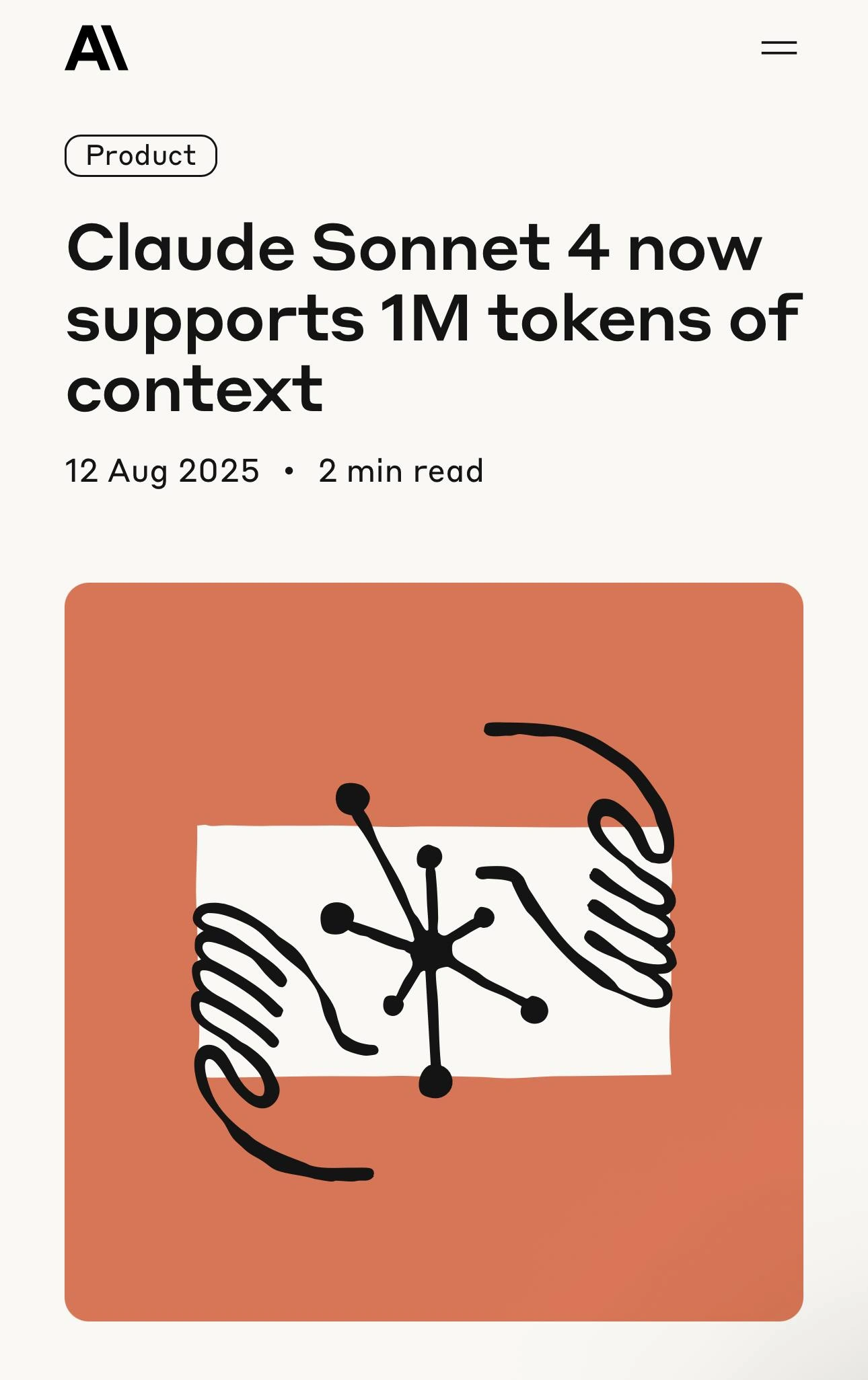
This is funny to developers because it’s an exaggeration of a real tech announcement. In AI circles, bigger context windows are a trending topic (AIIndustryTrends). The meme is referencing what looks like an Anthropic product announcement (“Claude Sonnet 4 now supports 1M tokens of context”). Anthropic is an AI company known for its Claude model, and they really did push context limits (Claude 2 had 100K tokens context). So “Claude Sonnet 4” is presumably a future version pushing it to 1M. The little 🎉 emojis in the post and the excited tone imply this is great news for anyone dealing with prompt engineering edge cases – those tricky scenarios where you have a ton of information you’d love to feed into an AI. For example, instead of having a complicated retrieval pipeline (where you store a bunch of documents in a database and fetch only the relevant bits to show the AI), maybe you can now just dump a whole pile of text into the prompt and trust the AI to handle it.

In simple terms: imagine you have a super-smart text assistant but it used to have a short memory. You could only talk about maybe 10 pages worth of text at a time, so you had to keep your questions or info limited. Now, its memory has grown so large that you could give it the entire manual of your software (hundreds of pages) plus all the footnotes, and it can still pay attention to every detail. The meme is half celebrating, half poking fun at the absurdity of that idea. It’s as if a limit we always took for granted (“AI can’t read that much at once!”) just got blown away.

For a junior developer or someone new to this:

  • This means tools like chatbots or AI assistants are becoming far more capable of understanding big chunks of your project. If you’re debugging and have a giant log file, you might not need to chop it up anymore – future AIs could handle the whole thing in one query.
  • On the flip side, it’s a bit of a hypey claim. Realistically, just because you can give the AI everything doesn’t always mean you should. But it’s an exciting development because it removes a big pain point (the previous token limit).
  • The meme’s humor also lies in its exaggeration: “entire monolith’s README history” is deliberately over-the-top. It’s saying, this context window is so huge, it’s borderline ridiculous – in a playful way.

In summary, this meme is joking about a cutting-edge improvement in AI models. It takes a genuine advancement (a super large context window) and frames it in a comedic, developer-centric way: “Hey, this AI can literally remember the entire (very long and boring) history of our project’s documentation. Isn’t that wild?” All the tags like AIHumor and AIHypeCycle fit because it’s humor born from the hype around ever-improving AI capabilities. It’s the kind of joke you’d chuckle at if you’ve ever cursed at ChatGPT for forgetting what you said 5,000 tokens ago – and dreamed of the day it wouldn’t. Well, that day might be coming, and we’re both excited and amused by it.

Level 3: Swallowing the Monolith Whole

Experienced devs can practically smell the humor here: the idea that an LLM can ingest an entire monolithic repository’s README history in one go. For years we’ve been cursed with context limits – you try to paste a lengthy log or a huge config and the chatbot hits you with “Too many tokens, please shorten your input.” Every senior engineer has done the token shuffle: trimming paragraphs, summarizing sections, splitting code into parts, all to fit within a few thousand tokens of context. It became an art form in prompt engineering: feeding just enough info to get a good answer, but not so much that you overflow the buffer. So when we see “supports 1M tokens of context” in a (pseudo) product announcement screenshot, it’s both awe-inspiring and comical. It’s like a database claiming infinite storage – sure, theoretically amazing, but also an invitation for absurd use cases.

Why is it funny to mention a monolith’s README history? Because monoliths in software tend to be big. A monolithic codebase might have a README spanning dozens of pages, plus years of revisions, appendices, and maybe an entire novella of architecture decisions and developer rants in the commit messages. It’s the kind of verbose internal documentation that new hires pretend to read. The meme quip implies you could stuff all of that – not just the polished README, but its every past version, every edit – into the AI’s prompt. In other words, “Here, digest our company’s entire documented history before answering my question.” The shock value is part of the joke. 1M tokens is so large that what used to be outrageous (“no way we can include that much context”) becomes doable. Remember when Anthropic wowed everyone with a 100K token context in Claude 2? That was enough to feed in, say, all 800 pages of War and Peace. Many devs already went wild with ideas: “Hey, I can drop a whole codebase or a heap of PDFs into this thing!” Well, 1M tokens is an order of magnitude beyond even that. It’s the difference between reading one big novel versus a whole library shelf. Prompt engineers who design inputs for these models are salivating – or maybe trembling – at the possibilities. No more painstaking summarization of an architecture decision record; just shove the entire record (and its predecessors, and related emails, why not?) straight into the prompt.

Of course, behind the excitement is a glint of skepticism-tinged humor. In practice, dumping an entire monolith’s docs might be unwieldy. Just because the model can read a million tokens doesn’t mean it’s wise to do so for every question. It’s like having a genius intern with eidetic memory: you could force them to read the entire company wiki before answering “Where is the API key config?”, but a cleverer approach is to direct them to the relevant chapter. Retrieval-augmented pipelines exist for that reason – they search and select the pertinent bits of info. With a 1M context, some might think “Great, now I can stop using a vector database to find relevant docs – I’ll just throw everything in!” But senior folks know that more data can be noise as much as it’s a boon. If you paste your entire README history, the answer might get bogged down or sidetracked by irrelevant details from five years ago. The meme exaggerates to celebrate the leap in capability, but it also nudges us: how far will we go just because we can? Are we going to have git log -p of the last decade in every prompt? It’s a playful reflection on the AI hype cycle: each breakthrough (bigger context, more parameters, higher accuracy) is met with both genuine excitement and a bit of eye-rolling “Here we go again” from veterans.

From an industry trends perspective, this also satirizes how AI product announcements love big numbers. It used to be parameter counts (“Our model has 175 billion parameters!”) that made headlines. Now it’s context window size. Today’s meme-worthy spec is 1,000,000 tokens. What’s next – models that accept an entire codebase’s Git history plus Stack Overflow archives as context? 🤣 “No context switch needed, just upload your whole hard drive.” The shared joke is that prompt engineers and devs always ask for “just a bit more room” to fit in that last chunk of info – and now the companies are delivering it in ludicrous proportions. As devs, we cheer 🍾 at the thought of not having to aggressively trim our prompts. At the same time, we recognize the absurdity: the context window arms race might be solving yesterday’s problems (fitting bigger text) while opening new quirks (like how do we even navigate a conversation when literally everything is in scope?). In essence, the meme highlights an almost sci-fi scenario that’s become reality: your AI can now pay attention to an entire monolith’s worth of text. It’s the kind of breakthrough that makes us both laugh and dream about the possibilities (and perhaps whisper a prayer for our token counters).

# Yesterday: prompt engineering with limited context
text_chunks = split_into_chunks(huge_readme, max_tokens=8000)
summaries = [llm.summarize(chunk) for chunk in text_chunks]
combined_summary = " ".join(summaries)
answer = llm.ask(combined_summary + user_question)

# Tomorrow: using a 1M-token context (no manual chunking needed, theoretically)
mega_prompt = huge_readme_history + "\nQuestion: " + user_question
answer = llm.ask(mega_prompt)

(Above: How we used to cram knowledge into an LLM vs. what a 1M-token context could let us do instead. The second part is tongue-in-cheek – in reality, you’d still want to be concise!)

Level 4: Beyond Quadratic Attention

At 1 million tokens of context, we’re pushing the limits of the Transformer architecture’s design. A vanilla Transformer’s self-attention mechanism has to compare every token with every other token – an $O(n^2)$ operation. Plugging $n = 1,000,000$ into that is an almost comically huge number of pairwise interactions (on the order of $10^{12}$). No GPU farm on earth could naively handle that in real-time chat. So how on earth does Claude Sonnet 4 handle a context window this large? Likely through a cocktail of sparse attention, hierarchical memory, and clever optimization. Research into long-context models (like Transformer-XL, Reformer, and Longformer) introduced ways to avoid comparing every token with every other token. For instance, chunking the sequence into blocks and only attending within or between certain blocks (reducing the comparison graph), or using recurrence so the model processes the text in segments while carrying forward a summarized state. Anthropic’s engineers probably combined such tricks with optimized attention kernels (e.g. FlashAttention style memory layouts) to make sure that handling a million tokens doesn’t require a million-dollar cloud bill for each prompt. They might also use dynamic retrieval behind the scenes: instead of truly loading every token into live attention, the model could be internally fetching relevant pieces on the fly from an external memory store. This would blur the line between a raw context window and a retrieval-augmented generation, but if done seamlessly, the user just sees a single huge context.

Another hidden challenge is positional encoding – how the model knows the order of tokens up to one million. Classical fixed positional encodings would have looped or lost precision by then. Newer techniques like relative position encodings or even learned embeddings that scale beyond the training length are needed so the model doesn’t get confused whether token #900,000 comes before token #100,000. It’s a bit like giving the model a map to navigate a very long book: it needs to keep track of chapters and pages, not just treat it as one run-on sentence.

One could say this achievement is where theory meets engineering. Scaling laws in machine learning suggested model performance grows with more data and more context, but hitting those numbers required breakthroughs in how memory and compute are handled. We’re essentially watching the context window scaling become the new frontier, much like model parameter count was a few years back. It’s a reminder that “Attention is All You Need” – but only if you can make that attention efficient. By conquering the quadratic bottleneck (through sparsity or other means), Claude Sonnet 4’s million-token context feels like science fiction made real. The meme humorously implies you can now feed the AI the entire kitchen sink – all the code, all the docs, maybe the whole Git history – and it just wraps its neural “arms” around it (as the illustration suggests) with a confident “I got this.” It’s both an astounding technical feat and a tongue-in-cheek promise that no context is too big anymore.

Description

A screenshot of a product announcement, likely from a blog or news site. The page has a minimalist design with a stylized 'A\' logo in the top-left corner, suggesting it's from Anthropic. The main headline in large, bold, black font reads: 'Claude Sonnet 4 now supports 1M tokens of context'. Below the title, the publication date '12 Aug 2025' and '2 min read' are visible. The article is tagged with 'Product'. Below the text is a large, abstract illustration on a terracotta-colored background, showing two stylized hands embracing a central, star-like node structure. The announcement itself is significant in the AI field, as a one-million-token context window allows a large language model to process and recall information from an extremely large amount of text (equivalent to a very long novel or a substantial codebase) in a single instance. This capability is a major leap for tasks like code analysis, document summarization, and maintaining long-form conversational context, representing a key milestone in the ongoing development and scaling of AI models
Comments

22
Anonymous ★ Top Pick The new Claude model has a 1M token context window, which is almost enough to remember what the original project requirements were before the last six pivots
  1. Anonymous ★ Top Pick

    The new Claude model has a 1M token context window, which is almost enough to remember what the original project requirements were before the last six pivots

  2. Anonymous

    Great - now the model can finally keep our entire sprint backlog, the stakeholder email thread, and the 12-year-old XML schema in memory… pity the GPU bill

  3. Anonymous

    By 2025, Claude will support 1M tokens of context, which is approximately how many lines of legacy code you'll need to paste in to explain why that one critical service is still running on PHP 5.3 and nobody dares touch it

  4. Anonymous

    Finally, Claude can hold an entire legacy codebase in context - now we can ask it to explain what the previous 47 developers were thinking without needing to implement RAG, vector databases, or that 'documentation' thing management keeps mentioning. Though at 1M tokens, I'm still not sure it's enough to capture all the reasons why we chose microservices

  5. Anonymous

    Great - now I can paste the monorepo, SOC2 binder, and three years of Slack into one prompt and still get lost‑in‑the‑middle while the KV cache warms longer than our deploys

  6. Anonymous

    1M-token context lets me paste our ADRs, kube manifests, and three years of postmortems - then watch the KV cache turn the GPU cluster into space heaters while the model recommends rewriting the monolith in Rust

  7. Anonymous

    Claude Sonnet 4's 1M context: Finally, an LLM that remembers your monorepo's full commit history without a summarization layer

  8. dev_meme 11mo

    Image tho… why Just why

    1. @TERASKULL 11mo

      https://imgur.com/gallery/things-that-look-like-goatse-uWyA3

    2. @async_andrew 11mo

      I guess they meant that hands widen the context window.. but it is what it is yea

  9. dev_meme 11mo

    Just sad that it’s not Opus tho But situation when for corporates they had 500k context and 200k is weird

  10. @sevos 11mo

    Goatse inevitable if your logo is an anus

  11. @advanced_name_1 11mo

    🙂

  12. @advanced_name_1 11mo

    😚

  13. @advanced_name_1 11mo

    картинка топ

  14. @sysoevyarik 11mo

    did you heard, that BimboNet can handle 1.2 GigaMuffins??? 😱 Unbelievable

  15. @advanced_name_1 11mo

    woman

    1. @RiedleroD 11mo

      yes

  16. @advanced_name_1 11mo

    😆

  17. @Algoinde 11mo

    where do i unsubscribe from ai newsletter

    1. dev_meme 11mo

      That’s just a comment for a post, not a post

      1. @lambda_coolusername 11mo

        if you want to post about ai stuff instead of dev stuff can you make a different channel for it

Use J and K for navigation