Closed Labs Feel the Open-Weight Pull
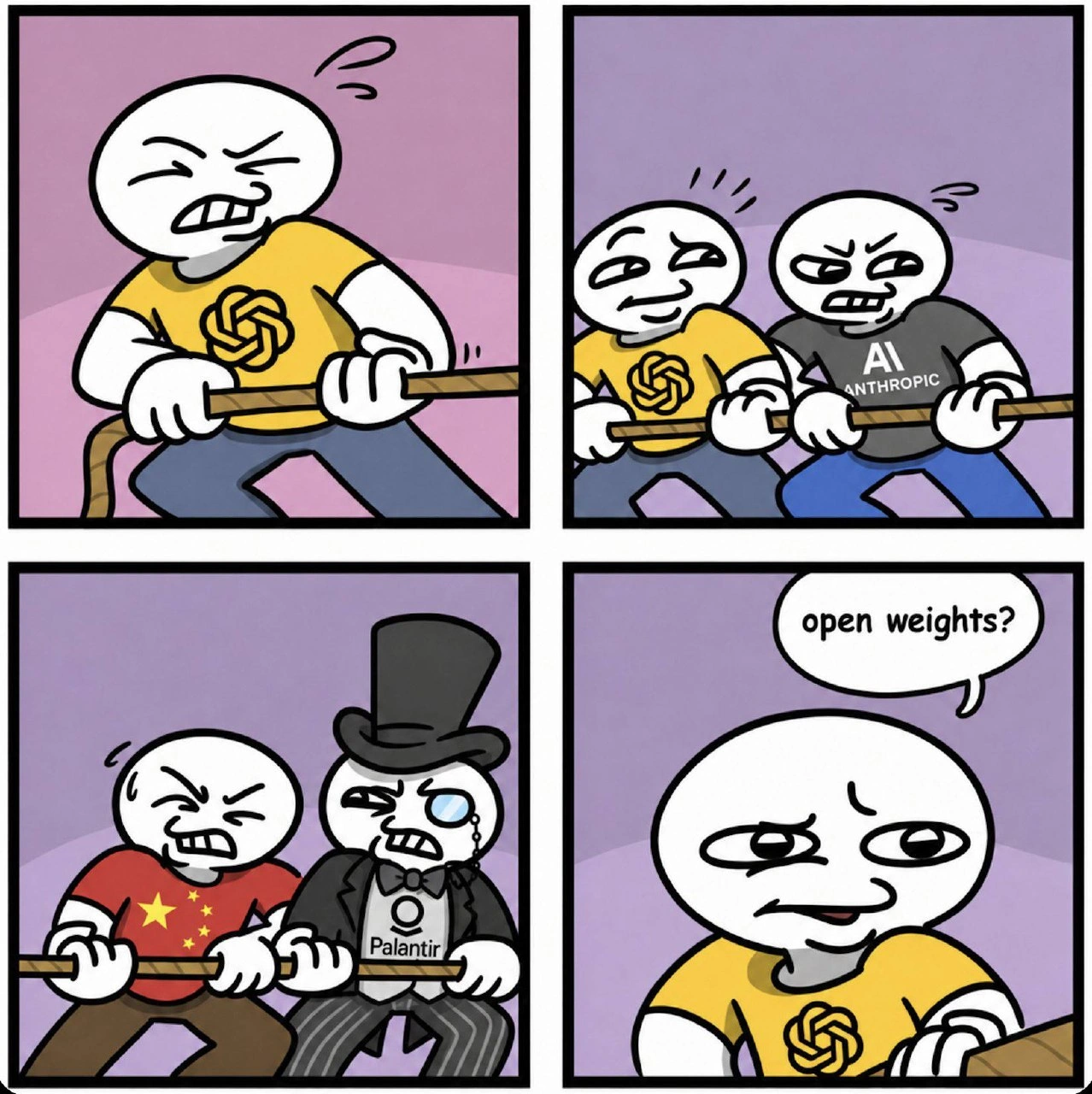
Why is this AI ML meme funny?
Level 1: Keep the Recipe Box
It is like choosing between ordering every cake from a famous bakery and receiving the bakery's recipe so you can bake at home. Ordering is easy and the cake may be better, but the bakery controls the price and can stop selling it. The recipe gives you control, yet you still need an oven, ingredients, and someone who can bake. The cartoon is funny because the powerful bakery suddenly notices everyone tugging away and coyly asks whether sharing the recipe might make it popular again.
Level 2: What Weights Actually Weigh
A large language model contains billions of adjustable numbers called weights. During training, software changes those numbers so the model becomes better at predicting and generating text. After training, the weights are stored in checkpoint files. They are not physical weights, which is why putting them into a literal tug-of-war supplies the visual pun.
With a closed model, a developer usually sends input to the provider's API and receives an output. The provider keeps the checkpoint and runs the computers. With an open-weight model, a developer can download the checkpoint and run it on compatible hardware or ask a hosting company to run it. That offers more control, but it also transfers practical jobs to the adopter: choosing GPUs, managing memory, updating serving software, measuring quality, and protecting the files.
Imagine a hospital that cannot send patient records to an outside service. A suitable open-weight model could run inside its controlled environment. Another startup may prefer a managed API because it has no infrastructure team and needs the strongest available model immediately. Neither choice is automatically superior; privacy rules, task quality, traffic, hardware cost, latency, and staffing determine which trade-off makes sense.
The four labels show why this has become an industry struggle. OpenAI and Anthropic are strongly associated with hosted frontier services; Chinese labs have made open-weight releases an important competitive channel; and Palantir sells the enterprise and government layer where control, permissions, and deployment location matter. Each has a different reason to pull on the rope, while developers mainly hope the competition pulls prices downward without tearing the API in half.
Level 3: The Moat Gets Tugged
The rope is a compact picture of platform power. A yellow-shirted OpenAI figure strains alone, then looks sideways as a gray AI ANTHROPIC figure grips the same contest. A Chinese-flag shirt and a top-hatted, monocled Palantir character occupy the next panel. Finally, the OpenAI figure turns outward with a sly face and asks:
open weights?
The successive panels do not provide a careful market map—the exact teams are visually compressed—but they do show more actors pulling control of the AI stack away from any single provider. The last line turns model weights into another teammate that can change the balance. It also needles a company named OpenAI for needing to ask whether openness might now be strategically useful. Naming remains the industry's most scalable abstraction.
The timing makes that cast unusually specific. Posted on July 3, 2026, the meme landed days after Palantir and NVIDIA announced an open-model deployment stack for United States government agencies, including isolated environments, and immediately after prominent reporting on Palantir CEO Alex Karp's criticism of OpenAI and Anthropic's enterprise economics. Chinese open-weight models were simultaneously applying price and capability pressure. In that moment, open weights? was not a generic philosophical question; it was a joke about customers discovering negotiating leverage.
Open-weight means that the learned parameter tensors—the numerical values produced by training—are available for others to download and run. It does not automatically mean the training data, training code, evaluation pipeline, or complete recipe is available. Nor does it guarantee an unrestricted license. Calling every downloadable checkpoint “open source” collapses several different kinds of openness into one marketing-friendly adjective. The meme uses the more precise phrase, which is a small technical detail doing a large amount of work.
For enterprises, downloadable weights alter the architecture and the bargaining position:
- Self-hosting can keep prompts, retrieved documents, and outputs inside an organization's chosen boundary.
- Data sovereignty can be easier when inference runs in a specific country, private cloud, or air-gapped environment.
- Customization can include fine-tuning, adapters, quantization, distillation, and specialized serving optimizations.
- Provider optionality can reduce exposure to unilateral price changes, model retirement, rate limits, or policy changes.
- Auditability improves in some dimensions because teams can inspect artifacts and reproduce a fixed deployment, though weights alone do not explain how a model learned its behavior.
Those benefits are not a free lunch wrapped in a model card. Owning a checkpoint means owning—or contracting for—GPU capacity, inference software, autoscaling, observability, upgrades, security response, and people who understand why the quantized build suddenly speaks fluent mojibake. Closed APIs bundle much of that operations burden and may offer capabilities, latency, or reliability that a local model cannot match. The meaningful comparison is total cost and risk for a particular workload, not “download costs zero, therefore inference is free.”
The rope also represents vendor lock-in at more than one layer. A team may depend on a provider's model behavior, prompt dialect, tool-calling schema, embeddings, safety policy, batch interface, and evaluation results. Swapping an endpoint can break an application even when both providers expose similar JSON. Open weights allow the model layer to be pinned and moved, but the surrounding GPU runtime and deployment platform can become the new lock-in. Palantir's presence is therefore deliberately ironic: sovereignty from a frontier lab may still arrive through a very substantial enterprise platform contract.
There are legitimate reasons not to release frontier weights. Once copied, a model cannot be centrally withdrawn, patched everywhere, rate-limited, or monitored by its creator. Wider access can improve independent research and competition while also widening misuse and model-tampering risks. Closed access centralizes control and enables managed updates, while concentrating economic and technical power in the provider. The meme does not settle that policy dispute. It shows why competitive pressure can make an openness argument suddenly sound persuasive to a company protecting a closed-model moat.
Description
A four-panel cartoon on purple backgrounds depicts a tug-of-war over a thick brown rope. First, a strained figure in a yellow shirt bearing the OpenAI knot logo pulls alone; next, a gray-shirted figure labeled “AI ANTHROPIC” joins while the OpenAI figure looks sideways. A third panel shows a red-shirted figure marked with the Chinese flag pulling beside a top-hatted, monocled figure whose vest says “Palantir.” In the final panel, the OpenAI character turns toward the viewer with a sly expression and asks, “open weights?” The rope literalizes the competitive pull between closed frontier-model providers and open-weight ecosystems favored for lower costs, local deployment, and organizational control.
Comments
1Comment deleted
Nothing opens the weights quite like watching your moat acquire a `git clone` URL.