Client's Sphinx-Sized Vision on a Sand-Man Budget
Why is this Stakeholders Clients meme funny?
Level 1: Big Plans, Small Budget
Imagine your friend wants a gigantic castle to play in, like the kind of real castle kings and queens had – tall towers, strong walls, the works. That’s a pretty huge wish! But now imagine your friend gives you only a small bucket of sand and says, “Here, build it for me.” 😅 What’s going to happen? Well, you’ll do your best and maybe make a little sandcastle, but it’s obviously not going to be a life-size, strong stone castle. It might sort of look like a castle in shape, but it will be tiny, crumbly, and probably fall apart if you poke it. This is basically what the meme is joking about. The client (like the friend with castle dreams) had very big plans and high hopes, but the money or materials they provided (like that little bucket of sand) were way too small to match those plans. So, the end result is a bit silly and disappointing – it’s funny because it’s such a big gap! In everyday terms, it’s like someone expecting a five-star birthday cake but only paying for a cupcake. You can’t get an ancient Great Sphinx on a sandbox budget, just like you can’t build a real castle out of one bucket of sand. In short, you get what you pay for – if you pay only for a sandcastle, you’re going to get a sandcastle (and not a Great Sphinx). That’s why we can laugh at this: it’s a cartoonishly clear example of someone wanting something huge without giving what's needed to make it happen.
Level 2: From Sphinx to Sandcastle
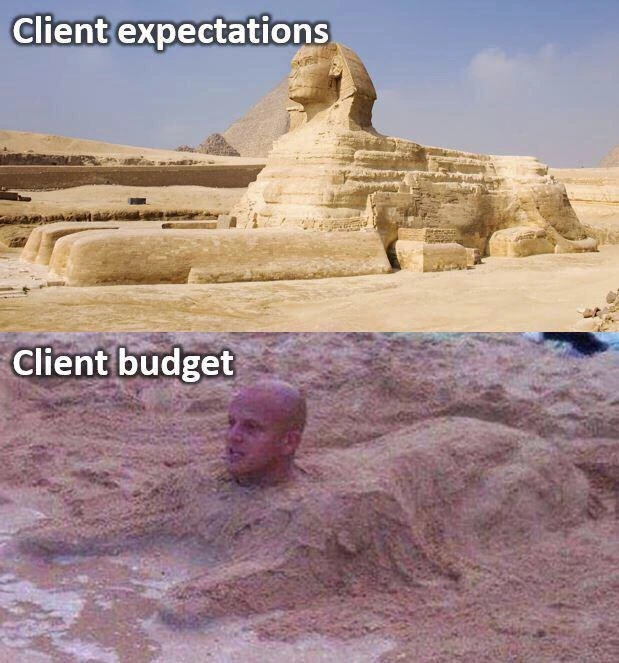
Let’s break down what’s happening in this meme in simpler terms. The top picture is the Great Sphinx of Giza, an enormous, famous stone statue in Egypt with the body of a lion and the head of a human (often thought to be a Pharaoh’s head). It’s massive and has survived for thousands of years – a real symbol of high-quality construction and grandeur. The caption calls this "Client expectations." That means the client (or whoever is asking for a project) is expecting something as impressive and perfect as this Sphinx. In other words, they dream of a project outcome that is huge, well-built, and awe-inspiring.
Now, look at the bottom picture. It’s a much smaller scene: just a pile of loose sand shaped a bit like a Sphinx, with a real person’s head sticking out to complete the look. It’s kind of funny and very clearly not the same as the real Sphinx. The caption there is "Client budget." The budget is how much money the client is providing for the project. So this part is saying: with the money the client has given (the budget), all you can make is this cheap sand sculpture version, not the grand stone monument. The phrase "sandbox of client budgets" is basically comparing the client’s limited budget to a child’s sandbox – it’s tiny. So, the whole meme compares the client’s huge expectations to the small amount of money they’re willing to spend. It’s a classic expectations vs. reality joke commonly seen in project management and developer circles.
In simple project terms, if a client wants a top-notch piece of software (imagine something like a big popular app or a very polished website), they need to invest enough money to pay for the developers’ time, proper testing, good design, etc. That’s like providing enough stone to build a real Sphinx. Budget constraints occur when there’s only a limited amount of money available. If the budget is constrained (tight), it limits what the team can do. It’s like only giving the team a little sand and asking for a pyramid – it just isn’t feasible.
Let’s introduce a couple of important concepts that this meme is poking fun at:
- Scope: This means everything that the project is supposed to include – all the features and work. In our analogy, the scope of the client’s request is as big as the Sphinx (a monumental scope).
- Budget: The money set aside for the project. Here, the budget is tiny, like a little pile of sand.
- Scope creep: When the scope of a project keeps getting bigger and bigger over time because people keep adding "just one more thing." This often happens when initial StakeholderExpectations are unrealistic. For example, if the client expected a Sphinx-quality result for cheap, they might keep requesting more changes or features later, thinking it will somehow reach that expectation. But since they aren’t providing more money or time, those extra requests creep beyond what was originally planned, causing chaos. Essentially, the project "grows legs" beyond control. Developers might start with a plan to build a small statue (since budget was small), but then the client keeps saying, "Actually, could it be bigger? And more detailed? And also include a pyramid next to it?" – that’s scope creep in action!
Because of limited budgets, teams often have to make tough choices. One common strategy is building an MVP (Minimum Viable Product) first. An MVP is like the most basic version of the product that still works – basically a smaller, simpler project that fits the budget. It’s like saying, "We can’t build a full stone Sphinx for you, but how about we start with a small sandcastle version to at least show something?" The idea is to deliver the core idea without all the fancy extras, given the constraints. Often project managers will say things like, "Let’s prioritize the key features given the budget, and leave the nice-to-haves for later." That’s essentially scaling down the scope to match the budget. If the client is on board with that, great. But sometimes, clients insist they want everything even if they aren’t paying for everything – and that’s where the trouble lies.
There’s a well-known principle in project management and engineering: “Good, Fast, Cheap – pick two.” What it means is: if you want something done good (high quality) and fast, it won’t be cheap (you’ll need a big budget). If you want it good and cheap, it won’t be fast (you have to wait longer or do with less manpower). And if you want it fast and cheap, it likely won’t be very good. In our meme’s case, the client is paying cheap and probably also wants it fast, so the end product is not going to be good – it ends up like that sad sand Sphinx, a bit of a mess. This is a core quality_vs_cost_tradeoff. Lower cost (budget) almost always means you have to trade away some quality or reduce what you build. It’s like if you buy the cheapest ingredients, you can’t cook a gourmet feast.
So why do developers and project managers find this meme so funny (or painfully true)? Because it happens a lot in real life! This is a form of inside ProjectManagementHumor. Many of them have had a client or a boss say, "We want an app that’s just as great as the top apps out there," but then provide a budget (and timeframe) that’s nowhere near enough to hire the people and do the work required for that level of greatness. For example, a client might expect a website as complex and slick as Amazon or Facebook, but their budget might only pay for a single developer for a month or two. The result can only be something very basic – or the developer works overtime and still produces something buggy and half-finished. It’s not that the team doesn’t know how to build great software; it’s that they weren’t given the time or money to do so.
In the bottom image, the person buried in sand could represent the developer or team lead on such a project. They’re swamped (quite literally!) trying to make it work. The sand all around them is like the overwhelming amount of work or problems they face when trying to create a grand result with insufficient resources. They manage to shape something out of that sand – but it’s pretty laughable compared to the real statue. In a real project, that might equate to a product that barely meets the requirements, has lots of rough edges, or will fall apart if you push it too hard.
In summary, this meme uses the Sphinx and a sand sculpture to say: the quality of the outcome is directly tied to the resources (budget) provided. The client’s expectations are huge and "set in stone," but their budget is tiny and shifting like sand. When those two don’t line up, the final product is often a let-down. It’s a lighthearted reminder to clients (and to all of us) that you can’t expect to get a masterpiece on a bargain budget. If you try, you’ll end up with exactly what you paid for – which, as shown here, might be a little tragicomic sand Sphinx instead of a Great Sphinx. Remember: in project planning, aligning expectations with reality (resources) is key. Otherwise, you’ll have a situation everyone jokes about later, just like this meme.
Level 3: A Pyramid Scheme
At first glance, this meme pits a monumental ambition against a minimal investment – a scenario every seasoned developer knows too well. The top panel shows the majestic Great Sphinx of Giza under a clear sky, labeled "Client expectations." This ancient stone monument is grand, meticulously crafted, and has stood the test of time. In contrast, the bottom panel – labeled "Client budget" – features a grainy shot of a lumpy sand sculpture vaguely shaped like a Sphinx, complete with a person’s bald head poking out where the Sphinx’s head would be. The stark expectations_vs_reality juxtaposition is immediately clear (and cringeworthy): the client’s vision is as colossal as a wonder of the world, but the resources they’re providing could barely build a sandcastle.
This ironic contrast embodies a classic software project dilemma. Clients (or other stakeholders who drive a project) often have StakeholderExpectations for a product that’s world-class – the software equivalent of a Great Sphinx, something robust and impressive. Yet, when it comes to funding, these same stakeholders might severely BudgetConstraints the project, offering only a shoestring budget. In other words, they want a Ferrari but are only willing to pay for a bicycle. In the meme, the Great Sphinx represents that monumental, production-grade quality the client expects (complete with all the bells, whistles, and enduring stability), whereas the sad sand-mound Sphinx represents what the low_budget_projects funding actually yields – a fragile facsimile of the vision, quickly thrown together and likely to crumble at the slightest touch.
Every experienced developer or project manager nods (perhaps with a pained laugh) at this, because it’s a scenario we’ve seen repeatedly. There’s even a famous adage for it: “Good, Fast, Cheap – pick two.” Here the client is essentially trying to pick all three, demanding “Good” (high quality, as grand as the Sphinx) delivered “Fast” (implied by their urgency and limited budget timeframe) while being “Cheap” (spending the bare minimum). It’s an impossible equation. In formal project management terms, this relates to the Iron Triangle (also known as the triple constraint): you have to balance scope, time, and cost. If one of these is constrained (like cost, i.e., budget), the others must adapt. You can’t fix scope at "monumental" and cost at "minimal" without either extending the timeline or, more realistically, sacrificing quality. Seasoned engineers know that when a client has champagne tastes on a beer budget, something’s gotta give. The meme is essentially calling out that flawed logic with a visual punchline.
The top-down format (expectation vs budget) highlights how Scope Creep and unrealistic deadlines are born. Scope means the total of what’s being built – features, complexity, polish – essentially the size of the project. In this meme’s terms, the client’s desired scope is as huge as an ancient monument. But with a tiny budget, there’s pressure to somehow deliver that same scope with far fewer resources. Teams often initially agree to an ambitious scope to win a contract or please the stakeholder, hoping for the best. Then reality sets in: with limited funding (and usually limited time, since budget often dictates timeline), the team struggles to meet the objectives. To compensate, they might start cutting corners or spreading themselves thin. New requirements start sneaking in with lines like, “Oh, it needs to have a login system too? We assumed that was included.” or “Could you also make it work on mobile and add analytics?” – all without extra budget. These small additions and adjustments accumulate insidiously, which is exactly what we dub scope creep.
Under such constraints, timelines also slip into the realm of fantasy. A ProjectManagement nightmare begins: to save money, maybe the client only pays for one developer for a project that realistically needs a team of five. That lone developer now faces an unrealistic timeline, trying to craft a grand system single-handedly. It’s like expecting one artisan to build a pyramid by himself. The stress and overtime mount, and the developer often ends up literally and figuratively buried in work – much like the poor fellow buried up to his neck in sand in the meme’s bottom panel. That buried human head isn’t just for laughs; it perfectly symbolizes the engineer’s plight. They’re swamped, scrambling to shape something – anything – out of the meager resources at hand, often feeling suffocated by the mounting pressure.
Now, what about the end result in these scenarios? The meme’s bottom image says it all: you get a deliverable that technically resembles the request, but only in the vaguest sense. It’s the software analog of a sand sculpture: hastily built, unstable, and probably missing finer details (the sand Sphinx has no real facial features or defined form – it’s just a blob with eyes and a nose drawn on, if that!). Likewise, a project delivered on a too-small budget might have the basic shape of the client’s request but lacks polish and robustness. Maybe the core feature is there, but edge cases aren’t handled, the UI is ugly, and it hasn’t been tested at scale. It’s a quality_vs_cost_tradeoff manifested physically. The Great Sphinx, carved from solid rock, has endured thousands of years; the sand Sphinx might not survive a stiff breeze or a toddler kicking it. In software terms, the high-budget “Sphinx” product could handle millions of users and rare error conditions gracefully, while the low-budget “sand” product crashes under slight load or falls over when asked to do anything beyond the happy path. Technical debt piles up in the low-budget approach – you’ve effectively built on a shaky foundation. There’s a popular metaphor here: “building a house on sand.” Without enough resources to lay a solid foundation (proper design, testing, infrastructure), the whole thing is one minor shake away from collapse.
It’s darkly funny because both developers and clients recognize the absurdity once it’s laid bare. The client, in the meme, expected an awe-inspiring result, like the Pharaoh’s finest work. The team, given the budget constraints, ends up delivering something held together by proverbial duct tape and hope – and perhaps a prayer that nobody looks too closely at it. The human face peeping out of the sand sculpture could even be seen as the developer or project manager presenting the outcome with a sheepish smile: “Here you go, it’s what you asked for... sort of.” It’s a tongue-in-cheek way of saying, “We did what we could with what we had.”
Among development teams, sharing a meme like this is a way to commiserate and vent. It’s common DeveloperHumor to exaggerate situations we find ourselves in. Nearly every engineer has a war story of a project where the client’s demands were huge and the budget tiny – and the inevitable compromise that ensued. Perhaps a startup wanted a product as polished as a top-tier tech giant’s, but only budgeted a few weeks of work. Or a stakeholder insisted on adding features without adding funds, resulting in a half-baked release. When we see the pristine Sphinx above and the silly sand-man below, we’re reminded of all those projects that started with grand visions and ended up as awkward hacks. It’s both cathartic and instructive: stakeholder expectations need to be aligned with their willingness to invest. After all, even the real Great Sphinx wasn’t built overnight or on the cheap – it took a workforce, materials, time, and money (or rather, a Pharaoh’s resources) to pull off such a wonder. The meme drives home a message with humor: if you want a masterpiece, don’t fund it like it’s a sandbox experiment. Otherwise, prepare for results that might just have you scratching your head (or burying it in the sand!).
Description
A two-panel 'expectations vs. reality' meme that contrasts client demands with their financial constraints. The top panel, labeled 'Client expectations,' shows the majestic Great Sphinx of Giza, representing a grand, complex, and high-quality project. The bottom panel, labeled 'Client budget,' shows a man buried in sand with a crudely sculpted body made of sand, symbolizing the inadequate resources provided to achieve the vision. This meme is a universally relatable joke for developers, designers, and project managers who have experienced the frustration of clients wanting a monumental outcome with a minuscule budget. It humorously captures the disconnect between scope, quality, and cost in the tech industry
Comments
7Comment deleted
Client: 'We want a system with the resilience of the Sphinx.' Dev: 'Understood. And with this budget, it will have the same data refresh rate.'
PO: “We need a Sphinx-scale, five-nines microservice.” SOW arrives: budget covers one intern, a plastic bucket, and the cloud’s free ‘sandbox’ tier - guess we’re literally building in the sand
After 20 years in the industry, I've learned that every client wants their own AWS-scale distributed system with five-nines availability, ML-powered everything, and real-time analytics... but their budget covers about three sprints with a junior developer and a WordPress plugin
Every architect knows this feeling: the client wants a distributed, fault-tolerant, globally-scaled microservices architecture with real-time analytics, ML-powered recommendations, and 99.999% uptime - but the RFP budget barely covers a single EC2 instance and a junior dev for three months. It's the eternal triangle: fast, good, cheap - pick two. Except clients somehow expect all three while you're buried up to your neck in technical debt before the project even starts
Procurement locked a fixed‑bid while PM promised “Sphinx parity,” so we shipped a sandboxed MVP and let change requests fund the limestone
Vision: a Sphinx with five‑nines and zero RPO; budget: a sandbox PoC on a t3.micro - sure, we’ll “harden it” after the demo
Clients spec a Kubernetes-orchestrated pyramid cluster for eternal uptime, but budget it like a flameout Lambda on free tier