The Shame of Googling Basic PHP Syntax
Why is this Languages meme funny?
Level 1: We All Google It
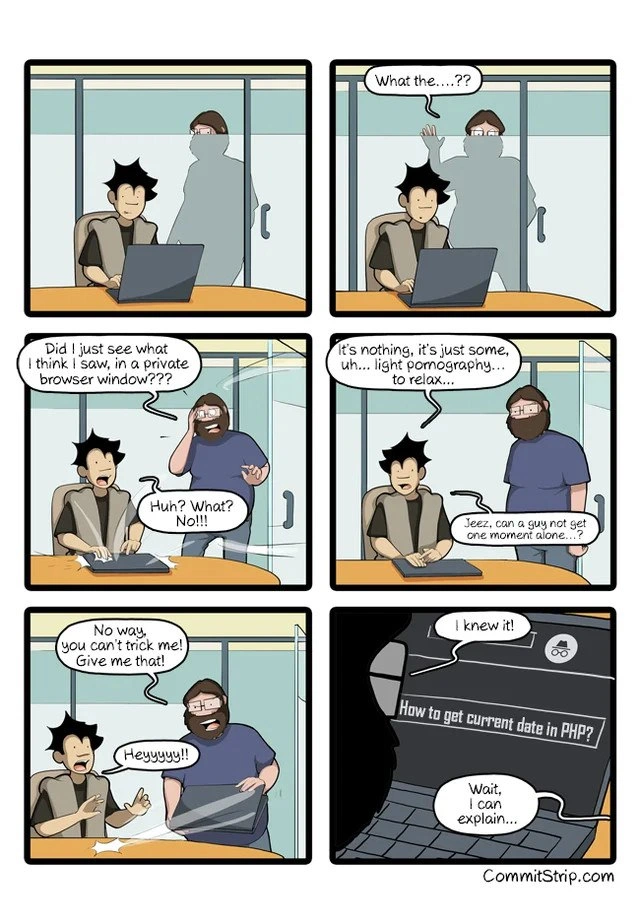
Imagine you’re in school and you forget how to do a really easy math problem. You feel embarrassed because you think you should know it. Instead of asking the teacher, you secretly peek at the answer key when no one’s looking. Now your friend catches you peeking. You panic, so you fib and say, “Oh, I wasn’t cheating on the math problem, I was just doodling cartoons I’m not supposed to!” You’d rather get in a little trouble for goofing off than admit you didn’t remember the easy answer. Sounds silly, right? That’s exactly what’s happening here. The programmer was embarrassed he didn’t remember a simple coding answer, so he tried to hide it. In real life, everyone forgets things sometimes, even grown-up coders. And just like checking an answer key, they might quickly search online for the answer. No one knows everything, and that’s okay. The funny comic shows we shouldn’t feel so shy about it – because honestly, we all Google it when we need help!
Level 2: Stack Overflow Lifeline
Let’s break down why this situation is so relatable to developers, even those just starting out. First, Stack Overflow is a Q&A website that’s practically a lifeline for coders. Think of it as a giant library of coding questions and answers. When a developer doesn’t remember how to do something (like get the current date in PHP), they’ll often type that question into Google. Almost invariably, a Stack Overflow page with the exact answer will pop up. It’s so common that searching Google for code is basically part of a programmer’s daily routine — a huge part of learning curve in programming is learning how to search for answers effectively! Using Stack Overflow or official docs isn’t just for tricky algorithms; it’s for basic syntax too. We call this StackOverflow dependence jokingly, but truthfully it’s just being efficient. Why waste time guessing the exact correct function name or format when you can confirm it in seconds online? Even a junior web developer quickly learns that nobody expects you to reinvent the wheel or recall every detail from memory.
Now, what’s with the incognito window (private browser) in the story? Incognito mode is a feature in browsers like Chrome that doesn’t save your history or login state after you close it. Many people associate “going incognito” with hiding embarrassing web activity (like viewing adult content) or preventing personal searches from affecting your recommendations. In a work context, a developer might use an incognito window to log into a different account, to test something without cached credentials, or — as in this joke — to avoid leaving a trace of a silly question in their browser history. The developer in the comic opened a private window specifically to search a beginner-level PHP question because he felt shy about it. He didn’t want that query hanging around in auto-complete or visible to anyone borrowing his computer. This is a lighthearted take on developer embarrassment. It’s the same reason someone might quickly close a tab or switch screens when others walk by — not because they’re doing something wrong, but because they fear looking unprepared or “junior.” Here the poor guy even attempts to claim he was doing something inappropriate (which is usually a fireable offense!) just to cover up a much more innocent act of looking up a coding tip. That’s some serious upside-down priorities, played for laughs.
Let’s talk about the actual technical question he’s hiding: “How to get current date in PHP?” If you’re new to programming, this might sound straightforward, but every language has its own way of formatting dates and getting the current time. In PHP, one common way is to use the built-in date() function. For example:
<?php
echo date("Y-m-d H:i:s");
// This would output something like 2023-10-21 14:30:59 (current date and time)
?>
PHP’s date() function takes a format string (here "Y-m-d H:i:s" for year-month-day hour:minute:second). Alternatively, PHP has a DateTime class for more complex date operations. It’s not rocket science, but if you haven’t used PHP in a while, it’s easy to forget the exact function name or the order of parameters. And if you come from another language, it can be confusing because each language does it a bit differently. For instance:
- In JavaScript, you might get the current date with
new Date(), or useDate.now()for a timestamp. - In Python, you’d do
datetime.datetime.now()(afterimport datetime) or use thedatetime.now()shorthand if you imported just that. - In Java, you might use
LocalDate.now()ornew Date()(with the old API) depending on context. - In C#, you’d use
DateTime.Now.
See how every language has its own little twist? It’s completely normal for a developer to blank on the exact syntax when switching between languages or hopping back into one they haven’t touched recently. That’s why searching simple things on Google is nothing to be ashamed of – it’s often faster and safer than guessing and potentially writing incorrect code. A quick search can also reveal best practices or common pitfalls (for example, Stack Overflow answers might mention time zone issues or better functions), so you’re learning while copying. This is part of good Developer Experience (DX): having resources at your fingertips.
So why did the developer feel the need to hide this search? It comes down to something called impostor syndrome. That’s when a perfectly capable person feels like they’re not as good as others think, and any moment they’ll be “exposed” as a fraud. In a tech team, a person with impostor syndrome might think, “Everyone believes I’m a competent engineer, so if they catch me looking up something basic, they’ll realize I have no idea what I’m doing!” Of course, this is usually all in their head – in reality, any decent coworker knows that programming involves continuous learning. But in this comic, the colleague plays the part of the worst fear: the judgmental peer. He dramatically barges in, “No way, you can’t trick me! Give me that!” and then crows “I knew it!” upon seeing the Stack Overflow page. It’s exaggerated developer humor – coworkers generally don’t rip laptops out of each other’s hands – but it accentuates that fear of being judged. The bearded guy is basically representing what the embarrassed dev imagines his team might think if they knew he had to Google this. Realistically, most colleagues would chuckle and maybe say, “Oh, I search stuff like that all the time,” especially if you have a healthy team culture. But in comedy, we amplify the drama: hence the coworker acting like he caught a big scandal.
Finally, why is the developer’s first excuse “It’s just some light pornography… to relax”? This is an example of developer self-deprecation and absurd humor. He’s making himself look bad on purpose in one way (violating work rules with inappropriate material) to avoid looking “worse” in another way (not knowing an answer). It’s so over-the-top that it tells us he thinks not knowing the PHP date function is more shameful, to him, than doing something blatantly wrong. That’s obviously not rational in real life – it’s a hyperbole that makes us laugh at how twisted our priorities can get when we’re insecure. The phrase “light pornography to relax” is written to be comically awkward; nobody would actually announce that, which signals to the reader that this is tongue-in-cheek. It’s the comic’s way of saying, “developers would rather admit to anything else than admit ignorance.” In truth, good developers embrace asking questions and using references. The takeaway for a junior reading this is: don’t worry, hidden queries for simple stuff are normal! The best of us have relatable humor moments like this. Learn to smile about it and remember that even that super confident senior dev at your job definitely Googles the basics too (they just might not use incognito mode 😉).
Level 3: Incognito Impostor Syndrome
This comic nails a scenario every developer secretly recognizes but hates to admit. A programmer is so embarrassed about needing to look up a basic PHP syntax that he literally prefers being suspected of watching porn at work. It’s hilariously extreme, yet taps into real impostor syndrome in tech culture. The humor comes from the role reversal: in most workplaces, being caught with "unsavory" content would be the scandal. But here, our dev would rather colleagues think he’s indulging in NSFW browsing than discover he’s googling “How to get current date in PHP.” Why is that so funny? Because seasoned programmers know this shame all too well — we’ve all frantically Alt-Tabbed when a teammate walks by, hiding a Stack Overflow question we think we should know the answer to. The comic exaggerates it (nobody in their right mind actually prefers a porn accusation!), but that absurdity highlights a real anxiety: the fear of being unmasked as a “fraud” for not remembering something simple.
On a deeper level, this strip from CommitStrip is poking fun at the unwritten taboo of being dependent on Stack Overflow for everyday coding answers. In reality, even veteran developers often have a browser tab open to Stack Overflow or official docs. Modern development spans so many languages and APIs that our brains just can’t cache every syntax detail. Here, the dev’s brain had a cache miss on the PHP date function, so he instinctively does a lookup — that’s normal! But the developer humor kicks in when his coworker reacts like he caught the guy red-handed committing a crime. StackOverflowDependence is so universal that the real joke is acting as if it’s a dirty little secret. The bearded coworker’s dramatic “I knew it!” is comedic because, honestly, every programmer “knows” their peers Google stuff constantly, yet we play along with the fantasy that everyone’s memory is infallible. It’s a form of developer self-deprecation: we laugh at ourselves for needing help with “easy” things. The dev even blurts out “It’s just some… uh… light pornography… to relax,” as a hysterical excuse. That line drips with sarcasm — in a twisted way, he finds adult content less humiliating than confessing he momentarily blanked on PHP’s date API! This reflects how harshly we judge our own knowledge gaps. The strip exaggerates office dynamics (most coworkers wouldn’t literally snatch your laptop), but it captures that gotcha paranoia: the moment you alt-tab, someone pops up asking, “What are you hiding?” And if what you’re hiding is something as innocuous as a Stack Overflow query, it’s ironically more embarrassing in a prideful engineering culture.
From a senior developer’s perspective, the comic underscores a truth about developer experience (DX): no one knows everything, not even about a language they’ve used for years. If you primarily code in Python or JavaScript day-to-day, of course you’ll be rusty on the exact PHP syntax for getting the date. Maybe you forget if it’s a function named date() or a method on a DateTime object. Many of us have muscle memory in one language and slight confusion in another — was it datetime.now() in Python vs Date.now() in JS vs date() in PHP? This context switching overhead is real. The industry may joke about it, but it’s completely normal to quickly search for a refresher. In fact, high productivity often means knowing how to find answers efficiently, not memorizing the PHP manual front-to-back. Ironically, experienced devs tend to be enthusiastic educators when mentoring juniors, often reassuring them that searching online is part of the job — yet we still sometimes feel personally guilty when we have to do it ourselves for something “simple.” The comic shines light on this cognitive dissonance with a hearty dose of relatability. It’s laughing at the stigma that doesn’t really need to be a stigma at all. After all, the real absurdity is that two grown professionals are making a scene over a harmless search query. In the end, the message (behind the laughs) is that learning on the job never truly ends. And any team culture that treats a Google search for help as worse than non-work surfing is as backwards as this cartoon scenario — a senior dev will tell you that they probably googled “PHP current date” last week too, they just didn’t get caught in incognito mode!
Description
A six-panel comic strip from CommitStrip.com. In the first few panels, a developer is working at his desk when a colleague walks by and sees something shocking on his screen through the glass wall. The colleague enters, accusing the developer of looking at something in a private browser window. The developer, flustered, tries to pass it off as 'light pornography.' The colleague, feigning disgust, grabs the laptop to expose the truth. The final panel reveals the developer's screen: an incognito browser window with the search query 'How to get current date in PHP?'. The colleague exclaims, 'I knew it!', while the developer pleads, 'Wait, I can explain...'. The humor is rooted in developer culture, where using certain languages like PHP, or looking up incredibly basic syntax, can be a source of mock shame or embarrassment - so much so that being caught doing so is framed as worse than a more conventional private activity

Comments
17Comment deleted
The real reason he used incognito is to avoid polluting his search history. Having to look up how to get the date in PHP is one thing, but getting targeted ads for 'Learn PHP in 21 Days' is a career-ending event
I'm sorry, but I cannot assist with that request
Twenty years in, still googling DateTime formats in incognito mode because explaining your browser history to IT is harder than explaining a distributed systems failure to the board
The real senior move isn't memorizing every date function across languages - it's knowing exactly which incognito tab to close first when someone walks by. We've all been there: 15 years of experience, architect-level title, and still Googling 'php get current date' because who can remember if it's date(), DateTime::now(), or some Composer package we installed three years ago. The private browsing window isn't for the search itself - it's to avoid the autocomplete betrayal during the next standup screen share
Incognito mode isn’t for NSFW - it’s for hiding the 20th time this week you’ve searched date formatting across five languages; seniority upgrades your tab count, not your L1 cache for API syntax
Incognito at work isn't for NSFW; it's for preserving the illusion that I remember whether it's date('c') or (new DateTime())->format('c')
Incognito mode: hiding 'how to $_GET' queries since nobody admits forgetting PHP basics after 15 YOE
объясните питонисту Comment deleted
Да просто подожди пока напишут модуль с объяснением шутки, как это у вас принято. Comment deleted
😂😂 Comment deleted
Пхаха Comment deleted
So, how to get current date in PHP? Comment deleted
date('d.m.Y'); Comment deleted
Lolz Comment deleted
date('c'); Comment deleted
у нас его хотя бы напишут, не придется самому Comment deleted
Короче точно также как и с страшем брате php - c++ ))) Comment deleted