Client Expectations vs. Budget: The Squid Game Edition
Why is this Stakeholders Clients meme funny?
Level 1: Big Dreams, Small Wallet
Imagine your friend wants a really fancy birthday cake, like one of those multi-layered, super detailed cakes with sparkling candles and custom decorations (the kind you see on a TV baking show). That’s the big dream – it’s like the client wanting a top-quality product. But then, your friend only gives you a little bit of money, just enough to buy a simple cupcake. With that small budget, you can only afford a plain cupcake with maybe one candle. The friend is still expecting the giant amazing cake, but all you have resources for is the tiny cupcake. That mismatch is exactly what this meme is about, and it’s why it’s funny! It’s saying: someone is expecting something huge and amazing, but they’re only paying for something small and basic. Of course, in real life, it means the result will be simple because you can’t magically turn a cupcake into a wedding cake without more ingredients and effort. In the meme’s terms, the client had big dreams (like a Hollywood movie or a blockbuster game), but a small wallet (only enough for a homemade short video or a mini-game). We find it funny because it’s a common silly situation: wanting a Ferrari when you only have money for a bicycle – anyone can see that doesn’t add up, and that’s the joke.
Level 2: Champagne Specs, Beer Budget
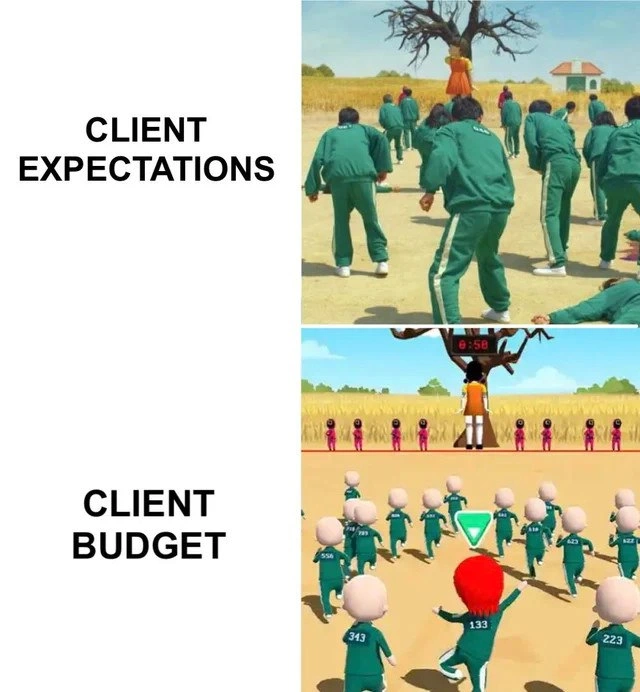
Let’s break down the meme in simpler terms. On the left side of the meme, it labels “CLIENT EXPECTATIONS” (top) and “CLIENT BUDGET” (bottom). On the right side, there are two pictures stacked. The top picture under “CLIENT EXPECTATIONS” is a scene from the famous Netflix series Squid Game – specifically the red_light_green_light_scene. This scene in the show has a bunch of people in green tracksuits cautiously moving toward a giant, eerie doll under a tree. It looks very high-quality and realistic, like a big-budget movie or AAA game cutscene. In contrast, the bottom picture under “CLIENT BUDGET” shows a cheap-looking mobile game version of that Squid Game scene. The characters in the bottom picture are little low-detail 3D figures with oversized heads (classic low-poly game style), and there’s a bright HUD (Heads-Up Display) with a timer. Essentially, it looks like a quick, indie game or a fan-made knockoff – something a small team with limited funds might produce.
Now the text above the meme says: “When the RFP screams AAA quality but the PO screams indie budget.” Let’s explain those terms:
- RFP (Request for Proposal): This is a document or request that a client puts out when they want a project done. Think of it like the client saying, “Here’s what we want and how we imagine it – please tell us how you’d do it and how much it would cost.” The RFP in this context “screams AAA quality” meaning the client is demanding a really top-notch result. AAA quality is a term borrowed from the video game world, where “AAA” (pronounced “triple-A”) games are the big-budget, high-quality games made by major studios (the kind with realistic graphics, tons of features, and huge teams). So if a client wants “AAA quality,” they’re expecting something as polished and impressive as a top-tier product. For example, they might be asking for a website or app that looks and feels as slick as the latest iPhone or a blockbuster game.
- PO (Product Owner): In many projects (especially using Agile/Scrum methodology), the Product Owner is the person responsible for defining the features of the product and usually managing the budget and priorities. They’re the liaison between the client/stakeholders and the development team. When the meme says “the PO screams indie budget,” it means the Product Owner is basically yelling, “We only have money for an indie-level project!” An indie budget implies a very small amount of money (and usually a small team) – like something a tiny independent developer or studio might have. Indie teams often have to simplify graphics and features because they don’t have millions of dollars.
So, combined, the line is painting a scenario: the client’s formal request (RFP) is asking for a big, fancy, feature-rich project (AAA quality), but the person in charge of execution (PO) is pointing out that the budget is tiny (indie budget). This mismatch is the core of the joke. It’s like the left side of the meme says “Client expects: Netflix-quality Squid Game experience” and the right side replies “Client paid for: random cheap Squid Game mobile app.”
For a junior developer or someone new to project management, this scenario is a valuable lesson (hidden in humor). Here are the key concepts and why it’s funny/meaningful:
Client Expectations vs Reality: Clients (or bosses/stakeholders) often have very high expectations. They might say, “I want this product to be the best in the market, with all the latest features, and it should look stunning.” That’s fine and normal – everybody wants the best. This meme labels that as “CLIENT EXPECTATIONS” and uses the super high-quality Squid Game scene to visualize it. It’s like saying, “They imagine something awesome like a blockbuster.”
Budget Constraints: However, the same clients may not provide enough budget (money) to actually achieve those dreams. Here the “CLIENT BUDGET” is represented by that simplistic game screenshot. Why? Because a low budget often means you have fewer developers, less time, maybe you can’t afford specialized artists or high-end tools. The result is a product that might look or feel more basic or rough around the edges. The low-poly, cartoon style in the meme’s bottom image is a perfect example of what a small budget yields in game development – you get simple shapes, basic textures, nothing fancy. It’s effectively saying, “With the money provided, we can only make the bare-bones version.”
Misaligned Expectations: This phrase means one side expects something different from what the other side can deliver. In many software projects, especially if communication isn’t clear up front, the client might expect “the moon” while the developers know they can only deliver “a moon-shaped balloon” given the time and budget. The meme is a humorous take on exactly that: the expectation (moon) vs reality (balloon). For a junior dev, it’s important to learn how to manage these expectations or at least recognize when they’re out of sync.
Scope and Trade-offs: You might have heard of “scope,” which means the total of what’s going to be built (features, quality, etc.). When budget is low, scope usually has to be limited. If someone wants AAA scope on an indie budget, something’s going to give. Often, teams will suggest making an MVP (Minimum Viable Product) first – that’s like the smallest version of the product that still works – and that usually looks closer to the indie version (simple, just core features). The meme’s bottom image is basically an MVP of the Squid Game concept: it has the game idea (red light/green light, players and a doll) but none of the cinematic flair. Recognizing these trade-offs is a skill: you learn that you can’t have everything (all features, best quality, quick delivery, low cost) at once. If a client insists on AAA features, then either the budget must go up or the timeline must stretch out. If budget is fixed and small, then the feature set or quality level must be toned down – or you risk ending up with a half-finished product.
Relatable Real-World Example: Think of when a non-technical friend or stakeholder tells a developer, “Can’t you just make an app like [big famous app] in a week or two? It shouldn’t be that hard, right?” They see the flashy result but aren’t aware of the huge effort behind it. It’s the dev’s job (or the PO’s job) to say, “Umm, actually, that kind of quality takes a lot of time and money.” In the meme, the PO is basically that voice of realism. And the contrast shown by using Squid Game references makes it obvious – anyone who sees those two images side by side will intuitively understand, “Oh, you can’t get the top image result with the bottom image resources.” That’s why the meme delivers its point so instantly.
Scope Creep: This term isn’t explicitly in the meme but it’s a related concept often experienced along with misaligned expectations. Scope creep is when a project keeps getting new features or requirements added on (creeping beyond original scope), often without adjusting budget or time. Why mention it here? Because in scenarios where the client wanted AAA but only funded indie, sometimes as development progresses, the client keeps asking for more (to inch closer to their original vision) – that causes scope creep. A junior dev might experience this as, “We thought we were only building A and B, but now the client also wants C and D, even though we don’t have time for it.” It’s a common outcome of the initial mismatch: the client’s mind is still on AAA features, so they keep requesting things, and the project can become a death march. The meme is a lighthearted warning: if you start a project with such a gap in expectation vs budget, you’re inviting scope creep and headaches unless someone reigns it in.
Stakeholder Communication: One lesson hidden here is the importance of communicating with stakeholders (clients, managers). The PO in the meme “screaming” indie budget suggests maybe a tense negotiation or discussion. As a developer, you might not be in those budget talks early on, but it affects you. It’s worth learning how to articulate, “If you want this level of quality, it will cost more or take longer.” Many junior devs eventually find themselves explaining to a non-tech boss why, for example, you can’t just “add realistic 3D graphics” without significant work. The meme’s underlying message supports that: be aware of the gap and address it early.
In summary, Level 2 is all about understanding the scenario in clear terms. The meme is using a pop culture reference (Squid Game’s high-end production vs a cheap mobile clone) to illustrate a common it-industry scenario: the disconnect between what clients want and what they’re willing (or able) to pay for. It’s poking fun at that disconnect. If you’re a new developer, know that this kind of situation is unfortunately common, and part of growing in the field is learning to navigate it. It might mean learning to say “no” or to suggest alternatives (like “how about we do a smaller version first?”). And if nothing else, when you see a meme like this on your Twitter or dev chat, now you get why everyone’s laughing and saying “so true.” It’s because they’ve lived through projects where the specs were champagne-grade but the budget was beer-grade, and it usually wasn’t pretty – except in hindsight when you turn it into humor.
Level 3: Red Light Budget, Green Light Expectations
This meme shines a harsh spotlight on a classic dev nightmare: a client with AAA ambitions and stakeholder expectations set sky-high, while the actual budget constraints are laughably low. On the left, CLIENT EXPECTATIONS vs CLIENT BUDGET reads like a setup to a cruel joke. On the right, the joke lands: the famous Squid Game “Red Light, Green Light” scene is split into two images. The top image (for expectations) is the real Netflix production – high-fidelity cinematography, dozens of actors in detailed costumes, a giant creepy doll under a gnarled tree, the works. It screams “triple-A” quality. The bottom image (for budget) is a low-poly mobile game version of the same scene – bobble-headed characters with minimal textures, a bright cartoonish timer UI – basically a bargain-bin imitation. The juxtaposition is hilarious to any developer who’s been in a sprint planning meeting where the RFP (Request for Proposal) promised a Ferrari, but the Product Owner (PO) hands you the keys to a used go-kart. It’s a perfect visual metaphor for MisalignedExpectations in software projects.
The humor here is equal parts catharsis and dark comedy. Seasoned devs recognize this scenario instantly. The client’s RFP “screams AAA quality” – meaning they wrote their requirements as if they expect a flagship, enterprise-grade product (the shiny Netflix-level experience with cinematic polish). They want flawless UX/UI, scalable architecture, rich features, maybe even an AI recommendation engine because someone read a trendy article – essentially the works. But then the PO “screams indie budget” – you discover the funds allocated are barely enough for a junior team to build a modest MVP. This is the engineering equivalent of being asked to “build the next Squid Game” with the budget of a student film. ProjectManagement veterans have felt this pain: it’s the old “Champagne taste on a beer budget” predicament, now memefied with a Squid Game twist.
Why is this so funny and painfully relatable? Because it happens all the time in the tech industry. A client or upper management demands a AAA-grade app or system (think: as polished as a top-tier video game or a big-tech product) but commits only minimal resources. In consulting and corporate culture, there’s even an incentive to overpromise during contract bidding – RFPs are dressed up with grand visions to win the client over. “Our app will have world-class graphics, real-time analytics, and scale to millions of users!” – sure, that’s what the StakeholderExpectations section says. Then the project kicks off and the truth hits: the timeline is six months, the team is three developers and maybe a part-time designer, and the budget wouldn’t cover one episode of a Netflix show. At this point the Product Owner or project manager becomes the bearer of bad news, essentially saying, “Given our indie-budget, we can only afford the basics.” The meme’s two images perfectly capture that gulf: Netflix-level production value vs. a clunky Unity game prototype.
Consider the engineering trade-offs implied by those images. The Netflix scene (AAA quality) had: a huge crew of set designers, VFX artists, cinematographers, and well-paid actors – analogous to a software project with a large team of senior developers, UX researchers, QA testers, and a generous timeline. The result? High polish, every detail refined – a product that might be over-engineered in all the best ways. Now look at the mobile game screenshot (indie budget): probably thrown together by a tiny team in a few weeks using out-of-the-box assets. The characters have identical bobble-head models, simple animations; the environment is flat, and the UI timer is just functional. This is what you get when you cut every corner to deliver something playable quickly. In software terms, that’s using a generic UI kit, minimal customization, maybe some copy-pasted StackOverflow code, and zero time for fancy optimizations. It’s an MVP (Minimum Viable Product) – it technically works, but it’s a far cry from the fully realized vision. The meme exaggerates the contrast to drive the point home, and oh boy, do developers recognize it.
This “AAA vs indie” dilemma touches on the project management triangle: Scope, Time, Cost – pick two. The client here picked scope (“AAA quality, full feature set”) and likely still expects quick delivery (“when can we launch beta? next month, right?”), but then pinches cost. Something’s gotta give. Usually, it’s scope/quality that suffer – you end up proposing a pared-down scope (fewer features, simpler design) or using cheaper solutions. Seasoned engineers might sarcastically joke, “Sure, we can do a AAA job on an indie budget – we’ll just violate the laws of physics, no biggie.” In reality, the team either pushes back (trying to reset expectations to a realistic level) or they enter a death-march trying to somehow meet those impossible goals. The meme’s Squid Game reference is apt: remember how in Red Light, Green Light, if you move at the wrong time, you get “eliminated”? In a project, if you proceed with AAA scope on an indie budget, your project is at risk of getting killed (delays, burnout, or outright failure). There’s a darkly humorous truth here: mismanaged expectations can be as lethal to a project as that giant doll was to contestants.
Another layer of humor is how everyone in development has their own war story of this scenario. It’s practically a rite of passage. Perhaps a startup founder says, “We need a product as slick as Instagram, but we only have two developers and $10k. Also, can it be ready in 3 months to show investors?” – The developers’ reaction internally is exactly the bottom image: we’re about to deliver something very, very basic and hope it doesn’t fall apart. Or a government client’s RFP might specify a “secure, scalable, beautiful portal” (buzzword soup) but the contract value is so low that the dev shop can barely afford a WordPress theme with a few plugins. The resulting site is inevitably… underwhelming. Those who’ve been through it laugh at this meme as a coping mechanism. It’s laugh or cry, and we choose to laugh.
Notice how the meme text itself is phrased: “When the RFP screams AAA quality but the PO screams indie budget.” The use of screams is telling – it’s a loud, dramatic conflict between dream and reality. The RFP (a formal document where the client spells out what they want) screaming AAA quality implies the client is adamant they want top-notch results. Meanwhile the PO (Product Owner, the one responsible for the product’s success and often juggling scope vs budget) screaming indie budget implies an equally strong opposing force yelling “No way can we afford that!”. It’s a tug-of-war familiar to anyone in ProjectManagement: sales teams, C-suite, or clients stretching goals upward, and project managers or POs pulling back down to earth with the financial reality. The developer team is stuck in the middle, eyes darting like the terrified Squid Game players: can we move forward toward that lofty goal, or will the budget constraints shoot us down if we try?
In an enterprise setting, this meme also pokes at CorporateCulture and the absurdity that arises from siloed roles. One side of the house (e.g., the business or client stakeholders) might not understand technology but demand the world; the other side (engineering/product) sees the misalignment and must become the voice of reason – or the bearer of disappointing news. There’s a shared grim chuckle among devs because often upper management will still insist “Oh, we’re sure you can find a way, you’re rockstar engineers, aren’t you?” – cue the overnight crunch sessions and cutting of every non-essential feature. The end product might work, but it’s often held together with duct tape and prayers. As a Cynical Veteran might quip: “We delivered alright – delivered something that looks like that goofy bottom picture. But hey, at least we came in under budget!” The reality is that quality had to be sacrificed, and everyone pretends to be surprised Pikachu later when the app is buggy or underwhelming. The meme resonates because it’s a truth we don’t always tell the client so bluntly, but we all know it internally.
To summarize the technical humor: Building AAA software (or a AAA game) requires exponentially more resources – more developers, specialized talent (like those senior graphics programmers or expert architects), more time for QA and polishing, possibly expensive tooling or infrastructure. If the budget doesn’t scale accordingly, you can’t magically conjure polish out of thin air. You instead get RealWorldTradeoffs: perhaps you use a cheaper tech stack, reuse open-source libraries, settle for a simpler design, or cut features. The final product ends up more like an indie game – maybe it gets the job done, but it won’t have the depth or shine that was expected. The meme uses the stark visual contrast to drive home how obvious this mismatch is: anyone can see the two images don’t line up, just like any developer can see an unrealistic project plan a mile away. And that’s what makes it funny: it’s painfully obvious to everyone except the people setting those demands. In other words, RelatableHumor for devs, eye-opening if the “client” side ever sees it (though they might not laugh as hard).
In the end, this meme is a tongue-in-cheek cautionary tale. It says, “Triple-A ambitions on an indie budget? Expect an indie outcome.” Or as a cynical project lead might warn in a sprint retro: “We can’t build a spaceship with parts for a bicycle.” Every dev who’s survived a scope creep bloodbath or a death-march to deliver v1.0 chuckles at this, because we’ve learned the hard way that in software, like in Squid Game, reality always catches up. You either align expectations with resources up front, or you get a low-poly result and a lot of awkward conversations later. This meme just captures that lesson in one neat, darkly comic snapshot.
| Client’s AAA Expectations | Indie Budget Reality |
|---|---|
| Cinematic visuals and polished design (Netflix-level) | Basic graphics, stock images, functional UI (mobile-game vibe) |
| Full feature set, “no compromises” | Core features only, many cuts and compromises |
| Extensive QA testing, zero bugs on launch | Minimal testing – expect some quirky bugs live |
| Large dedicated team of specialists for each component | Tiny team wearing multiple hats (one dev = UI + backend + QA) |
| Scalable, custom architecture for high load | Quick solutions using off-the-shelf tools, hoping it scales |
| Generous timeline for iterative refinement | Tight deadlines, perhaps overtime and crunching |
Description
A two-panel meme contrasting client expectations with their budget, using scenes from the popular culture phenomenon 'Squid Game'. The top panel, labeled 'CLIENT EXPECTATIONS,' displays a high-resolution, cinematic still from the actual Netflix series 'Squid Game,' showing the 'Red Light, Green Light' game with realistic lighting and detail. The bottom panel, labeled 'CLIENT BUDGET,' shows a cheap, low-poly, and cartoonish mobile game adaptation of the exact same scene, with simplistic graphics and character models. The meme humorously and effectively captures a universal frustration in the tech and creative industries: the massive gap between the high-quality, feature-rich product a client envisions and the limited financial resources they are willing to allocate. It's a visual metaphor for being asked to deliver a blockbuster experience on an indie game budget
Comments
7Comment deleted
The client wants the performance and scalability of Netflix, but the budget can only afford a mobile web view wrapped in a cheap game engine
Sure, we can deliver a photorealistic, globally distributed, zero-downtime platform - just as soon as Finance approves something bigger than a t3.micro and a Fiverr logo refresh
The only difference between Red Light Green Light and a client-driven sprint is that in Squid Game, at least the rules don't change halfway through when someone realizes they forgot to mention 'just one small feature' that requires rewriting the entire architecture
When the client's RFP reads like they want AWS-scale infrastructure with Netflix-level UX, but the PO comes back with a budget that screams 'single EC2 instance and a prayer.' Suddenly your elegant microservices architecture becomes a monolith speedrun, your comprehensive test suite becomes 'it works on my machine,' and that two-week sprint planning session gets condensed into 'ship whatever survives code review.' Welcome to enterprise software development, where the technical debt isn't a decision - it's the entire business model, and the real Squid Game is explaining to stakeholders why their $50K budget won't build the next Salesforce
Procurement playing Red Light, Green Light with the iron triangle: red on cost, green on scope, timer still running
Client expectations: Kubernetes-orchestrated microservices swarm. Budget: Single Heroku dyno that sleeps at night
Client expectations: Netflix‑grade Squid Game; client budget: Unity template, Firebase free tier, one t3.micro - yet they still want five nines, SOC 2, and SSO