Skip to content
DevMeme
3577 of 7435
A Syntactically Significant Rejection
Languages Post #3914, on Nov 10, 2021 in TG

A Syntactically Significant Rejection

Why is this Languages meme funny?

Level 1: Lost in Translation

Imagine two friends who speak different languages trying to share a joke. One friend says something super nice in his language, like a secret code word that means “you complete me.” But the other friend doesn’t speak that language, so the special word doesn’t mean anything to her. Instead of being romantic, it just causes confusion. That’s what’s happening in this meme, but with programming languages.

It’s kind of like a boy saying to a girl, “You’re the gasoline that makes my engine run,” expecting her to feel all happy because gas is super important for a car. But then she laughs and says, “Um, I drive an electric car – I don’t need gas.” 🤭 His compliment doesn’t work because in her world (her car, or her programming language), that thing isn’t needed at all.

So the result? A funny little misunderstanding! He tried to be sweet using a special coding symbol he cares about, but she basically said “that doesn’t even apply to me.” Even if you don’t know about semicolons or Python, you can relate to the idea that sometimes we try to say something nice and it just doesn’t click because the other person lives in a slightly different world. In the end, it’s silly and cute because it shows how even our languages (or the way we talk) need to match up for compliments to make sense.

Level 2: Semicolon? Not in Python

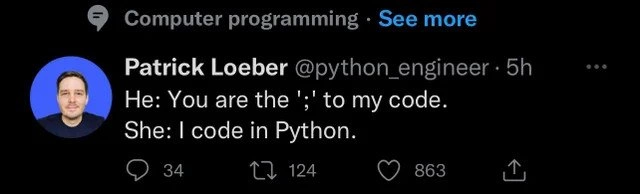
Let’s break down the joke in simple tech terms. In the tweet, a guy says to a girl, "You are the ‘;’ to my code." Think of this as a nerdy pick-up line. In many programming languages (like C, C++, Java, or JavaScript), every command or statement must end with a semicolon ;. It’s like putting a period at the end of a sentence – it lets the computer know “this instruction is done, move on to the next.” So, what he really means is “You complete me, just like a semicolon completes my code.” Kinda sweet and geeky, right? 🤓

However, the girl responds, "I code in Python." Here’s why that response turns the cute line into a punchline: Python is a programming language that does not use semicolons to end statements. Instead, Python treats the end of a line (the newline character when you press Enter) as the end of the instruction. In Python, you just write one statement per line, and you’re done – no ; needed. The only time you’ll ever see a semicolon in Python is if you really want to put two commands on the same line (which most people avoid for clarity). But generally, Pythonistas never bother with ; at the end of each line. It’s one of Python’s well-known LanguageQuirks and part of why many find Python code clean and easy to read.

To visualize the difference, consider a simple example of printing a message:

// In C (or similar languages), you need a semicolon at the end of each statement
printf("Hello, World");   // <– semicolon is required here
printf("Welcome to the party");   // another statement, another semicolon
# In Python, no semicolons are needed at line ends
print("Hello, World")    # This line ends naturally, no semicolon
print("Welcome to the party")    # Just a newline separates the statements

If you put a semicolon at the end of a Python print statement, like print("Hello");, the Python interpreter won’t throw an error (it will interpret it, because Python tolerates an unnecessary semicolon), but it’s completely optional and non-Pythonic style. Most Python developers would never add it – it would be like wearing suspenders and a belt. 😉

Now back to the meme: when he calls her the semicolon to his code, he assumes that semicolons are as important in her world as in his. It’s as if he said, “you complete me” in a language dialect that she doesn’t use. So her reply “I code in Python” is a witty comeback meaning, “that special thing (semicolon) you’re comparing me to is something I never need.” She’s basically politely burning his pick-up line by pointing out it doesn’t make sense for a Python coder. The humor comes from this mismatch. It’s a syntax incompatibility turned into a joke: one person speaks Java/C# love language, the other answers in Python reality.

For a newer developer or someone not familiar with both worlds, here’s the context: different programming languages have different rules and syntax (syntax means the set of rules for how code has to be written so the computer can understand it). A semicolon in programming is just a character, but whether it’s needed or not is totally language-specific syntax. Forgetting a semicolon in a language that requires it will cause an error – your code won’t run. On the flip side, putting a semicolon where it isn’t needed (like at the end of every Python line) won’t break Python code, but it will look odd to experienced Python developers and is unnecessary. It’s like saying an extra word at the end of every sentence that doesn’t need to be there.

This meme is a screenshot of a tweet (notice the Twitter interface in dark mode with the profile and the little heart and retweet icons). Tweets like this often go viral in programmer circles because they capture a relatable scenario in a funny one-liner. In this case, it’s relatable because many of us have had moments where our knowledge didn’t translate to someone else’s context. Also, the idea of a pickup line (a one-liner to flirt with someone) being based on programming is just inherently humorous – it’s mixing romance with geeky stuff. But if you don’t share the same tech background, that mix can misfire, exactly like it does for this pair.

So, to sum up the technical bit: He used a programming metaphor that only works if you assume semicolons are vital. She basically said, “well, not in my programming world.” It’s a clever play on the fact that Python lets you drop the ; and just focus on code logic, whereas his romantic comparison assumed that ; was universally important. For anyone who has coded in both Python and a semicolon-heavy language, this little conversation is an instant chuckle: we get why his line made logical sense to him and why her response is the ultimate gotcha!

Level 3: Terminated by Syntax

In plain developer terms, this meme delivers a punchline that hits right in the DevCommunity culture. The scene: a guy drops a cheesy programming pick-up line, "You're the semicolon to my code," implying “you complete me” in coder lingo. You can almost hear the smug grin of a Java/C++ developer using a LanguageQuirk as a romantic metaphor. But then comes the twist: the girl counters with "I code in Python." Boom – his clever line is instantly null and void. Why? Because any Pythonista knows that Python doesn’t need semicolons at the end of each statement. It’s a gentle roast: she’s basically saying “Nice try, but that compliment doesn’t apply to me.”

This humor works so well because it plays on a language barrier that seasoned developers immediately recognize. It’s the programming equivalent of referencing an inside joke from one culture that falls flat with someone from another culture. Developers often have strong loyalties and identities tied to their primary programming language (hello, LanguageWars 😀). Each language has its own little idiosyncrasies that its community jokes about. For C, C#, Java, and JavaScript folks, forgetting a ; is a rite of passage (and a common bug for beginners). Entire threads of CodingHumor are dedicated to tales of missing semicolons causing heartache compile errors. So when the guy uses a semicolon as a romantic symbol, he’s speaking from that world where ; is king — the syntax that saves the day (or at least saves your code from not compiling).

Now enter a Python developer’s mindset: Python prides itself on a clean, minimalist syntax for better Developer Experience (DX). No clutter of semicolons or curly braces – just natural, readable code. Python devs sometimes jokingly look at semicolons as an archaic relic or a needless handshake from older languages. Many of us have that muscle memory of adding ; everywhere after years of Java or C, only to switch to Python and be lovingly told by the interpreter (or style guides) “hey, you don’t need that here.” It’s both liberating and a point of pride. So when she says "I code in Python", there’s a playful subtext: “Semicolon? I don't even use those, thank you very much.” It’s a one-line reality check that not only snubs his attempt at romance, but also elevates Python’s syntax subtly, as if saying, “In my world, we’ve evolved past that symbol.” 🚀

This kind of cross-language comedic jab is relatable humor to developers because we’ve all experienced the friction of switching between languages or the friendly ribbing about what's “better”. For instance, a JavaScript dev might joke to a Pythonista, “At least my code braces itself,” and the Pythonista might reply, “Sure, but my code is whitespace-conscious and elegant.” Here, the Python dev in the meme effortlessly scores a point in that endless debate by implying semicolons are irrelevant to her. It’s tongue-in-cheek, not mean-spirited — a nerdy way of saying “your fancy romantic line doesn't work on me, try again in Pythonic syntax.”

Let’s not ignore the format: this meme is a screenshot of a tweet (notice the dark-mode Twitter UI with those likes and retweets). The tweet got a lot of hearts (❤ 863) and retweets, meaning it resonated with many programmers. Why such a reaction? Because it compresses a whole DeveloperExperience into two snappy sentences. Instantly, you remember times when you or a colleague made a tech joke that totally bombed due to audience mismatch. Maybe you’ve tried explaining a Python joke to a Java dev or vice versa, and got blank stares. Or you recall the trauma of a missing semicolon causing a bug, and how weird it felt that Python just doesn’t have that problem. The meme points out that when it comes to romance (or communication in general), knowing your audience’s “language” is key. A senior developer reading this likely chuckles and thinks, “Yep, always know the tech stack of your crush before dropping a pickup line!” It’s funny because it’s true – a minor syntax detail can make or break both code and flirtation.

In short, the guy’s line terminated abruptly – much like a premature ; in Python could terminate a statement unexpectedly. The statement_terminator became a conversation terminator. 😅 For experienced devs, it’s a perfect little joke about how our beloved code habits can slip into our social lives, sometimes with awkward (but hilarious) results. Better luck next time, Romeo – maybe try “You had me at print('Hello, world')” when talking to a Python developer!

Level 4: Significant Other vs. Significant Whitespace

From a language design perspective, this meme highlights a grammar collision between two programming paradigms. In many languages descended from ALGOL (like C, C++, and Java), the semicolon (;) is a crucial statement terminator. It's a deliberate token in the language's context-free grammar that tells the compiler, "This line of code ends here." Historically, this design choice made it easier for early compilers and interpreters to parse code: the semicolon acted like a clear stop sign between instructions, allowing multiple statements on one line or ignoring irrelevant whitespace.

Python, however, follows the "off-side rule" (a term from programming language theory) where indentation and newlines are syntactically significant. In Python’s grammar, the end of a line implicitly terminates the statement, so the parser doesn’t need an explicit ; token most of the time. Whitespace and line breaks aren’t just formatting—they’re part of the code’s meaning. This idea wasn’t new (languages like Haskell and occam also use indentation-based blocks), but Python made it mainstream. The goal was to improve readability: if the structure is visually clear (thanks to indent levels and newlines), extra punctuation like semicolons or curly braces become redundant. Guido van Rossum, Python’s creator, intentionally designed the language so that a newline is like an "invisible semicolon" and consistent indentation replaces { } braces. The result is cleaner looking code and one less thing to worry about forgetting (or flirting with, in this case!).

Now, when the guy in the meme says "You are the ‘;’ to my code", he’s expressing affection using a programming syntax metaphor rooted in languages that require that terminator. In essence, he’s saying, “You complete me, just like a semicolon completes a statement.” It’s a nerdy, sweet sentiment if you’re used to those languages — without a semicolon, the code (and perhaps the coder’s heart) feels incomplete or broken. But here’s the deep irony: in Python’s world, a semicolon is unnecessary, even extraneous. In fact, adding a stray semicolon in Python has no effect; the interpreter simply treats it as an empty statement. So the woman’s retort "I code in Python" is a precise syntax reality check. Under the hood, it’s as if her mental “parser” doesn’t even register semicolons as meaningful input. She’s playfully pointing out that his romantic code won’t compile for her because her "language" doesn’t include that symbol in its love grammar.

On a theoretical level, this mismatch is like a miniature type error in human communication: one party speaks in the formal language of C/JavaScript romance (where ; is significant), but the other party’s language (Python) treats that character as a no-op. It’s a bit of LanguageQuirk lore manifesting in a flirtatious context. The humor here is rooted in fundamental language design differences—Python’s significant whitespace vs. C-style explicit terminators. It’s a nod to the fact that even abstract decisions in compiler design can trickle down into our daily lives and jokes. And as any compiler textbook would tell you, when two grammars don’t align, you get a parsing failure – or in this case, a failed pick-up line. The poor guy offered a token of affection that literally doesn’t parse in the woman’s world. That’s a syntax incompatibility of the heart if there ever was one!

Description

A screenshot of a tweet from user Patrick Loeber (@python_engineer). The tweet is a short, two-line dialogue that plays on programming language syntax. The first line is, 'He: You are the ';' to my code.' This is a romantic compliment among programmers who use languages like C++, Java, or JavaScript, where the semicolon is a mandatory statement terminator, implying 'you complete me.' The second line is the punchline, 'She: I code in Python.' In Python, semicolons are optional and rarely used, making the statement effectively mean 'you are unnecessary.' The humor arises from this clever, geeky rejection based on the syntactical differences between major programming languages

Comments

28
Anonymous ★ Top Pick The relationship was never going to compile; he was looking for a strongly-typed commitment, and she was into dynamic, duck-typed flings
  1. Anonymous ★ Top Pick

    The relationship was never going to compile; he was looking for a strongly-typed commitment, and she was into dynamic, duck-typed flings

  2. Anonymous

    Cross-language romance is basically writing C headers for a Python module - one misplaced semicolon and the whole relationship fails to compile

  3. Anonymous

    After 20 years of explaining to stakeholders why their 'simple' feature request requires rewriting half the codebase, the most unrealistic part of this exchange is a developer actually understanding what makes them incompatible before committing to the relationship

  4. Anonymous

    The real tragedy here isn't the rejected pickup line - it's that he clearly didn't check her tech stack before deploying to production. Any senior engineer knows you validate compatibility before committing to a relationship, especially when one party treats whitespace as sacred and the other thinks semicolons are mandatory. This is what happens when you skip the architecture review and go straight to implementation

  5. Anonymous

    Try that line on a Pythonista and you'll get PEP 8'd - Black deletes the semicolon, flake8 files E703, and the relationship fails CI

  6. Anonymous

    When your Python is so idiomatic, the code handles intros while you debug the existential crisis

  7. Anonymous

    Cross-language romance: he offers semicolons; she runs Black - his affection gets removed as an unnecessary delimiter

  8. @justjonniejoy 4y

    Better to break with her

  9. @Rumbatutumba 4y

    or in Swift

    1. @freeapp2014 4y

      swift supports semicolons tho

      1. @Rumbatutumba 4y

        does not need them tho

        1. @freeapp2014 4y

          yes but it doesnt freak out like python

          1. @RiedleroD 4y

            python just ignores semicolons at the end of lines tho

  10. @karim_mahyari 4y

    Burn

  11. Anon 4y

    i hate twitter so much it's unreal

    1. @RiedleroD 4y

      u on mastodon?

  12. @zherud 4y

    He: Me to.

    1. @dsmagikswsa 4y

      You are right. Actually his username is python_engineer. So the story is he try to insult her and she thought he doesn’t know she code in python or try to flirt her.

  13. Deleted Account 4y

    He:I code in COBOL

    1. @SamsonovAnton 4y

      Brainfsck! https://www.reddit.com/r/Python/comments/cmuc4r/i_wrote_a_brainfuck_interpreter_in_a_single_line/

  14. Deleted Account 4y

    print("hello");

  15. Deleted Account 4y

    its valid

    1. @sylfn 4y

      but useless (as python is)

      1. @RiedleroD 4y

        python isn't useless as a scripting language

        1. @RiedleroD 4y

          but yes, the semicolon is useless in python

          1. @sylfn 4y

            unless you want to make shitty one-liner (good one-liners dont use them)

        2. @sylfn 4y

          tcc -run now you can use C in scripts

          1. @RiedleroD 4y

            how about no? writing in C takes much more time than writing the equivalent code in python - so it's perfect for glueing other programs together (as I have done in my automated video rendering script)

Use J and K for navigation