Skip to content
DevMeme
3575 of 7435
The LeetCode Grinder's Moment of Feigned Brilliance
Interviews Post #3912, on Nov 9, 2021 in TG

The LeetCode Grinder's Moment of Feigned Brilliance

Why is this Interviews meme funny?

Level 1: Exam Day Luck

Imagine you have a big test at school, and right before class, you quickly peek at one of the tough questions from your notes. You only had a minute, but you manage to read the solution to that one hard problem. Now, the test starts and guess what – the very first question on the exam is that exact problem you just looked at! You feel a huge wave of relief and a little bit of “I can’t believe my luck.” You know the answer right away because it’s fresh in your mind, but you don’t want your teacher to think you cheated or something. So you pretend to solve it slowly, maybe scratch your head a bit, and then write down the answer like you just figured it out. It’s a funny situation because on the inside you’re celebrating – you basically got handed the answer – but on the outside you’re acting normal and surprised, like “Hmm, let me think… oh, I know!” The meme is joking about that exact kind of feeling, but in a job interview for programmers. It’s highlighting the silly and lucky moment when studying at the last minute pays off in the best possible way, and how we might playfully hide that we already knew the answer so it doesn’t look too easy.

Level 2: Last-Minute LeetCode

Let’s break down what’s happening in this meme in simpler terms. If you’re newer to the tech world or just starting to go through interviews, you might know the grind of coding practice. LeetCode is a popular website where programmers practice coding problems – think of it like a big database of programming puzzles (sorting, finding paths in a maze, optimizing something, etc.) that companies love to ask in interviews. Many candidates, especially those trying to land their first big tech job, spend a lot of time solving these coding challenges to prepare. Sometimes it turns into a cramming marathon: solving as many problems as possible, memorizing common solutions, and hoping the interview question is one you’ve seen before. Cramming is that classic last-minute studying – like trying to shove facts into your brain right before an exam in the hope they stick. Here, the meme describes someone who literally memorized a LeetCode problem solution 10 minutes before their interview. That’s as last-minute as it gets – probably right outside the office or in the lobby on their phone, quickly reviewing a tricky algorithm solution (maybe a dynamic programming one involving, say, computing the number of ways to make change or the longest increasing subsequence – those can be tough to whip up on the fly).

Now, incredibly, the interviewer asks the exact same question the candidate just reviewed. This is the ultimate déjà vu moment. “Déjà vu” is that eerie feeling that you’ve experienced something before. In this case it’s not just a feeling – it literally happened moments ago in practice. The meme shows a character (that’s Loki from the Marvel movies, by the way) smirking, which represents the candidate’s internal face: they’re pleasantly shocked. Imagine the mix of relief and disbelief: “No way... I was JUST looking at this problem!” It’s like studying the night before for a specific question and finding that exact question on the test the next morning. That’s why the meme’s title says “brain cache hits.” In computing, a cache is a small, fast memory storage that holds onto recently used information so it can be retrieved quickly. A cache hit means the data you need was found in the cache, so you get it immediately instead of doing the longer lookup. When they say brain cache, they’re joking that the person’s brain had this solution stored in its “quick access memory.” And a few minutes gap definitely counts as “recently used” in human memory! So a brain cache hit is basically recalling something instantly because you literally just learned it.

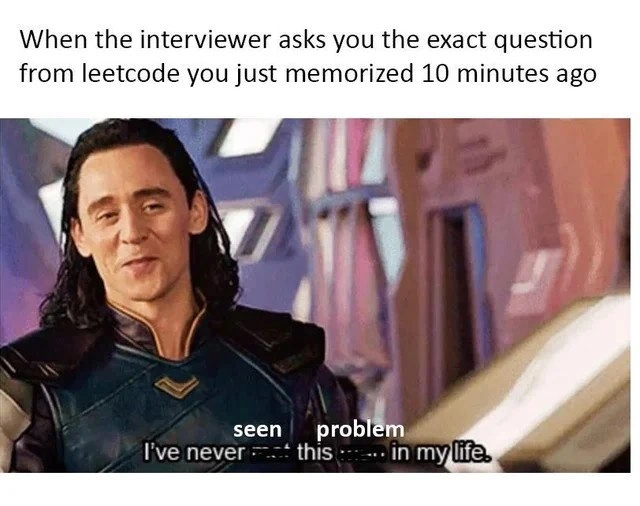
The top text of the meme sets up the scenario in a single sentence, and the image plus bottom caption delivers the punchline. The bottom caption is styled like a subtitle from a movie scene. It reads, “I’ve never seen problem this in my life.” It looks a bit off because the words seen and problem are pasted over something – clearly, the meme creator edited an original movie subtitle to fit this joke. What does that line mean in plain English? It’s the candidate pretending they have never seen this problem before in their life. In other words, acting totally innocent and surprised: “Hmm, interesting question. Gosh, I’ve never encountered this one, but let’s see…” Why would someone pretend not to know it, instead of just saying “Oh, I solved this yesterday, I got this!”? Well, in many technical interviews, the expectation is that you solve the problem in real time, demonstrating your thinking process. If you admit you memorized the answer, it might undercut the whole purpose of the exercise. Some interviewers might even think it’s unfair or doesn’t count because they want to see your problem-solving skills, not just your memory. So candidates often feel they have to put on a bit of a show – walking through the solution step by step as if it’s the first time, even if internally they could write it out in one go. This is the “charade” aspect: you don’t want to look like you just have a cheat sheet in your head (even if you basically do).

For someone early in their career, this scenario is both a fantasy and a laughable reality. The fantasy: wouldn’t it be great if the random coding interview question you get is one you already know? A huge stress saver! The reality: it almost never happens that perfectly, and if it does, you might ironically stress about having known it too well. This is where imposter syndrome can sneak in. Imposter syndrome is when capable people feel like frauds – they worry they’re not as good as others think and fear being exposed. In this context, a candidate might think, “I didn’t truly solve it; I just remembered it. I’m faking!” Even though being prepared is nothing to be ashamed of, the whole interview setup can make you second-guess yourself. The meme is relatable humor because it exaggerates a situation we joke about: studying a specific LeetCode problem last second and it miraculously appearing in the interview. It pokes fun at how the interview process can sometimes feel like a weird trivia game – one that rewards rote preparation. And by using Loki’s image (a character known for being cunning and sly), it also teases the slight sneakiness in the candidate’s position. Loki’s little grin in that scene practically says, “Heh, piece of cake – but I’m gonna act like it’s a challenge.” If you’ve ever done a bunch of practice problems before an interview, you can probably imagine feeling exactly this way in that lucky scenario, which is why the meme is so relatable among developers.

Level 3: Whiteboard Charade

On a more practical level, this meme hits home for any experienced developer who’s survived the gauntlet of modern technical interviews. Picture the scene: you’re in a high-stakes whiteboard interview (or its virtual coding equivalent), heart pounding, palms slightly sweaty. You’ve spent weeks on the LeetCode grind, cramming solution patterns for every classic puzzle in the book – binary trees, dynamic programming, graph traversals, you name it. You walk into the interview bracing for some never-before-seen twist, only to hear the interviewer recite a question that you literally solved in a practice session 10 minutes ago. Internally, it’s as if you just rolled a natural 20; you’ve hit the LeetCode lottery. The humor here comes from that deer-in-headlights meets smug relief moment of “Oh wow, I actually know this!” mixed with the need to hide that fact. The top caption sets that scene perfectly: “When the interviewer asks you the exact question from LeetCode you just memorized 10 minutes ago.” It’s absurdly lucky, almost like cheating fate, and every engineer who’s frantically scrolled through coding problems right before an interview can appreciate the cosmic irony.

But the real punchline is in the acting that follows. The meme uses a shot of Marvel’s Loki – the God of Mischief – giving a sly, knowing grin in a high-tech spaceship corridor. Loki is the quintessential trickster, and here he represents the candidate who’s about to pull off a subtle con of their own. The movie subtitle at the bottom has been doctored to read: “I’ve never seen problem this in my life.” It’s intentionally a bit janky in appearance (words pasted out of place), emphasizing the tongue-in-cheek deception. In the likely original scene, Loki was denying familiarity with something (typical Loki “who, me?” denial). In the meme, this translates to the interviewee’s feigned innocence: “LeetCode problem? What LeetCode problem? Why, I’m just thoughtfully considering this novel challenge you’ve presented!” The seasoned folks reading this will smirk at this whiteboard charade. We’ve all been coached to “talk through your solution” in interviews, but if you already have the solution memorized, you end up doing a little performance art – slowing down, explaining the “thought process” as if you’re inventing it on the spot. It’s half comedy, half strategy: you don’t want to blurt out the answer too fast like a student who peeked at the answer key, or the interviewer might suspect you’ve merely rote-learned it. So you put on an Oscar-worthy act of problem-solving: furrow your brow, start with “hmm, let’s think about this…”, maybe even throw in a “perhaps we could use dynamic programming here?” as if it just struck you, all while the full solution is already queued up in your brain’s buffer.

This situation is painfully relatable because of the way the technical interview process has evolved. Many big tech companies (think the Google/Amazon ilk) rely on a pool of well-known algorithm questions – so well-known that entire websites (LeetCode, HackerRank) and books (“Cracking the Coding Interview”) are dedicated to them. The result? Preparing for interviews often devolves into a memory game. Candidates end up memorizing dozens or even hundreds of solutions in preparation, effectively building their own mental cheat-sheet. It’s an open secret: the hiring funnel is supposed to test problem-solving skills and computer science fundamentals, but it often rewards quick recall and pattern matching more than real engineering intuition. The meme is satirizing that disconnect. The caption “reward short-term recall over deep, production-hardened experience” from the description nails it – companies say they want innovative thinkers, but then filter for people who can replay textbook solutions to toy problems under pressure. A grizzled engineer who’s designed scalable systems might stumble on a binary tree inversion question if they haven’t done it since college, whereas a new grad who drilled that exact problem yesterday will whip it out effortlessly. Who aces the interview? Usually the latter. It’s a bit of a joke, and not the funny kind when you’re on the losing side of it. The meme lets us laugh at it: we see Loki’s smug face and recognize that shared absurdity.

And let’s not forget the psychological side: the tags mention Imposter Syndrome, and it’s spot-on. Imagine you do luck out like this – you get the question you know cold. You should feel confident, yet a nagging voice in your head goes, “Am I a fraud? I didn’t solve it here, I just regurgitated a solution. Do I actually deserve this job?” This adds another layer to the humor: it’s a self-deprecating laugh. Everyone in that situation tries to play it cool, but inside you’re juggling giddy relief and the fear of being found out. The meme resonates because it’s a scenario born from the game of tech interviews that so many of us have had to play. It gently mocks both sides: the candidates who resort to last-minute cramming (and sometimes hilariously get away with it), and the interview system that practically forces this behavior and then pretends to be evaluating pure problem-solving. The use of Loki – a character who’s all about illusions and cunning – is the perfect embodiment of the candidate’s mindset in that moment. In summary, this level is about the shared industry in-joke: Interview humor that underscores the gap between evaluating skill and the theatrics we go through in a flawed interview process. Seasoned devs are nodding (or eye-rolling) because yep, we’ve seen this show before – some have been the pretender, some have been the interviewer watching the oddly over-prepared “spontaneous” solver, and all of us recognize the hilarious dysfunction of it all.

Level 4: Memoization vs Memorization

At a deep technical level, this meme riffs on the concept of caching – both in algorithms and in human memory. In computer science, memoization (note the lack of "r") is a technique where expensive function results are stored so you don’t recompute them each time. It’s a cornerstone of dynamic programming: you break a problem into subproblems, solve each once, and stash the answers in a table (a cache) for quick lookup later. The interviewee here has unwittingly treated their brain like an L1 CPU cache, preloading it with the exact solution code just minutes before. When the interviewer asks that same dynamic programming question, the candidate experiences a cache hit in their brain: the answer is retrieved in near-constant time from short-term memory, instead of being computed from scratch. We’re basically witnessing a space-time tradeoff in action – the candidate sacrificed extra space in their brain (by memorizing the solution ahead of time) to minimize time during the interview. It’s a cheeky real-life implementation of the algorithmic principle: use more memory to save on computation.

From a theoretical perspective, this highlights the principle of temporal locality. In systems, temporal locality means if you accessed something recently, you’re likely to need it again soon – that’s why caches work. Here the candidate’s last-minute LeetCode grind exploited temporal locality of knowledge: they studied a specific problem just before the interview (recent access) and voila, it came up (needed again soon). The odds of this “prefetch” paying off might be astronomically low, but when it does, it’s like a branch predictor guessing the next instruction with 100% accuracy. The “brain cache hit” phrase itself is a clever nod to low-level computing concepts. A cache hit on a modern CPU might save dozens of clock cycles compared to a cache miss; analogously, recalling a memorized solution saves the candidate a ton of mental cycles under pressure. In Big-O terms, deriving a fresh solution could feel like $O(2^n)$ brainwork for a nervous interviewee, whereas a memorized recall is effectively $O(1)$ (constant time lookup in one’s mental cache). Of course, unlike a true algorithmic solution, this is more lookup table than derivation – the candidate built a personal LUT (Lookup Table) of problems to solutions by brute force studying. It’s the human equivalent of precomputing all answers to an NP-sized problem set and hoping the query falls into that set.

There’s an ironic twist in the meme’s subtitle edit: “I’ve never seen problem this in my life.” The words “seen” and “problem” are clearly pasted in, altering what was likely a different quote in the movie scene. It’s as if the candidate is deliberately simulating a cache miss externally (“Nope, not in my cache, never seen it before…”) while internally enjoying the fastest cache hit of their life. In computing terms, it’s like a processor that pretends it had to go to slow main memory just to keep up appearances, even though the data was right there in L1. That’s an absurd scenario in hardware, which makes it hilariously apt here – the candidate is intentionally throttling their apparent speed to avoid revealing that they’ve effectively cheated the “algorithm” of the interview. The meme captures a kind of computational paradox: the optimal solution to the technical interview process (minimize on-the-fly problem-solving) is to pre-store answers, yet the rules of the game forbid admitting you’ve done that precomputation. It’s a sly commentary on how the very algorithmic puzzles meant to test raw problem-solving can be short-circuited by applying the right real-world algorithm (i.e., memorization). In short, there’s a whole stack of irony here: from hardware cache theory to algorithm design, the candidate leveraged every level of optimization – and now they have to cloak it in Loki-like mischief.

Description

A popular tech interview meme featuring the character Loki from the Marvel Cinematic Universe. The top caption reads, 'When the interviewer asks you the exact question from leetcode you just memorized 10 minutes ago'. The image below shows Loki (played by Tom Hiddleston) with a smug, confident, and slightly mischievous expression. The original subtitle from the movie has been cleverly edited to say, 'I've never seen this problem in my life,' with 'seen' and 'problem' whited in over the original text. The humor lies in the dramatic irony: the candidate is pretending to encounter the complex algorithmic problem for the first time, while internally celebrating their luck at having just reviewed the exact solution. It satirizes the performative nature of technical interviews and the prevalent strategy of 'grinding LeetCode' to pass them
Comments

8
Anonymous ★ Top Pick My brain is just a cache with O(1) lookup for the top 100 LeetCode problems; please don't ask me to explain the time complexity, as that would trigger a full table scan
  1. Anonymous ★ Top Pick

    My brain is just a cache with O(1) lookup for the top 100 LeetCode problems; please don't ask me to explain the time complexity, as that would trigger a full table scan

  2. Anonymous

    Twenty years scaling distributed systems, yet the hiring bar is whether your brain’s L1 cache still holds that O(n log n) solution you prefetched in the lobby

  3. Anonymous

    The real skill isn't solving the problem - it's perfectly timing your "hmm, interesting edge case" comment at the 7-minute mark before arriving at the optimal solution you've implemented three times this week

  4. Anonymous

    The ultimate Schrödinger's algorithm: simultaneously knowing the optimal O(n log n) solution from your morning LeetCode session while convincingly deriving it 'from first principles' during the interview. Bonus points if you can fake the moment of 'insight' when switching from the brute force O(n²) approach you pretended to consider first. Senior engineers know the real skill being tested isn't solving the problem - it's the theatrical performance of solving it as if you've never seen a binary search tree before, complete with strategic 'hmm, interesting' pauses and perfectly timed whiteboard hesitations

  5. Anonymous

    When the exact LeetCode shows up, I trigger manual cache invalidation - can’t let the panel detect I’ve overfit to their test set

  6. Anonymous

    Senior dev wisdom: Memorize LeetCode trees, deny them live, then bill six figures to 'invent' the same traversal for prod graph DBs

  7. Anonymous

    LeetCode interviews: where a cache hit is considered cheating, so you simulate a cold start with verbose “thinking out loud” logs

  8. @kitbot256 4y

    When the interviewer asks you the exact question another interviewer had asked the day before. BONUS POINTS: And they think of different answers.

Use J and K for navigation