Skip to content
DevMeme
970 of 7435
Feline Intervention in Debugging
Debugging Troubleshooting Post #1093, on Mar 4, 2020 in TG

Feline Intervention in Debugging

Why is this Debugging Troubleshooting meme funny?

Level 1: Kitty to the Rescue

Imagine you’re trying to solve a really hard puzzle or homework problem, and you just can’t figure it out. You feel super frustrated and tired. You’ve tried everything you can think of, but nothing works. Now, guess who comes along? Your pet cat! The cat jumps up next to you, puts a paw on your notebook (or keyboard), and looks at you like, “Let me see if I can help!” Suddenly, you start telling your cat all about this problem. Of course, your cat doesn’t understand your homework or how to code – cats can’t really solve math problems or write computer programs. But as you’re explaining it out loud to your cat, something amazing happens: you begin to see what you might have missed before. Just talking it through, even to a pet that can’t talk back, helps the answer click in your own head. And even if the answer doesn’t come right away, having your cute kitty there makes you feel less alone and stressed.

This meme is funny and heartwarming because it shows a cat acting like a helper for a very frustrated developer (a person writing code). The cat lying there with one paw on the laptop and a “thinking” pose looks just like a human trying to figure out a tough problem. It’s as if the cat is saying, “Hmm, I see the issue. Have you tried turning it off and on again?” – which is silly, because cats don’t talk or know about computers! But when we’re desperate, even a cat’s “help” can seem better than nothing. It’s like when you’re so stuck on something that even asking your dog or your stuffed animal for advice seems like a good idea. Kids do this too sometimes – you might talk to your teddy bear when you’re upset, right? It makes you feel better. In the same way, a grown-up who codes might talk to their cat when they’re upset with a tricky bug. It might sound funny, but just having the cat there can make them calm down and think more clearly.

So the big idea is: when you’re really stuck on a hard problem, sometimes you just need a friend — even if that friend is a furry one who just listens. The picture of the cat “helping” is cute and absurd, which makes people laugh. And anyone who has struggled with a tough task can understand that feeling. In the end, the kitty comes to the rescue not by actually solving the computer bug, but by giving the person a little comfort and a fresh way to think about the problem. That’s why this meme strikes a chord: it’s saying, “I was so lost fixing this bug that even my cat had to step in!” in a playful way. It reminds us that a little break and a little companionship (even from a pet) can make a hard job easier and put a smile on your face.

Level 2: Rubber Ducking: Cat Edition

Let’s break this down for a newer developer or someone not yet familiar with these terms. In software, a bug is a mistake or problem in the code that causes things to go wrong. Debugging means the process of finding and fixing that mistake – essentially detective work in your program. Debugging can be really frustrating, especially when the bug is hard to find or keeps coming back. We often call a stubborn bug a persistent defect, and if it’s in a live app that users are seeing (in production), the pressure to fix it quickly is even higher. You can imagine the frustration (hence tags like DebuggingFrustration): you try one fix after another, but nothing seems to work.

Now, developers have some clever tricks to tackle this. One famous technique is called rubber duck debugging. The idea is super simple: when you’re stuck, you take a rubber duck (yes, like the yellow bath toy) and explain the problem to the duck step by step, as if it were a junior programmer. Why a duck? It’s just a metaphor – it could be any object (some people use a teddy bear, some talk to an empty chair). The key is that by explaining the problem out loud in simple terms, you often end up understanding the bug better yourself or catching the mistake. It forces you to slow down and examine each part of the code. Often the moment you start describing it, you realize, “Oh! I see what I did wrong.” The duck, of course, doesn’t give you answers – you find the answer by talking it through. It’s a proven troubleshooting method and a bit of an inside joke among programmers (hence a common tag BugsInSoftware paired with rubber duck stories).

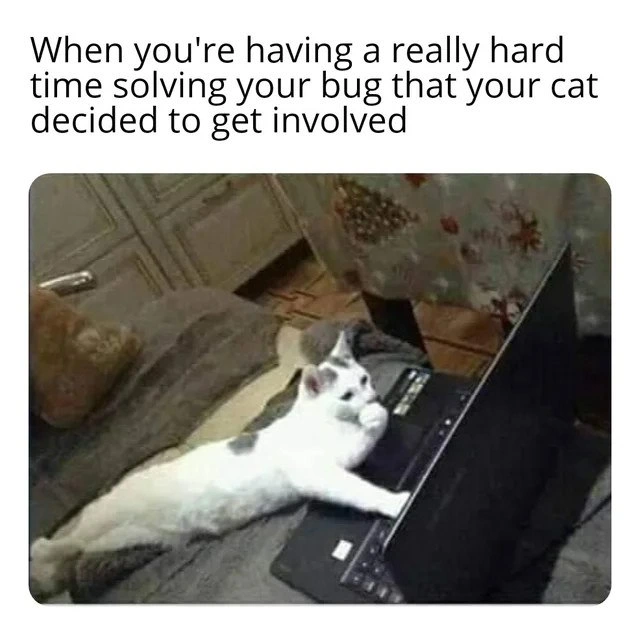
In this meme, instead of an actual rubber duck, the developer’s cat has taken on that role! The image shows a cat stretched out next to a laptop, with one paw on the keyboard and the other under its chin like it’s deep in thought. It looks like the cat is seriously working on the computer. The caption says, “When you’re having a really hard time solving your bug that your cat decided to get involved.” This implies the coder is so stuck that even the cat deciding to help is a welcome idea. It’s a comical twist on pair programming too. Pair programming is a real practice where two developers team up on one computer: one writes code, the other reviews each line in real-time, and they constantly switch roles. It’s great for catching errors because two minds are on the problem. Of course, a cat isn’t actually a programmer, but the meme is joking that the cat becomes the second pair of eyes (or paws) because no human colleague is around. If you’ve ever heard someone say “rubber duck debugging,” this is basically pet-based rubber ducking – using your pet as the “listener” for your problem explanation. The tag cat_pair_programming is spot on: the cat is acting like a little coding partner.

This scenario is very relatable humor in the coding world. Many developers work from home or pull late nights, and their pets often wander into their workspace. Cats, especially, love to sit on keyboards or lap tops (they’re warm and they get attention that way). Usually, a cat on your keyboard causes new problems (ever had random characters suddenly appear in your code because your cat stepped on the keyboard? It’s chaotic!). But here it’s portrayed as if the cat intentionally wants to fix the bug. It’s funny because it mixes something everyday and cute – a pet cat – with the nerdy reality of coding. It’s a mashup of DeveloperHumor and CatMemes. Even if you’re new to coding, you can appreciate the picture of an earnest kitty “helping” with computer stuff. And if you are a developer, you probably chuckle because you know that exact feeling of DebuggingPain: being so stuck you’ll take help from anyone or anything, even your fluffy friend.

In simpler terms, the developer is stuck on a coding problem and decides to talk it out. Since no human is around, the cat becomes the audience. Just explaining the bug to the cat might help the developer think of something they missed. And if nothing else, the cat’s presence is comforting. This is a part of the developer experience not often mentioned in textbooks – the emotional rollercoaster of coding. One moment you’re tearing your hair out over a bug, the next moment you’re laughing because your cat is literally pawing at the keyboard like it’s pair programming with you. That laughter can break the stress, and suddenly the bug doesn’t seem as impossible. Many people in tech share these kinds of shared pain moments to remind each other that it’s normal to struggle and to find humor in the struggle. So, this meme is both a joke and a tiny lesson: when you’re truly stumped by a bug, sometimes a break and a silly debugging method (like explaining it to your cat) can actually help.

Level 3: Pair Paw-gramming at 2AM

Late-night debugging sessions have a way of eroding our pride. After hours staring at the same stubborn bug (a notorious software defect that just won’t budge), you’ve tried everything short of summoning mystical forces. It’s the classic scenario of desperation-driven development. Logging every variable, stepping through code instruction by instruction, scouring Stack Overflow for that one clue – yet the issue persists, defying all logic. In a proper agile world you’d call a teammate for pair programming, but it’s 2 AM and your only awake companion is the cat. So what’s a weary developer to do? Hand the reins to the nearest life form with a pulse (or in this case, a purr).

Enter the feline pair programmer: your cat sprawls across the keyboard, one paw on the keys and the other under its chin as if in deep architectural contemplation. The meme’s text – “When you’re having a really hard time solving your bug that your cat decided to get involved” – perfectly captures that absurd moment when you’ll accept any help offered, even if it comes with fur and whiskers. It’s poking fun at how debugging frustration can reach a point where a cat pair programming buddy doesn’t seem all that crazy. In fact, this visual gag is a nod to an actual problem-solving trick developers use: rubber duck debugging. Usually, you’d grab an inanimate rubber duck (or any object) and explain your code problem to it step by step. The simple act of articulating the problem often triggers an “aha!” moment. Here, the cat has effectively become the rubber duck, except it’s fuzzy, occasionally meows, and might literally press the Enter key for you.

The humor lands because it’s too real: many of us have experienced a critical bug or a persistent production defect so baffling that we resort to talking to ourselves, inanimate objects, or yes, even our pets. We share this collective DebuggingPain – that mix of stubborn determination and creeping despair when a solution remains elusive. The cat’s involvement is an exaggeration of the developer experience (DX) during an all-nighter fix: you’re exhausted, out of ideas, and even your cat walking across the laptop starts looking like a viable debugging strategy. Seasoned engineers chuckle knowingly because they’ve been there – maybe not literally with a cat hitting keys – but certainly at that stage where a fresh set of eyes is needed and none are available. A senior dev might quip, “At that point, even the office ficus plant would make a good rubber duck.”

There’s also a delicious irony in play. Historically, the term “computer bug” came from an actual moth found jamming the circuits of an early computer (true story from 1947). If only our modern bugs were so tangible – a cat could simply pounce on the offending insect and save the day! But today’s bugs are abstract lines of faulty code, so our intrepid kitty has to settle for metaphorical bug-hunting by peering at (or sitting on) the screen. It’s a lighthearted spin on troubleshooting: when standard methods fail, sometimes a fresh perspective – or at least a pair of cute, non-judgmental eyes – is what breaks the mental logjam.

Ultimately, this meme perfectly blends developer humor with classic cat meme energy. It’s a reminder that programming isn’t just a mechanical process; it’s deeply human (and occasionally feline) with all the shared pain and creativity that implies. The next time you’re stuck on an intractable bug, you might just find yourself muttering, “Time to do some pet-based rubber ducking,” and inviting your cat to your coding session. Don’t be surprised if that’s when the breakthrough happens – at the very least, you’ll have some moral support (and a paw) to help press “Run” one more time.

Description

A meme with the caption: 'When you're having a really hard time solving your bug that your cat decided to get involved'. The photo shows a white cat with grey spots lounging on a person's lap, with one paw resting decisively on the laptop's keyboard or trackpad. The cat is looking intently at the screen with its other paw held to its chin in a thoughtful pose, as if deeply contemplating the problematic code. The scene humorously personifies the cat as a helpful colleague, stepping in to assist with a difficult technical problem. This plays on the concept of 'rubber duck debugging,' where explaining a problem to an inanimate object (or, in this case, a pet) can help a developer see the solution. It's a wholesome and relatable meme for anyone who has worked from home with pets

Comments

7
Anonymous ★ Top Pick The cat's suggestion was to randomly delete lines until it compiles. It's a bold strategy known as 'Felis Catus-trophic Debugging'
  1. Anonymous ★ Top Pick

    The cat's suggestion was to randomly delete lines until it compiles. It's a bold strategy known as 'Felis Catus-trophic Debugging'

  2. Anonymous

    Spent an hour tracing a race condition; the cat sprawled on the keyboard, killed the process, and everything worked - apparently our fail-over strategy is “feline-driven chaos engineering.”

  3. Anonymous

    After 15 years in the industry, I've finally found a pair programming partner who's more interested in catching bugs than writing them - though their PR comments are just 'meow' and they keep trying to refactor everything into a ball of yarn

  4. Anonymous

    Ah yes, the classic race condition: you're racing to fix a critical production bug while your cat races to occupy maximum keyboard real estate. The cat always wins with O(1) complexity, while your debugging session degrades to O(n²) as you attempt to gently relocate 15 pounds of uncooperative feline without triggering a catastrophic rollback of your unsaved changes. At least the cat's contribution is deterministic - unlike that Heisenbug you were chasing before the interruption

  5. Anonymous

    Cat debugging: masters of injecting race conditions via paws-on parallelism - far superior to your multithreaded woes

  6. Anonymous

    Heisenbug finally reproduced: one paw on the keyboard, one on the touchpad, tail flick on F12 - turns out our input handler isn’t thread-safe; adding a Whisker Test to CI

  7. Anonymous

    Rubber ducking escalated to CatOps: a 4kg heat-and-paw interrupt that perturbs scheduler timing just enough to reproduce your heisenbug, then stares until you write the blameless post-meow-tem

Use J and K for navigation