Skip to content
DevMeme
971 of 7435
It's Not a Bug, It's a Feature
CodeQuality Post #1094, on Mar 4, 2020 in TG

It's Not a Bug, It's a Feature

Why is this CodeQuality meme funny?

Level 1: Wrong Tool, Right Result

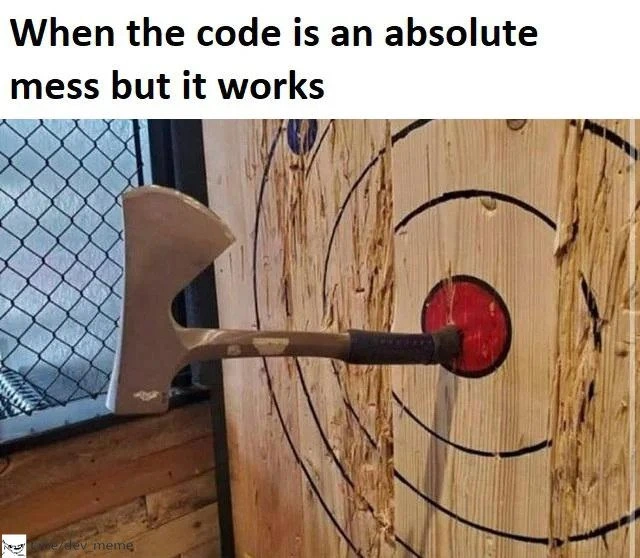
Imagine you have a job to do, like hitting a target with a dart. But instead of the pointy tip of the dart hitting the middle of the target, you accidentally hit it with the wrong end – and it still lands perfectly in the center! It’s kind of funny because you succeeded in the task, but not in the way anyone expected. This meme is just like that. It’s saying the code (the instructions that tell a computer what to do) was super messy and not done the “right” way, but somehow it still got the job done. It’s like using a hammer upside-down and still managing to drive a nail in. Everyone is surprised that it worked. People are happy the result is correct, but also a bit nervous or laughing because they know it was done with the wrong tool or method. The picture of the axe with its handle in the bullseye shows this in a simple, funny way: usually you’d use the sharp blade to hit the center, but here the handle did it. It’s a silly way of winning, and that’s why it’s humorous. The feeling is “Well, it worked... but that was lucky and a little crazy!”

Level 2: It Ain't Pretty

So, what’s going on here? We have an axe-throwing target with the handle of the axe stuck dead-center in the bullseye. That’s not how you’re supposed to hit a target – you’d expect the sharp blade to stick, not the handle. In coding terms, this is like a program that meets its goal (hits the bullseye) but in a really messy, unorthodox way. It’s ugly, but it works. Developers often call such messy code spaghetti code. Why spaghetti? Imagine a big bowl of spaghetti noodles all tangled and twisted – spaghetti code is written with a similar lack of clear structure. You try to follow its logic and it loops and jumps all over, just like trying to trace one noodle in a knot of pasta. It’s hard to tell where things start and end. Yet somehow, out of that tangle, the correct output or behavior emerges.

When the meme says “code is an absolute mess but it works,” it’s hinting at the concept of TechnicalDebt. This is a metaphor in software: if you take shortcuts or write sloppy code to ship a feature quickly, you’re incurring a "debt" that you’ll have to pay off later by fixing or refactoring the code. Refactoring means cleaning up and reorganizing code without changing what it does – basically turning that axe around to use the blade next time. If you never refactor, the TechnicalDebt (the messy parts) accumulates interest: the code becomes harder and harder to maintain or extend. In the meme’s scenario, maybe a developer wrote something quickly to hit a deadline – the code is full of bad practices (like not following normal rules, similar to using the wrong end of the axe), but hey, all the tests pass and the feature works. Developers joke about this with phrases like “Works on my machine!” or “Ship it!” followed by a nervous laugh, because they know the solution is brittle.

CodeQuality is basically how clean and easy-to-understand the code is. High code quality is like throwing the axe properly and hitting the bullseye cleanly – everyone can see it was done the right way. Low code quality (like in this meme) is the handle-in-target scenario – it met the requirement, but nobody’s proud of the technique. It often comes with lots of CodeSmells. CodeSmell is a term for an indicator that something might be wrong in the code. For example, a super long function, duplicate code everywhere (copy-paste programming), or variables named thing1 and thing2 – these are smells that the code might need attention. In a junior developer’s experience, you might have written something quickly that seemed clever at the time (maybe a giant if-else chain or a hacky workaround) and you were happy it worked. But when you show it to a more experienced colleague, they raise an eyebrow. It “hits the target” (the program does what it should), but they know it will be hard for anyone else to understand or modify without breaking it.

The image setting implies a kind of axe-throwing game. The thrower got the axe to stick, but backwards. In a coding team, this often leads to mixed feelings: relief that the feature or bugfix is done, but anxiety because the solution is so brittle. Everyone knows that one piece of code that nobody wants to touch because it’s held together by luck and maybe a little magic. The phrase “RefactoringNeeded” (as tagged) would be the rallying cry here – “This works for now, but we really should clean it up before it causes problems.” Often, due to time pressures, that cleanup keeps getting postponed.

In simple terms, the meme humorously highlights a hacky_solution – a solution that is done in a quick-and-dirty way. It’s about the tension in software development between just making something work right now and building it the right way. Junior devs quickly learn that just because something works doesn’t mean it’s good. The goal is to eventually learn to throw the axe blade-first every time, not rely on lucky handle hits!

Level 3: Accidental Architecture

Picture an axe hitting a target blade-first. Now flip that absurd: the axe handle nails the bullseye. That’s this meme’s vibe. In software, it's like achieving a product goal with code so spaghetti-tangled and backward that you’re shocked it actually works. Seasoned devs have all seen this: a project where the code’s an absolute mess but it somehow passes all tests and sails into production. It’s a victory that feels accidental – the bullseye was hit, yet none of the proper techniques were used.

Under the hood, this speaks to technical debt and dubious CodeQuality. The codebase might be full of elegant design bad practices: global variables controlling logic from the shadows, functions hundreds of lines long, copy-pasted snippets breeding inconsistencies. These are classic code smells – obvious red flags that the design is off. It’s as if the developer threw together whatever stuck, just like tossing an axe irresponsibly and somehow scoring points. The result works, yes, but maintaining it is a nightmare. One wrong touch and the whole thing could fall apart, because the solution isn’t robust – it’s a fluke. In a robust throw, the axe’s blade does the work; in robust code, structured logic and clear architecture hit the target. Here, the handle did it – a sign something’s fundamentally backwards.

Any grizzled engineer recognizes the “it ain’t stupid if it works” bravado swirling here. We hit the deadline, shipped the feature, and the users are happy. But open the source and it's an eyesore: the SpaghettiCode equivalent of an axe handle lodged in the bullseye. You might joke that it’s held together with duct tape and prayers. This is a hacky_solution that probably violates every clean coding principle, yet it’s in production. The humor (and horror) lies in that contradiction. We met the spec, so business folks applaud, oblivious that the dev team is cringing internally. They know the TechnicalDebt bill will come due.

This scenario is all too real in crunch-time projects. Perhaps there was no time for proper design, or a works_on_my_machine moment occurred – the code ran by coincidence and got promoted to live. Continuous Integration (CI) might be green, but only because the tests don’t peer into how ugly the internals are. The meme screams “RefactoringNeeded!” to those in the know. Senior devs have been there: a fragile module that you’re afraid to modify because it’s so chaotic, yet critical. It’s that legendary function doEverythingAndTrackState() that you never dare open in your editor. It works today; break it tomorrow and you’ll be on call at 3 AM sorting through the wreckage. The cynical veteran in us chuckles because we’ve seen this bullseye hit the wrong way before. The code is essentially an unorthodox success story – non_orthodox_success in agile reports – and technical debt like this accumulates interest. One day, an innocuous change causes a complete axe-handle catastrophe: the system misses the target entirely or, worse, falls over.

In summary, the meme captures that bittersweet engineering win: a feature delivered via a cringe-worthy implementation. It’s a perfect hacky_solution bullseye. We can’t decide whether to celebrate or start writing a long refactoring ticket. As the saying goes, “Works in production, don’t question how.” This image nails (or rather axes) that sentiment – a messy codebase hitting the mark by pure, dubious luck.

Description

A meme with the caption, 'When the code is an absolute mess but it works'. The image below shows an axe embedded in a wooden axe-throwing target. However, the axe is backwards; the handle has struck and stuck directly in the red bullseye, while the sharp blade end points outwards, away from the target. The visual gag perfectly represents a common software development scenario: creating a solution that is completely unconventional, messy, and technically incorrect, yet somehow manages to produce the correct result. It's a humorous take on 'spaghetti code,' hacks, and the accumulation of technical debt, where the outcome is successful even if the method is baffling and likely unmaintainable

Comments

7
Anonymous ★ Top Pick This code was approved with the comment: 'Merges cleanly, passes all tests, and is now a load-bearing pillar of our infrastructure. Do not touch it. Ever.'
  1. Anonymous ★ Top Pick

    This code was approved with the comment: 'Merges cleanly, passes all tests, and is now a load-bearing pillar of our infrastructure. Do not touch it. Ever.'

  2. Anonymous

    Sure the SLA dashboard shows a perfect bullseye - just don’t look too closely at the hot path where grep | awk | sed is doing the job of an entire microservice

  3. Anonymous

    This is every senior engineer's dirty secret: that one critical service running in production for 5 years that nobody dares refactor because despite violating every SOLID principle and looking like it was written during a fever dream, it handles 10 million requests per day without breaking. The code review was just everyone slowly backing away saying 'if it works, don't touch it.'

  4. Anonymous

    This is the architectural equivalent of a microservices system held together by a single 10,000-line God class that somehow passes all integration tests. Sure, the axe handle violates every SOLID principle and the wood grain suggests zero fault tolerance, but the blade hit the bullseye - so naturally, we'll ship it to production on Friday at 4:45 PM and call it 'battle-tested.' The real question isn't whether it works, it's whether anyone will dare refactor it when the original developer left no comments and the only documentation is a Slack thread from 2019 that just says 'lol it works now.'

  5. Anonymous

    It hits the SLO like that axe hits the bullseye - handle-first, powered by undefined behavior and tribal knowledge, and the runbook’s mitigation step is literally: don’t touch it

  6. Anonymous

    The architectural anti-pattern that scales to millions while your microservices Kubernetes cluster blue-screens on deploy

  7. Anonymous

    Acceptance criteria said “hit target,” not “use the blade” - we’ll amortize the refactor over the next two reorgs

Use J and K for navigation