A PSA for Python Developers
Why is this Documentation meme funny?
Level 1: Lego Without Instructions
Think of it like building a LEGO set. Python code that’s written cleanly is like having LEGO pieces that are nice, big, and colorful – easy to see and sort, almost like they’re made for kids to understand. You might look at those pieces and have a pretty good idea what goes where. But if the box came with no instruction booklet, you’d still have a tough time building the exact model. You might guess, and maybe you’ll get some of it right because the pieces kinda make sense, but you’ll probably get frustrated or make a mess. Writing documentation for code is like giving the instruction booklet along with your LEGO pieces. No matter how simple and obvious each individual piece is, the instructions (documentation) tell you how to put them all together, what the final result should look like, and tips to not get lost. The meme is basically Lisa Simpson standing up there telling all the programmers in the room: “Hey, your code might be easy to read (like clear LEGO bricks), but without instructions (a little guide or explanation), everyone else is going to struggle to understand the bigger picture or how to use what you built.” In everyday terms: even if you write something really clearly, it’s always helpful to also explain it in words. That way, nobody has to play guess-and-check to figure out what you meant.
Level 2: But Did You Document It?
Let’s break down the joke in simpler terms. Python is a programming language known for having very clean and easy-to-understand syntax. When people say “Python looks like pseudocode,” they mean that a Python program can read almost like plain English or like the step-by-step outline you’d write in English before turning it into actual code. Pseudocode is that outline – it’s not real code, just written steps that resemble code, used to plan or explain an algorithm. For example, pseudocode might say: “for each item in list: if item is red, remove it.” Python can express that almost identically with actual code: for item in items: if item.color == 'red': items.remove(item). So, Python is often praised for being human-readable.
Now, code that’s easy to read is wonderful – it’s a big part of writing clean code and good code quality. The problem, and the humor here, comes from some developers thinking, “My code is so clear, I don’t need to write documentation.” They assume other programmers will just read the code itself and understand everything. Documentation in programming means the extra explanations we write to help others (or our future selves) understand the code. This can be comments in the code, docstrings in Python (which are special triple-quoted strings at the top of a function or class that describe what it does), or separate files like a README or user guide. Good documentation tells you how to use the code, what to expect, and why it’s written that way. Code alone might not tell you those things, even if it’s written clearly.
For instance, imagine you find a Python function in a project: process_data(data_set). The name is nice and readable – you know it processes some data. But that’s it. What kind of data_set does it need? What exactly does “process” do – does it transform the data, filter it, output something? And what does it return? Without any documentation or docstring, you have to open up the function and read every line to figure these things out. If the original developer had included a one-line docstring like """Filter the dataset for valid entries and return the cleaned list.""", you’d know immediately what it’s meant to do. Or better yet, documentation might tell you why it’s doing this filtering, so you understand the context. This saves time and prevents misunderstanding.
Sometimes beginners think their code is straightforward so they only write minimal docs or none at all. A classic newbie documentation mistake is writing a docstring that literally just repeats the function’s name in English, adding no new info. For example:
def load_data(path):
"""Load data from path."""
# ... imagine the code that loads data here ...
return data
Thanks, docstring, we kind of guessed that! 😅 This trivial comment doesn’t explain what format the data is, or what “load” exactly entails (is it CSV, JSON, from a database?), nor what the function returns. It’s basically useless – that’s “shitty documentation” in action. The meme is warning against doing this or nothing at all. Writing useful documentation means giving details that the code’s name and implementation don’t directly reveal. For example, a great docstring would mention the expected file format or an example of usage, not just restate the function name.
As a junior developer, you might also encounter senior team members insisting on good docs. You’ll hear things like, “This code is good, but please add documentation before we merge it,” or “Update the README with how to run this script.” Early on, it may feel tedious – after all, the code is written and working, why spend time writing about it? This meme is the answer: because readable code isn’t the whole story. Pythonic code (a fancy term for code that follows Python’s style and philosophy) encourages clarity and minimal clutter, but even in the Python world there’s an understanding that you should include docstrings and comments for anything non-trivial. Python even has built-in tools like help() that read those docstrings. If you don’t write them, help(your_function) will just show “no documentation available,” which is a missed opportunity to help someone use your code. The Python community also has conventions (like PEP 257) specifically about writing docstrings – showing that writing docs is considered a best practice, not an optional extra.
So, the bottom line for a newer developer: Don’t rely solely on your code being “clean” or “obvious.” Even if you think your Python code reads like a story, always include at least a bit of explanation. Future you (and everyone else) will be grateful. Imagine coming back to your own project after 6 months – without good docs, you might have forgotten the details and you’ll be scratching your head. As the meme implies, just because Python is easier to read than other languages doesn’t give you a get-out-of-writing-docs free card. Good code and good documentation go hand-in-hand to create a project that others can understand and use without pulling their hair out. In short: write the docs, even if the code seems readable! 📖🖊️
Level 3: The Pseudocode Paradox
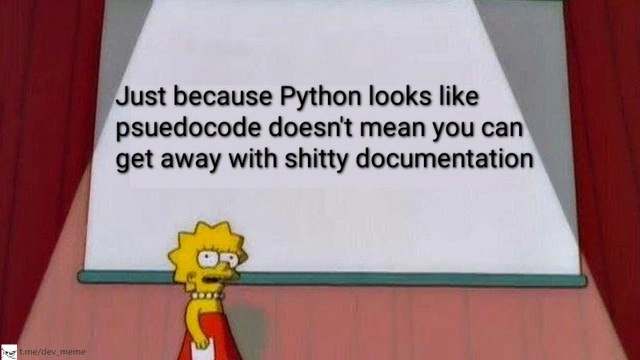
Lisa Simpson (on the projector slide): “Just because Python looks like pseudocode doesn’t mean you can get away with shitty documentation.”
In this classic Lisa Simpson presentation meme, Lisa delivers a hard truth to developers: Python’s clean syntax is not a free pass to slack off on docs. Python is famous for looking like executable pseudocode – its syntax is minimal, using indentation and plain-English keywords that make it easy to read. It’s so readable that newcomers often say, “Wow, Python code looks like the pseudocode in textbooks!” That’s Python’s readability culture in action (the Zen of Python literally says “Readability counts.”). But here’s the paradox: that very strength can lure developers into a false sense of security about documentation. The meme pointedly calls out this pseudocode vs real code dilemma: just because the code is easy to follow line by line doesn’t mean it magically communicates everything a user or future maintainer needs to know.
Seasoned engineers recognize this scenario all too well. We’ve seen teammates (or our younger selves) brag, “My code is self-documenting!” only to leave others utterly confused about how to use it. The meme’s blunt phrasing – including the spicy “shitty documentation” – resonates because it’s developer humor born from real frustration. It’s a poor documentation callout that likely triggers war stories in any veteran coder’s mind: remembering that one project with “beautiful” Python code but zero README or comments, where onboarding a new dev was like throwing them into a jungle with no map. Readable code improves maintainability, yes, but it doesn’t convey intent, usage, or higher-level context. As the saying goes in software teams: “Code tells you how, but docs tell you why.” No matter how clean your def solve_problem() implementation is, it won’t explain the problem’s background, the edge cases, or how to actually invoke it in a real scenario – that’s what good documentation is for.
The industry has learned the hard way that self-documenting code is a bit of a myth when taken too far. Sure, using meaningful variable names and clear logic is part of Clean Code principles and good code quality. It reduces the need for trivial comments (like i += 1 # increment i – we don’t miss those). But true documentation goes beyond the code. It includes docstrings, usage examples, architecture notes – the things that answer questions code alone doesn’t. Why was this approach taken? What does this function expect as input? What are common pitfalls? Code won’t tell you any of that no matter how “Pythonic” it looks. This gap between code readability and actual maintainability is exactly what Lisa is cheekily warning about. It’s a reminder that “docs or it didn’t happen” isn’t just a snarky phrase – it’s a real rule in mature teams. A feature without docs might as well not exist for the end user. An API without proper docstrings and examples will have developers scrolling through source code, guessing how to use it (or more likely, moving on to a better-documented library). In short, readable syntax ≠ documented behavior.
Even the meme itself sneaks in a bit of meta-humor: the slide text misspells “pseudocode” as “psuedocode.” That irony isn’t lost on senior devs – it’s like a little self-own: preaching about documentation quality while tripping on a small detail. 😅 It perfectly illustrates the point that lack of attention to detail (whether in docs or slides) can undercut your message. In documentation, a tiny mistake or omission can mislead readers or erode trust, just as that typo gives Lisa’s serious lecture a comedic twist. The experienced perspective here is clear: writing Python that reads like a story is great, but it’s not a substitute for writing the user manual to go with that story. If you don’t, be prepared for confused colleagues asking “Uh, what is this supposed to do?” at the worst possible times. As any cynical veteran will tell you, nothing haunts you faster than code you wrote 6 months ago with no “self-evident” docs at 3 AM when production is on fire. In the end, the meme gets a collective nod (and chuckle) from senior developers because it underscores a universal truth in tech: no language, however readable, exempts you from documenting your work.
Description
This meme uses the 'Lisa Simpson Presentation' format from the animated TV show The Simpsons. An earnest-looking Lisa Simpson stands on a stage next to a large projector screen. The screen displays the text: 'Just because Python looks like pseudocode doesn't mean you can get away with shitty documentation'. The meme uses Lisa's character, often a voice of reason, to deliver a blunt and widely-held opinion within the software development community. The joke critiques a common pitfall among Python developers who, relying on the language's high readability, neglect to write thorough documentation. For experienced engineers, this is a familiar frustration, as even the clearest code lacks the context, intent, and usage examples that proper documentation provides, making maintenance and collaboration difficult in the long run
Comments
7Comment deleted
'My Python code is so readable it doesn't need docs' is a phrase found only in the commit messages of soon-to-be-unmaintainable projects
Python’s “it reads like pseudocode” vibe is great - right up until a new hire asks why the context-manager inside the decorator mutates a module-level singleton, and your only architecture doc is a 2017 Slack thread
The real snake in Python isn't the logo - it's the senior dev who insists their 'self-documenting' code doesn't need docstrings because 'it reads like English,' then leaves you deciphering their clever one-liner comprehensions that would make Guido van Rossum weep
Ah yes, the classic 'Python is so readable it documents itself' fallacy - right up there with 'we'll add tests later' and 'this is just a temporary fix.' Sure, your variable names are descriptive and your code flows like prose, but six months from now when you're staring at that clever list comprehension wondering why it filters by `lambda x: x[2] > threshold`, you'll wish past-you had written a single comment explaining what 'threshold' represents in the business logic. Self-documenting code explains *what* it does; documentation explains *why* it exists - and no amount of PEP 8 compliance will save you from the architectural decisions that seemed obvious at 2 AM during that sprint
Python may read like pseudocode, but production reads like forensic evidence - write the docstrings and ADRs, or your on-call will be doing archaeology at 3 a.m
Python's 'self-documenting' syntax is the siren's song that strands junior code on the rocks of senior maintainer despair
Python looks like pseudocode until the 3am on-call, when 'self-documenting' means grepping through decorators, metaclasses, and implicit None returns