C++ fans mock Python speed, Python fans mock C++ compiler scavenger hunt
Why is this Languages meme funny?
Level 1: Building a Car vs Riding a Bike
Imagine you and a friend are having a race to the top of a hill. You decide to build a fancy racecar to go super fast, while your friend just hops on a bicycle and starts pedaling right away.
- You (with the racecar, that’s like using C++): You spend a lot of time in the garage first. You’re finding tools, putting the engine together – it’s a whole hour before your racecar is even ready. But once it’s built, wow, it zooms! You drive up the hill at lightning speed and cover a lot of ground quickly.
- Your friend (with the bicycle, that’s like using Python): They couldn’t be bothered with all that setup. They simply dust off a bicycle and start going. In the first minute, they’re already on the road, overtaking you while you were still tightening bolts. But the bicycle isn’t very fast. As the race goes on, you in your racecar eventually catch up and zoom past because your vehicle is much faster, even though you started later. Meanwhile, your friend is ringing the bell on the bike, saying “at least I didn’t have to build a car for an hour!” while you laugh and say “have fun pedaling, slowpoke!” as you speed by.
This is exactly the joke of the meme in simple terms. C++ is like building that racecar – it takes more time and effort before the ride (you had to find the compiler tools and build your program), but then it runs super fast. Python is like using a bicycle – you can start right away (just run the code directly, no waiting), but the actual ride (the program running) is slower. Each side is teasing the other: one says “Ha! Your bike is so slow, it takes you forever to finish the race!” and the other says “Ha! You wasted forever just getting ready, I was already on the road!”. It’s a friendly and funny way to say different approaches have different trade-offs, just like the fast car and the easy bike in our race. The meme makes us laugh because both sides have a point, and it’s silly to see them yelling at each other (just like the lady and the cat at the dinner table) about who’s doing it the “wrong” way. In the end, whether you choose a racecar or a bike (C++ or Python) depends on what you care about more – going as fast as possible, or starting as quickly and easily as possible.
Level 2: Speed vs Setup
Let’s break down the technical jokes here. The meme contrasts C++ and Python, two popular programming languages, by highlighting one’s strength as the other’s weakness.
C++ (compiled language) – C++ code is written in files (say
program.cpp), and you can’t run it directly. You first need a compiler (likeg++for GNU C++ or Microsoft’s MSVC) to turn the C++ source code into an executable program. This process is called compiling or build. It can involve steps like compiling each file to machine code, then linking them together. On a new system, finding or installing the right compiler and configuring it can be an adventure (hence the joke about “finding a compiler” taking an hour). Once compiled, though, the program is directly in machine code and tends to run very fast. That’s C++’s big advantage: speed at runtime. It’s used in systems programming, game engines, anything performance-critical. But the cost is upfront complexity – you spend time setting up the environment and waiting for code to compile. For example, if you wrote a C++ program to process a huge dataset, you might wait a few minutes to compile it, but then it might finish the processing in, say, 5 minutes.Python (interpreted language) – Python code is usually run by an interpreter. You write a script (say
script.py) and you can execute it right away with the Python interpreter (python script.py). No separate compile step is needed each time you run; Python will internally do a quick conversion of your code to bytecode and start running it on the fly. This makes development very quick and easy – you can write something and see results immediately. However, the trade-off is speed at runtime. Python’s interpreter has to do a lot of work behind the scenes for each operation (like variable type checks, managing dynamic objects, etc.), which makes Python programs generally slower for heavy computations or loops. So if that same data processing task was written naïvely in pure Python, it might take, say, 60 minutes to finish processing the data (where the optimized C++ version did it in 5). Python’s strength is simplicity and quick iteration – it’s great for scripting, automation, machine learning prototyping, etc., where developer time matters more and absolute speed isn’t the top priority (or the heavy lifting is done by optimized libraries).
Now, the meme quotes:
C++ FANS: “IMAGINE TAKING 1 HOUR TO RUN A PROGRAM.”
This is the C++ crowd mocking Python’s slow execution. They’re basically saying: “Wow, your code runs so slow it takes an hour to finish. That’s pathetic – if it were in C++ it’d be done in a fraction of that time!” It’s a jab at Python’s interpretation overhead and lower performance. Python enthusiasts sometimes hear this whenever performance comes up: “Python is so slow!” (Of course, whether it actually takes an hour depends on what the program is doing – the meme is exaggerating to get the point across.)
PYTHON FANS: “IMAGINE SPENDING 1 HOUR TO FIND A COMPILER.”
Now the Python crowd hits back at the pain of setting up C++ tooling. They’re effectively saying: “Wow, you spend so long just getting your program to run at all – hunting down the right compiler or fixing compile errors for an hour. I, a Python user, can run my code instantly without that nonsense!” This references how using C++ can involve installing a compiler or dealing with build configurations. For instance, on Windows, a beginner who wants to compile a C++ program might have to download Visual Studio or Mingw, set environment variables, etc. – which can be quite time-consuming and frustrating if you’re new to it. In contrast, Python comes pre-installed on many systems (or is easy to install in one go) and doesn’t require any separate build step to run a script.
Key terms explained:
- Compiler: A tool that converts high-level code (like C++ source) into low-level machine code that the computer’s CPU can execute. Examples:
gcc/g++(popular on Linux), Clang, MSVC on Windows. If you don’t have the right compiler set up, you literally cannot run C++ code. That’s why Python fans joke about “finding a compiler” – sometimes it feels like you need a treasure map to configure C++ on a new machine! - Interpreter: A program that reads and executes code directly, without a separate compile step to full machine code. Python’s interpreter (CPython) does a quick bytecode compile internally, but it’s all automated when you run a script. No manual compile step for the user. This makes it super convenient to run code but generally slower in execution speed compared to a fully compiled program.
- Runtime vs Compile-time: Runtime is when the program is actually running (executing tasks), compile-time is when the program’s code is being translated by the compiler (before it runs). The meme juxtaposes these: Python makes you “pay” in runtime (the program might run longer), C++ makes you “pay” in compile-time (you wait before it even runs).
For a junior developer, think of it like this: if you wrote a simple "Hello World" program in both languages, running the Python version is immediate, while running the C++ version means you first must compile it. Example:
# In Python, you can run the script directly:
$ python hello.py
Hello, world!
# In C++, you must compile it then run:
$ g++ hello.cpp -o hello # compile step (produces an executable)
$ ./hello # now run the executable
Hello, world!
If g++ isn’t installed or set up, that first step will fail – hence the Python fan’s sassy remark about searching for a compiler for an hour. Conversely, if you had a more complex program doing calculations, the C++ version might finish its output much faster than the Python version – hence the C++ fan’s taunt about waiting an hour for the Python program to complete.
In summary, this meme is a lighthearted take on compiled vs interpreted language experience. It’s highlighting what newcomers quickly learn: C++ gives you speed when running programs but can be slow and finicky to set up; Python is easy to get running but might be slow to actually execute heavy work. Both groups like to poke fun at each other’s “hour-long problem,” but it’s all in good fun as part of programming culture’s LanguageWars.
Level 3: Compile-Time Clapback
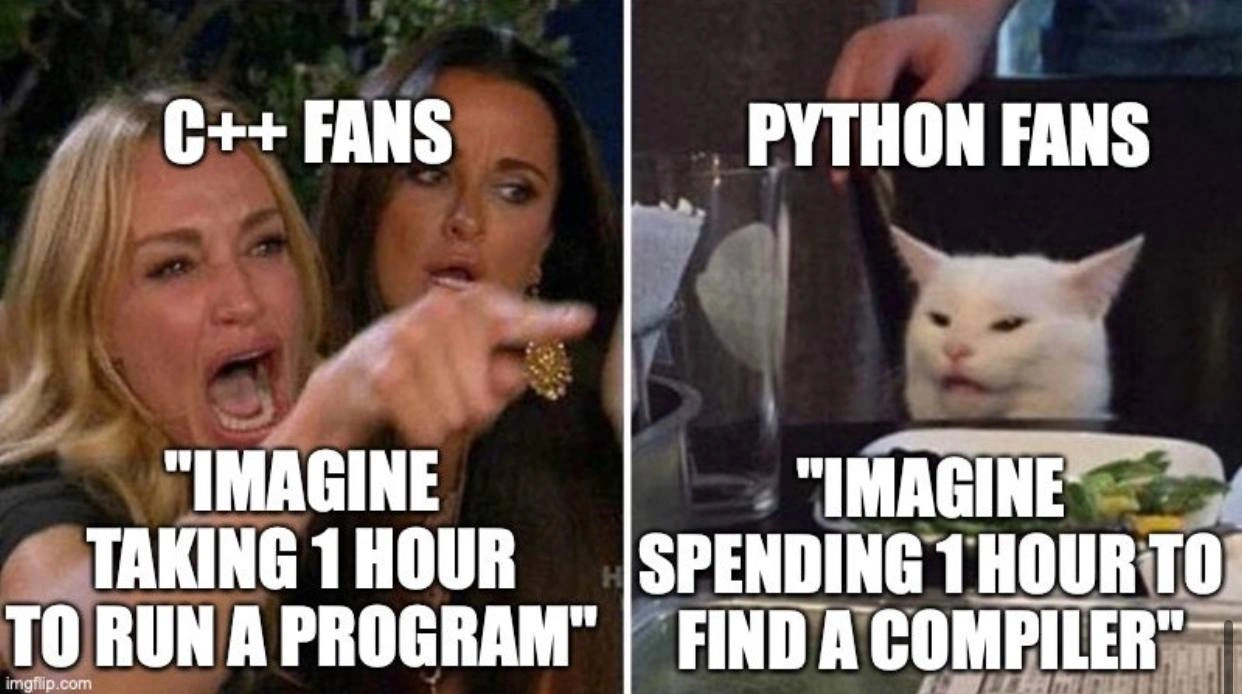
This meme uses the familiar "Woman Yelling at Cat" format to stage a blamestorm between two programming language camps. On the left, the enraged woman (labeled “C++ fans”) is shouting "IMAGINE TAKING 1 HOUR TO RUN A PROGRAM," calling out Python’s notorious slowness in executing heavy tasks. On the right, the unbothered white cat (labeled “Python fans”) fires back "IMAGINE SPENDING 1 HOUR TO FIND A COMPILER," poking fun at the C++ ecosystem’s infamous setup and tooling headaches. It’s a portrait of classic language wars bravado, where each side mocks the other’s pain points. The humor hits home for seasoned developers because we’ve all seen this dynamic in real life:
- C++ developers boast about blazing-fast runtime performance and low-level control. They’ve optimized code to run in microseconds, so to them waiting around for slow scripts is agony. They joke that Python devs must sip coffee for an hour while their code chugs along ("why is this script still running?!"). The meme plays on this stereotype that anything in Python runs at a glacial pace for compute-heavy work compared to optimized C++ binaries.
- Python developers counter with pride in their language’s simplicity and quick turnaround. They can write and launch a script in seconds without worrying about linker errors or compiler versions. To them, the real nightmare is the C++ build process – tracking down the right compiler (
gcc,clang, or Microsoft’s Visual C++?), configuring toolchains, dealing with mysterious linker errors, or waiting ages for a giant codebase to compile. The line “spending 1 hour to find a compiler” evokes that very real frustration: e.g. a newcomer trying to compile a C++ project might spend an afternoon installing Visual Studio Build Tools or figuring out whyg++isn’t in the PATH. Meanwhile, their Python friends just hitpython run_my_code.pyand laugh.
The comedy is that both sides are a bit self-righteous and hypocritical. Each language has its trade-offs, and every experienced engineer knows it. We chuckle because we likely have felt both frustrations: we’ve cursed Python for taking forever on a big data job and cursed C++ when a simple “Hello World” wouldn’t build due to missing compilers or dependency hell. The meme exaggerates to make the point: hardcore C++ folks act like any slow runtime is a sin (“Premature optimization? No, permanent optimization!”), while hardcore Python folks act like spending time on environment setup is a fool’s errand (“Why waste time compiling? Just run it!”). It’s the classic productivity vs performance debate encapsulated in a snappy visual. The Languages category of the meme signals this is about programming language culture. The tags like Cpp and Python and LanguageComparison highlight that shared understanding: if you’ve worked with these languages, you’ve likely encountered the ribbing and rivalry. It’s good-natured coding humor, and most senior devs will grin because they’ve learned that in reality you pick the right tool for the job – sometimes you need C++’s speed (and you tolerate the compile times), other times Python’s agility wins (and you tolerate that it’s not the fastest). But in the heat of online forums and meme battles, each side loves to portray the other as the one making a ridiculous compromise. This meme perfectly captures that reciprocal eye-roll: “I can’t believe you live with that!” – which, of course, is met with “Well, I can’t believe you put up with that!”. It’s a playful jab at the language fanboyism we see in tech communities, distilled into a scene of a screaming lady and a smug cat. 😹
Level 4: Bytecode vs Native Code
At the deep internals level, this meme riffs on language execution models. C++ is an ahead-of-time compiled language: its code is translated by a compiler into native machine code (binary) before you run it. That translation process isn't trivial – the compiler parses source into an AST (Abstract Syntax Tree), performs heavy optimizations (inlining functions, unrolling loops, clever register allocation), and finally emits CPU-specific instructions. These optimizations can be computationally expensive (some are NP-hard problems like optimal register coloring), meaning complex C++ projects can literally spend hours crunching code into a fast binary. On the flip side, Python is typically interpreted: when you run a .py script, the CPython interpreter quickly compiles it into bytecode (the .pyc files) and then executes that bytecode in a virtual machine. This makes startup near-instant – no lengthy compile step – but each instruction is executed through an extra layer (the interpreter) which adds overhead at runtime. In essence, C++ shifts the time cost to compile-time, Python delays it to run-time. The meme humorously highlights this trade-off: the C++ fans sneer at how slow an interpreted program can be (imagine a Python script taking an hour to crunch data), while Python fans retort that setting up C++ can be a scavenger hunt (imagine wasting an hour chasing the right compiler or wrestling with build tools). It’s a classic case of AOT vs. interpreter design philosophy. The deeper irony: both insults have truth rooted in computer science. C++’s speed comes from meticulous upfront optimization (at the cost of developer waiting time and complex toolchains), whereas Python’s ease comes from deferring work to execution time (at the cost of slower performance and higher CPU work per operation). Advanced developers know there’s also middle ground – e.g. JIT compilers (Just-In-Time) like PyPy try to speed up Python by compiling hot code paths on the fly, and many Python libraries (NumPy, TensorFlow) under the hood use optimized C/C++ extensions for performance-critical bits (often leading Python devs to… you guessed it… install a C++ compiler 😼). So the meme’s comedic exaggeration actually points to a real engineering balancing act: do you invest time compiling upfront for maximum runtime efficiency (C++ philosophy), or do you start running immediately with more flexible, slower execution (Python philosophy)? It’s a fun, nerdy nod to how fundamental compiler theory and execution models shape the daily experience of programming with these languages.
Description
Two-panel “woman yelling at cat” meme split by a vertical white line. Left panel shows the reality-show woman (faces blurred) pointing angrily; white uppercase text over her head reads “C++ FANS”, and at the bottom: “IMAGINE TAKING 1 HOUR TO RUN A PROGRAM”. Right panel shows the famous white cat sitting behind a dinner plate; top text says “PYTHON FANS”, and bottom text says “IMAGINE SPENDING 1 HOUR TO FIND A COMPILER”. The joke contrasts C++’s long compile setup and tooling pain with Python’s slower execution speed, riffing on language-war stereotypes and the compile-time vs run-time trade-off familiar to backend and systems engineers

Comments
6Comment deleted
C++ devs boast about nanosecond loops, Python devs mock their 20-minute link steps, and somewhere in the middle a staff engineer rebuilds the same Docker image for the fifth time thinking, “joke’s on both of you - layer cache misses are still my biggest latency.”
The C++ dev who spent 3 days optimizing their code to run in 0.3ms instead of 0.5ms just watched the Python dev ship the same feature using a library that someone else already optimized in C++
The real irony? Both camps spend an hour debugging, but C++ devs blame the compiler while Python devs blame the lack of types. Meanwhile, Rust developers are still explaining lifetimes to their rubber duck, and Go developers have already shipped three microservices in the time it took to read this meme
C++ spends an hour linking; Python spends an hour hunting the compiler pip needs for that one native dep - either way, the SLA for Hello World is one meeting
Senior truce: Python is blazing when a manylinux wheel exists, and C++ is painless when the Dockerfile already ran vcvarsall and put the right clang in PATH
C++: hours linking templates into oblivion. Python: milliseconds to import hellfire