Skip to content
DevMeme
4441 of 7435
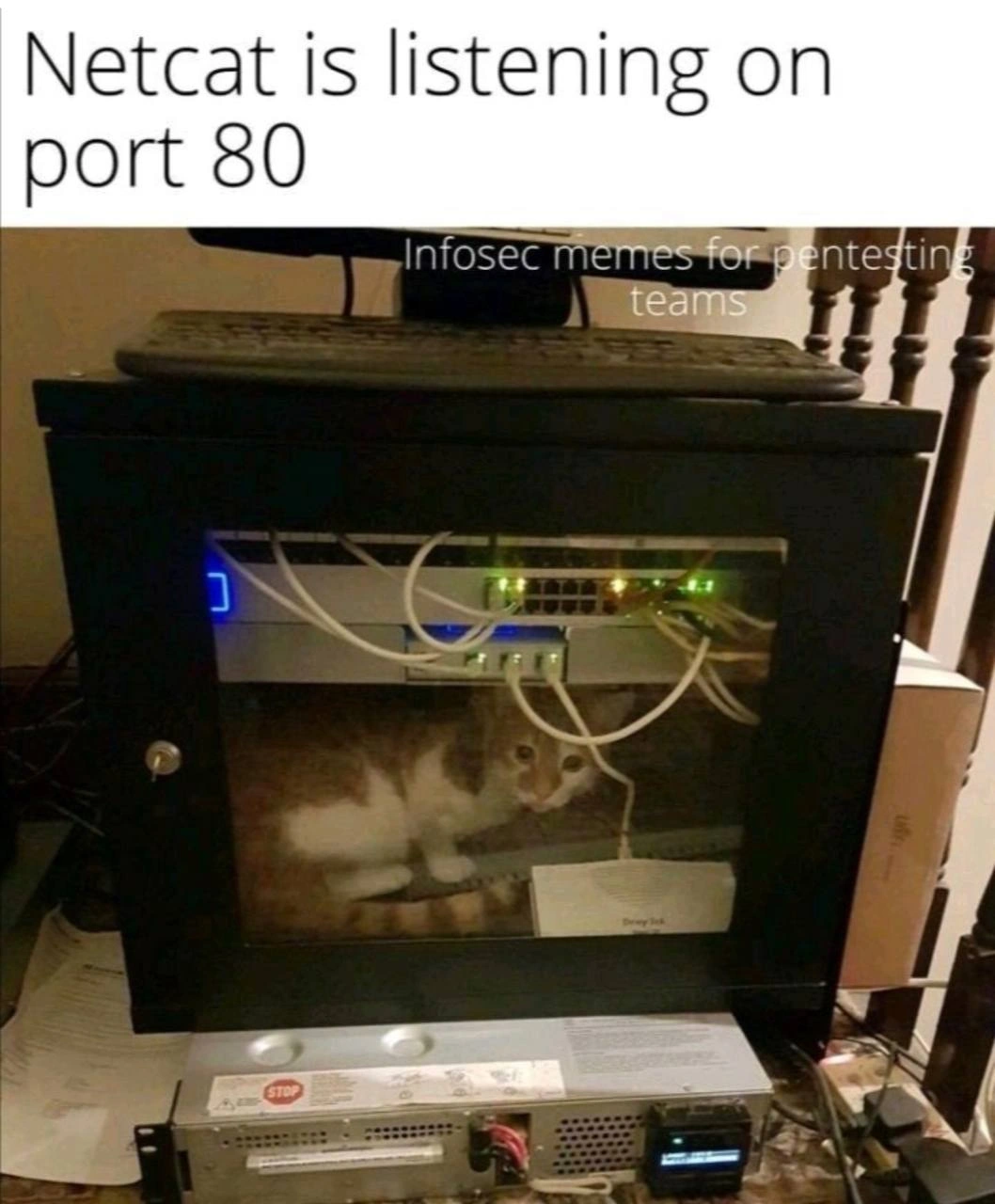
When Netcat literally listens on port 80 inside your network rack
Security Post #4871, on Sep 19, 2022 in TG

When Netcat literally listens on port 80 inside your network rack

Why is this Security meme funny?

Level 1: The Cat at the Door

Imagine you have a house with a bunch of numbered doors, and door number 80 is a special one where your friends can come in to visit. Normally, you might have a doorman or a security guard listening for a knock at that door. In computer terms, port 80 is like that special door for web traffic, and “listening” on it means someone (a program) is waiting there to greet any visitors (like web browsers) who come knocking. Now, picture someone took that idea a little too literally and instead of a security guard or a computer program, they put a cat behind door 80 to wait for visitors!

That’s exactly the silly scene this meme shows. There’s a real fluffy ginger cat sitting inside a network cabinet (think of it like a small closet that holds important internet gadgets). The caption says “Netcat is listening on port 80,” which sounds very technical, but here it’s turned into a joke. Netcat is actually the name of a computer tool, but it sounds like “network cat.” So the joke is: a cat on the network, listening at the door. Of course, in real life, a cat has no idea how to run a website or talk to computers. The poor kitty doesn’t understand anything about ports or data – it’s probably just wondering why it’s in this cozy little cabinet with blinking lights!

Why is this funny in a simple way? It’s like if you heard someone say “firewall” and you imagined a wall of actual fire around your computer, or if someone said “virus” and you pictured a cartoon germ inside the laptop. Here, someone said “netcat… listening on port 80,” and the picture shows a literal cat dutifully sitting and “listening.” It’s humorous because it mixes something very serious and technical with something cute and literal. Even if you don’t know the tech words, you can laugh because a cat in a bunch of wires looks adorably out-of-place, like a pet trying to do a job meant for a machine. It’s the same kind of giggle you get when you see a cat lounging on a keyboard while its owner is trying to work – the cat has no clue, but it’s stealing the scene anyway.

So, the meme is basically saying: “We put a kitty in charge of this important computer task, isn't that silly?” It tickles us because we know cats don’t belong there, yet this one looks so earnest as if it’s actually on duty. It’s a fun reminder that our computer jargon can sound like everyday words, and imagining them literally can lead to very funny pictures. In the end, it’s just plain cute and goofy — the kind of joke that makes techies and kids alike smile at the idea of a cat becoming an honorary IT engineer for a moment.

Level 2: Not That Kind of Cat

For those newer to programming or IT, let’s break down what’s happening in this meme. First, you need to know what netcat is. Despite the name, it’s not an animal at all – netcat (often just called nc) is a classic CommandLineInterface tool, basically a simple network utility. Think of it as a basic phone or walkie-talkie for computers: it can listen on a network port or send messages to one. In fact, netcat’s nickname is the “TCP/IP Swiss Army knife” because it’s so flexible. If you run nc -l -p 80 on a machine, you’re telling that computer: “Hey, open up port 80 and wait there, listening for anyone who tries to talk to us.” In computing, ports are like numbered doors or channels on a computer through which data travels. Port 80 in particular is famous for being the default door for web traffic (HTTP). So if something is “listening on port 80,” it usually means a web server (or a tool like netcat mimicking one) is waiting for web browsers to connect. No actual ears are involved – “listening” is just a figure of speech for “ready to receive data.”

Now, the meme text says, “Netcat is listening on port 80,” and the picture shows… a real cat inside a network rack! Here’s the play on words: netcat the tool versus “net cat,” as in a network cat. The cat_in_network_rack in the photo is a ginger and white feline sitting among real network equipment (you can see the Ethernet switches with cables and blinking lights). It looks like the cat sneaked into the server cabinet probably because it’s a cozy spot. The joke is that instead of a program quietly listening on port 80, we have an adorable kitty “listening.” It’s as if the cat is in charge of the network service. Of course, in reality, a cat can’t run any services (except maybe causing mischief!). This is what we call a pun – a form of wordplay. The meme takes a very technical phrase and makes it funny by interpreting one of the words in an unexpected way.

Let’s clarify a few terms and why they’re funny here:

  • CLI (Command Line Interface): This is a text-based way to interact with the computer by typing commands. Netcat is a CLI tool, meaning you run it by typing commands in a terminal. In the meme, the phrase comes straight out of what an admin might say or see in a terminal log: “netcat [nc] is listening on port 80.” If you’re not used to CLI talk, that sounds a bit weird – like saying “Firefox is listening on channel 80” – but tech folks instantly get it.

  • Networking & Ports: Computers that communicate over the Internet or a network use ports as logical gates for different services. Port 80 is typically where a web server waits for HTTP requests. When we say something is “listening” on a port, imagine someone sitting by a particular door (door number 80) waiting for a knock. Here, netcat would be that silent guard by the door, but the meme gives that job to a live cat! 🐈

  • Security/Pentesting Angle: This image came from an “Infosec (information security) memes” page, so it’s geared towards security enthusiasts. In security, penetration testers (“pentesters” for short) often use netcat to set traps or poke at systems. For example, during a test, a pentester might leave netcat running on a certain port to catch data or shell connections from a target machine. It’s a bit of a sneaky tool – simple, but effective. The idea of an actual cat performing that role is funny because it’s mixing a very serious security testing setup with something as non-serious as a pet cat. It lightens the mood around what is otherwise a complex, important task (finding vulnerabilities).

So, essentially, the meme is explaining “netcat is listening on port 80” in the silliest way possible: by placing a real cat inside the network cabinet as if it were the one doing the job. It’s the kind of joke you appreciate more once you know the tech lingo. If you’re new to these terms, just remember: netcat (the tool) = good at networking tasks, cat (the animal) = good at napping on warm equipment. Combine them and you’ve got a memorable visual pun that helps demystify the jargon. After seeing this, you won’t forget that “listening” in a network context has nothing to do with ears, and everything to do with being ready on a port! And if someone ever says “there’s a cat in the server room,” you might just double-check if they mean C-A-T or C-A-T. 😄 (Get it? Catalyst switch? Okay, I’ll see myself out.)

# Example of using the netcat utility to "listen" on port 80 (no actual cats required)
sudo nc -l -p 80  
# This command opens TCP port 80 and waits for incoming connections.
# It's like telling the computer to put a virtual ear on door 80 and listen for knocks.

Level 3: Paws on Pentesting

At the senior engineer level, the humor here comes from a blend of wordplay and real-world tech culture. Netcat (the tool) is famously known as the “Swiss Army knife” of TCP/IP. It’s a simple command-line program that network engineers and penetration testers use for all sorts of nifty tricks – from debugging network services to spawning remote shells. One of its classic uses in Security and PenetrationTesting is to open a listening backdoor on a machine. For example, an ethical hacker might run nc -l -p 80 on their box to create a listener, then get a compromised server to connect back to that, establishing a shell. In that context, saying “netcat is listening on port 80” is completely routine – it usually means somebody has a little TCP server running on the HTTP port, often to catch a connection.

Now, bring in the infosec_pun: instead of the expected headless terminal utility quietly running in the background, we see an actual cat in a network rack literally “listening.” The photo shows a ginger-and-white kitty sitting comfortably among rack-mounted switches and tangled Ethernet cables, with link LEDs blinking around it. For seasoned folks, this scenario hits on multiple inside jokes at once:

  • Literal Interpretation of Jargon: In tech we often use phrases like “listening on a port,” which sound bizarre if taken at face value. Here that literal meaning is visualized. A server_cabinet_cat with its ears perked up among networking gear is basically a dad-joke come to life. It’s as if someone misunderstood the command and thought they needed a real cat to monitor port 80. This makes experienced developers chuckle, because we’ve all encountered absurd literal interpretations of our instructions (think of the classic joke of a developer being told to “rotate the logs” and then physically spinning a log file 😉).

  • Netcat’s Name and Unix Traditions: There’s a long tradition of whimsical names in command-line tools. The name “netcat” itself is a play on the Unix cat command (which concatenates or prints files) but applied to network streams. It’s as if cat got a networked cousin. Seeing an actual cat in the network rack is like an easter egg for those in the know: it’s the netcat utility come to life in the most literal way. This tickles the veteran crowd because it reflects a deep familiarity with these tools. We’ve used nc so often that seeing a feline “running” it feels ironically appropriate.

  • Pentest Humor and Culture: The watermark “Infosec memes for pentesting teams” tells us that this joke is tailor-made for security professionals. Pentesters often deal with stressful, high-stakes scenarios (late-night Networking puzzles, tricky exploits) and have developed a subculture of humor to blow off steam. Cats, of course, are beloved mascots of the internet. Mix that with hacking, and you’ve got pure meme gold. A senior infosec engineer likely has war stories of all-night hacking sessions with only a cat (or the office pet) for company. The image of a cat “doing” the pentest with you — literally listening on the network — resonates as both adorable and absurd. It’s a nod to the fact that sometimes our job can feel as Sisyphean as herding cats, so why not put a cat in charge for a change?

  • Reality Meets Absurdity: Any experienced ops or network engineer will tell you that real cats love warm, cozy electronics. It’s not unheard of to find a cat snoozing on a warm server chassis or batting at loose cables (we’ve seen those cute cat6 cable chew marks 🐈🕹️). The meme plays on this reality: a cat sneaking into the network cabinet is plausible (if not exactly encouraged in a professional datacenter). It’s “too real” and yet completely out-of-place at the same time. We know a cat in your rack is not actually a threat actor, but it sure looks like it’s up to something. A ginger furball behind the glass among the blinking green lights looks surprisingly at home. That visual juxtaposition — a physical_layer_pet where only digital guardians should be — makes the seasoned engineer grin. It satirizes how even the best security setups can be foiled by something as simple as forgetting to close the door… and let the cat in. In infosec terms, it’s a comical reminder of the often-neglected “physical security” aspect: you secured your ports with firewalls, but did you secure the literal doors?

In summary, for the veteran developers and hackers, this meme is a multi-layered treat. It references a trusty tool (netcat) we’ve all used, pokes fun at our jargon by making it literal, and throws in a cute cat for good measure. It underscores a familiar experience — explaining to newcomers that no, “netcat” isn’t an actual cat! — and it brings to life a scenario that’s both absurd and endearingly relatable. The combination of a CLI in-joke with a fluffy intruder hits the sweet spot of geeky humor that senior folks love to nod and share in Slack with a chuckle.

Level 4: The Layer 8 Cat Problem

At the deepest technical level, this meme is a collision of networking abstractions with physical reality. In networking, “listening on port 80” is a precise term: it means a program has bound a socket to TCP port 80 (the default HTTP port) and is waiting for a connection. Under the hood, the netcat utility (often abbreviated as nc) calls low-level OS network functions like socket(), bind(), and listen() to achieve this. Normally, these operations happen in software at the transport layer of the network stack, far removed from any physical fuzziness. But here we have an actual cat curled up inside a server rack — a literal physical layer pet among the switches and cables — doing the “listening.” This is a tongue-in-cheek play on the OSI model layers: the cat in the rack bridges Layer 1 (physical hardware) and the idea of a service listening at Layer 4/7 (transport/application).

The phrase “Netcat is listening on port 80” would typically appear in a console or log to indicate a network service is up. It’s a very CLI-centric description of a state: a socket open, kernel resources allocated, possibly awaiting that first TCP SYN packet to start a handshake. If we think academically, port 80 is a privileged port on Unix systems (requiring root access to bind). So one could jokingly ask: is this feline running with root privileges to open port 80? 🐱💻 The humor touches on that absurdity — a cat clearly has no concept of SYN/ACK handshakes or root vs. user permissions, yet here it is “running” a service. The meme takes a deep technical convention (using netcat for a quick TCP listener) and gives it a surreal twist by introducing a living, purring element into the equation. It’s funny because it violates our expectations of the network stack: the server_cabinet_cat has no packet analyzer, no protocol stack in its brain, but it’s depicted as if it is the server. Essentially, a listening_port in networking is purely logical, but the image cheekily literalizes it. This infosec_pun leverages a homophone—“net cat” sounds like some kind of network kitty—to poke fun at how jargon can sound like everyday words. Seasoned engineers appreciate this joke because it plays with the conceptual boundaries: mixing a real cat into the meticulous world of ports and protocols highlights how abstract our tech language can be when taken literally. In essence, the meme operates on a complex dichotomy: the rigor of computer networking (with its exact requirements like three-way handshakes and port bindings) versus the chaos of a curious cat at Layer 8 (the mythical “user” layer where unpredictable things happen). The result is an absurd yet intellectually satisfying scenario that underscores both the precision and the occasional silliness of our field.

Description

A photo shows a small black glass-front network cabinet sitting on the floor; behind the door, a ginger-and-white cat crouches among rack-mounted switches, blinking green and amber link LEDs, and loosely draped white Ethernet cables. Above the image, bold text reads: “Netcat is listening on port 80.” A faint watermark across the upper portion states: “Infosec memes for pentesting teams.” The joke hinges on the homonym between the CLI tool “netcat” - often used by security engineers to open a TCP listener on ports such as 80 during penetration tests - and a real cat now physically “listening” inside networking hardware. The visual pun playfully highlights infosec culture, command-line utilities, and wordplay familiar to network and security professionals

Comments

6
Anonymous ★ Top Pick Red team finally automated lateral movement: deploy a literal Netcat in 1U, bind it to :80, and let blue team debate whether the purring is fan noise or an exfil channel
  1. Anonymous ★ Top Pick

    Red team finally automated lateral movement: deploy a literal Netcat in 1U, bind it to :80, and let blue team debate whether the purring is fan noise or an exfil channel

  2. Anonymous

    Finally, a security tool that sleeps 18 hours a day and still has better uptime than our Kubernetes cluster

  3. Anonymous

    When your netcat listener has been running so long it's achieved sentience and physical form. At least this one won't silently drop connections or have buffer overflow issues - though it might knock your packets off the table at 3 AM. Still more reliable than most legacy network monitoring tools, and the purring provides better observability metrics than half the APM solutions out there

  4. Anonymous

    nc -l 80: The only listener surviving rack failures with nine lives of uptime - no pager needed

  5. Anonymous

    SOC alert: “netcat listening on port 80.” Root cause: zero trust ended at Layer 1 - there’s an actual cat in the rack behind the firewall

  6. Anonymous

    We upgraded from nc -lvnp 80 to a hardware-assisted listener that drops SYNs with claws and enforces a ruthless physical-layer ACL

Use J and K for navigation