Skip to content
DevMeme
4443 of 7435
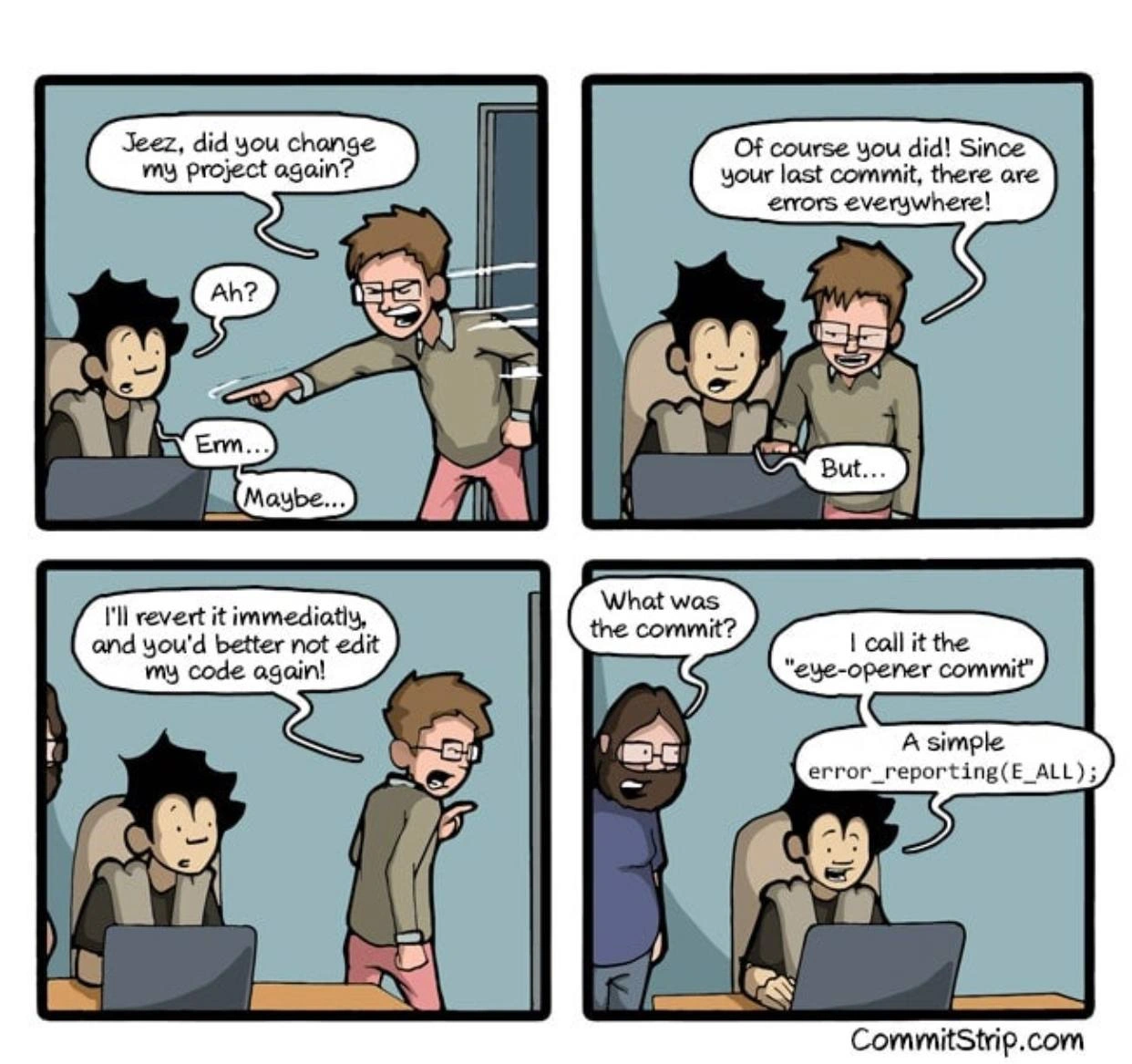
Enabling error reporting commit exposes hidden bugs across the codebase
Bugs Post #4870, on Sep 19, 2022 in TG

Enabling error reporting commit exposes hidden bugs across the codebase

Why is this Bugs meme funny?

Level 1: Turning on the Lights

Imagine you’re in a slightly messy room, but it’s really dimly lit. In the low light, everything looks okay – you don’t see any clutter or dust, so you assume the room is clean. Now, your friend comes in and flips on a super bright light. All of a sudden, you notice there’s dust on the shelves, toys and clothes scattered on the floor, and even a big stain on the carpet that was hidden in the darkness. The room didn’t actually become messier in that moment – it was messy all along – but now with the bright light you can see all the problems clearly. You gasp, “Ack, everything looks dirty now!” and maybe you get a bit upset with your friend for turning on such an unforgiving light. In this story, the bright light is like that error_reporting(E_ALL) in the code. The code had a bunch of little mistakes (like the dusty, messy room), but they were hiding in the shadows. When the developer turned on full error reporting (switched on the bright light), all the mistakes popped up into view at once. It can be a shock, and the other people reacted by getting mad at the person who revealed the mess instead of the mess itself. It’s a funny take on human nature: sometimes we’d rather stay in the comfortable semi-darkness than see the uncomfortable truth, and we might yell at whoever gave us that light for our own good. So, the meme is like a joke about cleaning up code: don’t blame the flashlight for what it shows!

Level 2: All Errors, All at Once

Let’s break down what’s happening in simpler terms. The key is the PHP function error_reporting(E_ALL). In PHP, error_reporting is like a settings dial for how much bad stuff the program should talk about when it runs. By default, a program might hide minor issues (like small warnings or notices) so that it doesn’t flood the screen or logs. When a developer sets it to E_ALL, they’re telling PHP: “Hey, don’t hide anything – show me all the warnings and errors.” This includes things like using a variable that was never defined, calling functions that are deprecated (old and slated for removal), or doing things that are not outright fatal but are considered bad practice. These are often called notices or strict errors in PHP. They don’t usually stop the program from running, but they do indicate something’s probably wrong or could lead to bugs.

In the comic, one developer made a commit (a saved change in the code repository) that consists solely of adding error_reporting(E_ALL); to the project. Think of a commit like a snapshot of changes with a message – here the message humorously is “eye-opener commit”. As soon as that change went in, the project started displaying a ton of error messages that nobody had seen before. These were hidden warnings that the code always had, but previously the configuration was hiding them. Now they all popped up, essentially turning a “green” (problem-free looking) project into a “red” one full of errors. In a development team, when we say something “broke the build,” we mean a change caused the project to fail tests or show errors, so it can’t be considered stable. Here, enabling full error reporting basically broke the build because all those warnings are now visible failures.

Why did the colleague get so upset? Well, from his perspective, everything was fine until this commit. Suddenly, after this change, “there are errors everywhere!” It looks like the commit caused all these problems, even though it technically just revealed them. This is like flipping a switch from silent mode to loud alarm. The colleague is embarrassed or annoyed that what was his “working” code now looks bad. He says “I’ll revert it immediately,” meaning he plans to use Git to undo that commit (revert means make a new commit that cancels out the changes of a previous commit, effectively going back to how it was before). This is a common reaction when a change has unexpected bad consequences: just undo it to restore order. He also scolds, “you’d better not edit my code again!” indicating a bit of territorial attitude – he feels the other developer invaded his part of the project without permission. Ideally, in a team, you discuss changes, especially ones that could impact others. The comic exaggerates this to make it funny, but it reflects a real tension in teams over code ownership and collaboration.

To understand what exactly error_reporting(E_ALL) does, let’s consider a quick PHP example. Normally, if error reporting is turned off or low, small mistakes don’t show up. For instance:

<?php
error_reporting(0); // turn off all error reporting
echo $undefinedVar; // using a variable that isn't set - no error shown, just no output

error_reporting(E_ALL); // turn on reporting for *all* errors
echo $undefinedVar; // Notice: Undefined variable $undefinedVar, PHP will alert this is not defined
?>

In the first part, error_reporting(0) means “report no errors at all.” So echo $undefinedVar; doesn’t complain on screen; it fails silently (you just get nothing output and you might not even realize $undefinedVar was never set). In the second part, we turn on E_ALL, so the same undefined variable usage now triggers a notice/warning telling us “Undefined variable”. It’s not catastrophic – the program might still continue – but now you know something’s wrong that you should probably fix.

Now imagine a big project with hundreds of files. If lots of little things like this were happening and nobody noticed (because error reporting was lenient or off), switching to E_ALL would produce a flood of messages. It can be overwhelming! However, it’s actually helpful for debugging: those messages are pointing out places where the code might not be doing the right thing, even if it was running seemingly “fine” before. Often, each warning is a hint at a possible bug in software – maybe a variable that never got a value, or a function that’s being used incorrectly. In terms of CodeQuality, good practice is to run your development environment with E_ALL (or highest warning levels) so you catch and fix these issues early. Many developers consider a warning as important to address as an error, because it usually means the code isn’t as clean or correct as it could be.

However, teams differ. Some teams, especially on old legacy projects, prefer to hide these warnings because they’ve accumulated so many over time – fixing them all feels like a huge task, and as long as the program works, they turn a blind eye. That’s why one tiny change to enable strict error checking can cause a lot of DebuggingTroubleshooting work. The colleague in the comic just saw a wall of errors and panicked. Rather than methodically fixing each warning (which would improve the project), he opts to revert the change and go back to the quieter, ignorance-is-bliss mode. It’s a bit like an ostrich sticking its head back in the sand. The humor of the comic comes from this very human reaction: blame the person who revealed the problem, rather than the problem itself. In real life, developers might joke about such a commit as a “build breaker” or say “you really opened a can of worms with that one!” Here the author literally calls it the "eye-opener commit" because it forces everyone to open their eyes. And indeed, it caused quite the commotion in their Git-based workflow. This scenario is drawn from everyday DeveloperHumor – developers laugh because, yes, we’ve seen someone enable a strict setting and suddenly the build that was “fine” is on fire. The lesson for a junior developer is: beware, even a one-line change in configuration can have far-reaching impacts if the codebase isn’t clean. And also, communication with your team is key – if you plan to “turn on all the lights,” maybe warn everyone first!

Level 3: E_ALL Hell Breaks Loose

This comic strip captures a classic code quality showdown: one developer’s innocuous change opens Pandora’s box on a legacy PHP project. The culprit? A one-line commit calling error_reporting(E_ALL). In PHP, this function sets the error level to report everything – all notices, warnings, and strict suggestions. The result is immediate chaos: what looked like a “working” project now spews errors everywhere. Seasoned developers recognize this scenario as the moment all those hidden bugs and sloppy coding practices come to light. It’s as if the codebase went from quietly sweeping problems under the rug to blasting an air horn for each issue. No wonder the colleague comes storming in yelling, “Since your last commit, there are errors everywhere!

From a senior dev perspective, the humor lies in how painfully true this is. We’ve seen projects where warnings were simply ignored or turned off for convenience. The commit in the comic didn’t introduce new bugs at all – it exposed existing ones. That’s why the author cheekily calls it the “eye-opener commit.” It’s a simple config tweak that instantly reveals a flood of issues lurking in the code. The panicked reaction (“I’ll revert it immediately!”) is a textbook example of shooting the messenger. Instead of thanking the dev for uncovering real problems (like uninitialized variables, deprecated calls, or logic mistakes), the team would rather revert the change and go back to blissful ignorance. This reflects a common Debugging Frustration: nobody noticed the patient was sick until someone read the thermometer, and now they blame the thermometer for the fever.

This scenario satirizes a deeper truth about CodeQuality in software teams. Enabling strict error reporting or turning warnings into errors is a hallmark of mature, robust development – but in a codebase with lots of technical debt, it’s like setting off a minefield. Imagine adding -Wall -Werror (enable all warnings and treat them as errors) to an old C++ project: suddenly, hundreds of compilations fail on issues that were always there. The developer humor here is that a tiny “improvement” commit created a huge headache. The angry colleague’s reaction (“you’d better not edit my code again!”) hints at fragile ego and poor collaboration practices. He’s treating the code like his turf and resents that this change embarrassed his project. In VersionControl culture, this is also a lesson: surprise changes that break the build – even for good reason – can cause interpersonal drama. The phrase “did you change my project again?” suggests this isn’t the first time one dev’s tweak disrupted another’s comfort zone. It’s a funny exaggeration of real office dynamics where people yell “Who broke the build?!” and quickly run git blame to find the guilty commit. Here the commit was literally just shining light on bugs, yet its author becomes the villain.

Ultimately, the comic pokes fun at both sloppy coding and the Git workflow panic that ensues when someone raises the strictness bar. It’s a perfect storm of BugsInSoftware meeting developer ego. The eye-opener commit is a one-liner that unleashed a cascade of truth. Seasoned devs grin at this because we know the paradox: improving the code’s honesty can temporarily make you the most hated person in the room. Git Blame culture meets quality control – and as usual, messengers get blamed for the message. The humor hits close to home, as many of us have been that person nervously pushing a “let’s do the right thing” commit, only to watch all hell (or rather E_ALL) break loose in the build logs. It’s both cathartic and cringe-worthy, a reminder that sometimes “fixing” things means revealing just how broken they already were.

Description

Four-panel CommitStrip style comic with clean pastel colors shows three cartoon developers around a laptop. Panel 1: the seated dev with spiky black hair asks, “Jeez, did you change my project again?” while a colleague bursts in saying “Ah?”; the seated dev mutters “Em… Maybe…”. Panel 2: the standing colleague leans over the screen yelling, “Of course you did! Since your last commit, there are errors everywhere!” while the seated dev protests “But…”. Panel 3: the angry colleague says, “I’ll revert it immediately, and you’d better not edit my code again!” as the seated dev shrinks behind the monitor. Panel 4: a bearded teammate asks, “What was the commit?”; the seated dev smiles and replies, “I call it the ‘eye-opener commit’ - A simple error_reporting(E_ALL);”. The joke hinges on a Git commit that merely activates PHP’s error_reporting(E_ALL), instantly surfacing countless previously hidden warnings and breaking the build, illustrating the tension between code quality, debugging practices, and version-control collaboration
Comments

6
Anonymous ★ Top Pick One-liner commit: error_reporting(E_ALL); - instant proof that our strongest dependency wasn’t a library, it was PHP’s default error suppression
  1. Anonymous ★ Top Pick

    One-liner commit: error_reporting(E_ALL); - instant proof that our strongest dependency wasn’t a library, it was PHP’s default error suppression

  2. Anonymous

    The best part about error_reporting(E_ALL) is watching someone discover their "production-ready" code has been living on a foundation of suppressed warnings and undefined index notices since 2008, like finding out your house was actually built on a burial ground of deprecated functions

  3. Anonymous

    Ah yes, the classic 'Schrödinger's Codebase' paradox: the bugs simultaneously exist and don't exist until someone enables error_reporting(E_ALL). The real eye-opener isn't the commit - it's realizing your 'working' production code has been running on hope, @ operators, and strategically disabled error levels. Nothing says 'enterprise-grade PHP' quite like discovering your application has been silently swallowing notices, warnings, and deprecated function calls for years. The person who exposes technical debt is always blamed faster than the person who created it - a tale as old as version control itself

  4. Anonymous

    That 'simple' error-reporting commit which instantly unmasks every hidden coupling and tech debt shortcut your monolith was blissfully ignoring

  5. Anonymous

    Only in legacy PHP can enabling error_reporting(E_ALL) be classified as a breaking change - apparently observability is a feature flag for reality

  6. Anonymous

    Eye-opener commit: error_reporting(E_ALL); it doesn’t introduce bugs - it just revokes the illusion your PHP monolith ever worked

Use J and K for navigation