Skip to content
DevMeme
1413 of 7435
Big Tech's Eavesdropping on Your Thoughts
DataPrivacy Post #1586, on May 15, 2020 in TG

Big Tech's Eavesdropping on Your Thoughts

Why is this DataPrivacy meme funny?

Level 1: Speak and Ads Appear

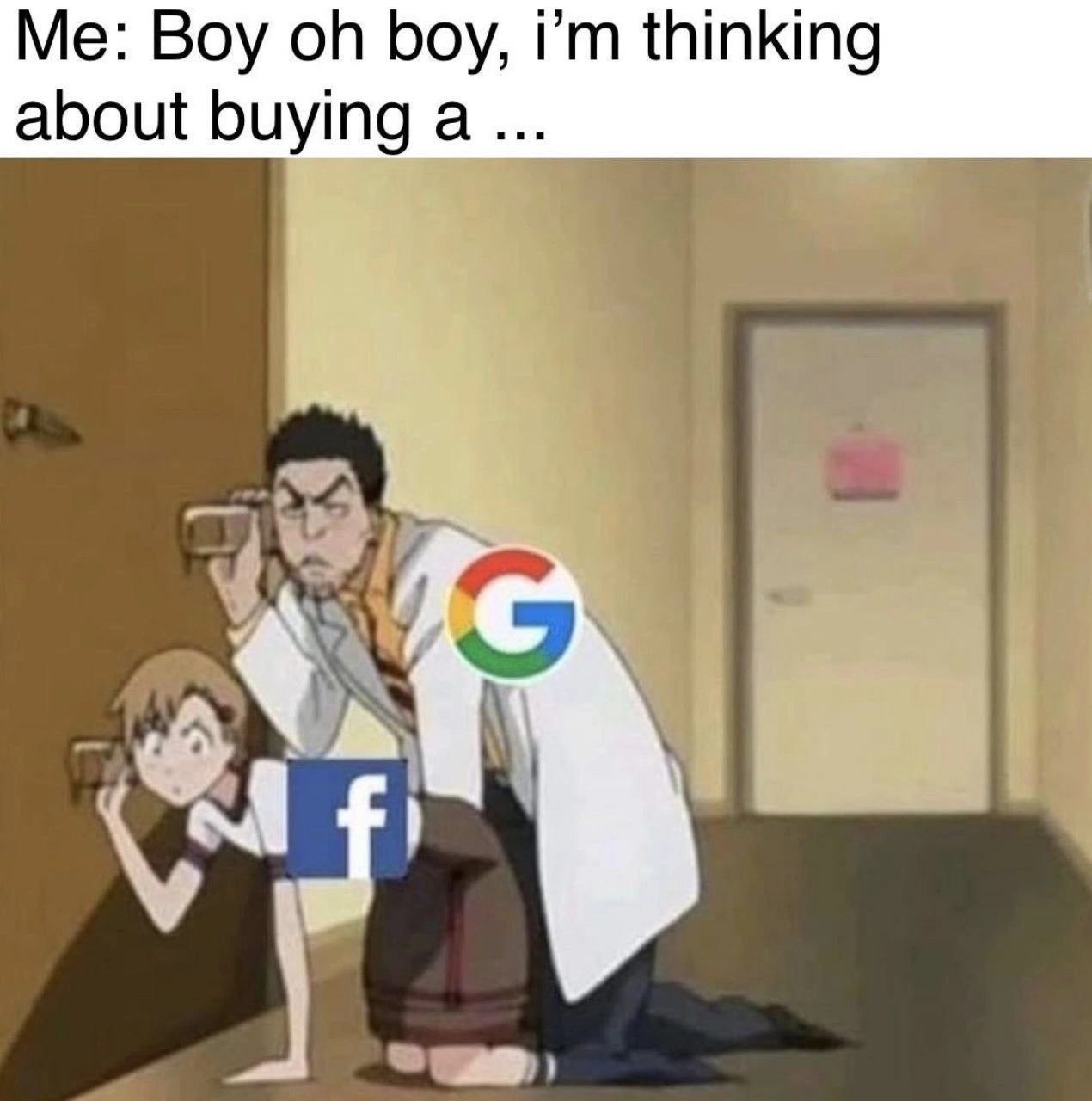
Imagine you’re chatting with a friend at home and you say, “I really want to buy a new toy.” Suddenly, as if by magic, a salesperson pops up at your window holding that exact toy, saying, “Hey, I heard you might want this!” That would be pretty creepy, right? Well, that’s the feeling this meme is joking about. In the picture, the person (behind the door) says they’re thinking of buying something. Instantly, Google and Facebook (huge companies on the internet) are shown snooping by the door, trying to listen in. It’s a funny way to show how it sometimes seems like our phones or apps are secretly listening to what we say. Have you ever talked about a movie or a food, and later that day your phone shows you an ad for it? It’s like the phone was eavesdropping on your conversation! This meme makes a cartoon out of that exact idea: when you talk, ads appear. It’s making us laugh at a worry we all have – that these big internet companies are a bit like sneaky elves or spies, hearing our wishes and then trying to sell us stuff. It’s funny because it’s exaggerated (Google and Facebook aren’t actually crouching outside your room with cups to the wall!), but it’s also telling a simple story: be careful, because it can feel like your devices are always listening. In real life, Google and Facebook show you ads based on what you like and do online. The joke here is it’s so accurate sometimes, you’d think they heard you say it out loud. Even a kid can get the idea: it’s like if you say you want ice cream, and out of nowhere an ice cream truck immediately drives up to your house. Funny, a bit spooky, and that’s why people are sharing this meme – it captures that “Hey, were you listening to me?!” feeling in a single silly image.

Level 2: Big Tech’s Big Ears

For those newer to tech or not as deep into the jargon, let’s break down what’s going on in this meme. The image shows two cartoon people pressing drinking glasses against a door trying to eavesdrop on a private conversation. One has the Google “G” logo on his back, and the other has the Facebook “f” logo. Above them, the caption (from the person inside the room) says: “Me: Boy oh boy, I’m thinking about buying a …”. So basically, the joke is that the moment you say out loud you’re thinking of buying something, Google and Facebook are right there listening as if they had cups against your wall.

Why Google and Facebook? These two companies are infamous in the tech world for how they handle user data and ads. Both offer lots of “free” services – Google gives you search, Gmail, Android phones; Facebook gives you a huge social network, Instagram, etc. – but they make almost all of their money through advertising. And not just any advertising: targeted advertising. Targeted ads are ads that are specifically tailored to you based on your personal data. For example, if you’ve been browsing online for new phones, you might notice you start seeing ads for exactly the phone you want. It’s not magic; it’s because companies like Google and Facebook track your activities to know what you’re interested in. They use Marketing Tech tools to collect information such as what websites you visit, what you search for, where you physically go (if you have location turned on), and possibly what you talk about. All of this is used to show you ads that they think are most likely to make you click or buy something. This is a form of behavioral advertising – “behavioral” meaning it’s based on your behavior and interests.

Now, a big concern here is data privacy – basically, your right to keep your personal information (and personal moments, like conversations) private. People care about online privacy because nobody wants to feel like they’re being spied on or listened to without consent. That’s where the humor of the meme comes with a side of discomfort: it’s funny to picture Google and Facebook literally on all fours eavesdropping, but it’s also referencing a worry many people have. There have been tons of anecdotes (stories) where someone mentions a product out loud in conversation, and shortly after, an ad for that product pops up on their phone. It’s happened enough times that people wonder, “Is my phone’s microphone always listening to me for ads?” This meme is directly poking at that idea — hence tags like always_listening_meme and voice_surveillance. Voice surveillance would mean using the microphone to surveil (listen in on) what you say. And indeed, there’s a persistent rumor that apps like Facebook or Google’s services might be doing exactly that.

Facebook has explicitly denied they listen to your conversations through your mic to target ads, and Google says it only listens when you trigger the Assistant (like saying "Hey Google"). Technically, apps are supposed to ask for permission to use your microphone. You might remember seeing pop-ups like “This app wants to access your microphone: Allow or Deny.” If you tap Allow, you’re granting that app the right to hear sound through your phone’s mic. Most of the time, apps request this for legitimate reasons (e.g., a messaging app for voice messages, or a video app for recording sound). But privacy concerns arise when people suspect apps are abusing that permission in sneaky ways – essentially turning on the mic to gather data about what you might want to buy. If that sounds like a dark pattern, it kind of is: a dark pattern is a design or feature that tricks users into doing something they might not want to do. In this context, a dark pattern might be an app asking for mic access under a vague excuse and then using it for ad targeting – something you never really agreed to knowingly.

The meme falls under Tech Humor because it’s using a lighthearted cartoon to highlight a pretty creepy idea. It combines PrivacyConcerns with a bit of silliness. On the more technical side, the way ads seem to appear “magically” after you talk about something can also be explained by other tracking methods. For instance, Google and Facebook track a lot of what you do online through cookies, pixels, and other surveillance technology. Say you search for shoes on Google; even if you don’t buy them, Google remembers that and might tell advertisers, “Hey, this person showed interest in shoes.” So later, when you’re on Facebook or another website, an ad for shoes appears. Sometimes you might not even realize you signaled interest (maybe you lingered on a post about hiking gear), and then you talk about hiking boots, and then an ad comes – it feels like the talk caused it, but it could be your past clicks. It’s a bit like you have an invisible profile that marketers are using to guess what you might want next. That’s the essence of AdTech (advertising technology) and MarketingTech: lots of data collection and algorithmic guessing to show the right ad to the right person at the right time.

Still, because many people have experienced the “I spoke about it and then I saw an ad” scenario, this has become a running joke (and worry). The tags like big_tech_spying and ads_after_you_talk capture that exactly. “Big Tech” refers to giant tech companies (like Google, Facebook, Amazon, Apple, etc.). And “spying” is a strong word, but that’s what it feels like if your phone is doing something without telling you. SurveillanceCapitalism is a buzzword referring to the economic system where companies make money by surveilling (watching/listening to) users and then using that data commercially. So this meme is basically illustrating surveillance capitalism in action in a funny way: you mention you want to buy something (that’s valuable data!), and immediately the two biggest players in online ads are shown literally surveilling you to capitalize on it.

In simpler terms: the meme artist is joking that Google and Facebook have “big ears” – as in, they hear everything you say if it relates to you buying something. It’s poking fun at how, in the modern tech world, nothing you mutter is truly private if there’s money to be made. And for a junior developer or someone new to this, it’s a memorable way to learn about the intersection of tech and privacy. You might start thinking: How do these ads work? Why do I see such coincidentally relevant ads? It encourages you to learn about things like data permissions, how advertising on the internet is driven by data, and why people are increasingly talking about privacy laws and regulating these companies.

So, in summary: Google and Facebook in the meme are acting out the common fear that our devices might be listening to our conversations to show us ads. It’s funny because it’s exaggerated with the glasses-against-the-door cartoon, but it’s also a bit of a “haha… unless?” moment. The categories DataPrivacy and Marketing tie it together: it’s a joke about how marketing tactics (targeted ads) can clash with our sense of data privacy. And even if you’re new to tech, you likely use these products daily – this meme is a cheeky reminder to be aware that free platforms aren’t truly free, and sometimes it can feel like the cost is letting them peek into your life in spooky ways.

Level 3: Mentioned It? Monetize It!

At a more practical tech perspective, this meme hits on a familiar privacy concern nearly every developer and user has joked about: you talk about something with a friend, and moments later you see an ad for that exact thing. It’s the classic “phone is always listening” conspiracy, brought to life by Google and Facebook literally eavesdropping at a door. Why is this so funny (and uncomfortable) to those of us in the industry? Because it captures a bit of truth about how Big Tech and advertising work. Google and Facebook aren’t just search and social platforms – they’re the world’s biggest advertising companies, making billions by showing targeted ads. The joke here is that the instant you even think about buying something, these companies are on high alert to monetize that thought. The meme uses the visual gag of two characters pressing glasses to a door to represent how we imagine these apps secretly listening through our microphones. Technically, the companies insist they don’t do open-ended microphone eavesdropping for ads – and indeed, continuously uploading your live audio would be a bandwidth and battery nightmare. But the feeling users get, after enough eerily spot-on ad coincidences, is that Zuckerberg and Google’s ad team might as well be camped outside your room with a cup to the wall.

From a senior dev standpoint, this is poking fun at the very real surveillance technology and data harvesting techniques that modern marketing relies on. The characters chosen are spot on: Facebook (the blue “f” logo) and Google (the multicolored “G”) are notorious for tracking user behavior across the web and apps. Facebook’s apps have historically vacuumed up everything from your location to your browsing activity (and yes, at one point Facebook was caught experimenting with audio cues through the app’s microphone access, though they claimed it was for detecting what TV show was on in the background). Google, for its part, basically built the playbook for behavioral advertising – using your search queries, YouTube views, and Android phone data to build a profile on you. So when a seasoned developer sees this meme, they nod and smirk: “Yep, that’s our two biggest ad brokers, doing what they do best – snooping for profit.” It’s tech humor with an edge of truth. We’ve all seen the dark patterns: mobile apps that ask for excessive permissions (why does a weather app need microphone access?), or social media platforms that bury privacy settings under layers of menus. Engineers have even joked in commit messages about analytics modules being “alwaysOn.” The meme’s humor comes from exaggeration, but it underscores how invasive ad-tech can feel.

In real-world terms, what’s being lampooned is the sophistication of marketing surveillance. Even without literally spying on your speech, companies have so much data that their ads can seem psychic. Perhaps you searched for a product on your laptop – Google Ads remembers that. You lingered on an Instagram post about camping gear – Facebook’s pixel caught it. Your phone’s GPS pinged at a mall – location data sold to marketers. All these breadcrumbs are compiled into a profile. Then you chat aloud about maybe buying a new tent, and voila – the next time you open your phone, there’s an REI advertisement in your feed. Coincidence? The seasoned dev in me knows it’s likely a mix of data aggregation and timing, but it feels exactly like they just heard me speak. That’s why this image is so instantly relatable. It visualizes the invisible: those moments when the AdTech machinery reacts so quickly it might as well have been listening in real time.

We also find this funny because it’s uncomfortably true. Most of us have resigned chucklingly to the idea that “privacy is an illusion” when using free online services. This meme is basically saying: the moment I express consumer interest, the two biggest ad platforms are like “Did someone say shopping?!” It’s a form of gallows humor among developers who know how the sausage is made. We laugh, but we’re also a bit horrified because we know the code and systems enabling this are written by people like us. Many devs have worked with analytics SDKs or ad APIs and seen how much data gets vacuumed up. We joke about our voice assistants possibly sending snippets back to HQ. In meetings, someone might wisecrack, “Careful what you say, or risk summoning an ad.” In fact, targeted advertising is an entire engineering domain now – folks with titles like “Data Engineer” and “Machine Learning Scientist” are perfecting algorithms to increase that creepy accuracy.

Consider the attribution angle too: if you do buy that product after seeing the ad, Facebook and Google want to take credit. They run complex systems to link ad impressions to purchases (did the ad we showed lead to you clicking “Buy now”?). The better they can spy – er, track – the whole chain from your intent to your purchase, the more money they can charge advertisers. So there’s enormous incentive for them to get as close to your raw thoughts as possible. If scraping your casual conversations would bump conversion rates, you bet they’re at least thinking about it. (They’ll just be careful to call it an “enhanced user experience” in the PR, one of those classic dark pattern style rebranding of a privacy grab.)

From an industry history perspective, privacy invasions have crept up on us. A decade ago, the idea that your phone might be actively listening to your living room chatter for ads would sound like sci-fi paranoia. Today, not only is it technically plausible, but there have been enough strange anecdotes that it’s an ongoing urban legend. And who’s at the center of most of those stories? Google and Facebook – because together they corner the majority of online ad spending and have the deepest reach into our personal lives (via Android, Chrome, Gmail, Instagram, WhatsApp, you name it). The meme nails this by showing those two logos specifically as the culprits crouched at the door. No caption needed to explain – everyone gets it.

To engineers, the image also slyly hints at the behind-the-scenes engineering. The characters pressing glasses to the wall are like an analog for background processes in your apps. In Android, for example, a service could be running that monitors audio input. On the cloud side, a consumer service might be waiting to receive any juicy data. It’s not far off from how telemetry works: your phone collects data and a backend ingests it for analysis. In fact, here’s a tongue-in-cheek pseudo-code of what we imagine might be happening behind closed doors:

# Pseudo-code: the app continuously listens in the background
phone.mic.activate(always_listening=True)

for phrase in phone.mic.stream_transcripts():
    # If user talks about buying something, flag it
    if "buy" in phrase or "thinking about buying" in phrase:
        marketing_db.add_new_interest(parse_item(phrase))
        ad_engine.trigger_ads(phrase)  # Send data to ad system to serve relevant ads ASAP
        # (Because nothing says "user-centric design" like immediate monetization of spoken words)

In reality, Google and Facebook don’t expose an API like phone.mic.stream_transcripts() to third-party developers (for good reason!), but internally, who knows? The joke in the code comments — “immediate monetization of spoken words” — is basically the business model here. As senior devs, we recognize the pattern: if something can be turned into data, and that data can be turned into dollars, it will be. It’s an open secret in tech that many apps and platforms have overreached in collecting user data (remember the uproar when a certain flashlight app was caught tracking users’ locations? Or when smart TVs were found listening for background audio from commercials?). This meme rings true because we’ve seen case after case of companies stepping over the line, apologizing, maybe paying a fine, and then…finding subtler ways to keep doing similar things.

So, the humor carries a cynical lesson: in the world of OnlinePrivacy and AdTech, if you’re enjoying a “free” service, you are likely the product. The characters with glasses at the door remind us that behind our friendly apps, there are giant corporations eagerly listening for any opportunity to target us with ads. It’s a shared joke among developers that even though we know how it works (and sometimes because we know how it works), it still feels almost magical and sinister when it happens. We laugh to cope with the fact that this is the state of modern tech – a bit invasive, a bit absurd, and driven by monetizing every possible user utterance. In short, mention anything, and the ad machines are gonna monetize it. The meme nails this reality with a single, funny visual, and every tech veteran chuckles because we all have our own “I swear my phone heard me” story (as well as the technical knowledge to be just the right amount of paranoid).

Level 4: Panopticon as a Service

On a deep technical and theoretical level, this meme evokes the concept of surveillance capitalism – a term for how companies like Google and Facebook turn personal data into profit. Imagine an architecture where your smartphone is effectively a node in a vast sensor network, continuously streaming telemetry to the cloud. In this scenario, every spoken word is a signal, and these ad-tech giants have built pipelines to capture and exploit those signals at scale. Under the hood, it’s a fusion of cutting-edge tech: always-on speech recognition models running on your device, streaming APIs sending transcripts to data centers, and machine learning systems that parse your words for intent (say, detecting phrases like “buy a new laptop”). This data flows into real-time ad auctions – lightning-fast bidding wars where advertisers compete to show you a product ad within milliseconds of your expressed interest. It’s as if a digital stethoscope is pressed to the world’s walls, feeding an AI-powered recommendation engine. The humor of two cartoon figures (Google in a lab coat, Facebook in a school uniform) pressing glasses to a door belies an advanced reality: these companies have effectively created a cloud-scale panopticon, an all-seeing system where even a hint of consumer desire can be harvested and monetized instantly. In academic terms, we’re looking at a socio-technical system optimized for behavioral advertising and attribution – connecting the dots from you mentioning a product, to showing you an ad, to you finally clicking “Purchase”. It’s equal parts brilliant engineering and dystopian design. The fundamental trade-off comes down to data privacy vs. predictive power. Modern recommendation algorithms thrive on more data (conversations included), but the idea of your devices always listening raises ghastly privacy implications. Technically, it’s feasible: continuous voice processing is now lightweight enough, and cloud infrastructures can easily ingest billions of audio-derived events per day. Google Assistant, Alexa, Siri – they’ve proven that devices can stay in an “always-listening” mode (at least to detect wake words) with minimal battery drain. Extending that to full-time eavesdropping is a policy choice, not a technical impossibility. And while both Google and Facebook publicly insist they don’t use your microphone for ad targeting, the meme wryly suggests we’d be naïve to take them at face value. After all, their entire MarketingTech stack – backed by sophisticated data science – is built to know everything about you. Whether through direct microphone surveillance technology or indirect data inference, the result feels the same: mention anything, and you’re served a hyper-targeted ad. The theoretical backbone here also touches on confirmation bias – our brains are shocked by the eerily relevant ads and assume we’re actively bugged, because the coincidence is just too uncanny. But from a systems perspective, this AdTech ecosystem doesn’t rely on supernatural mind-reading. It doesn’t have to. By aggregating your search queries, browsing history, location trails, and social graph, the algorithms can predict your desires with such accuracy that when an ad for that exact thing you chatted about appears, it’s indistinguishable from actual eavesdropping. The meme exaggerates with literal eavesdroppers at the door, but under the hood it’s pointing at very real high-tech listening posts: smartphones, smart speakers, and apps as the ubiquitous ears of Big Tech. The scary part – and the dark humor at Level 4 – is that from a purely engineering standpoint, the groundwork for constant audio surveillance is already laid. We’ve built the distributed systems, the neural networks, and the data pipelines to make “listening in on everyone” not only possible but efficient. In a nutshell, this meme hints at the almost magical and creepy capabilities of modern advertising algorithms. It’s a perfect storm of technology and business where your casual conversation can theoretically trigger a cascade: voice -> text -> user profile update -> ad selection -> $$$. It’s surveillance capitalism-as-a-service, delivered by the biggest names in tech, and it’s equal parts impressive and unsettling.

Description

This is an anime meme format depicting two characters, one older and one younger, pressing their ears against a door with listening devices. The older character, a man in a lab coat, has the Google 'G' logo superimposed on him. The younger character has the Facebook 'f' logo over them. The text at the top reads, 'Me: Boy oh boy, i'm thinking about buying a ...' The meme humorously illustrates the pervasive feeling that tech giants like Google and Facebook are constantly listening to our conversations, both online and offline, to target us with ads. The moment a user even thinks about a product, it feels like ads for it magically appear everywhere. This reflects a common sentiment about the intrusive nature of modern targeted advertising and the perceived lack of digital privacy
Comments

7
Anonymous ★ Top Pick I'm not saying my phone is listening, but I whispered 'serverless' in my sleep and woke up to a $500 AWS bill and a job offer from Amazon
  1. Anonymous ★ Top Pick

    I'm not saying my phone is listening, but I whispered 'serverless' in my sleep and woke up to a $500 AWS bill and a job offer from Amazon

  2. Anonymous

    I said “maybe I need a new TV” on a muted Zoom, instantly became the partition key in Google’s Kafka stream - Facebook consumed the topic, and the ads hit me with exactly-once billing and at-least-once irritation

  3. Anonymous

    The real microservices architecture is when Google and Facebook's tracking pixels are so distributed across the web that they achieve better uptime monitoring of your shopping habits than your own Datadog dashboard does for your production systems

  4. Anonymous

    When you're about to diversify your tech stack but Google and Facebook remind you that you've already signed 47 OAuth agreements, integrated 23 SDKs, and your entire monitoring infrastructure depends on their APIs. At this point, switching platforms would require a migration plan longer than your company's entire product roadmap - and they know it

  5. Anonymous

    Adtech isn’t using your mic; the identity graph left-joined your spouse’s loyalty card, your GAID, and a broker feed - mic input would just raise the model’s noise floor

  6. Anonymous

    Impressive CAP theorem mastery: perfect ad Consistency and Availability, zero user Privacy

  7. Anonymous

    I whisper “thinking of buying a…” and their ad stack’s pub/sub beats our pager - intent streamed with at-least-once delivery and infinite retention across every surface I own

Use J and K for navigation