Skip to content
DevMeme
1414 of 7435
Project Management: The Ultimate Conspiracy Theory Debunker
ProjectManagement Post #1587, on May 15, 2020 in TG

Project Management: The Ultimate Conspiracy Theory Debunker

Why is this ProjectManagement meme funny?

Level 1: Keeping a Surprise Secret

Imagine you and a few friends are trying to plan a surprise birthday party for someone. You have to organize who brings the cake, who distracts the birthday person, and where everyone will hide. Now, if it’s just 3 of your friends, maybe you can keep it a secret (though there’s always that one friend who nearly spills the beans because they’re too excited!). But what if you had to involve your whole class in the secret? That’s like 30 people all trying to coordinate and not let the birthday person find out. Pretty soon, someone might accidentally mention “party” in front of the wrong person, or one kid might forget what time to show up. It gets really hard to keep everything perfectly organized and secret with so many people.

Now take that idea and imagine a thousand people were in on the secret plan! 😮 Sounds impossible, right? That’s exactly what this joke is about. Some people believe in giant secret plots (kind of like huge surprise parties, but for big events) where thousands of folks are all working together and never telling anyone. The meme is saying that those people probably never tried to organize even a normal project or event in real life. Because if they had, they’d know it’s super hard to get even a small group to do everything on time and keep their lips zipped.

Think about a time you tried to do a group project or even play a big team game. Was it easy to get everyone to follow the plan without any mix-ups? Usually not! There’s always some confusion or someone who doesn’t do exactly what they were supposed to. And if you tell everyone a secret, chances are someone will let it slip.

So the funny part of this meme is basically: “You believe a giant secret plan could work? Aww, that’s cute. Try planning something with a dozen people – it’s almost impossible to keep them all quiet and on schedule!” It’s using a simple truth we all know (keeping a secret and coordinating a group is really tough) to poke fun at a crazy idea (a perfect giant conspiracy). Even a little secret, like a surprise party, can be hard to keep. So a huge secret with many people? That would be like expecting perfect teamwork magic. The meme makes us laugh because we realize how silly that expectation is once we compare it to everyday experiences. It’s saying that real life is messy, people talk, and plans often change – and that’s why the idea of a flawless big secret is just funny.

Level 2: Deadlines vs Reality

Let’s break down why this meme rings true, especially for folks who’ve dealt with project management (even on a small scale). A project manager (PM) is someone responsible for planning and guiding a project – they set deadlines, assign tasks, track progress, and try to keep everyone working together. If you’re a junior developer or new to team projects, you might have already seen how tricky this can be. The PM often uses tools like task boards or schedules to know who should be doing what by when. But despite all the planning, reality likes to mess things up: people get sick, tasks turn out more complicated than expected, communication breaks down – and suddenly that neat timeline is out the window.

In the meme, the PM’s perspective is basically: “You think a huge secret plan with thousands of people is possible? Ha! I can barely get a team of 12 to meet one deadline without someone leaking info early.” This is classic ProjectManagementHumor born from experience. Why is coordinating a team so hard? For starters, people aren’t robots. Even if each person has the best intentions, things happen:

  • Misaligned expectations: Maybe the boss (a stakeholder) expects a feature to be done super fast, but the dev team knows it realistically takes longer. Or two team members think a task means slightly different things. This mismatch can cause delays and frustration. For example, say we’re building a sign-up page; one developer might assume it only needs email login while the product manager expected social login too. Oops – now we have extra work and a likely deadline slip.
  • Communication gaps: Ever play “telephone” as a kid? In projects, a message can get lost or misunderstood as it moves between people. A manager says one thing, but by the time it reaches the developer, it might sound like something else entirely. These gaps mean tasks might be done incorrectly or not at all, until someone catches the mistake (often late in the game). Even with emails, chats, and meetings, ensuring everyone has the same information is tough.
  • Team dynamics: This refers to how people work together. On any team, you’ll have different personalities and work styles. Some folks are proactive, others procrastinate. One person might be juggling two projects at once, another might be stuck waiting on a teammate to finish something before they can start. If one person falls behind, the whole group can be affected. If someone is unhappy or doesn’t fully buy into the plan, they might not put in their best effort – or they might accidentally (or intentionally) spill the secret. It’s like group projects in school: if one person doesn’t do their part, the whole project suffers.
  • Deadlines: These are the due dates for when tasks or projects should be completed. Meeting deadlines consistently is hard. In software, unexpected bugs, testing issues, or requirement changes can all push a deadline out. Most teams have experienced that crunch time where a due date approaches and folks scramble, or they have to tell the boss “we need more time.” Now imagine trying to align multiple deadlines (design, coding, testing, deployment) across a bunch of people. It only takes one piece of that puzzle to slip for the whole schedule to need adjustment. That’s why project managers often build in a little slack or contingency time – because they expect things to go wrong somewhere.
  • Stakeholder management: Stakeholders are anyone with an interest in the project – bosses, clients, other departments, etc. A project manager has to keep them updated and happy. But sometimes stakeholders want to know everything that’s going on, which can risk information spreading. Other times, stakeholders might inadvertently reveal something about the project to others (“I heard the team is working on feature X” in a hallway chat) without realizing it was supposed to be a secret. Juggling who knows what, and how much to reveal, is a delicate task. It’s common for PMs to label info as “confidential” or share only on a need-to-know basis, but even then, rumors can start.

So, why is the meme funny? Because it highlights a huge gap between fantasy and reality. Conspiracy theories imagine that an enormous number of people can coordinate in absolute secret and perfect timing. But anyone who’s been on a real team chuckles at that idea. In real projects:

  • Someone might “blab” early – meaning they reveal information before they’re supposed to. It could be unintentional, like a team member mentioning the project to a friend (“Oh yeah, I’m working on this cool new app feature, but shh!”) and that friend shares it. Or it could be deliberate, like a disgruntled employee leaking details. Either way, keeping 100% silence is nearly impossible even in a small group.
  • Getting everyone to do what they’re supposed to on time is really hard. Think about a simple scenario: five people working on a group assignment. Chances are one of them will ask for an extra day, or another will finish their part late. Now scale that up to a dozen people on a software project – you often have at least one piece running behind or needing changes. Scale it to hundreds or thousands of people (like a large organization or a supposed secret plot) – delays are almost a given. Even big companies with experienced teams and lots of resources regularly miss launch dates or have to change plans last-minute.
  • Coordination complexity grows with each additional person. Adding more people means more meetings, more emails, more chances someone doesn’t get the memo. Imagine a team of 3 versus a team of 30. On the small team, you can have a quick chat and everyone’s in the loop. On a 30-person team, maybe 5 people miss the meeting, 2 people misunderstand the email summary, and 1 person forgets to tell their sub-team about a change. Multiply that by an even larger factor for a giant group. It becomes extremely challenging to keep everybody aligned and not working at cross purposes.

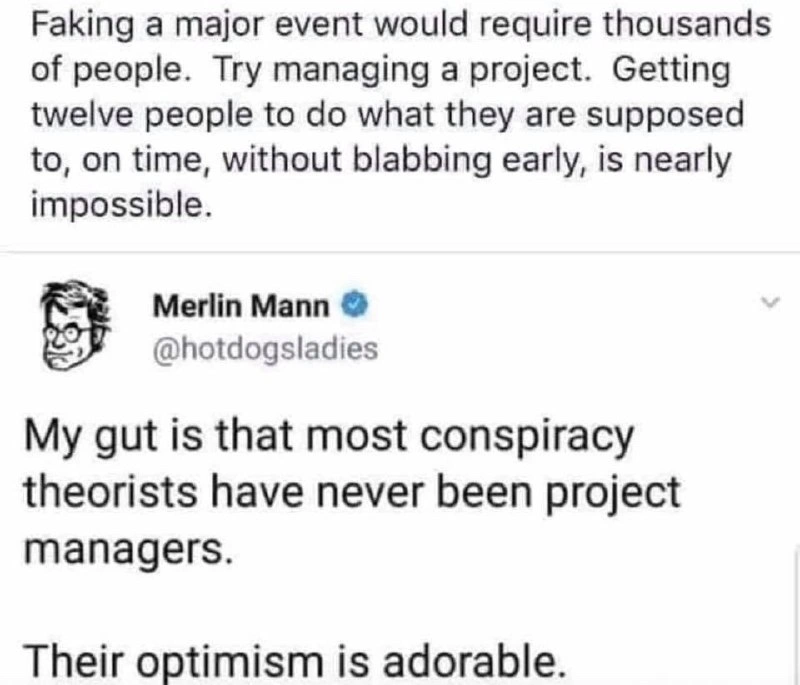
The quote by Merlin Mann joking that “most conspiracy theorists have never been project managers” drives this home. It’s basically saying: If those folks had ever tried to coordinate a complex project, they’d realize how absurd the idea of a flawless giant conspiracy is. In the world of Management_PMs (project managers in management), optimism like that is almost cute because it’s so far from everyday experience. A PM’s job often feels like putting out small fires and dealing with surprises: “Feature A took twice as long? Okay, adjust the timeline. Marketing leaked a hint about our secret project? Damage control mode!” There’s always something off-plan.

To put it simply, this meme uses humor to highlight a truth: organizing a team is hard, and the more people involved, the harder it gets to keep things on track and under wraps. It resonates with developers and managers because we live this struggle. We know that behind every successfully delivered project, there were probably dozens of hiccups, adjustments, and near-misses. So the idea of a massive, perfectly executed, hush-hush project just sounds ridiculous in comparison. It’s a fun reality check, wrapped in sarcasm, that pokes fun at both conspiracy theorists’ wild ideas and the daily challenges of project coordination. After all, as the saying goes, coordinating developers is like herding cats – and you certainly can’t herd a thousand cats without chaos!

Level 3: Herding Cats at Scale

Anyone who’s wrangled a software project knows that coordinating even a small team can feel like herding cats. This meme lands a direct hit on that reality. It juxtaposes the wild idea of pulling off a huge secret conspiracy (involving thousands of perfectly synchronized, tight-lipped participants) against the very real struggle of getting a dozen team members to simply do their jobs on time without spilling the beans. The contrast is hilarious to any senior dev or project manager because we’ve all experienced how chaotic real-world project coordination is.

In practice, adding more people to a project doesn’t magically make things smoother – it usually magnifies the chaos. In fact, there’s a well-known adage in software engineering, Brooks’ Law, which grimly states: “Adding manpower to a late software project makes it later.” More people means more communication overhead, more misalignment, and more chances for someone to slip up. A conspiracy theory blithely assumes thousands can work in perfect unison (and silence!), but an experienced PM knows that with every additional person, the complexity skyrockets. Just consider communication paths: if each person might talk to every other, the number of possible communication channels grows combinatorially. For 12 people, there are about 66 ways things can be discussed (or miscommunicated!). For 1000 people, the communication web explodes to almost half a million possible connections. It’s a nightmare of potential leaks and crossed wires. This is coordination complexity on steroids.

Keeping secrets is its own special hell. In the tech world, we constantly see leaks and premature announcements. Maybe a tester whispers about a cool upcoming feature to a friend, or someone on the team posts a bit too much info on social media. Despite all the NDAs and “Internal Use Only” stamps, information finds a way to seep out. Every additional person “in the know” is an extra leak vector. From a probability standpoint, if even 99% of people are perfectly discreet, with a thousand people involved you’re almost guaranteed one blabbermouth. The meme’s top panel nails it: “Getting twelve people to do what they are supposed to, on time, without blabbing early, is nearly impossible.” Every senior dev has lived this. We plan “big reveal” product launches, only to find out later that some teammate’s cousin’s friend was gossiping about it weeks beforehand. Stakeholder management often involves damage control for exactly this reason – someone, somewhere, opens their mouth or misses a step.

And let’s not forget timelines. Project deadlines are slippery in the best of times. In theory, a project manager creates a neat Gantt chart and everyone’s tasks sync up perfectly. In reality? Tasks slip. Integration takes longer because of unforeseen bugs, key contributors call in sick, dependencies don’t line up – you name it. We’ve all seen that desperate Jira comment: “slightly behind schedule due to unexpected issues” (an understatement of epic proportions). Now imagine a clandestine operation with a hard date (say, faking a major event on a specific day). If even one of thousands of co-conspirators bungles their task or misses a cue, the whole plan wobbles. Hitting a coordinated deadline with a huge team and zero snafus is the stuff of fantasy. Real project schedules require constant adjustment, slip days, and frank reality checks. As seasoned devs quip, “No battle plan survives first contact with reality” – and conspiracy plans are basically war-scale projects.

The humor here also lies in a role reversal: Conspiracy theorists are usually thought of as paranoid, but as Merlin Mann’s tweet wryly observes, their belief in vast secret plots actually makes them absurdly optimistic about human coordination. It’s ironic – they trust that enormous groups of people can maintain perfect cover stories and timing, whereas an actual project manager is incredibly skeptical of even a basic 10-person team staying 100% on-script. The tweet’s punchline “Their optimism is adorable” drips with a senior-level sarcasm. It’s the kind of deadpan snark a battle-hardened engineering manager drops in a retrospective meeting after yet another launch plan was foiled by reality. We laugh because it’s painfully true: large-scale secret coordination isn’t just unlikely, it’s verging on impossible, and anyone who’s managed a real project can attest to that.

To put it in perspective, here’s how a veteran PM views grand conspiracies vs. real projects:

Conspiracy Theorist’s Fantasy Project Manager’s Reality
Thousands keep a flawless secret for years We struggle to keep next quarter’s roadmap from leaking. 🤐
Everyone executes their task perfectly on schedule Half the tasks slip, and we’re constantly updating the timeline.
0% chance of a leak – absolute silence Someone always accidentally CC’s the wrong person or talks. 💬
One mastermind controlling it all effortlessly Endless status meetings, Slack pings, and “Who’s got this action item?” 📋

Every seasoned developer or manager reading this meme nods knowingly. Team dynamics and Murphy’s Law guarantee that trying to orchestrate something with so many moving parts is folly. We’ve all witnessed how even well-intentioned collaboration can go sideways: requirements misunderstood (communication gaps), team members with misaligned goals (misaligned expectations), or just simple human error. Remember the time a confidential feature branch name gave away a product name? Yup, someone’s done that. Or when a partner team casually mentioned “that secret project” in a company-wide demo? Oops. These things happen all the time. So the meme brilliantly highlights an insider truth: running a large project is hard, and keeping it perfectly secret and on-time is nearly magical. Anyone who believes thousands of people could coordinate a grand secret without a hitch clearly hasn’t managed even a medium-sized sprint.

In short, the meme speaks to a deep ProjectManagement humor: managing projects is messy, people are unpredictable, and information will leak. The idea that a vast conspiracy could run like a well-oiled machine is laughable to those of us scarred by collaboration challenges on much smaller scales. It’s a tongue-in-cheek reminder that reality has a way of derailing even the tightest plans – a truth every senior dev learns sooner or later (usually the hard way at 2 AM on release night). So when we see conspiracists imagining perfect coordination, we can’t help but chuckle. As far as project managers are concerned, coordinating secrets beats any grand fantasy, because in real life, keeping twelve people aligned is hard enough – forget thousands.

Description

A two-part text-based meme. The top portion is a statement: 'Faking a major event would require thousands of people. Try managing a project. Getting twelve people to do what they are supposed to, on time, without blabbing early, is nearly impossible.' Below this is a screenshot of a tweet from Merlin Mann (@hotdogsladies) that reads, 'My gut is that most conspiracy theorists have never been project managers. Their optimism is adorable.' The humor stems from the truth that anyone in tech who has managed a project, even a small one, understands the immense difficulty in aligning a team, maintaining secrecy, and executing a plan flawlessly. The meme posits that the logistical nightmare of managing a simple project serves as a powerful argument against the feasibility of large-scale conspiracies, making the belief in them seem naive to those with project management experience
Comments

7
Anonymous ★ Top Pick A grand conspiracy is like a distributed monolith with no documentation, no version control, and thousands of committers. The first pull request would reveal the entire plot
  1. Anonymous ★ Top Pick

    A grand conspiracy is like a distributed monolith with no documentation, no version control, and thousands of committers. The first pull request would reveal the entire plot

  2. Anonymous

    Anyone convinced thousands can keep a global conspiracy quiet has clearly never watched eight microservice teams negotiate a schema change - half the org knows (and has Opinions) before the first PR even compiles

  3. Anonymous

    The same people who believe the government can orchestrate a perfect conspiracy are the ones who've never tried to get three microservices to agree on a timestamp format

  4. Anonymous

    The real conspiracy theory is believing your sprint planning will survive first contact with the team. Any PM who's watched a 'quick sync' turn into a 45-minute architecture debate knows that coordinating twelve engineers to ship on time without someone accidentally pushing to prod early is basically the same difficulty level as faking the moon landing - except the moon landing only had to happen once, and you have to do this every two weeks

  5. Anonymous

    Conspiracy theories assume O(n) secrecy; real projects are O(n^2) leak vectors

  6. Anonymous

    NASA nailed moonshot coordination with checklists; try that with 12 devs before the retrospective whistleblows

  7. Anonymous

    Conspiracies assume thousands can coordinate in silence; my 12-person team can’t keep a feature flag quiet - CI gossips to #general before stand-up

Use J and K for navigation