IT Professionals: The Band on the Sinking Titanic
Why is this OnCall ProductionIssues meme funny?
Level 1: Keep the Music Playing
Imagine you’re at school and a huge storm hits. The lights go out, thunder is booming, and everyone is worried. Now, picture your teacher calmly taking out a flashlight, gathering everyone, and starting to read a fun story aloud to keep you all calm. The teacher doesn’t stop the lesson, even though the weather is scary, because they know it’s important to keep you feeling safe and normal.
This meme is joking that IT people during the pandemic were like that teacher – or like the band on the sinking Titanic ship. In real life, when the Titanic was sinking, a group of musicians kept playing their instruments to help people stay calm. It sounds crazy, but it was their way of helping others. Similarly, in 2020 when everything shut down because of the virus, IT professionals (the folks who keep the internet and computers working) just kept on working calmly, even though the world around them felt like it was falling apart.
Why is that funny? It’s a funny image because you’d think in a disaster people would just stop what they’re doing and save themselves. But here you have people doing their regular job, like nothing can stop them. It’s a little silly and also heroic at the same time. The meme makes us smile because it’s saying, “Even if things get as bad as a ship sinking, IT folks just keep on working to help others.” It’s an exaggerated way to show how dedicated tech people were during the COVID-19 crisis. They didn’t give up; they kept the “music” (in this case, the websites, servers, and apps) playing so that everyone else could keep going with their lives as much as possible.
So the simple idea is: just like a band that wouldn’t stop playing music in a sinking ship, IT professionals didn’t stop working during a global pandemic. It’s a mix of “Wow, that’s dedication!” and “I can’t believe we actually did that,” which is why it’s shared as a joke.
Level 2: Keep Calm & Code On
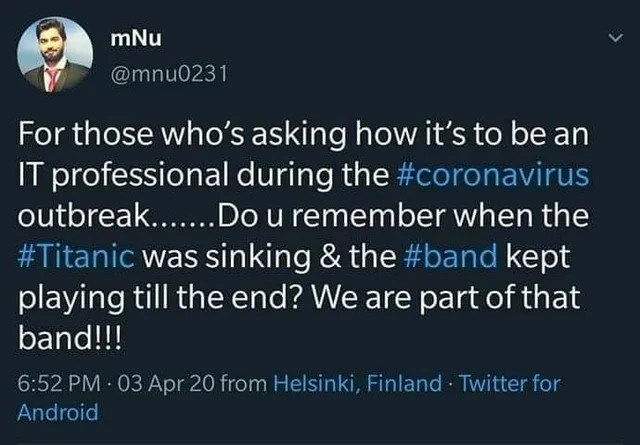
This meme is a screenshot of a tweet that compares being an IT professional during the 2020 COVID-19 outbreak to being a musician on the Titanic as it sank. Let’s break down what that means, especially if you’re new to tech or didn’t experience this period as a developer.
The Titanic analogy: The Titanic was a huge passenger ship that famously sank in 1912 after hitting an iceberg. A well-known story from that disaster is about the ship’s band (the musicians). As the Titanic was sinking, the band reportedly kept playing music the entire time to help keep people calm. They played until the very end, even though the ship was going down. This is often cited as a profound example of dedication and duty — doing your job to help others, even in a hopeless situation. When the tweet says “We are part of that band,” it means IT workers are like those musicians: they keep doing their work calmly and professionally, even when everything around them is falling apart.
The COVID-19 pandemic context: Fast forward to 2020. The coronavirus pandemic (COVID-19) caused governments around the world to enforce lockdowns and social distancing. Almost overnight, millions of people had to start Working From Home. Schools moved to online classes, offices turned into Slack and Zoom chats, and even doctor visits became teleconferences. Our lives suddenly depended on technology more than ever. If the internet or critical systems went down, lots of people might be stuck or cut off. So, who keeps all that tech running? IT professionals do. These include software developers, system administrators, DevOps engineers, tech support teams – basically anyone in charge of building, maintaining, or fixing the computer systems and applications we rely on.
When everyone started working remotely, IT teams had a lot of extra work to do. For instance, they had to:
- Set up remote work tools: Companies needed things like VPNs (Virtual Private Networks) for security, new laptops or software for employees, and good video conferencing setups. IT professionals scrambled to roll these out so that businesses could continue operating from home.
- Keep services online under heavy use: Think of services like video calling, online shopping, or streaming movies. Usage skyrocketed because suddenly everyone was online. Developers and engineers had to quickly add more server capacity (often via cloud services), optimize code for performance, and fix any crashes or bugs that showed up under the new load. A small glitch could affect thousands of people, so the pressure was on to prevent Production issues.
- Be available 24/7: Many IT teams have an on-call rotation. That means at any given time, there’s someone who can be paged or alerted if a critical system breaks. During the pandemic, being on-call was even tougher because lots of things could go wrong as systems were pushed to their limits. The person on-call might get a phone alert at midnight that a server is down and then have to wake up and log in immediately to fix it. Even though everyone was at home, these emergencies didn’t stop — if anything, they increased.
- Support everyone remotely: Normally, tech support might walk over to your desk to help with a problem. In lockdown, they had to help over the phone or via screen-sharing. This could be harder and took patience. IT support folks often dealt with panicked users who couldn’t connect to work networks or had trouble with new software. They had to talk people through solutions calmly, even if ten other help requests were waiting.
All this meant that many IT professionals were extremely busy and under stress during COVID-19. The term DeveloperBurnout started popping up more, because some developers and IT staff were working very long hours without breaks. Burnout is when someone feels totally exhausted and stressed out by their job, to the point they can’t do it well (or don’t care anymore). Imagine working every day late into the night, dealing with emergencies, and not taking days off – after a while, you’d burn out like a candle used up at both ends.
Now, where’s the humor in all this? The tweet approaches it with a kind of PandemicHumor – joking not because it’s truly funny that people are stressed, but because sometimes humor is how we deal with tough situations. Saying “we’re part of that band” is a witty way to describe the feeling of “We can’t stop working, even if the situation is disastrous.” It also carries a bit of pride: the band on the Titanic did something noble (playing to calm others), and in a similar way, IT workers were doing something important (keeping systems running so society could keep functioning). It’s a TechHumor spin on being an unsung hero.
We can compare the two scenarios to make it clearer:
| Titanic’s Musicians (1912) | IT Pros During COVID-19 (2020) |
|---|---|
| Kept playing music to calm passengers as the ship sank | Kept vital websites, apps, and networks running as society went into lockdown |
| Knew the ship was doomed but still did their duty to help others | Knew they couldn’t stop the pandemic but still did their jobs to help others work, learn, and communicate |
| Symbol of selflessness and duty – they put others’ comfort first | Seen as “essential workers” in tech – they put keeping systems up (for others) above their own comfort or anxiety |
So, the meme is a way for IT folks to say: “We didn’t stop, just like that band didn’t stop. We kept the tech world afloat.” It’s a bit of a proud statement wrapped in a joke. It also lightly pokes at CorporateCulture: some companies expected their IT staff to keep everything normal, business-as-usual, despite the extraordinary circumstances. That’s why the tweet feels a bit sarcastic too — it’s like saying, “Sure, the world was ending, but hey, gotta close those tickets, right?” There’s truth and bitterness in that humor, which is why it resonated with a lot of developers and IT employees.
Level 3: The Show Must Go OnCall
Picture the Titanic’s deck at midnight: the ship is listing, chaos everywhere, yet the band keeps playing an upbeat tune as water rushes in. Now swap that image with an IT department in early 2020: the coronavirus pandemic is the iceberg that struck our global tech operations, everything’s in disarray, but the engineers? They’re hunched over laptops at home, calmly deploying code and monitoring servers as if nothing’s wrong. In developer circles, this dark tweet quickly became a memorable DeveloperMeme because it nails that absurd reality. In early April 2020, as much of the world locked down, tech teams faced a surge in demand. RemoteWork didn’t mean time off – it meant doing your WorkFromHome job under siege. All the internet services that suddenly became lifelines (video calls, online shopping, emergency websites) had to stay up. Outages were not an option (viruses don’t excuse downtime!). If a critical system faltered at 6:52 PM or 3 AM, pandemic or not, someone was on the other side of a screen scrambling to fix it. Crisis be damned, the site must stay live. It’s the classic CorporateCulture mantra of “the show must go on,” updated for the digital age: “the servers must stay online.”
Let’s be honest: for veteran developers and ops folks, this meme’s humor is as dark as it is accurate. We’ve all gotten that call at an ungodly hour, rubbing our eyes in the glow of a monitor, thinking, “Of course the database decided to crash now.” For those who have lived with a pager under their pillow, that brand of OnCallHumor in this tweet is both cathartic and a little too real. The Titanic analogy resonates because we literally felt like those musicians. The world outside was figuratively sinking, but our duty was to keep playing—that is, keep coding and tending to systems. The tweet’s hashtags drive it home: #Titanic and #band instantly evoke unwavering dedication in disaster, while #coronavirus ties it to our 2020 reality. We chuckle (maybe with a weary sigh) because it’s painfully true: when you’re responsible for production uptime or critical infrastructure, you don’t get to abandon your post. If anything, you double down. Many IT teams joked that if the apocalypse came, they’d be committing code from a bunker. It’s gallows humor – behind the jokes were sleepless nights and mounting DeveloperBurnout. This meme says, “We know it’s crazy we’re still working like this, but what else can we do?” We are part of that band, bravely (or stubbornly) deploying into the void.
// Pseudocode for life in IT during a crisis:
while (world.inPandemic()) {
engineer.keepSystemsRunning();
// just like the Titanic band kept playing music until the end
}
The analogy cuts deep into on-call life and Production nightmares too. “On call” means someone’s always designated to handle emergencies, and those emergencies didn’t care that everyone was stuck at home and afraid. A major database going down at midnight still had to be revived immediately. Every experienced SRE (Site Reliability Engineer) or sysadmin reading this can practically hear the violin music as they recall firefighting a production incident with grim news playing on a second screen. It’s a shared trauma in tech: we hold the systems together with duct tape and determination, even as everything else is falling apart. The comedic brilliance here is that it equates an IT professional’s never-stop attitude during COVID-19 to one of the most iconic examples of unwavering duty in history. It’s funny because back in March 2020, our friends and family might have said, “So you’re home, you must have it easy now, right?” And we could only laugh. Easy? Try telling that to the dev who just pulled a 12-hour shift rolling out emergency patches to handle a Zoom traffic explosion, or the network engineer frantically scaling up a VPN server so hundreds of coworkers could log in from home. We were working harder than ever – with a smile (and maybe a grimace), like that Titanic orchestra playing “Nearer, My God, to Thee” while the ship plunges.
This slice of TechHumor also touches on MentalHealthInTech. The image of calmly playing music (or quietly coding) amid disaster is a form of quiet heroism, but it’s also a sign of suppressed panic. Tech workers often cope with impossible situations using deadpan jokes. Better to laugh at the absurdity than to break down from stress. Inside companies, many of us felt invisible like the Titanic band – essential enough to be expected to keep everything running, but not exactly getting lifeboats or applause. The CorporateCulture here had a subtext of, “keep calm and carry on, folks,” often conveyed in cheery company emails, while the reality was relentless work and anxiety. DeveloperBurnout became a real risk as days and nights blurred together. Still, just like those musicians, IT teams took a deep breath, maybe muttered “Welp, guess we’re going down with the ship,” and kept on working. The meme strikes a chord (pun intended) because every seasoned dev, from Helsinki to Silicon Valley, knows this feeling too well: when things are at their worst, that’s when IT professionals refuse to quit. We pride ourselves on that tenacity, even if we joke about it through tweets and memes.
Description
This image is a screenshot of a tweet from a user named mNu (@mnu0231). The tweet reads: 'For those who's asking how it's to be an IT professional during the #coronavirus outbreak......Do u remember when the #Titanic was sinking & the #band kept playing till the end? We are part of that band!!!'. The tweet, posted in April 2020, captures the sentiment of many IT and tech professionals during the early days of the COVID-19 pandemic. It uses the powerful metaphor of the Titanic's band to convey a sense of duty and surrealism: while the world is in a state of crisis (the ship is sinking), they are expected to continue performing their essential duties (keeping the digital infrastructure running) to maintain a sense of normalcy and operational continuity
Comments
7Comment deleted
We're the band on the Titanic, but we're also the SREs on call, receiving alerts that the iceberg has a 99% packet loss and the ship's uptime SLO is about to be breached
Pandemic sprint retro: the business rows away in lifeboats labeled “cost savings” while we stay below deck hot-patching the monolith, humming “Nearer, My CLI, to Thee.”
The difference is the Titanic's band knew when their performance was over, while we're still maintaining Jenkins pipelines from 2020 that everyone swore were temporary
Ah yes, the classic 'band on the Titanic' analogy - except our iceberg was a global pandemic, our lifeboats were VPNs that couldn't handle the load, and instead of playing violins, we were frantically scaling infrastructure while explaining to stakeholders why 'just add more servers' isn't an instant solution. At least the Titanic's band got to finish their set; we're still on-call three years later, and the ship somehow keeps sailing despite taking on water through every legacy system we swore we'd replace 'next quarter.'
IT pros as Titanic band: delivering graceful degradation while the monolith breaches the waterline
Pandemic IT was basically the Titanic’s band: keep four nines while scaling VPN 10x, babysitting a 2003 ERP - PagerDuty kept the tempo
Incident commander report: root cause - planet; mitigation - scale out, update the status page, and pretend “force majeure” is in the SLA