API Key Management, Literally
Why is this API meme funny?
Level 1: Password Locksmith
It is like losing the key to your house, but the "house" is a website service and the "key" is a secret code a program uses. The funny part is that the van looks like a normal locksmith, but the words make it seem ready to fix missing computer keys too.
Level 2: What API Keys Do
An API is a way for one program to talk to another program. An API key is like a password or badge that tells the service, "This request is allowed to use this account or application."
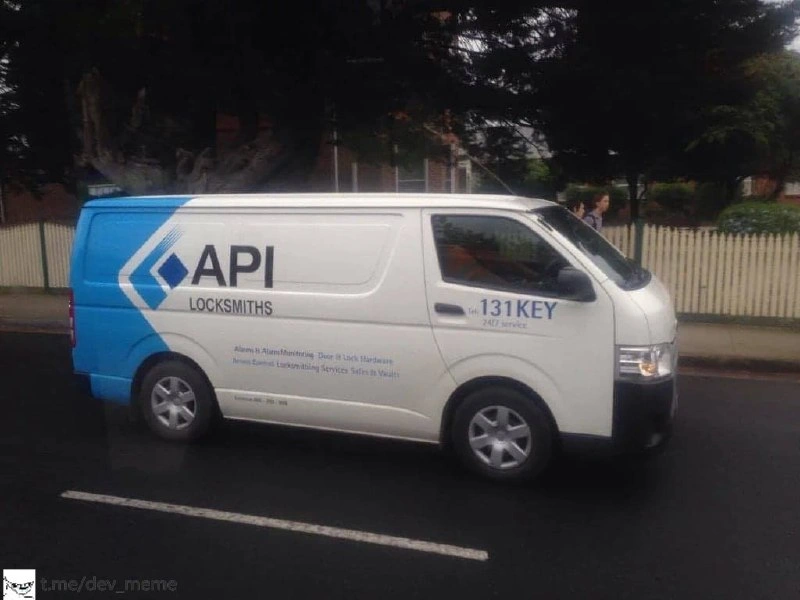
The meme shows a real-looking locksmith van whose company name includes API. Because locksmiths deal with physical keys, the image makes it look like they also handle API keys. That is why the caption asks, Lost your API key?
For newer developers, the practical point is that API keys should be treated carefully. They should not be committed into code, pasted into public chats, or shared between too many systems. If one is exposed, the team should rotate it, which means creating a new key, updating the application, and disabling the old one.
Level 3: Keys, But Literal
The van reads:
API LOCKSMITHS
The door adds:
131 KEY
24/7 service
With the post message, Lost your API key?, the image becomes a perfect literal pun. In software, an API key is a credential used to authenticate a program to a service. In the physical world, a locksmith helps when you lose a key. The van accidentally looks like the on-call team for forgotten tokens, expired credentials, and that one production secret someone pasted into a wiki in 2019.
The reason this works for developers is that key management is not just an abstract security topic. It is daily operational hygiene: issuing credentials, storing them safely, rotating them, scoping their permissions, revoking them after leaks, and keeping them out of source control. The word "key" sounds simple until the incident channel asks which service account owns the failing integration and whether anyone knows where its secret was originally provisioned.
The locksmith branding also maps surprisingly well onto security practice. A physical locksmith might change a lock, cut a replacement key, or respond outside business hours. A software team does the digital version: rotate an API key, create a new token, update secret stores, redeploy services, and invalidate the compromised credential. The joke is that the van promises 24/7 service, which is exactly when credential failures prefer to happen: outside business hours, during a vendor outage, while the one person with admin access is on a plane.
There is a cynical little truth underneath the pun. Many organizations treat secrets management like a lost-key problem instead of a system design problem. They scramble when a key disappears or leaks, but they do not always invest in least privilege, automated rotation, audit trails, environment separation, or clear ownership. Then a simple credential becomes load-bearing infrastructure with the documentation quality of a sticky note.
Description
A street photo shows a white and blue locksmith van parked by the curb. The large side branding reads "API" with a geometric logo, followed by "LOCKSMITHS" underneath; the front door reads "131 KEY" and "24/7 service." Smaller service text near the bottom of the van is present but too blurred to read fully, and a faint "t.me/dev_meme" watermark appears in the lower-left corner. The meme works as a literal visual pun: a locksmith company named API looks like the physical-world department responsible for API keys, credential rotation, and secrets management.
Comments
1Comment deleted
At last, a vendor that rotates API keys by changing the locks.