When Logic Gates Meet Relationship Gates
Why is this CS Fundamentals meme funny?
Level 1: When Words Get Too Literal
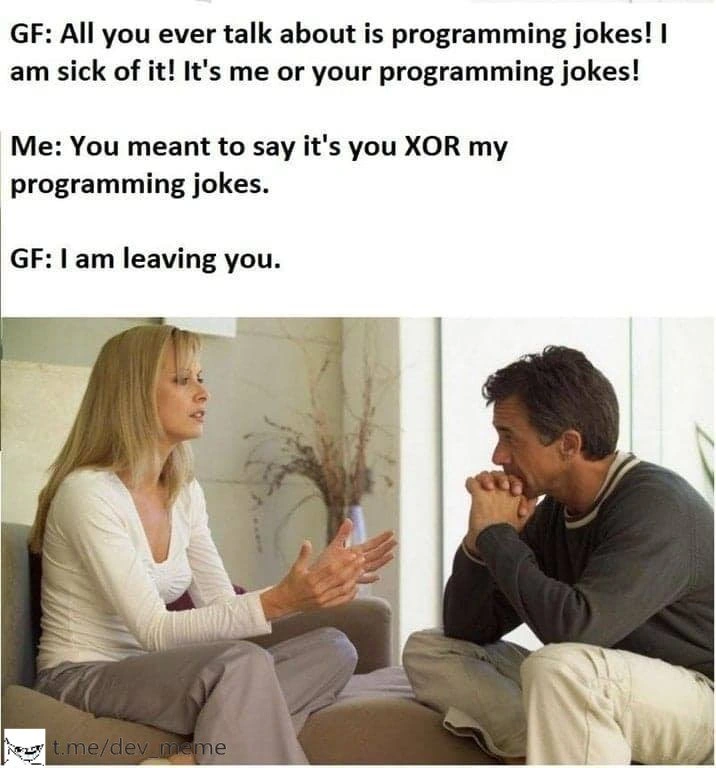
Imagine your friend is very mad and says, “You have to choose: it’s me or your video games!” That’s a serious moment, right? Now picture you reply with a cheeky grin, “Hmm, technically, do you mean one or the other but not both?” 😬 That’s basically what’s happening in this meme. The girlfriend gave a big ultimatum – she wants him to stop with the programming jokes and pay attention to her. But instead of answering sincerely, the programmer guy makes a nerdy word-play about the word “or.” It’s like she spoke from the heart, and he answered with a math problem. Not surprisingly, she gets even angrier and decides to leave.
Why is this funny? Because he completely missed the point in the silliest way. It’s as if someone said, “Stop doing that or I’m gone,” and you start correcting their grammar instead of listening to their feelings. We laugh (a little nervously) because the poor guy was so wrapped up in his coding brain that he treated a relationship issue like a computer bug. It’s a goofy example of being too literal. In simple terms: she wanted him to care more about her than his jokes, but he just couldn’t resist one more joke. It’s the kind of mistake a lot of us can imagine making – focusing on being “right” about words when we should be understanding the other person. The humor comes from that over-the-top mismatch: love isn’t a computer program, and if you treat it like one, somebody’s going to crash!
Level 2: One or the Other
Let’s break down the tech and talk through what’s happening. The crux of the joke is the difference between normal “or” and XOR in programming. XOR stands for eXclusive OR. In plain English, that means “one or the other, but not both.” It’s a fundamental bitwise logic operator often seen in CS classes or programming contests. By contrast, the everyday word "or" can be a bit ambiguous: sometimes it’s meant exclusively (choose one, not both) and sometimes inclusively (at least one, possibly both). Computers don’t like ambiguity, so programming languages have clear operators: usually || (or just OR) for inclusive-or, and a special operator (often ^ or a function) for exclusive-or, i.e., XOR.
In the meme, the girlfriend says “It’s me or your programming jokes!” In context, any human understands she means an exclusive choice: if he wants to stay with her, the programming jokes must go. However, the developer’s brain zeroes in on the word “or” like it’s code. By jokingly replying “you meant to say you XOR my programming jokes,” he’s treating her sentence like a buggy Boolean expression that needs fixing. He’s implying: “If we were writing that condition in code, we should use XOR to correctly reflect that I can’t have both you and my jokes.” It’s a classic programming_vs_relationships moment – he’s talking in code while she’s talking about feelings.
To clarify the logic, here’s a quick truth table comparing inclusive OR vs exclusive OR for the two options (Girlfriend vs. Jokes):
| Girlfriend (choose her) | Programming Jokes (keep them) | Inclusive OR (A OR B) |
Exclusive OR (A XOR B) |
|---|---|---|---|
| No (0) | No (0) | No (0) – (neither chosen) | No (0) – (neither) |
| No (0) | Yes (1) | Yes (1) – (jokes chosen) | Yes (1) – (one or the other) |
| Yes (1) | No (0) | Yes (1) – (girlfriend chosen) | Yes (1) – (one or the other) |
| Yes (1) | Yes (1) | Yes (1) – (both chosen ✅) | No (0) – (both not allowed 🚫) |
If you look at the last line: with inclusive OR, choosing both girlfriend and jokes would still satisfy the condition (“A or B” would be true if both are true). But with exclusive OR, that scenario fails – you can’t have both at once. The girlfriend’s ultimatum clearly intends the last line to be a no-go. So the developer, ever the stickler for precision, pops in with the XOR clarification. It’s a knee-jerk bitwise_logic correction that only makes sense in a programmer’s world.
For a junior developer or someone learning CS fundamentals, this is a textbook example of mixing up contexts. Boolean logic is a core topic: you learn that OR vs XOR are different logical gates (imagine circuits where current flows differently based on inputs). It’s cool stuff – XOR is used for things like parity checks, cryptography, and bitwise tricks (like swapping two numbers without a temp variable). But in everyday conversation, nobody explicitly says “XOR” – they assume context will tell you it’s exclusive. The humor here comes from the guy acting like a human compiler, treating a heartfelt statement as if it were code with a logical bug. The photo below the text even shows the likely aftermath: the girlfriend gesturing emphatically (“seriously?!”) and the guy with that face of realization, perhaps thinking “did I just logic-nerd myself into a breakup?”. It’s funny in a facepalm way because we understand both sides: the girlfriend is frustrated about communication, and the dev... well, he just proved he can’t stop joking like a coder, even when it really matters. Talk about a CommunicationBreakdown! For anyone new to these concepts, if you’ve ever been so deep into a hobby or subject that you start speaking its language at the wrong time, you’ll recognize the dynamic. The meme exaggerates it for comic effect, turning a simple logic operator into the relationship’s final boss.
Level 3: Exclusive Heartbreak
This meme paints a painfully funny picture of what happens when Boolean logic crashes into real-life romance. The girlfriend issues a classic ultimatum – “I’m sick of it! It’s me or your programming jokes!” – basically demanding the developer choose between relationship and hobby. In true pedantic programmer fashion, he can’t resist tweaking her wording: “You meant to say it’s you XOR my programming jokes.” 🤦♂️ Here, XOR (exclusive OR) is the precise logical operator meaning “one or the other, but not both.” Of course she meant that already; no sane partner offers inclusive “or” (where both options are allowed) in an ultimatum! By correcting her with nerdy exactness, he proved her point – all he ever talks about is coding humor – and promptly earned a real-life NullPointerException in his love life.
Seasoned developers recognize this scenario as a hilarious communication breakdown. It’s an InsideJoke about our instinct to treat words like code. We spend our days ensuring every if and || behaves exactly as intended, so hearing “or” in a heated conversation automatically triggers the mental compiler. 😅 The humor comes from a mix of relatability and absurdity: an emotionally charged moment is defused (or rather, detonated) by a completely inappropriate CodingHumor correction. It’s relatable because many of us in tech have caught ourselves being overly literal or nitpicky with language – sometimes at the worst times. The meme exaggerates it perfectly: the developer humor reflex was so strong, he effectively ran a bitwise operation on a relationship ultimatum. The result? A logical truth table might say he can’t have both, but reality handed him neither. This contrast between logical correctness and human wrongness is what makes the joke land. In the end, the BooleanLogic was flawless, but the relationship crashed – a classic case of logic winning the battle and losing the war.
Description
The meme displays a stock photo of a man and a woman having a serious, tense conversation while sitting on a couch. Above the image, a dialogue is written. First, 'GF: All you ever talk about is programming jokes! I am sick of it! It's me or your programming jokes!'. This is followed by the programmer's response, 'Me: You meant to say it's you XOR my programming jokes.'. The final line of dialogue is 'GF: I am leaving you.'. The humor comes from the programmer's pedantic correction of his girlfriend's ultimatum. She is expressing an 'exclusive or' situation, and he literally points this out using the computer science term XOR (exclusive OR), a logical operator that is true only when its operands differ. This socially inept, overly literal response completely misses the emotional point of the conversation, perfectly capturing the stereotype of a programmer who thinks in code and logic to the detriment of their personal relationships, resulting in the breakup
Comments
7Comment deleted
This is why we have RFCs for communication protocols. An emotional ultimatum is a lossy channel; correcting the protocol instead of acknowledging the payload is a guaranteed packet drop
She said, “It’s me OR your programming jokes.” I switched it to XOR for correctness; the next GC cycle reclaimed the relationship - turns out she held the last strong reference
After 20 years in tech, you realize the real bug isn't in your code - it's explaining to your partner why correcting 'OR' to 'XOR' during a breakup conversation was technically accurate but emotionally catastrophic. The stack trace on that relationship crash is going to be painful to debug
The real tragedy here isn't the breakup - it's that he missed the opportunity to explain that in a proper XOR relationship, they could both exist as long as only one of them was 'true' at any given time. Though given her reaction, I suspect she's already implemented a NOT gate on the entire relationship and moved on to someone who understands that some operations are better left unoptimized for human interaction
Natural-language “or” has undefined semantics; in relationships it’s XOR with instant hard delete and no rollback
Correcting “me or your programming jokes” to XOR is a CAP decision - you kept Consistency, lost Availability, and immediately got Partitioned
GF offered inclusive OR; he delivered XOR - now debugging solo: 1 ^ 1 = eternal singlehood