Skip to content
DevMeme
1764 of 7435
Docker Inside Docker Brainwave
Containerization Post #1971, on Aug 27, 2020 in TG

Docker Inside Docker Brainwave

Why is this Containerization meme funny?

Level 1: Box In A Box

It is like putting a toy box inside another toy box, then asking the small box to organize all the other boxes in the room. It might work, but soon nobody remembers which box is in charge. The smoky reaction face is funny because the idea sounds brilliant for one second and exhausting for the next hundred.

Level 2: Boxes Running Boxes

Docker packages an application with the files and settings it needs so it can run consistently. Kubernetes manages many containers across machines or environments. Putting Docker inside Docker means running Docker commands from inside a container so that container can build or start other containers.

This is common in CI/CD, where automated jobs build images and run tests. It sounds convenient because the build environment is itself packaged. The tricky part is that the inner Docker still needs power from the outside system. It may need special permissions or access to the host's Docker service.

The meme is funny because the idea starts simple but quickly becomes recursive: Docker inside Docker, inside Kubernetes, inside Kubernetes. Each layer can hide where the actual program is running, where files are stored, and who is allowed to stop it when something goes wrong.

Level 3: CI Runner Enlightenment

The reaction image sells the idea as a huge insight: put Docker inside Docker, then maybe put that inside Kubernetes, then perhaps put Kubernetes inside another Kubernetes, and by Friday the build pipeline has achieved spiritual opacity. The joke is funny because Docker-in-Docker is both a real pattern and a real source of pain.

Teams reach for it for understandable reasons. CI jobs need to build container images. Integration tests need disposable services. Platform teams want reproducible environments. A containerized runner that can spin up more containers feels clean: one job, one environment, no host pollution. Then the details arrive with a clipboard and a bad attitude.

The typical trade-offs are ugly:

  • Run a nested Docker daemon and deal with privilege, storage drivers, caching, and cleanup.
  • Mount the host Docker socket and accept that the job can effectively control the host.
  • Use rootless or alternative build tools and discover a new class of limitations.
  • Move the problem into Kubernetes and explain why a pod is launching things that look suspiciously like more pods.

None of these choices is automatically wrong. They are context-dependent engineering compromises. The meme is about the moment those compromises get pitched as if they were a breakthrough instead of a future incident retrospective. Nested container systems can work, but they demand boring clarity about trust boundaries, cleanup, image caching, network access, and resource limits. Without that, the setup becomes a build pipeline where docker ps answers a different question depending on which shell you are currently lost in.

Level 4: Namespaces All The Way

The visible caption asks:

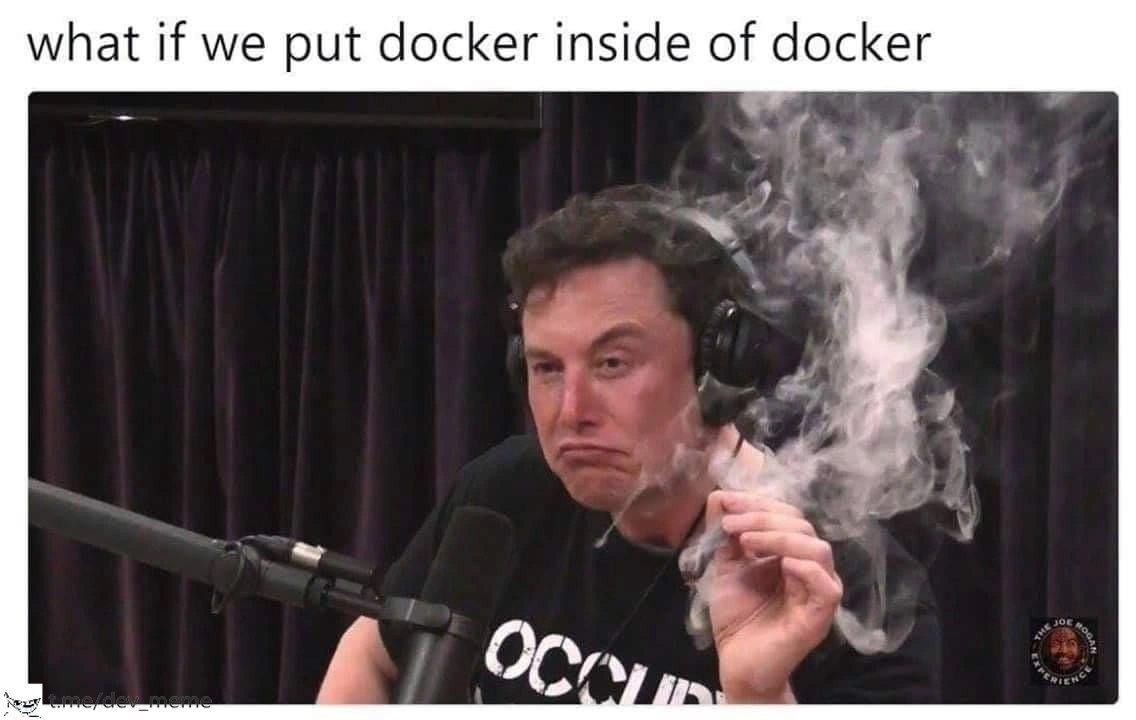
what if we put docker inside of docker

That sounds like a stoned architecture diagram because containers are not miniature computers in the same way virtual machines are. Docker relies on Linux kernel primitives such as namespaces, cgroups, capabilities, mount propagation, and layered filesystems. A container is a process tree with carefully constrained views of the host. So "Docker inside Docker" is not simply a box inside a box; it is a containerized process trying to manage other containers while still ultimately negotiating with the same underlying kernel.

The hard part is the control plane boundary. Docker is split between a client and a daemon. If a container runs its own Docker daemon, that inner daemon needs enough privilege to create namespaces, set up mounts, manage networking, and write storage layers. That often means a privileged container, which is a polite way of saying, "the isolation story has become more aspirational than contractual." If instead the container mounts the host Docker socket, then the inner Docker command is not really inside anything meaningful; it is controlling the host daemon. Congratulations, your CI job found root with extra YAML.

The metadata says, Which will sit inside k8s, which is inside k8s, adding Kubernetes recursion to the smoke cloud. Kubernetes already orchestrates containers through a container runtime, pods, volumes, service networking, cgroups, and cluster state. Nesting that inside another Kubernetes environment can be useful for local clusters, integration tests, or CI isolation, but every layer adds questions about which runtime owns which process, where logs live, how storage is mounted, what network namespace traffic crosses, and whose resource limits are actually enforced.

This is why the meme earns a Level 4: the absurdity is created by real OS boundaries. At the bottom, there is still one kernel deciding process isolation, scheduling, filesystems, and network behavior. The nesting looks recursive in a diagram, but the kernel does not care about your diagram. It cares about syscalls, permissions, mounts, and cgroup accounting. The smoke in the image is basically the architectural review leaving someone's head.

Description

The meme has the text "what if we put docker inside of docker" across the top in plain black lettering. Below it is a reaction image of Elon Musk wearing headphones at a podcast microphone, holding a smoking item while a large cloud of smoke rises around his face. A faint "t.me/dev_meme" watermark appears near the bottom-left, and a small circular "The Joe Rogan Experience" mark is visible near the lower-right. The technical joke points at Docker-in-Docker setups, especially CI environments that trade isolation convenience for awkward daemon nesting, socket mounting, and hard-to-debug container state.

Comments

1
Anonymous ★ Top Pick Somewhere, a CI runner just mounted `/var/run/docker.sock` and whispered, "this is fine."
  1. Anonymous ★ Top Pick

    Somewhere, a CI runner just mounted `/var/run/docker.sock` and whispered, "this is fine."

Use J and K for navigation