Anders Hejlsberg's Language Exception Clause
Why is this Languages meme funny?
Level 1: Favorite Tool Maker
Imagine people argue about every kind of hammer. Some hammers are popular, so everyone complains about them. Some hammers are beautiful, but nobody owns one. Then someone says, "Except the hammers made by this one builder. Those are special." The meme is funny because it treats a famous programming-language designer like the one person who can escape arguments that programmers never stop having.
Level 2: Language Wars With Logos
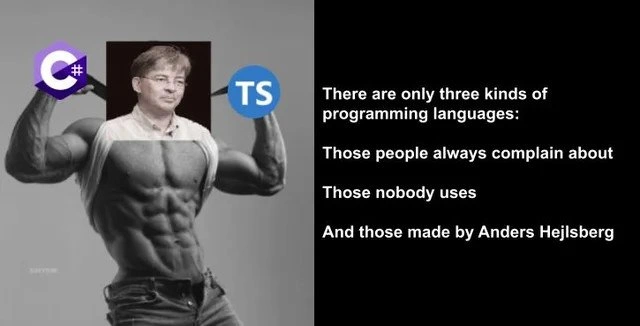
The image shows two recognizable language logos: C# on the left and TypeScript on the right. Both are strongly associated with Microsoft, both belong broadly to the CFamilyLanguages tradition, and both are used heavily in professional software development.
The text says there are three kinds of programming languages: the ones people complain about, the ones nobody uses, and the ones made by Anders Hejlsberg. This is funny because programmers argue constantly about languages. A language can be popular and still criticized every day. In fact, popularity usually creates more criticism because more people are depending on it for real work.
Anders Hejlsberg is important in TechHistory because he helped create or lead several influential developer tools and languages, including Turbo Pascal, Delphi, C#, and TypeScript. The meme exaggerates that history into superhero worship. For a newer developer, the simple idea is: this person has repeatedly worked on languages that became practical, mainstream tools, so the meme pretends his languages are exempt from the usual arguing.
Level 3: The Hejlsberg Exception
There are only three kinds of programming languages:
Those people always complain about
Those nobody uses
And those made by Anders Hejlsberg
The meme riffs on the old programming-language taxonomy that says languages are either complained about or unused, then adds a fan-club escape hatch: languages made by Anders Hejlsberg. The visual makes that exception deliberately ridiculous. A grayscale bodybuilder holds the C# logo in one hand and the TypeScript logo in the other, with Hejlsberg's head pasted on top like the patron saint of pragmatic language design. It is not subtle, which is fair; subtlety rarely survives LanguageWars anyway.
The joke works because C# and TypeScript occupy an unusual place in modern developer debates. People absolutely complain about both, but they also solved real adoption problems with a level of practicality that made them hard to dismiss. C# gave the DotNet ecosystem a modern C-family language with strong tooling, generics, LINQ, async support, and a long path of evolution without throwing away the enterprise world that already existed. TypeScript did something similarly pragmatic for JavaScript: it did not demand that the web stop being JavaScript. It layered a structural type system, editor intelligence, and incremental migration over the chaos already running in production.
That is the real senior-level admiration underneath the bodybuilding edit. Many language projects are beautiful on paper and painful in organizations. Hejlsberg-associated languages tend to respect migration, tooling, interoperability, and working programmers who have deadlines. Turbo Pascal cared about fast compilation and an approachable development loop. Delphi made GUI and database application development feel productive. C# built a managed-language bridge for Microsoft-heavy shops. TypeScript let large JavaScript teams get static checking without rewriting the web. That lineage is why the meme's praise lands as more than random celebrity worship.
The right panel's three categories also mock how developers talk about languages as identity markers. If a language is popular, people complain because they encounter its rough edges every day. If a language is obscure, people praise its elegance because nobody has forced it through payroll systems, legacy integrations, browser compatibility, and hiring constraints. The meme says Hejlsberg's languages get a third bucket: complained about, widely used, and still annoyingly successful. Somewhere, a design meeting just became a type-system feature.
Description
A grayscale bodybuilder meme shows a muscular torso with Anders Hejlsberg's head pasted on top, flexing a purple C# logo in one hand and a blue TypeScript logo in the other. On the black right panel, the white text reads: "There are only three kinds of programming languages: Those people always complain about Those nobody uses And those made by Anders Hejlsberg". The image riffs on the classic programming-language complaint taxonomy by carving out a heroic exception for Hejlsberg's languages, especially C# and TypeScript. The humor lands for developers who have watched both languages become unusually pragmatic mainstream tools despite endless language-war discourse.
Comments
4Comment deleted
The fourth kind is the one your team standardizes on six months before Anders ships a nicer type system.
Twenty+ years no one can invent Delphi for web.... Comment deleted
I'd go with Ada for practical Pascal-inspired language. Anything of the sort is hard to adapt to web though, due to suckiness of it's interfaces. (Something every platform has to some extent, Unices have libc, Windows have C++ WinApi, Android has Binder. Some are worse than others though.) Comment deleted
Also, there are a lot of perfect languages without m$ Comment deleted