Pointers gatekeep, templates body-slam: the uphill battle of learning C++
Why is this Languages meme funny?
Level 1: Always a Bigger Monster
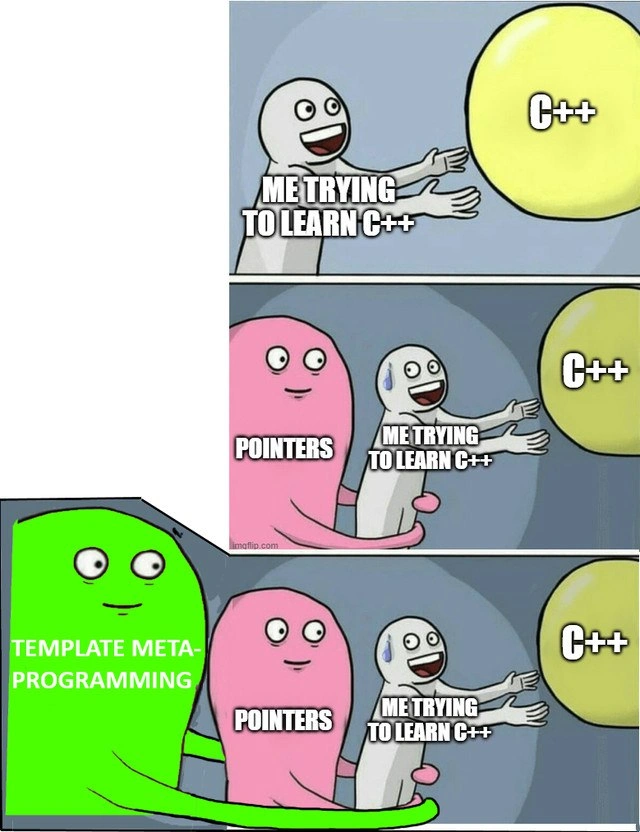
Imagine you’re playing a game where you need to grab a big golden ball to win. You run toward it, but suddenly a small pink monster jumps in front of you. This little monster is tricky – you have to figure out how to get past it because it’s blocking your path. This is like the first big challenge of learning C++: the pointers. Pointers are that pink monster. They’re a bit scary at first, because if you don’t handle them right, they can cause trouble (just like how a small monster can trip you up). Now, suppose you take a deep breath, learn the monster’s moves, and slowly get around the pink monster. Phew! You think, “Great, now I can finally get the golden ball of C++ knowledge!” But – plot twist – as soon as you move past the first monster, a giant green monster leaps out of nowhere! It’s even bigger and more confusing than the first one. This huge monster represents the next big challenge of C++: template meta-programming. It’s as if the game said, “Oh, you thought that first bit was hard? Here’s something even tougher!” The meme is funny because it exaggerates how learning C++ can feel. Just when you think you’ve solved one hard puzzle, an even harder one appears, almost comically so. In everyday terms, it’s like trying to climb a hill and discovering there’s a mountain right behind it. The yellow ball labeled “C++” is the prize of fully learning the language, and the monsters are the obstacles. The joke is that in C++, the obstacles (concepts like pointers and templates) keep getting bigger just when you think you’re in the clear. It’s a playful way to say “Learning C++ is hard – there’s always a bigger monster to overcome!”
Level 2: Pointer Pitfalls
Let’s break down the meme’s content in more straightforward terms. We have two big concepts here: pointers and template meta-programming, both within C++ (often stylized as C++ or Cpp). To a new programmer, C++ can feel like an uphill battle because of these concepts. Here’s why:
Pointers: In many high-level languages (like Python or Java), you don't have to think about memory addresses directly. But C++ is a language close to the hardware (hence classified under LowLevelProgramming in the meme’s categories). A pointer in C++ is basically a variable that holds the address of another variable. Think of memory as a huge numbered grid, and each variable sits in some box (memory location) on that grid. A pointer is like a slip of paper with a number that tells you which box to go to. With that, you can directly access or modify the value in that box. Powerful, right? But also risky! If you have the wrong address on your slip of paper (i.e., the pointer’s value is incorrect), you might end up in the wrong box – possibly one that you’re not allowed to touch – leading to errors or crashes. This is why pointers are often tricky for beginners: you must carefully manage what address they hold and ensure it’s valid.
Common pointer pitfalls include:
- Null pointers: A pointer that doesn’t point anywhere (often set to
nullptr). If you try to use it (dereference it), your program will likely crash because it’s like trying to open a mailbox that doesn’t exist. - Dangling pointers: A pointer that used to point to something valid, but that thing was deleted or went out of scope. Now the pointer is left with an address to memory that’s no longer yours – a trap ready to spring a mysterious bug on you.
- Pointer arithmetic: In C++, you can do math on pointers (e.g., increment a pointer to make it point to the next element in an array). This is powerful for things like iterating through arrays manually, but doing the math wrong can easily misalign the pointer – suddenly you’re reading memory one element off, or beyond the array’s end (buffer overflow territory!).
Here’s a quick example to illustrate some pointer basics and the kind of mistake a learner might make:
#include <iostream>
int main() {
int x = 42;
int* p = &x; // p holds the address of x
std::cout << *p << "\n"; // prints 42, by dereferencing p to get the value at that address
*p = 100; // writing through the pointer, x is now 100
std::cout << x << "\n"; // prints 100, showing we changed x via the pointer
p = nullptr; // p now doesn't point to anything (null)
// std::cout << *p; // If we uncomment this, dereferencing nullptr would crash the program!
}
In the snippet above, we see p = &x; which makes p point to x. Using *p we can read or write the value of x indirectly. Setting p to nullptr means “no address” – and trying to use *p after that is a classic error that beginners might run into (and it causes a runtime crash). This illustrates how careful one must be with pointers. It’s a manual gear car: powerful control but easy to stall or crash if you’re not used to it. No automatic garbage collector or runtime safety net will save you if you misuse a pointer. That’s why the meme shows “POINTERS” grabbing the learner. It’s like saying, “Hold on, you can’t get to learning all of C++ until you deal with me first!” Many newcomers indeed find their progress halted by confusion over pointers until they take the time to really understand them.
Template Meta-Programming: Now, templates in C++ are another big concept, but of a very different flavor. A template is basically a way to write code that can work with any type. If you’ve seen something like std::vector<int> versus std::vector<float>, that’s made possible by a class template std::vector<T> where T can be int, float, or any user-defined type. At face value, templates are C++’s version of generics (parametric polymorphism). They let us avoid writing the same code for different types. For example, instead of writing separate functions to sort an array of int and an array of double, you can write one template function sort<T> and the compiler will generate the specific versions for you when you use them. This is super handy and one of C++’s strengths.
However, template meta-programming refers to a more advanced technique where templates are used not just to avoid code repetition, but to perform computation during compilation. Essentially, you write templates that recursively define logic, and the C++ compiler evaluates that logic while building the program. It’s “programming with types and constants” rather than with runtime values. For instance, you might use templates to calculate a value at compile time (like computing a factorial or generating a lookup table), or to enable/disable certain functions for certain types (this is where you see things like std::enable_if or std::is_same in template code). This kind of code can get really complex, because you’re writing code that writes code. If pointers are about managing concrete data, template meta-programming is about manipulating abstractions and types.
To a junior developer, encountering heavy template meta-programming can feel like stumbling into an alien land. The syntax looks more convoluted (lots of <>::, and ..., and typename keywords scattered around), and error messages from mistakes can be baffling. For example, if you misuse a template, the compiler might spit out an error that’s a paragraph long, filled with terms that are hard to decipher. This can be frustrating and intimidating – akin to being body-slammed by an unexpected wrestler, which is exactly what the meme is picturing in that third panel. The “TEMPLATE META-PROGRAMMING” monster engulfs everything because when you’re new and you accidentally wander into template territory (or just peek at the implementation of something like std::tuple or a Boost library), it can feel overwhelmingly complex.
The learning sequence often goes: learn the basics of C++ (syntax, variables) → learn about pointers and memory management (tough) → maybe learn about classes and inheritance → then, at some point, encounter templates → then much later, realize templates can be used in crazy ways at compile time. The meme comically compresses this into one scene, highlighting the two biggest “oh no” moments: pointers and advanced templates. It’s saying, “Learning C++? First big challenge: pointers. And if you get past that... surprise! An even bigger challenge: template meta-programming.” This is why under ContextTags we see things like language_learning_pain and pointers_vs_templates – the meme is directly about the painful learning experiences with those features.
So, in simpler terms: the meme resonates with developers because it’s a funny exaggeration of trying to learn C++. It’s like trying to reach for the golden prize (becoming proficient in C++), but you get blocked by a door guard (pointers). Then, while you’re wrestling that guard, an even bigger guard (templates) pounces on you. If you’re new to C++, you might not have met the second guard yet – but more experienced folks see it and chuckle, remembering their own “what on Earth is this?!” moment with templates.
Level 3: Template Tsunami
From a seasoned developer’s perspective, this meme is a chef’s kiss to the shared LearningCurve of C++. It humorously illustrates how C++ learning often feels like facing a two-stage boss battle. First, you encounter the mid-boss: pointers, which act as the initial gatekeeper to understanding C++’s power and peril. Pointers let you directly interact with memory (e.g., to manually manage dynamic allocation or to implement data structures with absolute control). Every experienced C++ dev remembers the early days of wrestling with * and &: figuring out the difference between a pointer and the thing it points to, debugging mysterious crashes caused by reading from a wild address, or trying to comprehend pointer arithmetic when iterating through an array in memory. Pointers are infamous for being both gatekeepers and foot-guns – they gatekeep in the sense that until you grasp them, you can’t comfortably advance in C++; they’re foot-guns in that misuse can metaphorically shoot your software in the foot (think segmentation faults or memory leaks). The meme’s second panel nails this: “POINTERS” (depicted as a pink blob) wrapping around “ME TRYING TO LEARN C++” shows how pointers can restrain a newcomer from freely reaching the blissful big yellow sphere of “C++” mastery. It’s a gentle ribbing of every junior programmer’s horror the first time they see something like int *p = &x; or have to delete memory they new-ed.
But then comes the plot twist that veteran C++ folks know all too well: just when you think you’ve made peace with pointers and feel ready to grab that shiny “C++” proficiency, an even larger beast appears – TEMPLATE META-PROGRAMMING. This is the tsunami after the tremor, the final boss that makes pointers look almost cute by comparison. The meme’s third panel visualizes this escalation brilliantly: a giant green blob labeled “TEMPLATE META-PROGRAMMING” barges in, overwhelming both the learner and the pointer monster. This resonates as DeveloperHumor because anyone who has ventured beyond the basics of C++ has likely been stunned by the complexity of templates. Templates in their everyday use (like std::map<Key, Value>) seem harmless enough – just a way to write generic containers or functions. But advanced template usage – meta-programming – is like discovering an entire sub-language within C++ where the “program” runs during compilation. The phrase compile-time wizardry often gets thrown around because it genuinely feels like magic (or perhaps black magic). We recall war stories of trying to decipher error messages that span dozens of lines, all thanks to a minor mistake in template usage. For example, using template constructs like std::enable_if or template specialization can trigger errors so convoluted that they appear as if the compiler is speaking in tongues. Seasoned devs joke that template error messages are C++’s way of hazing programmers – and surviving that haze is a rite of passage.
The language_complexity captured here is that C++ isn’t just one thing to learn; it’s layers upon layers. Pointers test your understanding of how data is laid out in memory, how references and addresses work – essentially, how computers organize information. Template metaprogramming, on the other hand, tests your ability to think about code that produces code, about abstractions so meta that they operate outside the runtime. It’s like going from wrestling with a physical monster (pointers and real memory) to wrestling with a conceptual phantom (abstract code patterns and compile-time logic). The meme gets a chuckle from experienced developers because it dramatizes something very real: many of us expected C++ to be tough due to pointers (and it was!), but nothing prepared us for the head-spinning moment of encountering something like template<typename T, typename = std::enable_if_t<Condition<T>::value>> or trying to grok template-heavy libraries (hello, Boost MPL or modern constexpr templates). It’s a bigger monster indeed.
In real-world scenarios, this might look like a newcomer happily coding a simple program, when suddenly they need to use a library or feature that involves templates – say, understanding a cryptic compiler error from using std::sort with a custom comparator incorrectly, or reading an std::tuple type in a debugger and seeing an intimidating nested template type definition. The meme speaks to that common experience: “I thought I was finally getting this language, and then this new thing came along and completely overwhelmed me.” It’s the reason why C++ has a reputation for a steep learning curve (some tag it as language_learning_pain): you climb one hill (learn pointers), then realize it was hiding a mountain behind it (templates and beyond).
There’s also a bit of an inside joke about the culture of C++ programmers. Some seasoned C++ devs almost wear these struggles as badges of honor. They’ll reminisce (with a mix of pride and exasperation) about spending days debugging a pointer bug that ended up being a missing &, or about template metaprogramming so convoluted that they inadvertently blew the compiler’s recursion limit. The meme, with its monsters, captures the feeling of those challenges being almost comically outsized. Pointers_vs_templates is a playful framing: which was worse to learn? The meme sides with “templates” being the bigger foe. And indeed, for many, once you conquer pointers (and memory management via smart pointers, etc.), the next frontier – mastering template meta-programming or even just reading heavy template code – can feel like starting from scratch in a new, confusing land.
In summary, at this level we appreciate why the meme is so relatable and funny: it pairs a common beginner obstacle (pointers) with an advanced obstacle (templates) in one continuous visual gag. It’s the one-two punch of C++ education. Those of us who have been through it laugh (perhaps a bit ruefully) because we remember that progression: C++ first humbled us with its low-level intricacies, and then humbled us all over again with its high-level abstractions. It’s an affectionate ribbing of a language that we ultimately respect deeply – because if you can tame these monsters, you can build incredibly powerful and efficient software – but boy, does it make you earn it!
Level 4: Compile-Time Sorcery Unleashed
At the most esoteric level, this meme alludes to the nearly mythical powers hidden in C++. The humor draws on the language’s tendency to expose both low-level memory manipulation and high-level compile-time wizardry. Pointers in C++ let you manipulate raw memory addresses directly – a design inherited from C for maximal performance and control. This commitment to low-level detail is a double-edged sword: it offers power but demands precision. A pointer is essentially an address of a location in memory, and using it is like performing surgery with a sharp scalpel. One slip (like dereferencing a dangling pointer or miscalculating pointer arithmetic) and you’ve sliced into undefined behavior. This is LowLevelProgramming at its most intense: you are responsible for every byte and bit.
Yet just as one grapples with these concrete machine-level concepts, C++ reveals an entirely different dimension of complexity: template metaprogramming. Originally intended for generic programming (think std::vector<T> allowing any type T), templates were discovered to be Turing-complete at compile-time. This means the C++ compiler can be coerced into performing arbitrary computations before the program even runs. It’s as if C++ has a secret built-in compile-time interpreter capable of executing a program (written in the language of templates) while compiling your code. The meme’s giant green monster labeled “TEMPLATE META-PROGRAMMING” humorously personifies this mind-bending concept. Why monstrous? Because writing or reading complex template metaprograms can feel like confronting an eldritch beast: the logic is encoded in recursive template instantiations, constexpr evaluations, and patterns like SFINAE (Substitution Failure Is Not An Error). These techniques turn the compiler into a battleground of compile_time_wizardry, where errors spew out multi-page hieroglyphics of types and constexpr values. Seasoned C++ wizards have used template metaprogramming to compute Fibonacci numbers, solve Sudoku, or even generate fractals at compile time – feats that are theoretically fascinating but practically terrifying for the uninitiated. The meme captures this perfectly: just when you think you’ve mastered the fundamental (but already non-trivial) concept of pointers, you’re body-slammed by the realization that the language has yet another monster hiding in its depths. In academic terms, the learning curve of C++ isn’t a curve at all; it’s more like climbing a cliff that reveals a taller cliff behind it. The first cliff is learning pointers – grounded in computer architecture and memory models. The second, towering cliff is mastering templates – delving into a form of static, Turing-complete programming that challenges your understanding of how a “programming language” even operates. The absurdity and intellectual beauty here is that one language spans from the micro (bytes and addresses) to the meta (code that generates code at compile time). The meme exaggerates that span into an obstacle course of monsters, prompting a mix of laughter and PTSD-style groans from experienced devs who have ventured into these depths.
// A glimpse of the C++ template metaprogramming "monster":
template<int N>
struct Factorial {
static const int value = N * Factorial<N-1>::value; // compile-time recursion
};
template<>
struct Factorial<1> {
static const int value = 1;
};
static_assert(Factorial<5>::value == 120, "Computed factorial at compile time!");
// The compiler essentially computes Factorial<5>::value during compilation.
In this code, we see template metaprogramming in action: the factorial of 5 is calculated during compilation via recursive templates. This sort of compile-time sorcery demonstrates how C++ templates form a Turing-complete system. It’s powerful – enabling highly optimized libraries and compile-time algorithms – but it’s also profoundly counter-intuitive for newcomers. The meme magnifies this tension: the pointers that were once the focus of fear become merely the appetizer; the main course is a cerebral feast of templates doing seemingly impossible things before the program even runs. This layered complexity is why C++ is both revered and feared in the programming world. The meme cleverly uses the monster metaphor to depict how each advanced feature eats the previous challenge, leaving the poor learner overwhelmed. For those in the know, the joke lands because it’s rooted in C++’s very nature: a language where systems programming meets template calculus, and the unsuspecting learner must confront both.
Description
Three-panel cartoon meme: Panel 1 shows a happy stick-figure labeled “ME TRYING TO LEARN C++” reaching toward a large yellow sphere labeled “C++”. Panel 2: a pink blobby creature labeled “POINTERS” wraps an arm around the same sweating stick-figure (still captioned “ME TRYING TO LEARN C++”), blocking the path to the yellow “C++” sphere. Panel 3 adds an even larger green creature bursting in from the left, labeled “TEMPLATE META-PROGRAMMING”, which engulfs both the pink “POINTERS” blob and the struggling learner, while the distant “C++” sphere remains out of reach; the smaller captions “POINTERS” and “ME TRYING TO LEARN C++” are repeated. Visually, the escalating monsters humorously depict how basic pointer semantics already intimidate newcomers, but C++ template metaprogramming arrives as an even bigger, mind-bending obstacle. The joke resonates with developers who know that C++’s low-level pointer management and its Turing-complete compile-time templates often derail otherwise straightforward language learning journeys

Comments
11Comment deleted
Pointers teach you segfaults; template metaprogramming teaches you humility with a 4-page SFINAE stack trace that, somehow, still ends in iostream
The real horror isn't template metaprogramming - it's explaining to your team why the compiler takes 45 minutes to build after you discovered SFINAE and decided to implement a compile-time JSON parser using recursive variadic templates
Pointers are just the tutorial boss; template metaprogramming is when C++ reveals it's been Turing-complete at compile time the whole game
C++ learning progression: First you chase the language itself, then pointers chase you through your dreams with segfaults, and finally template metaprogramming shows up - a Turing-complete compile-time beast that makes you question whether you're writing code or performing dark rituals. By the time you understand SFINAE, you've aged out of 'junior developer' purely through existential suffering, not experience
C++ onboarding plan: master pointers, then smart pointers, then accidentally build a compile-time interpreter with SFINAE just to pick an overload
Pointers teach you to fear the stack; templates make you question why anyone compiles on purpose
Learning C++: you escape raw pointers with unique_ptr, then template metaprogramming uses SFINAE to remove you from overload resolution
Pointers and templates may be PITA, but they are still much better than marshaling and generics. Comment deleted
bigger one : type conflicts Comment deleted
not really Comment deleted
Pointers are not really that bad. You just need some mental adjustments. Memory management is worse. Comment deleted