Skip to content
DevMeme
3970 of 7435
Calling it Agile when you just ship more features and bugs faster
Agile Post #4320, on Apr 18, 2022 in TG

Calling it Agile when you just ship more features and bugs faster

Why is this Agile meme funny?

Level 1: More Features, More Problems

Imagine you’re building a tall LEGO tower. You notice that some of the lower blocks are cracked and the tower is a bit wobbly. Instead of fixing those shaky blocks, you just keep adding more and more blocks on top, even faster than before. You brag that you’re being “so agile” because the tower is getting taller quickly. But, um… the bottom is still unstable! 🙃 Eventually, the whole thing might tumble because those early problems were never fixed. This is exactly what the meme is joking about. It’s like a kid who doesn’t tidy up a messy room and just keeps dumping new toys in there — sure, the room has more toys fast, but it’s getting messier and messier. The word “Agile” in the meme is used ironically: Agile is supposed to mean building things in a quick but careful way, adjusting as you go. But here they’re calling it Agile when they’re really just rushing and making a bigger mess. The humor comes from that obvious silly idea: everyone knows you should fix what’s broken before adding more stuff, right? Calling the sloppy approach “Agile” is like calling a hurried, messy job a brilliant plan. Even a kid can see that if you never fix the first broken part, adding more on top will cause trouble. The meme makes us laugh and cringe because someone is proudly wearing “Agile” like a badge while doing the exact opposite of what makes things work well. It’s a funny way to say, “Going fast is pointless if you’re not doing it right!”

Level 2: Ship Now, Fix Later

So what exactly is Agile supposed to be, and what’s going wrong here? Agile is a way of developing software in small steps (often called iterations or sprints). The idea is to deliver something useful quickly, get feedback, and then keep improving it. In classic AgileProcesses like Scrum, teams work from a backlog (a prioritized to-do list of features and bugs). Each sprint, you’re supposed to pick a manageable set of tasks, which ideally includes new features and fixes or improvements, then build and deliver those. A key goal is to always have a working software increment at the end of each sprint – meaning it might not have every feature yet, but what’s there should work correctly. Agile also includes ceremonies like daily stand-ups (quick team check-ins) and retrospectives (meetings to reflect on how to improve the process continuously). In theory, Agile encourages balancing speed with quality: you release often, but you also adapt and address problems frequently, so you don’t let issues fester.

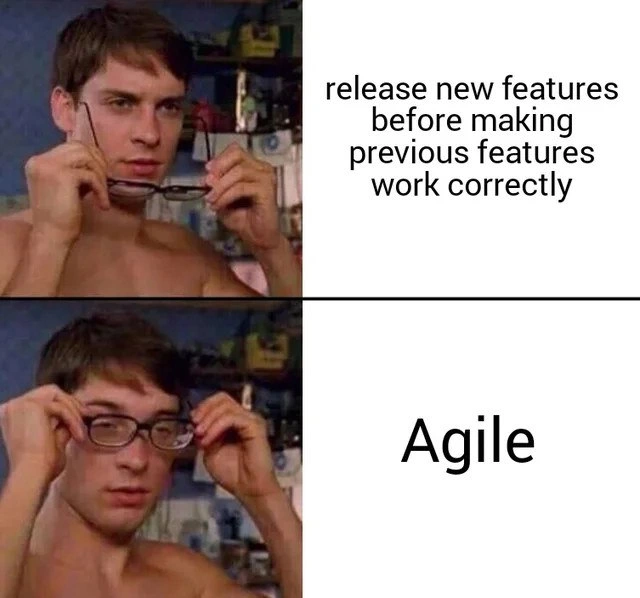
Now, the joke in this meme is that some teams or managers take only the “release often” part of Agile and ignore the “make sure it works and improve it” part. They think being Agile just means shipping new stuff all the time. That’s why the top panel says “release new features before making previous features work correctly.” It’s describing a team that keeps pushing out new features without fixing the bugs in the old ones. Then the bottom panel labels that approach as “Agile” – highlighting a misinterpretation_of_agile. Essentially, someone is putting on rose-tinted glasses and calling a messy process Agile because it sounds cutting-edge. For a junior developer or someone new to the industry, this is a common head-scratcher: you learned Agile is about quick iterations with feedback and fixes, but you might join a team where they just cram in features and skip the fixes. You might hear a manager say, “We’ll fix it later, we have to deliver this new feature by Friday – we’re Agile, we adapt!” and wonder, Is that really Agile? 🤔

Let’s break down some terms and concepts alluded to in this meme:

  • Feature Creep: This is when a project keeps getting more and more features added beyond what was originally planned. It “creeps” beyond scope. In an Agile context, adding features isn’t bad per se (because Agile is flexible), but if you keep adding new features over bug fixes, you end up with a bloated product full of glitches. Here, feature creep is hinted by “ship more features... faster” without cleaning up existing issues. The product grows in features, but also in problems.

  • Bugs: A bug is a mistake or problem in the code that makes a feature act wrong or crash. In a healthy Agile team, bugs are usually tracked in the backlog and prioritized according to severity. You’re supposed to fix critical bugs quickly (often in the same sprint they’re found). But in the meme scenario, bugs are left unresolved as the team rushes to the next shiny feature. It’s like a to-do list where you never cross off the old tasks (fixes), you just keep adding new ones on top. Those unchecked tasks pile up.

  • Technical Debt: This is a metaphor comparing messy code or quick-and-dirty solutions to financial debt. When a team says, “We’ll fix it later,” they incur technical debt – meaning the codebase gets a little harder to work with or a little buggier. Just like financial debt, technical debt isn’t free; you “pay” for it later with slower development, more bugs, or even system crashes. In our meme’s context, each time they skip fixing something and instead push a new feature, they’re swiping the company credit card on quality. The interest (in the form of compounded bugs and complexity) will come due. New developers often experience this when they inherit an older project: there’s a backlog full of old problems (debt) that make adding anything new really tricky. That’s the invisible cost of the “ship now, fix later” attitude.

  • Release Pressure: This term refers to the high-pressure environment to get releases out the door frequently. Agile is often misused as justification for constant deadlines — “We need to release something this sprint!” Management might measure success in terms of how many features you released this month. A junior dev might notice that any attempt to schedule a bug-fix sprint or a refactoring task is met with, “we don’t have time for that, there’s pressure to release the next feature.” This pressure can come from competitive markets (“We need that feature before our rivals do!”) or stakeholder expectations. Unfortunately, if mismanaged, it creates a vicious cycle: pressure leads to rushed code, rushed code leads to more bugs, more bugs then require even more time later.

  • “Agile” vs agile: Notice Agile with a capital A often refers to the formal methodology (with Scrum or Kanban, etc.), while agile with a small a is the general adjective meaning flexible and quick. Here it’s capitalized in the meme like a title. The joke is that by simply calling their process Agile, the team in the meme assumes it’s fine that they hurry out buggy features. It’s a sarcastic use of the term. They have the stand-ups and sprints, but they skip the sanity of fixing or finishing things properly. A junior dev might hear this and feel confused: isn’t Agile supposed to prevent low-quality rush jobs? Yes – in theory. But in practice, some teams only practice the ceremonies (meetings, sprint planning) and neglect the principles (quality, technical excellence, sustainable pace).

In summary, this meme resonates with developers who have been in a team that claims to be doing Agile, but in reality is just frantically pushing out code without discipline. If you’re newer to the field, the takeaway is: AgileHumor like this comes from real experiences. It’s a reminder that just using Agile buzzwords or doing things fast doesn’t guarantee a good outcome. Good Agile teams balance new features with bug fixes and improvements. When teams don’t, you get the kind of dark joke shown here – calling a pile of unfinished, buggy work “Agile” as if it were something to be proud of. Developers share this meme to commiserate about the frustration: we know this isn’t how Agile should be, but it’s happening anyway! 😅

Level 3: Features Over Fixes

At first glance, this meme takes a jab at Agile development gone wrong. In the classic spiderman_glasses_meme format, the blurry vision (no glasses) shows a team’s philosophy: "release new features before making previous features work correctly." Put the glasses on, and suddenly that chaotic approach is labeled as "Agile." It’s poking fun at a common industry anti-pattern where management twists the definition_of_agile_according_to_management into "move fast, break things, and never look back." Experienced engineers immediately recognize this scenario: a featureCreep culture where new features get priority over stabilizing what’s already built. The result? A product accelerating forward on a shaky foundation of Bugs and TechDebt.

In a proper Agile process (the kind preached in Scrum training and the Agile Manifesto), each iteration is supposed to deliver working software — emphasis on working. That includes fixing critical bugs and improving code quality continuously. But in real-world "Agile" at many organizations, there’s relentless releasePressure to show progress every sprint. New login page? Ship it. Chat feature? Ship it. Never mind that the last two releases introduced login glitches and broken chat notifications. Those issues languish in the backlog because releasePressure from stakeholders means every sprint must have flashy new user-facing changes. The meme nails this irony: calling something Agile because you deliver more stuff faster, even if that stuff barely works. It’s Agile in name, but not in spirit — some call it "Fragile" or Agile Theater: all the rituals (sprints, stand-ups) but none of the quality and reflection Agile is meant to foster.

Why is this funny to seasoned developers? Because we’ve all sat through Sprint demos where half the “completed” stories are held together with duct tape. Everyone nods along when the product manager proudly touts increased velocity (more story points completed!). Meanwhile, the QA team and developers are silently screaming inside because last sprint’s bugsInSoftware are snowballing. It’s a shared trauma: features deployed on top of unresolved defects often lead to late-night “surprise” outages or angry users. Yet leadership crows “We’re Agile! We ship every two weeks.” It’s the misinterpretation_of_agile the meme text highlights. TechnicalDebt accumulates like a credit card bill: every ignored bug or skipped refactor is principal + interest to pay later. Eventually, progress grinds to a halt under the weight of past shortcuts – the very opposite of being agile and adaptable.

From a senior perspective, this meme also hints at the gap between AgileHumor ideals and implementation. The Agile Manifesto (2001) emphasized collaboration, responsiveness, and quality. One of its 12 principles even says “Continuous attention to technical excellence and good design enhances agility.” But in many shops, the reality is:

  • Agile principle: “Working software over comprehensive documentation.”
    This team’s twist: “If it compiles and the demo sorta works, ship it! (Documentation and bug fixes can wait.)”

  • Agile principle: “Continuous attention to technical excellence.”
    This team’s twist: “Continuous attention to new features; technical excellence we'll handle someday (maybe never).”

The humor lands because it’s painfully true. We’ve seen managers use AgileProcesses as a buzzword to justify what is essentially a feature factory approach – pumping out updates without ever polishing the product. It’s like painting over mold: looks fine for the Sprint review, but the rot is still spreading underneath. Developers who’ve been around the block (the CynicalVeteran crowd) chuckle at this meme with a sigh. It encapsulates that cynical feeling of “Here we go again – they call it ‘Agile’ but it’s just new_features_over_bug_fixes on turbo mode.”

To put it in code humor, it’s as if the team’s workflow looks like:

# What "Agile" looks like in some teams (sarcastically)
while product_manager.has_new_request():
    develop(feature)
    if has_unfixed_bugs():
        defer_fix()  # "We'll handle it later," they promise
deploy_to_production("fast_and_flaky_release")

This snippet sums up the gag: releasePressure ensures features are released back-to-back (develop(feature) in a loop), and any unfixed_bugs() are kicked down the road (defer_fix()), then everything is hurriedly deployed as if it were a fully baked release. Calling this chaotic loop “Agile” is the punchline. Seasoned devs laugh (perhaps a bit bitterly) because they’ve lived this – on projects where Agile was just an excuse to cowboy-code new features without addressing the mounting bugsInSoftware, creating a Jenga tower of shaky software. The meme’s two panels perfectly capture that moment of realization: Oh, so this madness is what you call Agile. It’s a tongue-in-cheek critique of how the true meaning of Agile gets lost in translation when misused by feature-obsessed teams.

Description

Two-panel meme based on the popular "glasses" template. Each panel’s left half shows a shirtless young man with a blurred face in a cluttered bedroom workshop, holding a pair of glasses; in the second panel he is putting them on. The right half of the top panel contains the text: "release new features before making previous features work correctly". The right half of the bottom panel, separated by a black horizontal divider, simply reads: "Agile" in large bold letters. The gag suggests that some teams equate rapid feature releases - without stabilising existing functionality - with being Agile, highlighting a common misinterpretation of iterative delivery that leads to mounting bugs and technical debt

Comments

7
Anonymous ★ Top Pick Calling it Agile because the burndown for story points is steeper than the ramp-up for Sev-1 incidents is like calling a memory leak “dynamic scaling.”
  1. Anonymous ★ Top Pick

    Calling it Agile because the burndown for story points is steeper than the ramp-up for Sev-1 incidents is like calling a memory leak “dynamic scaling.”

  2. Anonymous

    After 20 years in the industry, I've realized 'Agile' is just Latin for 'the regression suite is optional if the sprint demo is tomorrow and the VP is watching.'

  3. Anonymous

    We don't have bugs, we have 'known issues deprioritized below the roadmap' - the sprint board absolves all sins, two weeks at a time

  4. Anonymous

    Ah yes, the classic Agile anti-pattern: 'Move fast and break things' rebranded as 'iterative development.' Nothing says 'working software over comprehensive documentation' quite like shipping features that don't work, then calling the inevitable firefighting 'sprint retrospectives.' At least when the production incidents wake you at 3 AM, you can take comfort knowing your velocity metrics looked great in the last standup

  5. Anonymous

    Agile: Demoing shiny new endpoints while the legacy CRUD silently crumbles under P0 regressions

  6. Anonymous

    Enterprise Agile: the burndown only drops because defects get reclassified as 'tech debt' and shipped behind flags

  7. Anonymous

    OKR-driven Agile: features ship on time; correctness becomes an eventual consistency problem for on-call

Use J and K for navigation