Skip to content
DevMeme
6038 of 7435
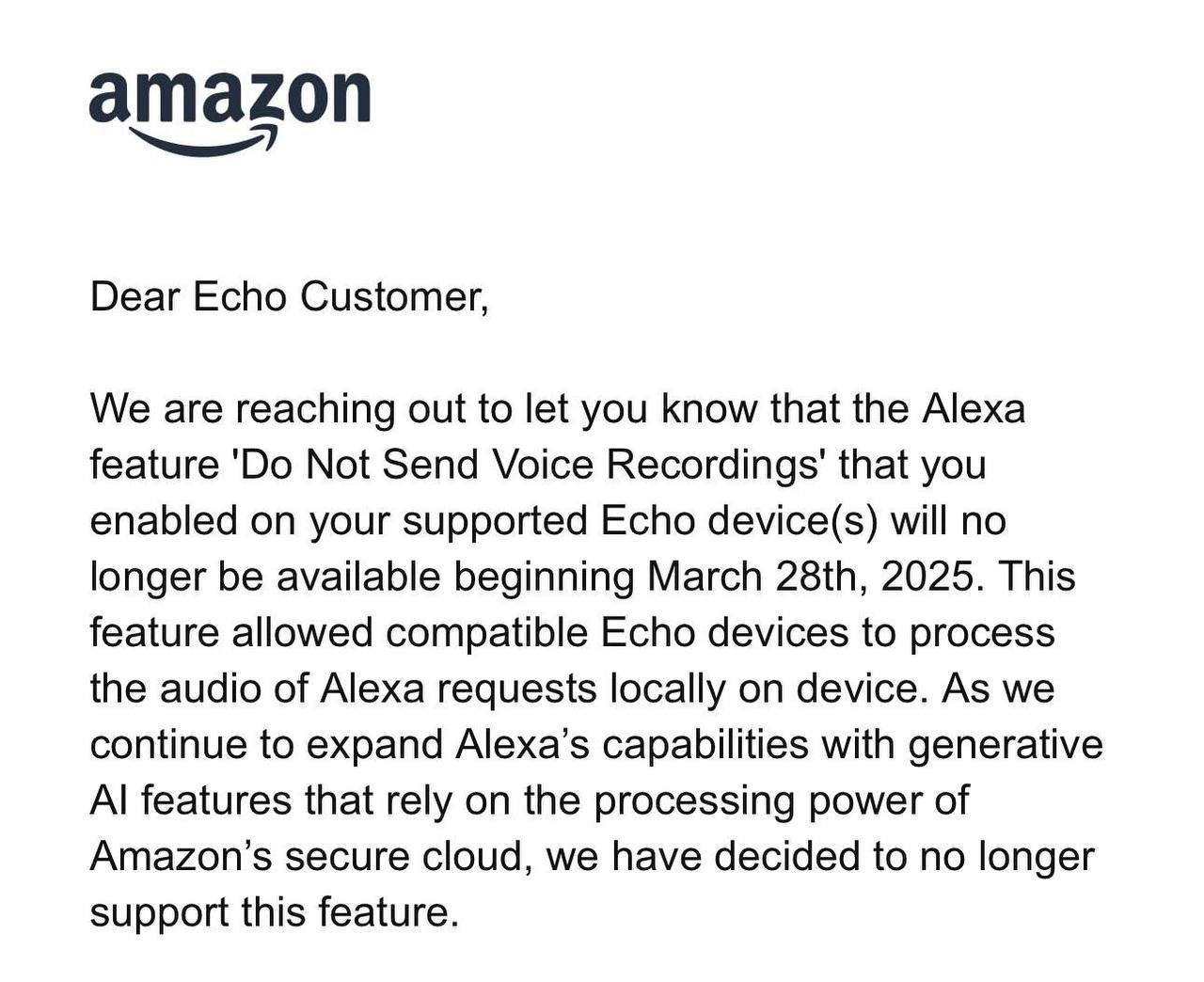
Amazon Politely Announces Your Privacy Settings Are Now a Legacy Feature
DataPrivacy Post #6611, on Apr 1, 2025 in TG

Amazon Politely Announces Your Privacy Settings Are Now a Legacy Feature

Why is this DataPrivacy meme funny?

Level 1: Always Phones Home

Imagine you have a special talking toy friend. At first, this toy could answer your questions all by itself, and it wouldn’t tell anyone else what you asked. It was like having a little buddy who could keep secrets and didn’t need help to respond. Now, the toy company decides to change how the toy works. They take away the toy’s ability to answer on its own (its little answer book or brain). Instead, every time you ask the toy a question, the toy has to call the company’s big computer far away to get the answer. That means whenever you say something to your toy, the company is always listening in because the toy phones home for help. On the bright side, the big computer at the company is super smart, so the toy can now give you fancier, more elaborate answers than before. It’s as if your friend suddenly got a lot wiser but can only get answers by whispering to a teacher every time. The downside? There are no more secrets between you and your toy. It’s like asking your friend something and your friend always runs off to ask an adult before replying. You might get better answers, sure, but you have to trust that adult with everything you said. This is why some people feel uneasy – the toy that once just listened and replied quietly now always phones home, so privacy is lost while the toy becomes smarter.

Level 2: Alexa Always Online

Let’s break down what’s going on in simpler terms. Amazon Alexa is the voice-controlled assistant that lives inside Echo devices (those smart speakers you talk to). When you say, “Hey Alexa, play some music,” normally the Echo records your voice and sends that audio up to Amazon’s servers (the cloud) where the request is understood and answered. However, Amazon had a privacy setting called “Do Not Send Voice Recordings”. If you turned that on, your Echo would process your voice commands locally on the device as much as it could, instead of uploading your words to Amazon. In other words, Alexa had a mode where it tried to be an offline, on-device assistant, keeping your voice data in your home. This is what we call edge processing – doing the computing at the “edge” of the network (on your device) rather than in a central server far away.

The big announcement (and the joke here) is that Amazon is removing that local-only mode. The memo basically says: “Hey Echo users, that feature you enabled to keep your voice recordings private? Yeah… we’re turning that off.” After March 28, 2025, all Alexa requests will have to go through Amazon’s cloud. Why would they do that? Because Amazon wants to add new generative AI features to Alexa – think of Alexa being able to have more natural conversations, create stories or jokes, or give super-detailed answers. Those new AIGeneratedContent capabilities are powered by advanced AI models (the tech behind them is similar to ChatGPT). Generative AI is very resource-intensive – it needs a lot of computing power and memory to work. Your little Echo speaker doesn’t have the horsepower to run these big AI models by itself. So when Amazon says Alexa’s new tricks “rely on the processing power of Amazon’s secure cloud,” they mean Alexa will send your voice to AWS servers which are strong enough to do the heavy AI calculations. The “secure cloud” part is Amazon trying to assure you that this process will be safe and your data will be protected while on their servers. (They’re emphasizing security to make you feel better about the whole thing, since PrivacyConcerns are bound to come up.)

Let’s illustrate the change in a more visual way. It’s kind of like switching from a car you drive yourself to a ride-sharing service that drives you – you lose some control but maybe get a fancier ride. Here’s a pseudo-code snippet of how Alexa’s processing might have worked before vs after:

# Before: edge processing was possible if privacy mode was enabled
audio_data = capture_voice()

if privacy_mode_enabled:  # 'Do Not Send Voice Recordings' is ON
    result = process_locally(audio_data)   # handle the voice command on the device
else:
    result = send_to_cloud(audio_data)    # send voice to AWS cloud for processing
# After: local privacy mode removed, everything goes to cloud
audio_data = capture_voice()
result = send_to_cloud(audio_data)   # always send voice to AWS for processing

As you can see, previously there was a big if around that privacy mode. With the feature gone, that conditional is gone — it’s cloud every time, no matter what. Alexa always needs the internet now to understand complex queries because that’s where the “big brain” lives.

To put some key differences side by side:

When Alexa Processed Locally (Old Mode) When Alexa Processes in Cloud (New Mode)
Voice stayed on the device (better privacy) Voice is sent to Amazon’s servers (privacy concerns)
Could work for basic commands even if internet was down Internet connection required for Alexa to work
Limited AI capability (simple or pre-loaded responses) Advanced generative AI responses (more powerful)
You had control via a privacy setting (opt-out of cloud) No opt-out: Vendor lock-in to Amazon’s cloud services
Less data for Amazon (they didn’t get your voice recordings) Amazon gets more voice data (can improve AI, but you must trust them)

In plain terms, Amazon is betting that you’ll trade a bit of privacy for a much smarter Alexa. Many tech products have this SecurityVsUsability or privacy vs. convenience trade-off. Here, the convenience is a more powerful, chatty, AI-driven Alexa that can do cool new tricks thanks to AI/ML in the cloud. The cost is that you, the user, can no longer say, “Don’t send my recordings out.” Everything you ask Alexa will be processed by Amazon (albeit on their “secure” servers). This move also means your Echo device is more tightly bound to Amazon’s ecosystem (VendorLockIn). If Amazon’s service has an outage or, knock on wood, one day Alexa service is discontinued, that Echo might not do much at all – because it can’t fall back to offline mode anymore.

For a junior developer or tech enthusiast, this is a real-world example of the tension between DataPrivacy and cutting-edge features. Alexa’s new generative AI talents come from big models that just aren’t feasible to run on a little gadget sitting on your shelf. So the device now acts more like a microphone and speaker, and the thinking happens in the cloud. It’s a bit like if you ask your phone to do a complex math problem: the phone might be capable of calculator math on its own, but for something like voice recognition or translation, it often asks a server to do it. The difference here is that Amazon used to let Alexa handle some requests internally for privacy, and soon they won’t. That’s why people who care about privacy or who liked using Alexa offline are upset – a feature they relied on is being yanked away. Meanwhile, others might be excited that Alexa could get much smarter with generative AI. Both reactions make sense. Amazon just made a business and technical decision that the future of Alexa is heavily cloud-dependent. And they’re informing customers in this very formal email style, which the meme highlights for its almost comical blandness: it’s a big change dressed up in polite, corporate language.

Level 3: Generative Gains, Privacy Pains

From a senior engineer’s perspective, this memo is a textbook example of a privacy feature being sunset in favor of shiny new functionality – and it rings all too familiar. The humor (tinged with frustration) comes from how blatantly it spells out the trade-off: “We’re killing the ‘Do Not Send Voice Recordings’ option so Alexa can be more powerful with generative AI.” It’s like the classic corporate move: vendor lock-in wins, user autonomy loses. Amazon is effectively saying: “Enjoy your new AI party tricks, and by the way, we’ll be routing all your voice data through our servers now — trust us, it’s for your own good.” Seasoned devs have seen this pattern: a feature that gave users more control or privacy gets axed when it conflicts with the company’s latest AI ambitions or business goals. Here, the DataPrivacy vs AIAssistants conflict is front and center.

Consider what’s being retired: a mode where Alexa could handle requests locally on the device, meaning your Echo didn’t need to constantly beam your conversations to AWS. This was a big deal for anyone worried about PrivacyConcerns — it was the one assurance that your Echo wasn’t constantly eavesdropping sending everything you say to the cloud. Now Amazon announces, in polite corporate-speak, that this privacy safeguard “will no longer be available.” Oof. They justify it with “expand Alexa’s capabilities with generative AI features that rely on… Amazon’s secure cloud.” Translation? SecurityVsUsability trade-off: to get a smarter Alexa (usability boost), you must surrender some security/privacy. The email highlights “Amazon’s secure cloud” as if to preempt the backlash – “don’t worry, your data will be safe with us!” – but senior engineers know that secure isn’t the same as private. Sure, the voice recordings might travel over HTTPS and sit encrypted on S3, safe from hackers, but they’re still accessible to Amazon (and whoever or whatever algorithms Amazon employs). In other words, your data is secure from outsiders, but not from the very party you might be trying to keep it from! It’s a classic Privacy vs. Corporate Convenience scenario.

There’s also an element of VendorLockIn humor here: by forcing cloud processing, Amazon ensures your Echo is forever tied to Amazon’s services. The device becomes a fancy paperweight without an internet connection to Mama AWS. Senior devs joke about IoT gadgets that “brick” when the company servers go down or when support is pulled – this is heading in that direction. The one mode that might’ve allowed the Echo to do something useful offline or without phoning home is gone. It’s the cloud or nothing now. Need an example? Think of those smart lightbulbs that stop working if the company goes bust because they require a cloud check-in. Here we’re seeing a similar CloudHumor trope: Alexa’s intelligence lives and dies by Amazon’s cloud connectivity, so in the name of generative AI, Amazon just tightened its grip on the entire user experience (that’s the VendorLockIn play).

From an industry history angle, it’s ironically the opposite of what some competitors have been doing. For instance, we’ve seen a push for on-device processing (Apple touting privacy by doing more on iPhone, etc.), but Amazon is doubling down on the cloud approach. Why? Likely because the AIGeneratedContent Alexa will provide (fancier, more human-like responses, custom stories, chatty interactions) requires serious processing. It’s a bit of an “AI Gold Rush” right now; every company wants to inject generative AI into their product to stay relevant. Internally, engineers probably debated this: “Can we keep the local privacy mode and still offer the new AI stuff?” But maintaining two pathways (one with limited on-device AI and one with full cloud AI) is a headache – it complicates testing, user experience, and splits development resources. Plus, the local mode might have delivered an obviously inferior Alexa experience once the fancy GPT-style features roll out. So the higher-ups likely decided it’s better to rip off the bandage: remove the privacy-first path entirely. After all, they must figure, the average user will prefer a smarter Alexa over a private but dumber one. And the privacy die-hards? Well, they’ll either have to accept it or stop using Alexa; a calculated risk Amazon is willing to take.

The meme’s email format accentuates the CorporateCulture satire: it’s bland, polite, and avoids any wording that admits “we’re taking away a privacy option you explicitly chose.” Instead, it’s phrased as “expanding capabilities” and “no longer support this feature.” It reads like so many internal tech deprecation notices we’ve seen. As a senior dev, you can practically hear the groans: here we go, killing off the one noble feature in the name of progress. It’s funny in a dark way because it’s true — the PrivacyConcerns of users often take a backseat when a company smells innovation or competitive edge. The notice might as well say: “That local processing mode was nice while it lasted, but our generative AI needs to phone home now, so... sorry (not sorry).” Everyone in the room nods knowingly, recalling countless meetings where Security vs. usability arguments ended with “we’ll go with the cooler feature.” In summary, the meme strikes a chord with developers: it’s AIHumor meets reality. Amazon is turbo-charging Alexa with cloud-fed AI, and the casualty is a little checkbox labeled “Don’t send my voice” that, for a brief moment, gave users a sense of control.

Level 4: Return of the Mainframe

At the deepest technical level, this change highlights an architectural reversal reminiscent of the old mainframe era: Alexa is essentially moving from edge computing back to a centralized “brain” in the cloud. Why? Because generative AI models are enormous—we’re talking billions of parameters that demand heavy computation. An Amazon Echo device (your little smart speaker) simply doesn’t pack the silicon muscle (CPU/GPU, memory, specialized AI accelerators) to run a state-of-the-art language model locally. So Amazon is offloading the intelligence to its data centers, a bit like how dumb terminals relied on mainframes in the 1970s. The email’s phrase about “the processing power of Amazon’s secure cloud” is basically code for “your Echo isn’t hiding an NVIDIA supercomputer in there, so we need AWS servers to do the heavy lifting.” From a system design standpoint, this is a classic trade-off: on-device inference offers privacy and low latency, but it’s bounded by the device’s limited CPU and power budget (think milliwatts and a few hundred MHz). Cloud inference, on the other hand, can tap into massive compute clusters (multi-core CPUs, GPUs, even AWS Inferentia chips) delivering exaFLOP-scale performance – plenty to run large transformer models and generate rich responses. The cost? Every voice request now makes a round trip over the network to a central server. Essentially, Alexa’s “brain” has been moved off-device and back into the cloud mainframe, because that’s the only place big enough to host the new AI/ML model complexity. This is a fundamental technical limitation: you can’t magically run a 20-billion-parameter model on a tiny IoT gadget without severely degrading quality or speed. Until hardware advances or model compression techniques evolve dramatically, the edge processing vs. cloud processing decision for generative AI will lean toward the cloud. In short, Amazon chose raw AI power (and perhaps centralized control of data) over the elegance of local computation. The cynical irony is that we keep rediscovering centralization – from thin clients to smartphones and now back to cloud-dependent gadgets – a cycle where convenience and capability trump the distributed autonomy we thought we wanted. Alexa’s local-only mode couldn’t survive this compute budget reality; the cloud has once again become the brain, and the Echo is just the ears and mouth.

Description

A screenshot of an official-looking email from Amazon regarding the Echo device. The email, addressed to 'Dear Echo Customer,' announces the discontinuation of the 'Do Not Send Voice Recordings' feature, effective March 28th, 2025. The text explains that this feature allowed on-device processing of Alexa requests. The reason cited for its removal is the expansion of Alexa's capabilities with generative AI, which necessitates the processing power of Amazon's secure cloud. The image captures a common tension in modern tech: the sacrifice of user privacy and local control for the sake of adopting powerful, data-hungry AI features. For developers, this highlights the architectural shift from on-device to cloud-centric processing and the corporate communication strategies used to justify decisions that have significant privacy implications for users
Comments

12
Anonymous ★ Top Pick It's not a bug, it's a feature: your privacy settings have been deprecated in favor of a new, mandatory, cloud-based 'Enhanced Eavesdropping' service to improve our AI's conversational skills
  1. Anonymous ★ Top Pick

    It's not a bug, it's a feature: your privacy settings have been deprecated in favor of a new, mandatory, cloud-based 'Enhanced Eavesdropping' service to improve our AI's conversational skills

  2. Anonymous

    Alexa, define irony: removing the privacy switch so my mic can help train the next LLM that will politely apologise for the intrusion

  3. Anonymous

    Remember when we thought edge computing was the future? Amazon just reminded us that 'your data' and 'your device' are really just marketing terms for 'our cloud' and 'our rental hardware.' Nothing says 'secure cloud' quite like removing the option to NOT send your voice to it

  4. Anonymous

    Amazon's latest innovation: removing the 'process locally' feature so they can 'expand capabilities' - because nothing says 'generative AI advancement' like forcing your voice data through their cloud. It's the classic enterprise move: deprecate the privacy-conscious option, wrap it in AI buzzwords, and call it progress. At least they're honest about the real reason - their 'secure cloud' needs your training data more than your Echo needs local processing. Next up: removing the mute button to 'enhance always-on contextual awareness.'

  5. Anonymous

    Edge won’t scale the AI flywheel, so the privacy toggle is now a network architecture decision - if you want “Do Not Send,” it’s called an air gap

  6. Anonymous

    Privacy feature sunset because gen AI on-device is for amateurs - real scale demands your whispers fueling AWS LLMs at 3 AM

  7. Anonymous

    Nothing says edge computing like deprecating on-device ASR so every living room becomes a managed data pipeline for LLM inference

  8. @a_646_man 1y

    All your voice are belong to us.

  9. @Agent1378 1y

    This is your device now

  10. @ZgGPuo8dZef58K6hxxGVj3Z2 1y

    "Let me opt out of the additional features" "What additional features?"

  11. Алексей 1y

    Aren't using this shit and never will be using

  12. @anim35h 1y

    It's about time to ditch that b*tch.

Use J and K for navigation