The Existential Dread of AI-Powered Infinite Possibility
Why is this AI ML meme funny?
Level 1: Careful What You Wish For
Imagine you have a magic genie who says, “Tell me what you want to build, and I’ll build it in no time!” Sounds great, right? You might say, “I want a treehouse that reaches the sky!” – and poof, the genie creates one in seconds. But when you look closely, the treehouse is flimsy, the ladder is missing steps, and the roof leaks when it rains. In the end, you still have to get your hammer and fix that treehouse a lot to make it safe and comfy. Now picture that every day a new genie shows up at your door with the same big promise – “I’ll build anything you want, instantly!” After a while, you’d probably put your face in your hands and groan, “Not this again…” because you know it’s never as simple as it sounds.
That’s exactly the feeling this meme is joking about. The “genies” are all those AI tools asking, “What do you want to build today?” They make it seem like magic: just say your idea and boom, your app is done. But the real life twist is that the app they make often isn’t complete or just isn’t quite what you hoped. Like a toy that’s advertised to do everything but when you get it, you still have to do a lot yourself. The cartoon guy in the middle (with his head in his hands) is like a tired kid who’s seen too many toy commercials and is disappointed too many times. He’s thinking, “Ugh, every ad says it’s so easy, but it always ends up hard.” The meme is funny in a “so true!” way because anyone who’s tried those “instant build” promises learns that easy fixes can lead to more work later. It’s a reminder: be careful what you wish for – if someone says they can do your homework (or build your app) in minutes, you might end up spending hours fixing the mistakes.
Level 2: When “No-Code” Needs Code
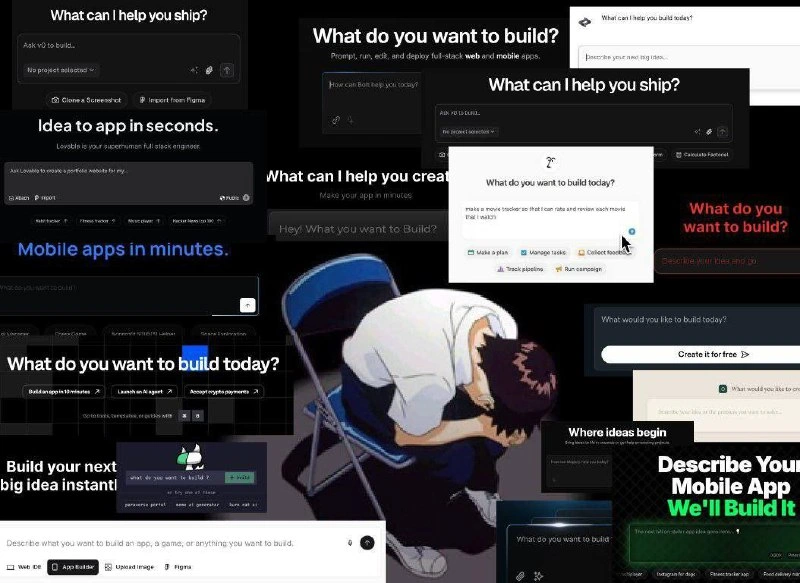
Let’s break down what’s happening in this meme in simpler terms. The image is a collage of many website screenshots, all from AI or “no-code” app builder platforms. No-code tools are services that let people create software applications without writing the code themselves. Instead, you might drag-and-drop elements or, in the recent AI-driven flavor, just type a description of what you want (this description is the prompt). Each of these screenshots has a text box interface asking essentially, “What do you want to build today?” They’re inviting the user (probably a developer or an entrepreneur) to input an idea in plain English. For example, you might type: “I want an app that lets users share photos with friends and comment on them.” The promise is the platform will then automatically generate the app for you – UI, backend and all – within minutes. Phrases seen like “Idea to app in seconds” or “Mobile apps in minutes” are bold claims that you can go from zero to a working app unbelievably fast.
In the center of the image, there’s an anime character sitting on a folding chair, head in hands, looking defeated. This character is actually Shinji Ikari from a famous anime (Neon Genesis Evangelion) often used in memes to represent someone in despair or existential dread. Here, Shinji represents a seasoned developer who’s just overwhelmed and tired. Why would a developer look so distraught in response to these cheerful UIs? Because experienced developers know building a real app is never as easy as “just describe it and done.” Each of those glossy platform promises can sound almost insulting to someone who’s spent nights and weekends dealing with real code. It’s as if these sites are saying, “Hey, it’s super easy, why are you working so hard?” when in reality, those same developers have encountered the pitfalls that aren’t mentioned in the ads.
Think about what happens when you actually use one of these AI app generators. You type your idea, and maybe it does generate something – say, a basic mobile app with a couple of screens that match your description. Neat! But as soon as you try to go beyond that basic prototype, you hit the limits. For instance, the generated app might not handle errors properly, or maybe it doesn’t scale if you add more than a few users. If you want to customize the app (which most real projects require), you often have to dive into the code it produced or into some configuration panels. Suddenly, you do need to know how the code works. This is why we cheekily title this level “When ‘No-Code’ Needs Code” – because in practice, no-code tools often still require coding when you push them to do something specific that isn’t pre-built. Junior devs or newcomers might not expect that. They might think, “This tool will do everything for me, because it says ‘no coding required.’” The seasoned dev in the meme, however, has probably been burned by that promise before: they know that at some point they’ll be opening the hood and getting into actual code or troubleshooting why the “instantly built” app isn’t quite right.
Let’s also talk about Developer Experience (DX) and why these platforms exist. There’s a genuine demand to make programming easier and faster – that’s the whole field of improving DX. Over the years, we’ve built higher-level languages and frameworks, all to help developers build more with less effort. AI-generated code is the latest step on that road. It sounds awesome: “Describe what you want, and the computer does the boring parts.” And to be fair, modern AI tools like this can be helpful for generating snippets of code or quick prototypes. The funny (and painful) part comes when every new service markets itself as the ultimate solution. Our meme is saying there’s a flood of such services now – so many that their websites all blur together, each claiming to be the revolutionary one. It’s like dozens of vendors all shouting the same thing; after a while, a developer just hears noise. That’s why in the image description they mention “DX noise that senior devs must filter daily.” A junior dev might not have experienced this yet, but imagine if every single day on your social media or tech news, you see a headline: “New AI Tool – Build Apps in 5 Minutes.” Initially, you’d be excited, but by the 30th time, you start rolling your eyes. It becomes hard to tell which tools are actually useful and which are just riding the hype. This is AI_hype overload.
We should clarify some terms that appear in the tags:
- AIHypeVsReality: This refers to the contrast between the exciting promises made about AI (hype) and the actual results you get (reality). In this meme, the hype is “AI will build your entire app from a prompt.” The reality is, “you often get a very rough draft that still needs lots of work.”
- Prompt engineering: This is a new skill in the AI era. It means crafting your input prompt carefully to try to get the AI to produce the best output. If you’ve ever worded a Google search very particularly to get better results, it’s similar. Developers find themselves doing this with AI code generators: tweaking the description over and over (like “hmm, the app didn’t include a login, let me mention login in the prompt”). The meme’s context tag prompt_engineering_fatigue hints that having to iterate on prompts repeatedly can become a tiring task on its own.
- No_code_prompts / AI_app_generators: “No-code” means the user isn’t writing code; “AI app generator” is the tool that creates the app. So a “no-code prompt” is basically what these platforms ask for – a description from a non-coder or any user – and then they handle the coding part automatically.
- Full-stack instantly claims: “Full-stack” means both the front-end (what you see in the app) and back-end (the server, database, etc.) components of an application. Some of these tools brag they handle the entire stack instantly. That’s a bold claim because full-stack development normally involves multiple layers and expertise. The meme makes fun of all these build_your_app_in_minutes style claims, because an experienced dev knows each layer has its challenges.
In simpler terms, the meme is relatable because many developers have felt this scenario: you see a cool new tool that says it will save you tons of time. You might even try it. But then you discover it’s not a magic wand – maybe it produces something half-baked, and you end up spending more time fixing or adjusting it. It’s a bit of a running joke in development: “We got this new tool to save time, but now we’re spending time dealing with the tool!” So the anime guy clutching his head in the middle is basically every developer who’s had that “Oh no, not again…” reaction. He’s overwhelmed because he’s thinking, “If I actually attempted to try all these ‘time-saving’ platforms, I’d have no time left to do real work!” It’s comedic exaggeration, of course – nobody literally sits surrounded by floating app builder UIs like Shinji in the Eva cockpit – but emotionally it captures that mix of frustration, fatigue, and a dash of humor at the whole situation.
Level 3: Hype Cycle Hangover
Zooming out to a senior developer’s perspective, this meme hits with a “here we go again” sigh. It collages a dozen nearly identical dark-mode landing pages, each asking some variant of “What do you want to build today?” in upbeat white text. Every tile boasts slogans like “Idea to app in seconds”, “Mobile apps in minutes.”, “Describe your app – we’ll build it.” It’s like a broken record of AI hype. The seasoned dev immediately recognizes this pattern from countless IndustryTrends_Hype cycles: a hot new technology emerges (today it’s Generative AI), and suddenly every startup and cloud vendor spins it as a magic bullet for productivity. The humor (laced with pain) comes from the sheer volume of clone products all making the same pitch. They even copy each other’s minimalist UI design – black backgrounds, neon accents, a single prompt box – as if looking futuristic substitutes for being practical. It’s a marketing_copy_clone frenzy, and our poor developer (represented by that anime character in existential dread) is overwhelmed by the noise. After the 30th time seeing “Build your next big idea instantly!”, any experienced engineer would be rubbing their temples.
Why? Because they’ve heard this song and dance before. The meme’s central figure – depicted by Shinji Ikari in the classic “head-in-hands” shinji_chair_memepose of despair – mirrors a dev’s feeling of “Not another one.” In the 90s it was 4GLs and CASE tools claiming to auto-generate enterprise software. In the 2000s, it was drag-and-drop app builders and glorified CMS platforms. A few years ago, low-code was the buzzword. Now it’s AI_app_generators promising to do the heavy lifting. Each time, the promise is the same: DeveloperExperience_DX revolution, “you won’t have to code the boring parts, just point and click (or just tell the AI) and voilà!” And each time, reality sets in: the generated app handles a toy scenario at best, and falls apart or requires massive tweaking for anything real. Fundamentally, these tools excel at generating starting points – maybe a boilerplate project with some generic screens. But they gloss over the last mile problems: performance tuning, security, custom business logic, cross-system integration, edge-case handling, i.e., all the stuff that actually keeps developers employed. The meme highlights that AIHypeVsReality gap with that huddled, defeated posture: the dev knows that shipping a maintainable, robust app is never truly “instant.” It might take minutes to get a demo running, but it takes weeks or months to get something production-ready.
There’s also a note of toolingFrustration and information overload. Modern devs are bombarded daily with “awesome new tools” threads and AI demos. Keeping up feels like chasing a speeding train – exhausting. Here, our dev can’t escape the repetitive prompt: “What can I help you ship?” It’s the same question everywhere, almost a taunt. After all, if it were that easy, would developers still be working late fixing deployment issues or corner-case bugs? It’s relatable humor: we laugh because we’ve all clicked those flashy demos thinking “maybe this one does solve it,” only to discover limitations. The tags like no_code_prompts and build_your_app_in_minutes capture exactly the sort of phrasing saturating tech media that triggers a senior dev’s skepticism.
Importantly, the meme also hints at a developer’s existential dread: a mix of fear and fatigue. Fear, perhaps, that one day a tool will replace a lot of their work (a common anxiety with each new wave of automation). And fatigue from constantly evaluating shiny tools that over-promise and under-deliver. It’s mentally draining to remain open-minded yet critical every single day. There’s a kind of gallows humor here: the anime character’s posture screams “I can’t take this nonsense anymore,” which seniors might feel internally whenever a CEO forwards them a TechCrunch article about “AI coding assistant – now anyone can be a developer!”. Cue the dev thinking: “Great, now I have to explain (again) that building an app involves more than just generating code, it’s also understanding user needs, architecture, testing, maintenance…”.
The disparity between AIhype and actual developer toil can be illustrated by how a senior interprets those slogans. For example:
| Tagline Says... | Senior Dev Hears... |
|---|---|
| “Mobile apps in minutes.” | “Here’s a quick scaffold, you’ll spend weeks finishing it.” |
| “Describe it, we’ll build it.” | “We’ll produce draft code; you debug and refine it.” |
| “No coding required!” | “...Until something breaks or needs customization.” |
| “AI does the heavy lifting.” | “AI handles the trivial 50%, you handle the hard parts.” |
This tongue-in-cheek table translates marketing speak to reality. It’s not that these tools are useless – they can save time on boilerplate – but the meme is a senior’s eye-roll at how marketing glosses over the inevitable gotchas. Seasoned devs have a sense for spotting AIHype: as soon as a site says “Idea to app in seconds,” the immediate mental retort is “Sure, and I have a bridge to sell you.” We know that after the shiny demo, there’s configuration to do, code to clean up, and likely a slew of DeveloperPainPoints hiding just off-screen (did the AI consider data migrations? accessibility? scaling beyond 10 users? Probably not).
The relatableDeveloperExperience here is also about pattern fatigue. The collage format – dozens of near-identical UIs and taglines – suggests the dev has seen so many of these that they all blur together. It’s humorous how each startup thinks it’s unique, yet they all copy the same catchphrases. It’s basically meme-ifying the startup pitch template. A jaded engineer could probably predict when a new one comes along: “Let me guess, dark-themed landing page, big bold What do you want to build? heading, maybe a rocket or lightning icon, and claims of ‘no code needed’.” And lo and behold, that’s exactly what the image shows. It’s a ModernTooling gold rush, and everyone’s panning in the same stream with the same pan. The Shinji-figure in the middle embodies the collective groan of developers who’ve been promised “magic” one too many times. He’s basically thinking, “I just want to write stable code and not chase the 100th trendy tool that promises to do it for me.”
Finally, consider the context of DeveloperExperience_DX: these AI builders are ostensibly about improving DX – making it easier to create software. Ironically, a senior dev might argue they sometimes worsen DX: you end up wrestling with the tool’s quirks instead of your own code. For example, you might spend an afternoon figuring out how to coerce the AI’s prompt to include a feature it left out – a new kind of prompt_engineering_fatigue – whereas writing the feature by hand might have been faster. Or you get a project generated, but now you have to learn that platform’s specific framework or fix layout issues the generator introduced. In other words, the cognitive load doesn’t vanish, it just shifts. The meme nails this dichotomy: the cheerful question “What do you want to build?” implies utter simplicity, while the dev’s body language replies, “Ugh… where do I even begin with that question?” In practice, the more realistic prompt is “What do I need to fix today?” – something no slick AI promo site is eager to ask.
Level 4: Program Synthesis Paradox
At the cutting edge of AI/ML, tools claim they can generate entire applications from a single prompt – essentially attempting program synthesis in one shot. Under the hood, these systems often leverage large language models (think GPT-like transformers) trained on heaps of code. In theory, you describe what you want (“a full-stack web and mobile app for X”) and the AI produces code for UI, backend, database schemas – the whole stack. But here’s the paradox: fully specifying a non-trivial program in natural language is as hard as writing the code itself. Computer science has long known that converting an ambiguous, high-level spec into a correct program is an undecidable problem in the general case (thanks, Halting Problem!). Even constrained approaches – like formal specification languages or model-driven development – hit combinatorial explosions of complexity. There’s a reason Turing completeness comes with the infamous Turing tar-pit: a system flexible enough to do anything (build any app) makes it non-trivial to do any particular thing correctly without detail.
These “build-anything” AI platforms essentially attempt a very hard search problem: traversing the vast space of possible programs to find one that fits a one-sentence description. It’s a bit like solving a complex multi-variable equation with most of the parameters undefined. No Free Lunch Theorem principles from ML whisper that a single general approach won’t magically solve all programming tasks optimally – trade-offs are inevitable. Sure, an AI might quickly cough up a CRUD app boilerplate (create-read-update-delete interfaces are common and easier to predict), but ask for something more specific or domain-heavy and the AI’s confidence can turn into nonsense (hallucinated APIs, anyone?). The meme’s humor stems from this fundamental mismatch: the glossy UIs show a simple text box (“What do you want to build?”) as if software creation has become O(1) time complexity. Meanwhile, seasoned devs know that real-world software involves plenty of iteration, debugging, and domain understanding – things you can’t instantly bypass with a cute prompt. It’s essentially highlighting the program synthesis paradox: the marketing suggests software can be conjured like a genie granting a wish, but theoretical limits and practical data show that even the most advanced automation can’t escape the underlying complexity of the problem space.
To put it another way, describing the right app completely is as hard as coding it. If you leave details out, an AI will fill in the blanks with average guesses (often literally, using statistical patterns from training data). Those defaults might be wrong for your case, leading to an app that “works” only in the happy path but crumbles on edge cases. Formal methods in academia try to prove program correctness from specs – a daunting task even with mathematically precise specs, let alone a one-line English request. Each additional requirement (“oh, it should support multi-user roles, and reconcile transactions, and …”) multiplies the complexity. The meme’s central figure – the despairing anime dev – implicitly understands this impossibility: he’s figuratively sitting at the intersection of computability theory and industry hype, facepalming because deep down he knows a one-click full-stack solution lives in the realm of science fiction (or perpetually “almost here” tech demos). In summary, this level exposes why the meme resonates on a nerdy plane: it’s poking fun at the idea that abstraction can completely eliminate complexity. As every CS theorist or battle-worn architect will tell you, you can move the complexity around (hide it behind an AI interface), but you can’t just make it vanish – not without consequences that someone (guess who?) will have to deal with.
Description
This meme features the character Shinji Ikari from the anime series 'Neon Genesis Evangelion' slumped over in a chair, a visual icon of despair and anxiety. He is surrounded by a chaotic collage of overlapping screenshots from various modern AI-powered no-code/low-code development tools and code assistants. These screenshots all display relentlessly optimistic and open-ended prompts, such as 'What do you want to build?', 'What can I help you ship?', 'Idea to app in seconds.', 'Mobile apps in minutes.', and 'Describe Your Mobile App We'll Build It'. The stark contrast between Shinji's emotional breakdown and the cheerful, demanding nature of the user interfaces creates the central conflict. The technical commentary is on the psychological pressure exerted by the current wave of AI development tools. While they promise to democratize and accelerate creation, they also create an overwhelming expectation of constant innovation and productivity. The meme resonates with senior developers who understand that the real challenge isn't the initial act of creation, but the subsequent maintenance, scaling, and dealing with complexity - aspects these tools often trivialize. It captures the feeling of creative burnout or paralysis when faced with the 'tyranny of the blank canvas,' amplified by tools that suggest building the next big thing should be effortless
Comments
8Comment deleted
The AI asks, 'What do you want to build?' I want to build a feature flag that turns off the part of my brain that feels existential dread every time I see this prompt
I’ve answered “What do you want to build today?” so many times that the prompt queue now has better uptime than half the microservices it promises to replace
After 20 years of building distributed systems, I've learned that the only thing that ships in 'seconds' is technical debt with a no-code wrapper and a $299/month subscription that still requires three senior engineers to debug the webhook integrations
When you've seen the 47th AI tool this week promising to turn your napkin sketch into a production-ready microservices architecture in 'seconds,' and you're just sitting there remembering that time you spent three days debugging why the AI-generated code was using a deprecated API, had no error handling, and somehow managed to create a memory leak in a stateless function. The tools say 'ship faster,' but your chair says 'I've seen things you people wouldn't believe.'
No-code: Ship prototypes in minutes, then rewrite in actual code when scalability demands a real architecture
Every page says “What do you want to build?” - I want versioned APIs, deterministic builds, and sane migrations; the wizard gives me “mobile apps in minutes” and lifelong vendor lock‑in in seconds
I typed “multi‑tenant, GDPR‑compliant, event‑sourced platform with SSO, audit logs, and blue/green deploys” - the builder generated a todo app and an upsell to the Enterprise plan
Literally my feelings as i keep hearing how everyone uses ai for their assigments in uni. Comment deleted