Skip to content
DevMeme
6039 of 7435
Internal monologue vs. professional feedback in tech
CodeReviews Post #6612, on Apr 1, 2025 in TG

Internal monologue vs. professional feedback in tech

Why is this CodeReviews meme funny?

Level 1: Polite Outside, Angry Inside

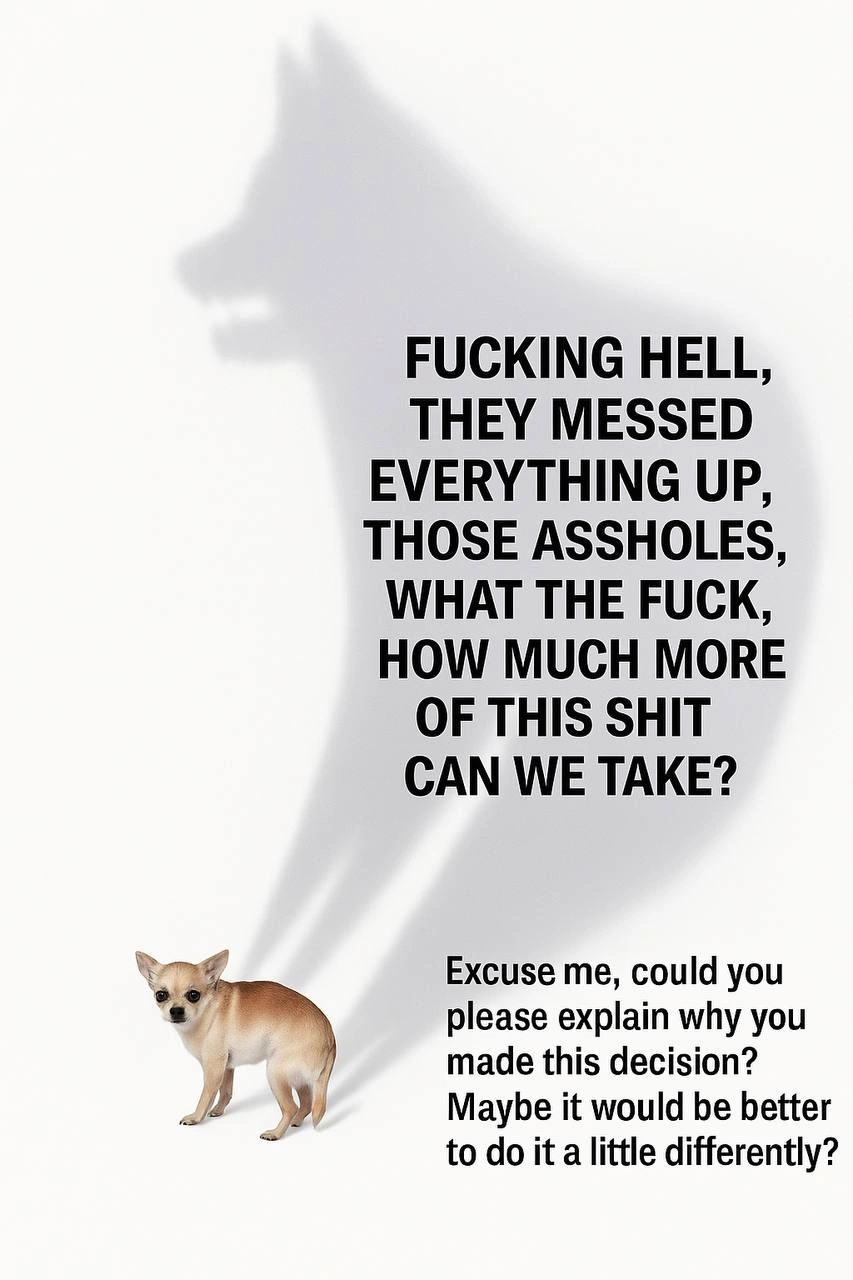
Imagine you built a big sandcastle with your friend, and then your friend accidentally knocks it down. Inside, you feel super angry – you want to yell, maybe even call them a mean name, because you worked hard on it and now it’s ruined. That’s the big scary dog shadow in the picture: it shows the huge anger you’re feeling on the inside. But on the outside, you remember to stay calm and polite because you still like your friend and don’t want to hurt their feelings. So instead of shouting, you say in a nice voice, “Hey, I saw the sandcastle fell. Could you tell me what happened? Maybe we can rebuild it a little differently so it’s stronger.” That’s you being like the tiny chihuahua in the picture: small and polite. The joke is that even though you feel like a big furious dog inside, you act like a gentle little dog on the outside to keep things friendly. This is funny because it’s true for grown-up programmers too – when someone breaks something important, they have to calm down and ask nicely about it, even if they’re really upset inside.

Level 2: Code Review Etiquette

Let’s break down what’s happening in this meme in simpler terms. In software development teams, a code review is a process where other developers examine your code changes before those changes get merged (integrated) into the main project. Usually this happens via a pull request (often abbreviated PR). A pull request is when you say, “Hey, I have some new code, can someone look at it and approve merging it in?” It’s a core part of collaboration on platforms like GitHub or GitLab. The idea is to catch bugs, improve code quality, and share knowledge. However, it’s also a situation where communication styles really matter.

Now, imagine you’re reviewing someone’s code and you find out their changes accidentally “messed everything up.” Maybe their code broke a feature or caused a bunch of new bugs or made the software fail tests. It’s normal to feel frustrated or even angry – after all, now you have to spend time fixing things or giving tough feedback. In your head, you might be screaming something like, “Oh no! Everything is broken because of this change. What were they thinking?!” The meme represents that internal anger with the big shadow of a huge, angry dog shouting an extremely angry rant full of curse words. This is the internal monologue – the thoughts the developer is having privately.

But here’s the catch: in a professional team, you can’t just dump your raw anger onto your colleague. Telling someone “Your code is garbage, you screwed up everything!” is not productive and would definitely cause a communication breakdown on the team. It would embarrass or demoralize the person who wrote the code and create a hostile atmosphere. That’s where code review etiquette comes in. Instead of yelling or using insults, you’re expected to give constructive feedback. Constructive feedback means phrasing your comments in a helpful way that focuses on the issue (the code) and not the person.

Look at the meme’s bottom text – that’s the small polite Chihuahua voice. It says: “Excuse me, could you please explain why you made this decision? Maybe it would be better to do it a little differently?” This is a textbook example of a polite code review comment. Let’s identify why it’s good:

  • It starts gently: “Excuse me, could you please explain…” – This shows respect and gives the original developer a chance to clarify their thinking. Maybe there was a good reason for the change that isn’t obvious at first glance.
  • It doesn’t accuse anyone of being stupid or doing a bad job. There’s no personal attack, just a request for explanation.
  • It then suggests “Maybe it would be better to do it a little differently?” – This is a soft suggestion. It implies there might be an alternative solution without outright saying “Your way is wrong.” It opens the door to discuss improvements collaboratively.

This kind of response is crucial for maintaining psychological safety on the team. Psychological safety is a term you’ll hear in corporate and team culture meaning everyone feels safe to share ideas or admit mistakes without fear of being yelled at or punished. When people feel safe, they’re more likely to be honest about problems and fix them, rather than hiding them.

In many workplaces (especially in tech companies with a modern WorkplaceCulture), there’s an emphasis on being “blameless” and positive when discussing mistakes. You might hear about blameless postmortems or blameless culture: this means when there’s a big problem (like a outage or a major bug), the team tries to focus on what went wrong in the process rather than “who screwed up.” They avoid pointing fingers because the goal is to learn and fix, not shame someone. The same idea applies to code reviews. Even if a developer made a mistake that you have to clean up, you’re supposed to address it calmly and avoid making it personal.

For a junior developer or someone new to code reviews, it can be surprising how much people police their tone in written comments. Many teams have unwritten rules or even documented guidelines for code review comments:

  • Use questions instead of commands. (E.g., “What do you think about naming this variable differently?” vs “Rename this stupid variable.”)
  • Use words like “we” or “this code” instead of “you.” (E.g., “Maybe we can refactor this section” instead of “You wrote this poorly.”)
  • Provide reasoning and educate when possible. (“We need to handle null here because the API might return nothing, which would crash the app.”)
  • Avoid absolute language or ridicule. (Don’t say “No competent developer would do X,” because that’s hurtful and arrogant.)

The meme humorously captures this contrast. Everyone who has been in a code review has probably had that moment: you want to write a scathing reply out of frustration, but you delete it and rewrite it in a very polite way. The tiny Chihuahua in the picture is how gentle and meek your comment comes out, whereas the huge raging dog shadow is how angry you actually felt. It’s a funny exaggeration of the DeveloperFrustration we keep inside to stay professional. In other words, on the surface you’re saying, “Could you clarify this part of the code?” but in your head you’re yelling, “This is all wrong! Fix it now!”

This difference is often jokingly referred to as a “filter.” People say things like, “Good thing I had my senior-dev filter on during that code review,” meaning they consciously filtered (cleaned up) their gut reaction into something more appropriate. Senior developers, in particular, are expected to set a good example and maintain a calm tone so that junior devs don’t feel attacked. It’s part of good Communication in a team. Being able to handle these situations with patience and tact is considered a senior-level skill. It helps keep the team working together smoothly even when tough feedback has to be given.

Level 3: Pull Request Anger Management

At a senior level, code reviews sometimes feel like an exercise in anger management. You open a pull request on Monday morning and discover that a colleague’s changes have completely broken the build again. Internally, your brain is firing off a dramatic internal_monologue that sounds a lot like the meme’s snarling shadow text: a blistering all-caps rant of “WTF, who wrote this garbage?!” and other unpublishable obscenities. But then the senior_dev_filter kicks in. Years of hard-earned survival skill compel you to take a deep breath, step away from the keyboard for a moment, and return to type out a calm, constructive comment instead. Instead of writing, “This is complete and utter nonsense, did you even test this?”, you end up with something like: “Excuse me, could you please explain why you made this decision? Maybe it would be better to do it a little differently?” – which is basically the corporate-approved translation of “HOW COULD YOU MESS THIS UP SO BADLY?!”

This meme nails the code_review_diplomacy that every experienced developer knows too well. It highlights the stark contrast between slack_vs_reality: the fury you might vent in a private Slack DM (or just scream internally at your screen) versus the measured tone you use on the public pull request thread for the sake of WorkplaceCulture. Seasoned devs have learned the hard way that unleashing raw frustration in a code review is a one-way ticket to team meltdown and endless CommunicationBreakdown. No one wants to be that developer who leaves a scathing comment and demoralizes a junior team member, sparking a flurry of HR emails or a tearful Zoom call. Instead, seniors practice a kind of Jedi mind trick: converting DeveloperFrustration into teachable moments. The visual of the tiny polite Chihuahua casting a huge raging shadow is hilariously accurate – the polite PR comment is the tiny dog we show to the world, while the enormous raging dog-shadow represents the monstrous scream we swallow.

There’s also a darkly funny blameless_postmortem_irony here. Modern dev teams preach blameless culture and psychological safety, meaning we criticize the code and not the person, focusing on processes rather than pointing fingers. In a blameless postmortem after a production outage, you’ll hear language like, “We had an unexpected issue when deploying the new feature,” instead of, “Bob’s terrible code broke the site.” Likewise, in a code review we say, “Maybe we could add more tests here,” not, “You obviously didn’t test this at all, did you?” The irony is that inside, everyone knows when “some code” caused the outage, it was Bob’s code – just like inside, you want to yell at Bob for it. But you don’t. You keep it diplomatic to maintain team harmony (and because everybody remembers that one time someone else’s bug blew up prod). It’s a survival mechanism: by engaging rage_commit_avoidance and focusing on solutions, senior devs ensure the team keeps talking to each other. After all, today you’re tearing your hair out over someone else’s screw-up; tomorrow it might be your deployment that brings production to its knees. Best not to burn bridges with a flame-thrower comment, no matter how satisfying it would feel for 10 seconds.

In essence, this meme is relatable humor about the gap between what a developer wants to say and what they should say. Every senior engineer has worn that forced polite smile while typing a tactful code review comment with clenched teeth. It’s part of the unwritten job description. You become fluent in the language of suggestions and questions, rather than commands and insults. Think of it as running your feedback through an exception handler that catches the raw NullPointerException("This code is null and void!") rage and transforms it into a gentle print("Could you clarify this?"). 😉 Over years of on-call disasters and CodeReviewPainPoints, you learn that tempering your tone is not about being fake – it’s about being effective. A well-phrased suggestion is far more likely to result in the code getting fixed and the developer learning something, whereas a personal attack just puts people on the defensive. As the cynical veteran might say, “I’ve been to war with production bugs at 3 AM, I’ve survived releases that went completely sideways – I’m not about to lose it in a GitHub comment now. This old dog knows when to bark and when to just suggest a better way.”

Description

A meme contrasting internal thoughts with professional communication. On a plain white background, a small, timid chihuahua stands in the lower left. In the lower right, its polite, professionally worded feedback is written: 'Excuse me, could you please explain why you made this decision? Maybe it would be better to do it a little differently?'. However, the chihuahua casts a large, menacing shadow of a snarling wolf. Within this shadow, the unfiltered, internal monologue is displayed in large, bold letters: 'FUCKING HELL, THEY MESSED EVERYTHING UP, THOSE ASSHOLES, WHAT THE FUCK, HOW MUCH MORE OF THIS SHIT CAN WE TAKE?'. This meme perfectly captures the immense gap between the visceral frustration a senior developer feels when encountering terrible code or poor architectural decisions, and the carefully curated, diplomatic language required to address it in a professional setting like a code review or a team meeting
Comments

9
Anonymous ★ Top Pick My PR comments are just my internal monologue piped through a corporate-speak translation layer. 'This approach may have unintended side effects' is base64 for 'This will bring down production on a Friday.'
  1. Anonymous ★ Top Pick

    My PR comments are just my internal monologue piped through a corporate-speak translation layer. 'This approach may have unintended side effects' is base64 for 'This will bring down production on a Friday.'

  2. Anonymous

    Translation layer v2.0: converts 500 lines of WTF per minute into one calm ‘LGTM after minor nit’

  3. Anonymous

    After 15 years in the industry, you master the art of translating 'WHO THE FUCK APPROVED THIS ARCHITECTURAL DISASTER' into 'I wonder if we've considered the long-term scalability implications of this approach' - it's basically a compiler optimization for human resources violations

  4. Anonymous

    This perfectly captures the architectural review process: your internal monologue is screaming about SOLID violations, the complete absence of error handling, and database queries in a loop that would make any DBA weep - but externally, you're channeling your inner tech lead with 'I see you've chosen an interesting approach here. Have we considered the implications for our transaction boundaries and N+1 query patterns?' Because nothing says 'senior engineer' quite like the ability to translate 'this will bring down production' into 'perhaps we could explore alternative patterns.'

  5. Anonymous

    The real senior skill is turning a “rollback now” brain dump into a politely worded ADR request with three options, two trade‑offs, and zero HR tickets

  6. Anonymous

    At staff-plus level, the rant runs behind an API gateway that translates "who approved this?" into "could we revisit the tradeoffs?" and rate-limits expletives

  7. Anonymous

    Wolf: unchecked PR rant that blocks the merge. Chihuahua: tech lead's 'NIT' that actually lands the refactor

  8. @Infinitelineman 1y

    Before harassment training and after (you now harass "by rules")

  9. @ZgGPuo8dZef58K6hxxGVj3Z2 1y

    Nah I am the toxic coworker who will laugh at you dodgy code

Use J and K for navigation