Skip to content
DevMeme
5910 of 7435
The Perilous Task of Estimating Legacy Code Fixes
LegacySystems Post #6469, on Dec 20, 2024 in TG

The Perilous Task of Estimating Legacy Code Fixes

Why is this LegacySystems meme funny?

Level 1: The Big Blue Bar

Imagine you took a test in school and scored 5 out of 10 the first time, then studied a lot and scored 7 out of 10 on a harder test next time. The teacher might show the class a simple chart with two bars: the first bar up to 5 (for your first score) and the second bar much taller up to 7 (for your new score). Maybe the second bar is in a bright color to celebrate the improvement. Everyone would be impressed – you got much better! Some friends might playfully joke, “Wow, did you secretly get the answers beforehand?” because the jump is surprisingly big, but they’d also acknowledge that you clearly learned a lot more.

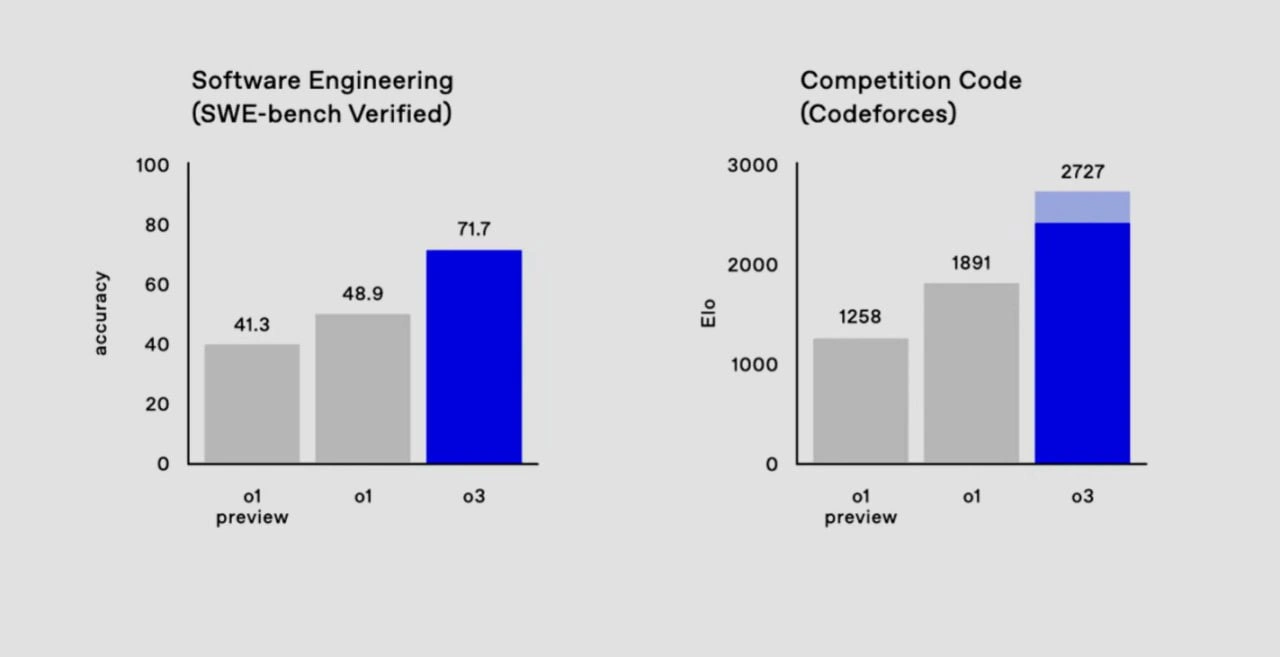
This meme is doing the same kind of thing, but with a smart computer program instead of a student. The program had an older version and a newer version. On the left, it shows how many coding challenges (like puzzles or tasks) the program solved correctly out of 100 – the new version solved about 72 out of 100, while the old one did about 49 out of 100. The blue bar for the new program is way taller, showing it did better. On the right, it’s like a score in a game (imagine a rating that goes up to 3000 points). The new program has around 2700 points, whereas the old one had around 1900. Again, the new blue bar is much taller, meaning a much higher score. In simple terms, the new version of the AI program is much stronger and more “skillful” than the old version, and the chart is bragging about that.

Why is this funny or interesting? Because it reminds us of those moments when someone brags by showing off a huge trophy next to a smaller one. It’s a bit of show-off humor. The big blue bar is like saying, “Look how awesome I am now!” in a single picture. People in tech have seen a lot of flashy claims about new gadgets and software, so we smile at this exaggerated display. We’re half-impressed – because wow, that’s a big improvement – and half-amused – because of course the makers of the new AI want to show it off in the most dramatic way. It’s like if a kid grew a foot taller over the summer and came back to school wearing neon platform shoes to make sure you really notice the difference. 🤭 The joke is in the playful over-the-top presentation of the improvement. Even if you’re not a tech person, you can understand that one bar shooting way above the others means “new thing good, old things not as good,” and the almost cartoony leap in height is what makes it a bit humorous. It’s both genuinely cool and a little cheeky, which is why it makes people smirk when they see it.

Level 2: Benchmark Scoreboard Explained

Let’s break down what’s happening in this meme in simpler terms. Essentially, we have an AI (specifically a Large Language Model (LLM) tuned for coding) and we’re comparing its performance across different versions on two kinds of tests. The meme uses a side-by-side bar chart to make the comparison clear and dramatic. On the left, it shows how well the AI does on software engineering tasks (think of things like writing code for a given task or fixing a bug in code). On the right, it shows how well the AI does on competitive programming problems (those tricky algorithm puzzles from coding competitions, like on a site called Codeforces). Each chart has three bars, representing three versions of this AI model: “o1 preview”, “o1”, and “o3”. You can think of those like version 0.1 (preview release), version 1.0, and version 3.0 of the AI, just using a shorthand. The labels “o1” and “o3” are also a playful reference to programming: compilers use flags like -O1 and -O3 to denote optimization levels (with -O3 meaning really optimized). So calling the new model o3 implies it’s an ultra-optimized, improved variant of o1. It’s a nerdy way to name versions, essentially saying “we’ve turned the dial up to 3 on this one.” 🚀

Now, what do the bars show?

  • Software Engineering (SWE-bench Verified) – This left chart has the y-axis labeled “accuracy” (0 to 100). That suggests they gave the AI a bunch of coding tasks and measured what percentage it got correct. “Verified” likely means the answers were actually checked by running the code or tests to be sure they truly work (not just looking at them). The bars tell us: the o1 preview got about 41.3 (so roughly 41% accuracy), the finalized o1 did about 48.9%, and the new o3 shoots up to 71.7%. That’s a big jump! In plain terms, if there were 100 coding problems or bug-fixes, the early version solved ~41 correctly, the first version solved ~49, and the new version solved ~72 out of 100. Going from solving about half to nearly three-quarters of the tasks is a major improvement. It signals that o3 is much better at those software engineering challenges – maybe it can fix many more bugs or implement features correctly far more often than its predecessor.

  • Competition Code (Codeforces) – The right chart’s y-axis is labeled “Elo” ranging up to 3000. Elo is a way to rank skill levels (originally from chess, and used on Codeforces for competitor ratings). Higher is better, and it’s not linear: going from, say, 1250 to 1891 is a significant jump in skill, and 2727 is huge. The bars here show the model’s performance on competitive programming problems, expressed as an Elo rating. The o1 preview was around 1258, the o1 model about 1891, and o3 leaps to roughly 2500+, with a note showing 2727 at the top of the bar. To put that in context: on Codeforces, a newbie might start around a 800-1000 rating, a good programmer might be 1500-1800, and really strong competitors (masters) are 2000+. Grandmasters (the top tier humans) are 2400 and above, with the best approaching 3000. So, o1 (at 1891) was already pretty competent – like it could beat many casual human programmers in contests. But o3 nearing 2727 implies it’s entering the elite range – that’s a level where it could challenge some of the best human competitive programmers. In simple terms, o3 can solve competition problems that the old version couldn’t, and do it consistently enough to earn a top-tier score. It’s like the AI went from college-level competition skills to almost world-champion skills in one upgrade. No wonder that bar is towering and in bright blue! They want you to notice it. 😃

So, overall, both charts are telling the same story: the new AI model (o3) is a lot better than the old one (o1) on these tests. The left says it’s much better at real-world coding tasks (fixing bugs, building features correctly), and the right says it’s significantly better at those tough algorithmic puzzles. For a developer or someone in tech, those claims are very attention-grabbing. It’s like saying, “Our new version isn’t just a little tweak – it’s a leap forward.”

Now, a few terms and tags were mentioned, which we can explain:

  • LLM: This stands for Large Language Model. It’s basically a type of AI that’s been trained on huge amounts of text (like books, websites, code, etc.) to learn how to generate text that humans find meaningful. ChatGPT is an example of an LLM. When you feed an LLM a prompt, it tries to continue or answer based on patterns it learned. In this meme’s context, the LLM is specialized in code, meaning it was trained heavily on programming data, so it can write code, fix code, or solve programming questions.

  • SWE-bench: Likely short for “Software Engineering Benchmark”. This isn’t a standard acronym you’d see every day, but here it means a set of tasks meant to represent real software engineering problems. For instance, it could include tasks like: “Here’s a piece of code with a bug – find and fix it,” or “Implement a function that does X based on this specification.” When they say Verified, it implies that for each task, the AI’s solution was checked, probably by running tests (like unit tests or sample inputs/outputs) to ensure the solution actually works. That’s important because an AI could write something that looks convincing but doesn’t actually run correctly – verification catches that. So an accuracy of 71.7% means out of all the tasks in this benchmark, 71.7% of the time the AI produced a correct, working solution.

  • Codeforces Elo: Codeforces is a popular online platform where programmers compete in timed contests, solving algorithmic problems (like puzzle-like coding challenges). It’s quite well-known among developers who enjoy competitive coding (sort of like the Olympics of coding puzzles, held regularly online). Elo is a rating system to rank competitors; you gain rating when you do well in contests and lose when you do poorly. The numbers roughly indicate skill – higher means you consistently solve more and harder problems under pressure. So when the chart says the AI has an Elo of 2727 in Codeforces terms, it means if the AI were a participant, it would be rated 2727, which is incredibly high. This suggests the AI can solve many hard problems quickly and reliably (at least in a practice setup). It’s basically a measure of the AI’s problem-solving performance.

  • o1 preview / o1 / o3: These are the version labels of the AI model, as mentioned. Possibly this refers to some product from a company (the context tag says openai_o3, hinting it might be an OpenAI model or a similar lab’s model). But even without knowing the exact origin, you can treat it like version 0.1 (preview) -> 1.0 -> 3.0. It is a bit unusual to jump from 1 to 3; maybe there was an “o2” internally that they didn’t publicize, or they just named the big new jump "3" to emphasize how major it is. The compiler optimization reference is a bit of an inside joke: in programming, -O3 is literally a flag meaning “optimize as much as possible”. So calling the model o3 gives a wink to developers that “we’ve turned on all the optimizations on this AI.”

  • Benchmark: A benchmark is a test or set of tests designed to compare performance. In machine learning, there are lots of benchmarks to evaluate models on different tasks. Here, SWE-bench and Codeforces problems are two different benchmarks to measure coding ability. Think of them as standardized exams for code-writing AI: one exam for practical coding tasks, another exam for competitive puzzle problems. By comparing scores on these, researchers or companies track progress from one version of an AI to another.

  • Performance: This category/tag just indicates we’re talking about how well something performs – here the accuracy and Elo scores are performance metrics. It’s about speed or success rates or scores, as opposed to, say, new features or capabilities. Everyone loves to brag when the numbers go up.

  • IndustryTrends_Hype: This tag is telling us that the meme is also commenting on a broader industry trend – namely the hype around AI improvements. In the tech industry, whenever a new model or tool comes out that’s markedly better, there’s a lot of buzz (sometimes over-the-top excitement). Each new breakthrough gets touted as game-changing, often with marketing teams highlighting the biggest jumps in metrics (like this bar chart does). The meme title “Bar-chart brag” itself is poking at that phenomenon: companies love showing bar charts that make their new thing look revolutionary. Developers have seen this pattern again and again, so it’s become something we nod and smile at. It’s impressive, but sometimes the hype promises a bit more than the reality will deliver immediately.

So, in simpler words: this meme is basically showing “New AI model vs Old AI model – look how much better the new one is!” The tall blue bar is the star of the show, leaving the smaller gray bars in the dust. It’s funny to developers because it’s such a classic way of boasting in tech. We’ve all sat through presentations where someone shows a dramatic chart like this. Here it’s distilled into meme form. It touches on AI hype (every new model claims to be a giant leap), and it also tickles that part of developers who understand the references (like the o3 naming). If you’re new to this, don’t worry – it’s basically just a mix of genuine excitement (“Whoa, it got that much better at coding!”) and a gentle ribbing of AI marketing (“Alright, we get it, your blue bar is huge.”). The takeaway is: AIs are improving really fast at coding tasks – almost unbelievably fast – and the meme is how we’re both marveling at and lightly joking about that fact.


Level 3: Overdrive or Overhype

Zooming out to a senior engineer’s perspective, this bar-chart brag provokes a mix of “Wow!” and “Wait a minute…”. The meme’s style is straight out of a tech keynote: minimalist graphs, tidy labels, and one blazingly tall bar to make us all ooh and aah. The left chart title, “Software Engineering (SWE-bench Verified)”, and the right, “Competition Code (Codeforces)”, sound official and very serious. It’s like the AI equivalent of saying “Clinical study shows our product works 50% better” – meant to squash any doubt with hard numbers.

The x-axis labels give away the inside joke: o1 preview, o1, and o3. Clearly version names of the model, but any programmer’s brain immediately parses those as -O1 and -O3 optimization levels. It’s a cheeky nod: in C/C++ compiling, -O1 is basic optimization, while -O3 cranks all the dials to eleven. So when we see o3 towering over o1, it subconsciously clicks – of course the code runs faster/better at -O3! They’ve effectively branded their AI like a compiler optimization setting, signaling to geeks that this version is the fully optimized, no-holds-barred mode. (One could almost ask, tongue-in-cheek: did they skip o2 because moderate upgrades don’t make for flashy memes? Marketing may prefer to jump straight to the “full turbo” label. After all, Windows went from 8 to 10, and we all noticed there was no 9 – sometimes you just skip a number to seem that much more advanced.)

Now, why is this funny to those of us in the trenches? Because we’ve lived this dance between hype and reality. Every few months, some new AI_ML marvel is announced with a glossy chart touting huge gains. We’ve sat through meetings where higher-ups giddily show such slides: “Look, our AI tool’s productivity score went up 50%!” and everyone glances around wondering, “So... why is our bug tracker still on fire?”. This meme compresses that experience into a single image: a jaw-dropping improvement that has to be part real, part showman’s flair. The AIIndustryTrends vibe here is strong – the fast-moving LLM benchmark race is almost comical in how each new model leapfrogs the last. It’s like watching a hyperactive version of Moore’s Law but for AI performance: today’s state-of-the-art becomes tomorrow’s baseline in record time.

The left bar chart (SWE-bench accuracy) likely speaks to every developer who’s battled a stubborn bug. It claims this AI can fix or implement code correctly ~71% of the time versus ~49% before. Imagine an AI that can solve 7 out of 10 tricky coding tasks you throw at it. That’s legitimately exciting — it’s approaching a junior dev’s output on certain tasks. But the seasoned folks recall earlier promises: “AI will eliminate debugging! AI will write all your unit tests by itself!” Those never quite panned out as cleanly as the promise. So when we see 71.7% with a “Verified” stamp, we grin and think, “Alright, show me the 29% it got wrong – that’s where the real fun (read: debugging hell) begins.” Often those failures are spectacularly bizarre. A highly “optimized” model might fix 7 bugs and then, on the 8th, confidently refactor your entire codebase into nonsense because it thought it found a pattern. It’s like a car that’s very fast when it stays on the road, but every now and then takes a hard left off a cliff. Experienced devs have learned to admire the speed but still keep one foot on the brake.

The right bar chart, boasting a Codeforces Elo of 2727, is equally eyebrow-raising. For context, Codeforces is an online competitive programming arena where humans solve complex algorithmic puzzles under time pressure. Elo is the rating system (borrowed from chess) that ranks contestants – cross ~2400 and you’re a Grandmaster in coder-land. So o1 at 1891 was already like a strong collegiate competitor, and o3 nearing 2727 is elite, possibly top 50 in the world territory if it were a human. That’s an “AI prodigy” claim. Senior engineers who follow these things might recall that DeepMind’s AlphaCode (an earlier AI coder) achieved roughly a 1200-1500 Elo, basically rookie level in contests. Even OpenAI’s GPT models, which wowed us with coding prowess, weren’t hitting Grandmaster scores on these hard, time-constrained problems. So seeing 2727 is both holy cow! and hmmmm…. It’s such a jump that it triggers the AIHypeVsReality sensor. Either they made a fundamental breakthrough in algorithmic reasoning, or they found a way to game the contest format (like unlimited trial submissions, or trained on the entire archive of past Codeforces problems – memorizing the tricks). It might be a bit of both, but seasoned devs know not to take such claims entirely at face value until replicated outside the lab.

Another comedic layer here is the constant re-optimization cycle this meme nods at. “o1 preview” to “o1” to “o3” all in presumably short order – it feels like we’re getting new model versions as fast as app updates. Today’s AI is O1, next week it’s O3, who knows, maybe by Q1 of next year we’ll see O5 Ultra with another giant leap. It highlights the almost absurd speed of AI development now. Folks in industry joke that you barely finish integrating one AI tool before a new, better one renders it obsolete. Keeping up is a mental treadmill. There’s both humor and exasperation in that: “Oh, you just bought the shiny AI? Cute, now here’s a shiner one, back to square one.” That IndustryTrends_Hype tag exists because many devs have felt the fatigue of the hype treadmill.

Let’s talk human dynamics: this meme’s big blue bar probably lit up some Slack channels with spicy commentary. You can picture a senior dev posting it with a dry caption, “Guess I’ll start polishing my resume, the machines are coming.” Half-joking, of course. There’s an underlying anxiety in the humor: if an AI truly becomes a 10x engineer who never sleeps, what happens to the rest of us? But then someone else replies, “Only if it can handle legacy Perl at 3 AM, then I’ll worry.” — reminding everyone that real-world coding has messy edges that AI might choke on. It’s a coping mechanism: we make memes and jokes to process the rapid change.

There’s even a whiff of “I’ve seen this movie before” in the tone. The Cynical Veteran vibe (that’s the voice you’re hearing now) comes from having watched grand promises falter. Remember when “AITools” like automatic code generators were going to replace junior devs a decade ago? They mostly produced boilerplate and weird bugs. Remember when IBM’s Watson was going to revolutionize everything? It beat Jeopardy, but it didn’t exactly take over as our coding overlord. So pardon us if we don’t immediately bow to the bar chart. We’ve learned the demo is not the deployment. The meme is funny because it’s true: the numbers are genuinely impressive and it’s likely only part of the story. We find ourselves both rooting for it (“wow, an AI that can fix my bugs, sign me up!”) and rolling our eyes a bit (“sure it can code jam, but can it name variables meaningfully – didn’t think so”).

To illustrate, imagine the hallway chat at a software company after this was posted:

CTO: “This new model can fix bugs 71% of the time! Maybe we can trim the QA team?”
Senior Dev (muttering): “Let’s have it handle the 3 AM outage call first, and see how that goes…”

It’s that blend of enthusiasm and hard-earned skepticism. The Performance gains are incredible on paper, but we know paper (or PowerPoint) is patient. In practice, someone still has to guardrail the AI, double-check that its “fix” didn’t introduce a security hole or degrade performance elsewhere. In a funny way, the meme’s big blue bar does excite us – who wouldn’t want a super-powerful coding assistant? – but it also validates our cynical inner voice that says, “If it sounds too good to be true, run it in a staging environment first.”

In conclusion (well, not a formal conclusion, but a knowing nod): We’re laughing with a mix of awe and caution. The LLMHumor here is that we’re essentially bragging to ourselves about a creation we made, yet only we know how fragile that creation can be. The meme captures that perfectly with its bold bars: a visual brag that is both genuinely cool and a little self-aware ridiculous. Senior engineers see it and think, “Nice one, AI team – now excuse me while I both applaud and prepare for the bug reports.”


Level 4: Overfitting the Benchmarks

Deep under the hood, this meme hints at the classic problem of benchmark-specific optimization. The dramatic rise in scores from o1 to o3 invites the question: did we create a genuinely more intelligent model, or did we effectively overfit to the benchmarks? (Hello, Goodhart’s Law: “When a measure becomes a target, it ceases to be a good measure.”) To achieve a 2727 Elo on Codeforces, an AI likely employs strategies beyond a vanilla transformer spitting out one solution. It might generate hundreds of candidate programs and run them against test cases, akin to DeepMind’s AlphaCode approach – effectively performing a brute-force search in program space guided by the model’s probabilities. In fact, one could imagine a conceptual "O3" pseudocode strategy like:

# Pseudocode: an aggressive solve strategy for O3
solutions = []
for attempt in range(100):               # try multiple candidate solutions
    code = model.generate(problem)       # AI generates code for the problem
    if passes_all_tests(code):          # run code against test cases
        solutions.append(code)
        
return select_best(solutions) if solutions else None

Here, O3 isn’t just a bigger brain; it’s also a tireless coder that debugs by trial and error. This is analogous to a compiler’s -O3 flag trying many aggressive transformations (inlining, loop unrolling, vectorization) to squeeze out performance. An LLM at “O3” might likewise use advanced techniques: for example, breaking problems into sub-tasks (chain-of-thought prompting), executing generated code in a sandbox to verify outputs, and iteratively refining its answer. These extra steps dramatically boost success rates on tests — but blur the line between an end-to-end smarter model and a cleverly orchestrated system of brute-force + feedback.

The SWE-bench (Software Engineering benchmark) being “Verified” suggests that the model’s outputs were checked by actually running the code or using unit tests. That’s a rigorous bar: a naive code-generating model might produce plausible-looking code that fails when executed. Jumping from ~48.9% to 71.7% accuracy means o3 isn’t just chatting about code, it’s producing solutions that work far more often. Under the hood, this likely required improving reliability (no missing semicolons, correct syntax every time), handling edge-case logic, and possibly internal self-debugging (some research has LLMs analyze their own output errors and try again — a very “O3” style trick). In essence, o3 might incorporate a feedback loop: write code -> run code -> observe failures -> adjust, which o1 perhaps didn’t have. This systemic improvement yields a non-linear performance jump on the benchmark, as the chart gleefully shows.

From a theoretical perspective, the meme underscores the interplay between raw model capacity and specialized training. If o3’s leap comes from massively scaling parameters or training data (following the scaling laws that often yield smooth gains), one would expect a more gradual improvement, not a step change. Such a discrete jump hints that the model was fine-tuned on the task distribution or equipped with new capabilities. In competitive programming, that could mean o3 was trained or reinforced with lots of algorithmic problem examples (possibly even Codeforces problems or their patterns). This raises the specter of memorization vs generalization: an AI that’s exceptionally good at solving seen or very similar problems (thereby acing the benchmark) but might still fumble a truly novel puzzle. The veteran observer in us whispers, “Impressive… but did they coach the model for this exam?” It wouldn’t be the first time an AI topped a leaderboard through targeted prep.

Moreover, the computational cost of going from O1 to O3 likely exploded. Enabling “optimization level 3” for an LLM might involve longer inference time, more memory, or additional model passes. There’s an echo of algorithmic complexity here: maybe o1 answered in a single forward pass (O(n) time), whereas o3 is doing something more elaborate, potentially iterative (O(n * k) or worse, if it runs through multiple attempts or tools). It’s an ironic twist that an AI model named after higher optimization might actually be consuming way more compute to achieve these results – much like how -O3 optimizations consume more compilation time and can even produce binaries that hog more resources for the sake of speed. The Performance gains are real, but the efficiency trade-offs are lurking off-chart.

In summary, at this deepest level, the meme highlights how spectacular benchmark results often mix genuine breakthroughs with narrow optimizations. It’s both a celebration of how far we’ve pushed AI in coding and a reminder to read the fine print. The triumphant blue bar screams “Look, we solved it!”, while the seasoned engineer in the back of the room raises an eyebrow, thinking: “Is O3 truly a smarter coder, or did we just throw more GPUs and clever hacks at the problem?” The humor is in that unspoken skepticism hiding behind the awe — a big blue accomplishment tempered by the quiet suspicion that reality might be a bit more complicated than the slide lets on.


Description

A two-panel comic strip featuring a character asking for a task estimate. In the top panel, a figure representing a project manager or stakeholder, with a speech bubble, asks, 'Can you estimate this task? It's just a small change in the legacy module.' The text is clear and direct, setting up a common, seemingly innocent request. In the bottom panel, the scene shifts to a developer, depicted as a skeleton, sitting at a desk with an ancient-looking computer. The skeleton is still seemingly waiting or working, implying an immense passage of time. The room is dark, lit only by the green glow of the monochrome monitor, enhancing the feeling of a forgotten tomb. This meme humorously exaggerates the experience of working with legacy systems. A 'small change' can often unravel a deeply complex and poorly documented web of dependencies, turning a simple-sounding task into a career-defining archaeological dig. The skeleton represents the developer who naively accepted the task, only to perish while trying to understand and modify the ancient code
Comments

7
Anonymous ★ Top Pick Estimating a change in legacy code is like giving an ETA for excavating a mammoth with a teaspoon. You start with optimism, but you know you'll likely become a fossil yourself before you're done
  1. Anonymous ★ Top Pick

    Estimating a change in legacy code is like giving an ETA for excavating a mammoth with a teaspoon. You start with optimism, but you know you'll likely become a fossil yourself before you're done

  2. Anonymous

    Remember when ‘-O3’ was just the flag you passed to clang? Turns out marketing discovered it too - now the compiler and the language model both promise ‘instant 2700-Elo’ if you trust the benchmark slide

  3. Anonymous

    o3 hitting 2727 ELO on Codeforces while I'm still explaining to stakeholders why our senior engineers with 2400+ ratings keep rage-quitting after code review comments from an AI that solves their interview questions faster than they can read them

  4. Anonymous

    When your new model scores 2727 Elo on Codeforces, you're not just beating competitive programmers - you're making them question their career choices. Meanwhile, 71.7% on SWE-bench means it's finally ready to handle that legacy codebase refactor... or at least understand why nobody else wants to touch it

  5. Anonymous

    AI hits 2277 Elo on Codeforces puzzles, but SWE-bench slaps it with monorepo deps, flaky tests, and zero tribal knowledge

  6. Anonymous

    Cool - o3 is 2727 Elo; wake me when it keeps 71.7 on SWE‑bench while tracing a stale feature flag through three services and a flaky CI - Codeforces doesn’t award points for YAML

  7. Anonymous

    Great - o3 crushes SWE-bench and Codeforces; ping me when there’s a Prod‑bench where the missing 28.3% is CI flakes, IAM perms, and a 2am rollback

Use J and K for navigation