
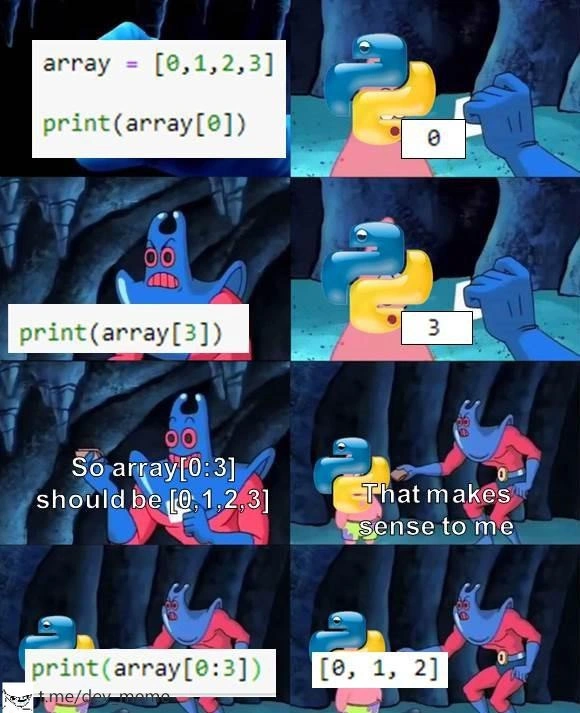
Python's Exclusive Relationship with Slicing
Description
An eight-panel meme using the 'Patrick Star's Wallet' format from Spongebob Squarepants to illustrate a common point of confusion in Python programming. A character (Man Ray) interacts with Patrick Star, who has the Python logo superimposed on his head, representing the Python interpreter. The meme demonstrates array indexing: `array[0]` correctly returns `0` and `array[3]` returns `3`. The developer character then logically assumes `array[0:3]` should produce the full list `[0,1,2,3]`, to which the Python-headed Patrick seems to agree. The punchline comes in the final panels when the code `print(array[0:3])` is executed, and the output is `[0, 1, 2]`, to the developer's shock. The humor hinges on the behavior of Python's list slicing, where the end index is exclusive. This is a classic 'gotcha' for developers new to Python, who expect the slice to be inclusive of the final index




Comments
7Comment deleted
Python's list slicing is the original 'it's not a bug, it's a feature.' It teaches you that in programming, as in life, the end is never included
Python didn’t fix the off-by-one bug; it shipped it as slice semantics - and 20 years later my staff engineers still sprinkle +1s in code reviews like Parmesan
After 20 years, I still explain Python slicing by drawing fence posts and fence sections on a whiteboard, then watch as junior devs have the same existential crisis I had in 2003
Ah yes, Python's slice notation - where `array[0:3]` gives you elements 0, 1, and 2, because apparently the end index is more of a 'suggestion of where to stop before reaching.' It's the programming equivalent of 'open until 9pm' meaning they lock the doors at 8:59. Senior devs have internalized this as 'half-open intervals' from their CS theory days, but watching junior developers discover that `range(10)` doesn't include 10 never gets old. At least it's consistent with how we all feel on Fridays: the weekend starts at index 5, but we're mentally checked out by 4
Half-open slices are the senior dev’s cheat code: len(a[i:j]) == j - i, turning off-by-one into a feature - until the PM reads “up to 3” in the spec
Python slicing: [0:3] grabs three elements but skips the fourth - exclusive ends, because who needs closure anyway?
Python slices are half-open: len(a[0:3]) == 3 is gloriously consistent while someone still points at 3 in code review asking where it went