A Programmer's Dictionary of Obfuscation
Why is this AI ML meme funny?
Level 1: Just Trust the Magic
Imagine you have three friends who each claim they solved a really tricky puzzle in different ways. You ask each of them, “Wow, how did you do that?”
Friend A smiles smugly and says, “Oh, I have a special method, but it’s a secret.” (They actually followed a clear set of instructions to solve the puzzle, but they don’t feel like explaining all the steps, so they just call it their “algorithm” and leave it at that. It’s like when a magician says, “I have my tricks,” instead of telling you how the trick works.) You’re a bit curious, but okay, they don’t want to explain. 🤷
Friend B looks a little puzzled and says, “Umm, I just tried a bunch of things until it worked. I’m not exactly sure which part did the trick.” (They didn’t have a sure plan; they were just guessing and checking, like trying different puzzle pieces randomly until something fit. This is what we’d call a “heuristic,” a fancy word for guessing smartly. They genuinely can’t tell you the exact steps because even they don’t know exactly – they were kind of feeling it out.) You get the sense that even the friend isn’t totally sure why what they did worked. 😅
Friend C throws up their hands and says, “Honestly, I didn’t solve it myself – I let a computer do it and it somehow figured it out!” (This friend used a computer program that learns by itself, kind of like a little robot brain. They gave the computer a ton of example puzzles and solutions, and the computer learned patterns and solved this puzzle on its own. But here’s the funny part: the friend doesn’t really know how the computer did it, just that it gave the right answer. It’s as if they sent the puzzle into a mysterious machine and out popped the solution. 🌟🤖) When you ask “But how does the computer do it?” the friend just shrugs and says, “I honestly don’t know, it just learned from examples.” It sounds like magic!
Now, why is this funny? Because usually when someone solves a puzzle or a problem, they can walk you through it. But here we have three increasing levels of not explaining:
- The first friend won’t explain (even though they could – they just choose not to).
- The second friend can’t really explain (because they tried things in a haphazard way, and there wasn’t a clear recipe).
- The third friend doesn’t know how it was done (because a computer did the learning and it’s a mystery to them too!).
It’s like three ways of saying “Just trust me”:
- “Trust me, I have a method.” 😉
- “Trust me, it just works somehow.” 🤞
- “Trust the computer, it knows what it’s doing (I think).” 🤖✨
We find it funny (and a bit true) that as the solutions get more high-tech, even the problem-solvers get more confused about how things happen. In the end, whether it’s a secret recipe, a lucky guess, or a clever robot, sometimes all a programmer (or a puzzle-solver) can say is, “It worked… please don’t ask me to explain why!”
Level 2: Fancy Terms, Simple Ideas
Let’s break down the buzzwords in this meme and see what they really mean in plain English. These are common terms in computer science fundamentals and AI/ML, but they’re being used here for a laugh:
Algorithm: In computer science, an algorithm is basically a recipe or a step-by-step plan for solving a problem. If you’ve ever followed instructions to assemble a LEGO set or a cookbook recipe, you’ve executed an algorithm! For example, a sorting algorithm might say: compare each pair of numbers and swap them until everything’s in order – clear steps you can follow. Normally, if a programmer writes an algorithm, they can explain each step of it because they designed it. However, in this meme, saying “It’s an algorithm” is jokey shorthand for “I’m not going to explain all the little details.” It’s like when you ask an older sibling how they solved a Rubik’s cube and they just shrug, “I used an algorithm.” Technically true (they did use a series of moves), but it doesn’t tell you anything useful about what they actually did. So here “algorithm” humorously means “I could explain it, but I’d rather not.” The programmer might fully understand their code, but they’re choosing to keep it vague – perhaps to sound impressive or to avoid a long lecture. It’s a bit of AI humor in that we often hear about algorithms everywhere, and sometimes people use the word without understanding it, almost like a magic word. In reality, though, an algorithm is usually the most explainable thing we create – it’s our own carefully written solution.
Heuristic: A heuristic is a shortcut or a best-guess method to get a solution that’s “good enough” when you can’t easily find the perfect solution. Think of it like a rule-of-thumb. If you’re trying to find your car in a huge parking lot, an algorithm might be to systematically walk up and down every row (guaranteed to find it, but slow!), whereas a heuristic is “I vaguely remember parking near a lamp post, so I’ll check those rows first.” The heuristic might save you time and probably works, but you can’t fully justify that it’s the best method – you’re just going on intuition and past experience. In programming, we use heuristics for hard problems: for example, a spam filter might use a heuristic rule like “emails with lots of $$$ signs are likely spam.” It’s not always right, but it’s a decent guess most of the time. Now, why does the meme say “when programmers can’t explain what they did”? Because with a heuristic, the logic isn’t ironclad. The developer’s conversation might go like: “Why does your program do X?” – “Well... it seemed to work when I tried it that way.” 😅 They can’t give a precise explanation because the solution wasn’t derived from strict logic, it was more “We tried this approach and it usually works.” It’s like when you ask a grandparent for their secret in a game and they say, “I don’t know, I just feel it out.” In tech, calling something “a heuristic” is an admission that “we don’t have a perfect formula, just a handy trick.” It sounds nicer than “guess,” right? But a junior developer should know: heuristic is not a scary word – it just means a practical approach that isn’t guaranteed to be perfect. It gets the job done, and we often choose it when an exact algorithm is too complicated or impossible. Just remember, if you hear “heuristic” you might also hear “we’ll fine-tune it later” – because it might need adjustments or only works in usual cases. It’s half science, half art – and that’s why explaining it can be hard!
Machine Learning (ML): Machine Learning is a fancy term for programs that learn from data. Instead of a human programmer writing down all the rules, the programmer gives the machine a lot of examples and a general method to learn, and the computer figures out its own rules or patterns. For instance, rather than coding an algorithm to recognize handwritten digits, we can feed a neural network thousands of sample images of each digit 0-9, and it “learns” the patterns that make a 5 look like a 5. The result is a model that can take a new image and (hopefully) output “This is a 5.” But here’s the catch: the rules the machine learns are buried inside the trained model – often a big blob of numbers (parameters). To the outside, it’s a black box model: you put input in, you get output out, but if you peek inside, you just see a lot of matrix weights or decision trees, not a simple easy-to-read checklist of steps. That’s why the meme jokes that machine learning is used “when programmers don’t know what they did.” It sounds silly – how can you not know what you did? – but what it means is the programmer didn’t hand-craft the solution, so even they aren’t 100% sure how the model is making its decisions. They know how they built the model (which algorithm and training data they used), but they might not know why the model made a specific choice on a specific input. For example, if a machine learning system predicts tomorrow’s weather, the developer can’t point to a single “if temperature > X then rain” rule; the logic is distributed across a complex model. For a junior, think of it like teaching a pet a trick: you show the dog how to roll over many times (training data), and eventually the dog learns to do it for a treat. But if your friend asks “How exactly did you teach your dog? What is the dog thinking when it rolls over?” – you can describe the training process but you don’t really know what’s in the dog’s head. The dog just learned it. Similarly, an ML program kind of develops its own way to solve the problem internally. Developers might say things like “the model weights indicate which features are important,” but that’s a bit abstract. In everyday development terms: when we integrate an ML model and it works, we’re happy – but if someone asks us to explain the precise logic, we end up describing the training procedure or data, not the step-by-step decision process (because we don’t have a simple step-by-step!). This lack of clear explainability is a big topic in AI – you’ll hear terms like “interpretability in AI” which is all about making ML models more understandable. But as the meme humorously points out, right now there are plenty of cases where even the programmer just trusts that the ML model got it right. If it misbehaves, we gather more data or tweak the training, but we often don’t have a neat explanation for its every move. So, machine learning in this joke is basically, “the computer wrote its own rules, and we kind of just watch it work.”
In summary, the meme is playing with these definitions: an algorithm (normally very explainable) becomes an excuse to NOT explain, a heuristic (a hazy approach) is admitted as something we CAN’T fully explain, and machine learning (super complex under the hood) is something even the creators DON’T KNOW how to explain stepwise. It’s contrasting ideal world vs real world:
- In an ideal world, every programmer can neatly explain every line of code or decision.
- In reality, we sometimes hide behind big words when the explanation is too tedious, too ad-hoc, or too uncertain.
For a new developer, the takeaway is: these terms have real meanings:
Algorithm = clear steps,
Heuristic = helpful shortcut,
Machine Learning = program learns from data.
But in daily programmer-speak (and in humor), they can also imply how clear or murky our understanding of the solution is. The more we rely on approximations or machine-generated solutions, the harder it is to explain in plain language. That’s the gap this meme is joking about – the explainability gap that grows from algorithm to heuristic to ML. And it’s poking fun at us programmers too: sometimes we act like magicians with technical jargon, especially when we’re not 100% confident in explaining our own work! 😁
Level 3: Black Box Blues
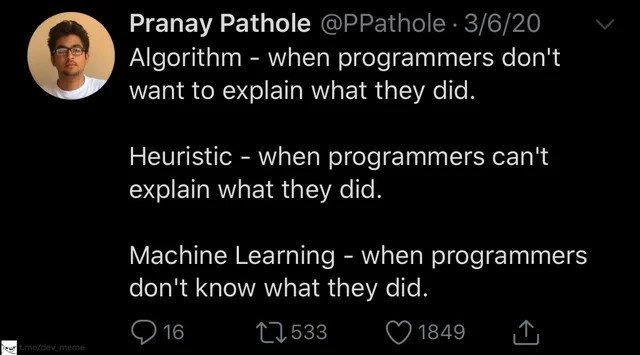
This meme hits home for many experienced developers by humorously categorizing three ways we explain (or fail to explain) our work. It’s funny because it’s relatable: we’ve all been in situations where we had to describe our code or solution to someone – a manager, a client, a teammate – and our answers fell into one of these buckets. The tweet distills it perfectly:
Algorithm – when programmers don’t want to explain what they did.
Heuristic – when programmers can’t explain what they did.
Machine Learning – when programmers don’t know what they did.
Why is this so amusing to developers? It shines a light on the little white lies and coping mechanisms in software development. Algorithms are the pride of computer science and CS fundamentals courses – they’re supposed to be well-defined and explainable. But in practice, when a programmer says “we have an algorithm for that,” they might be using it as a fancy way to dodge detailed questions. It’s like a chef saying “secret sauce” – technically, there’s a recipe, but they’d rather not break it down for you. Perhaps the code is too complex, or maybe it’s proprietary logic they’re not allowed (or too tired) to delve into. It’s a known trope in developer humor: calling something an algorithm gives it an aura of credibility. Ever hear non-technical folks talk about “the Facebook algorithm” or “the YouTube algorithm”? These sound super technical and important, and that’s often the intent – algorithm humor plays on this, implying that sometimes we invoke the A-word to end the conversation. A senior engineer chuckles because they’ve done this – maybe they wrote a gnarly piece of code with dozens of edge cases. When asked “How does it work?” they simply reply, “Oh, it’s an algorithm I came up with.” End of discussion. The truth might be a mess of if statements and special-case handling (the kind of thing that would make a code reviewer cry), but “algorithm” makes it sound pristine and scholarly. AI hype vs reality often has similar overtones: calling something an algorithm (or AI) can hype it up, glossing over messy details.
Moving to heuristics, this is where the engineer legitimately struggles to articulate what they did. We use heuristics all the time in engineering: maybe we tuned some parameters until the system behaved, or we chose an approach because it “felt right” based on experience. A classic scenario is performance tuning or solving a scheduling problem – you try a bunch of things and stick with what seems to work, without a rigorous proof. When a teammate asks, “Why does this work?” you might shrug and admit, “It’s heuristic; it just usually helps.” This corresponds to “can’t explain what they did” because the solution might not have a clear, logical explanation from first principles. It’s a bit embarrassing – no developer likes to admit they winged it used a good-enough guess, but it’s often the only practical way. Seasoned devs know the pain of this: for instance, using a magic constant in code (timeout = 37 seconds // picked experimentally). Why 37? You don’t have a solid reason except that 30 was too low and 60 was too high in your tests. If someone presses you on it, you probably mutter something about experience or testing – you can’t exactly explain it theoretically. This is the explainability gap in day-to-day form: the code works, but our rationale is fuzzy. We might document it as a “heuristic approach” to give it a veneer of legitimacy. The humor here is self-deprecating: we know a heuristic is a bit of a hack, and admitting “I can’t fully explain why this works” is humbling. But calling it a heuristic sure beats saying “I guessed.” 😅
Now, Machine Learning – this is where even the best of us sometimes throw up our hands. In the meme, “when programmers don’t know what they did” is painfully true in the era of complex ML models. This isn’t just a joke; it’s a real concern in the industry. Imagine a developer who integrated a pre-trained neural network into their app to recommend products to users. It’s running and increasing click-through rates – great! But then the boss asks, “So how exactly is it deciding who sees what?” The developer awkwardly replies, “Well, um, it’s a machine learning model… it analyzed a lot of past data and it just… figures it out.” In other words, they don’t exactly know what it’s doing inside. They know how they built it (collected data, chose an algorithm like random forest or a deep neural net, trained the model), but the resulting system’s decision-making process is not something they can spell out rule-by-rule. Every experienced ML engineer has faced this moment: the model makes a bizarre prediction and someone asks “Why did it do that?” Explaining that is an entire investigative project! You might check which features influenced the decision or run interpretability tools, but you can’t just look at the code to know – because the “code” is now numerical weights and complex computations. This is often called the black box problem of AI: even creators find their creations inscrutable. Senior developers find humor (tinged with anxiety) in this because it’s an inversion of how programming used to be – we went from writing explicit algorithms we thoroughly understand, to training models that surprise us. There’s even a bit of developer explanation anxiety involved: when you deploy a machine learning model, you live with a slight fear that you’ll be asked to justify its behavior and you won’t be able to. It’s like raising a teenager – you set the rules (training data and objectives) but you’re never 100% sure what they’re going to do next, and when someone asks “why did they do that?”, sometimes “I don’t know” is the only honest answer. We cope by joking about it: “The AI did it, not me!” or “It’s not a bug, it’s a feature of the model.” The meme nails this feeling with comedic brevity.
Collectively, these three lines encapsulate a progression in modern programming practices – from classical algorithms (clear but sometimes kept opaque intentionally), to heuristics (fuzzy by nature), to machine learning (outcomes that can be as mysterious to the developer as to everyone else). It’s a spectrum of interpretability. Tech folks laugh because it’s true: the more we move toward letting computers learn for themselves, the harder it is to explain what’s going on under the hood. And yet, we toss around terms like “AI” and “algorithm” in meetings all the time, often to justify decisions without deep dives. The humor has a self-aware edge: it pokes fun at our tendency to hide behind jargon when we either can’t or don’t want to elaborate. In a way, it’s a gentle roast of the entire industry’s current state – so much advanced tech, so many fancy names, but at the end of the day, sometimes we’re as clueless as anyone about the details. And if you ask us to diagram it out, don’t be surprised if we sigh, grin, and say, “It’s complicated… trust the algorithm.” 😉
Level 4: NP-hard to Interpret
At the most fundamental level of computer science, this meme hints at the epistemology of programming: how well can we know and explain what our code does? An Algorithm in the formal sense is a fully specified, step-by-step procedure. In theory, every step of an algorithm can be reasoned about; we can prove its correctness and analyze its complexity. For example, the merge sort algorithm has a clear logic that we can trace and explain line by line, with proofs guaranteeing it sorts in $O(n \log n)$ time. When a developer says they used an algorithm, it usually means there is an understandable method under the hood. However, calling something “my algorithm” can also be a convenient black box label to avoid a lengthy explanation, especially if the actual code is messy or proprietary. It’s a bit like invoking the name of Al-Khwarizmi (the mathematician whose name gave us “algorithm”) as a magical incantation to make a process sound rigorously designed, even if the explainer doesn’t want to get into details.
A Heuristic, by contrast, comes from the Greek word heuriskein (“to discover”) – think of Archimedes shouting “Eureka!” upon finding a solution. Heuristics are rule-of-thumb strategies or educated guesses. In theoretical terms, heuristics often arise in problems that are NP-hard or otherwise intractable to solve optimally in reasonable time. Since we can’t find a perfect algorithm for, say, the traveling salesman problem (visiting a bunch of cities optimally is famously exponential), we use heuristics like “always go to the nearest unvisited city next.” These strategies usually work well enough, but they’re not guaranteed optimal or fully predictable. Academically, heuristics lack the formal proofs algorithms have; instead, we justify them with empirical evidence or intuitive reasoning. This means even the programmer might not be able to formally explain why a heuristic works – it’s often a blend of experience, domain knowledge, and trial-and-error. In classical AI (before the current ML craze), heuristic functions were used to guide search algorithms (like A* in pathfinding uses a heuristic to estimate distance to goal). They improved efficiency without guaranteeing the perfect path. The meme’s joke that a heuristic is used “when programmers can’t explain what they did” rings true in a theoretical sense: the solution emerged from intuition or partial insight rather than full logical derivation. The explainability gap here is real – the reasoning is not fully codified, so explaining it becomes as hard as the problem itself.
Machine Learning takes this opacity to another level. In ML (particularly in complex models like deep neural networks), the “program” isn’t written out in human-readable instructions; instead, it’s learned from data. If an algorithm is a classical theorem, a trained ML model is like a vast empirical observation. For instance, a neural network might have millions of parameters (weights) that adjust during training through an algorithm like gradient descent. The end result is a mathematical function – essentially an enormous jumble of numbers and nonlinear operations – that can map inputs to outputs (say, image pixels to “cat” or “dog” labels). Interpreting this model is non-trivial; there’s no straightforward narrative a developer can give for why the network classifies a particular image as a cat beyond saying “these weights were optimized to minimize error on training data.” In theoretical computer science terms, the model’s decision function might be as hard to interpret as an arbitrary complex formula. There’s a famous concept in ML theory called the “No Free Lunch” theorem, which implies that no one approach is universally best – you always need some assumptions or knowledge. With ML, we let the data inform those assumptions implicitly, trading explicit understanding for often better practical performance on hard problems. We’ve basically outsourced the creation of the solution to an optimization process. The result can be thought of as a black-box model: given an input, it produces an output, but the intermediate reasoning is encoded in millions of tiny numerical interactions rather than human logic. Research fields like Explainable AI (XAI) have sprung up to pry open these black boxes, using techniques like feature importance, LIME, SHAP, or neural network visualization to get glimpses of what the model “thinks.” But fundamentally, if you ask a programmer to explain a complex deep learning model, they might reference the training process or input features, yet they still can’t detail the exact decision path for each outcome. This is sometimes compared to trying to interpret an alien language: the information is all there in the weights, but it doesn’t map neatly to concepts we understand without serious analysis. The meme quips “Machine Learning – when programmers don’t know what they did” because, at a theoretical level, the creators of a model often don’t truly know the full internal logic the model is applying – they only know it works based on evaluation. This touches on deep questions of interpretability in AI: we’ve created machines that learn in ways that defy simple explanation, echoing Arthur C. Clarke’s saying that “any sufficiently advanced technology is indistinguishable from magic.” Here, the “magic” is just very advanced statistics, but to even a seasoned developer it can feel like trying to explain a miracle.
Description
A screenshot of a tweet from user Pranay Pathole (@PPathole) presented in a dark mode UI. The tweet provides three humorous, cynical definitions that distinguish between common programming terms based on the programmer's ability to explain their work. The definitions are: 'Algorithm - when programmers don't want to explain what they did.' 'Heuristic - when programmers can't explain what they did.' and 'Machine Learning - when programmers don't know what they did.' The joke cleverly escalates the level of abstraction and obscurity, starting from a complex but explainable process (algorithm), moving to a solution that works but lacks a clear theoretical basis (heuristic), and culminating in the 'black box' nature of machine learning, where the model's internal decision-making process can be opaque even to its creators. This resonates deeply with experienced engineers who understand the practical differences and the challenge of explaining increasingly complex systems
Comments
7Comment deleted
It's not that we don't know what the ML model did. It's just that its reasoning is written in a dialect of linear algebra that only works on Tuesdays, and the documentation is just a picture of a shrug emoji
Architectural taxonomies: • If-else that compiles = algorithm. • If-else that frightens `git blame` = heuristic. • If-else serialized as a 400 MB TensorFlow checkpoint = “our breakthrough ML model.”
The real progression is: Algorithm - documented in JIRA, Heuristic - documented in Slack, Machine Learning - documented in a Medium article nobody will maintain after the author leaves for FAANG
This perfectly captures the evolution of technical debt: from 'I could explain this but won't' to 'I genuinely have no idea why adding dropout and batch normalization made the loss converge.' At least with algorithms, you can blame poor documentation; with ML, you're just hoping the validation set doesn't expose that your model learned to recognize the JPEG compression artifacts instead of actual features
Stakeholders demand audits? Algo: here's the proof. Heuristic: good enough. ML: emergent behavior, bro - deploy and pray
Algorithms ship with invariants, heuristics ship with TODOs, and ML ships with an on-call rotation
If you can add asserts, it’s an algorithm; if you can add knobs, it’s a heuristic; if you can only add more data, it’s ML