Skip to content
DevMeme
1116 of 7435
2020: The Buggy Release We All Want to Reinstall
Bugs Post #1254, on Apr 4, 2020 in TG

2020: The Buggy Release We All Want to Reinstall

Why is this Bugs meme funny?

Level 1: Restart the Year

Imagine if you had a big reset button for life — like how you can restart a video game or reboot a computer when something goes wrong. In 2020, the whole world faced a really bad problem: a virus was making a lot of people sick. It felt like the year got “broken” by this problem. This joke is basically someone saying, “Wow, 2020 went so badly, I wish we could just start it over fresh, like you’d reinstall a game that crashed.” It’s a funny idea because you can’t actually reinstall a year or roll time back, but a lot of people wished they could.

Think of it this way: if you built a huge Lego tower and it suddenly collapsed because one piece was messed up, you might sigh and say, “I want a do-over. Let’s take it apart and build it again right.” That’s what this meme is saying about the year 2020. The year had a “virus” — not a pretend computer bug, but a real germ that caused a pandemic — and people were frustrated. Jokingly asking to uninstall 2020 is like asking to return a broken toy and get a new one. It’s a simple wish: can we please erase this bad year and try again without the virus? We know it’s impossible, and that silly, impossible wish is what makes it funny and a little hopeful. It’s how people expressed, in a light-hearted way, “This year has been awful; I’d love to hit reset and have everything back to normal.”

Level 2: Uninstall & Reinstall

This meme uses a software troubleshooting metaphor to joke about the year 2020. Let’s break down the technical lingo:

  • Uninstalling something means removing it completely from a system. Think about deleting an app from your phone or removing a program from your computer.
  • Reinstalling means setting it up again fresh, as if you were installing it for the first time. This is a common fix for when a program is acting weird or has become corrupted. IT support often asks, "Have you tried uninstalling and reinstalling?" as a basic solution. It’s like giving the software a clean slate.

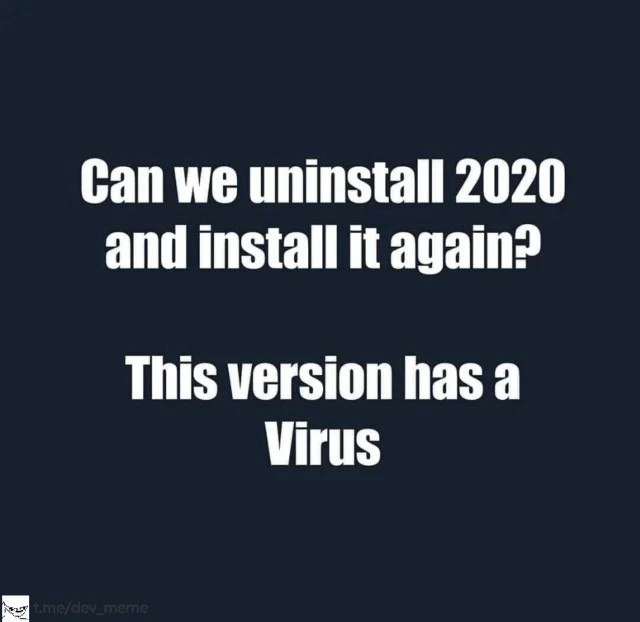
In the meme, someone asks: “Can we uninstall 2020 and install it again?” They are treating the year 2020 like it’s a piece of software that we all collectively installed, and now it’s malfunctioning. Why? Because “This version has a Virus.” Here “version” refers to the year-as-release (like how software versions are numbered), and the “virus” is a play on words: it refers to the COVID-19 virus that spread globally in 2020, but it’s phrased like a computer virus.

In tech terms, a computer virus is malicious software that infects your computer, kinda like how a real virus infects people. When a computer has a virus, it behaves strangely, slows down, or crashes – clearly a bad situation. One extreme way to fix a badly infected computer is indeed to uninstall the infected program (or even wipe the whole system) and then reinstall a safe version from scratch. By saying “This version has a virus,” the meme implies “2020 is corrupted by something awful (the coronavirus), so let’s wipe it out and start over with a clean 2020 or a new year altogether.” It’s a nerdy form of PandemicHumor: comparing our real-world pandemic to a giant software bug.

For a junior developer or someone new to coding, it helps to know that rolling back is a term we use when we undo an update or revert to an earlier version because something went wrong. In this meme, “uninstall and install it again” is essentially a playful way of saying a rollback to a pre-2020 state. The Categories: Bugs, Security hint at two things: (1) a “bug” in software is an error or problem – here 2020 is seen as a buggy year; (2) a virus is definitely a security issue – in computing, viruses breach security to harm systems, just as COVID-19 breached human health security. So the meme falls into DeveloperHumor because it’s using terms from software development (install, uninstall, version, virus) in a joking way. It’s also RelatableHumor: nearly everyone in 2020 felt like the year “had issues.” Even if you’re not a coder, you know the pain of a messed-up phone or a buggy app that makes you think, “Ugh, I wish I could just reset this.” This meme takes that feeling to an epic scale: let’s reset the whole year!

What makes it funny is the absurd uninstall_reinstall_metaphor applied to something non-technical. We can’t actually uninstall a year or roll back reality (if only!). But by phrasing it like a tech problem, the meme speaks to developers in their own language. It’s like saying, “2020 was one giant bad update, complete with a virus infection. Can we get a clean reinstall and pretend that never happened?” It combines the frustration we all felt with a bit of nerdy problem-solving humor. And if you’ve ever dealt with a computer virus or a disastrously buggy software release, you’ll smirk at the idea of treating the chaotic year 2020 the same way — with a hard reset.

Level 3: Rollback to 2019

At first glance, this meme reads like a production post-mortem from a grizzled DevOps engineer: "Can we uninstall 2020 and install it again? This version has a Virus." It’s using our everyday developer jargon to cope with a worldwide bug. In software terms, 2020 is being treated as a release version of reality that went horribly wrong. The phrase suggests performing a rollback – essentially reverting to a previous stable state (in this case, going back to 2019) – because the current release (the year 2020) shipped with a critical security vulnerability: a virus. The humor lies in conflating a biological virus (COVID-19) with a computer virus and imagining the entire year as buggy software that we might fix with a reboot or reinstall. For seasoned developers who have pushed bad builds to production, the scenario is painfully relatable. We’ve all had that “oh no, kill it with fire” deployment where the only viable fix was to yank the release and restore the last working backup. 2020 just happens to be the ultimate bad deploy — a global-scale outage with a malicious payload, and we’re jokingly looking for the “System Restore” button.

This joke also taps into real-life developer trauma around SoftwareBugs and security fiascos. Shipping a product version that unknowingly contains a virus is about as nightmarish as it gets in Software Development. It calls to mind those rare but infamous incidents where an official software update carried malware (whether through a compromised build pipeline or a supply-chain attack). If you’re a senior engineer, the words “This release has a virus” might trigger flashbacks to scrambling at 3 AM, revoking certificates, and desperately pushing out a clean version before users get hit. Here, the product is the year 2020, and the users are literally everyone on the planet. The meme humorously proposes the most brute-force solution imaginable — uninstall the year and reinstall it from scratch — paralleling the way IT folks sometimes handle an utterly hosed system: wipe it clean and start over. It’s the tech equivalent of “nuke it from orbit, it’s the only way to be sure.” A cynical old-timer in IT might chuckle darkly at this: “Yup, 2020 had a zero-day exploit on day one and we’ve been in incident response mode ever since. Where’s the big red rollback button when you need it?”

There’s an extra layer of nerdy cleverness in treating “2020” as a version number. Developers version everything – libraries, apps, APIs – so why not years? By that logic, 2019 was the last stable release, and 2020 is the ill-fated update that introduced a showstopper bug. The meme’s question “Can we uninstall 2020 and install it again?” sounds a lot like a dismayed sysadmin talking about a failed patch: maybe if we reinstall, the bug won’t manifest the second time. It’s tongue-in-cheek, of course; if life were software, we’d all be frantically reading the release notes for 2021 and hoping for a hotfix (in fact, we basically did — vaccines can be seen as the patch that finally debugged “version 2020”). This mix of PandemicHumor and DeveloperHumor was everywhere in tech circles around April 2020. Devs stuck in lockdown vented with jokes about "reformatting the year" or asking tech support for a new timeline. It’s a coping mechanism: when confronted with an uncontrollable real-world crisis, techies resort to familiar metaphors of control — rebooting systems, rolling back bad deploys, or scanning for viruses. The result is a meme that’s equal parts relatable humor and weary resignation: we wish solving COVID was as easy as reinstalling Windows. And as every battle-scarred engineer knows, when all else fails in the software world, uninstall & reinstall is basically the last-ditch attempt to fix the unfixable.

Description

A simple, text-based meme with bold white text on a solid dark navy blue background. The text is split into two lines. The first line asks, 'Can we uninstall 2020 and install it again?'. The second line provides the reason: 'This version has a Virus'. In the bottom-left corner, there is a small, faint watermark for 't.me/dev_meme'. This meme uses a software development analogy to comment on the disastrous events of the year 2020, particularly the COVID-19 pandemic. The humor lies in the double meaning of the word 'Virus', referring both to a computer virus that corrupts software and the real-world coronavirus. For developers, this is a relatable way to express frustration with a chaotic year, framing it as a buggy software release that needs to be fixed or rolled back
Comments

7
Anonymous ★ Top Pick Everyone wants to reinstall 2020, but nobody has read the source code. For all we know, 2021 is just a patch that introduces even more breaking changes
  1. Anonymous ★ Top Pick

    Everyone wants to reinstall 2020, but nobody has read the source code. For all we know, 2021 is just a patch that introduces even more breaking changes

  2. Anonymous

    Tried rolling back to the 2019 snapshot in staging, but the migration pulled in the 1918 pandemic as a transitive dependency - DevOps says we’re better off hot-patching 2020 in prod

  3. Anonymous

    Tried rolling back to 2019 but the dependency chain is completely broken and now half the world's infrastructure runs on Zoom 1.0 that nobody knew how to scale

  4. Anonymous

    Classic case of a production hotfix that somehow made things worse. 2020.0 shipped with a critical zero-day that affected global uptime, and the rollback strategy was... non-existent. No staging environment, no canary deployment, just straight to prod with a pandemic-level bug. At least we learned the importance of disaster recovery planning and having a proper incident response team - though I'm still waiting for the postmortem and the 'lessons learned' document

  5. Anonymous

    Uninstall 2020? The real bug was deploying straight to prod Earth with non‑reversible migrations and a transitive dependency called pandemic@latest; the only feature flag left to toggle was WFH

  6. Anonymous

    I’d roll back 2020, but the universe’s DR runbook has no tested restores - only snapshots named final_final_v3, and the virus shipped as a transitive dependency

  7. Anonymous

    2020: The legacy release where git revert wasn't an option, just like that COBOL monolith no one dares touch

Use J and K for navigation