The Art of Variable Naming: A Tragedy in One Word
Why is this CodeQuality meme funny?
Level 1: Label Your Toys
Imagine you have a bunch of toy boxes in your room. Your mom tells you to label each box with what’s inside so you can find your toys easily. She suggests doing it like: write "LEGO bricks" on one box, "action figures" on another, and "puzzle pieces" on a third. That way, when you want to play with your Lego, you can quickly spot the Lego box. Pretty good idea, right? But now picture this: instead of writing those specific labels, you just write “toys” on every single box. All the boxes get the same general label toys. Next time you’re looking for your Legos, every box says “toys” so you have no clue which one has the Legos. You’d probably have to open all the boxes until you finally find the right one. 🙄
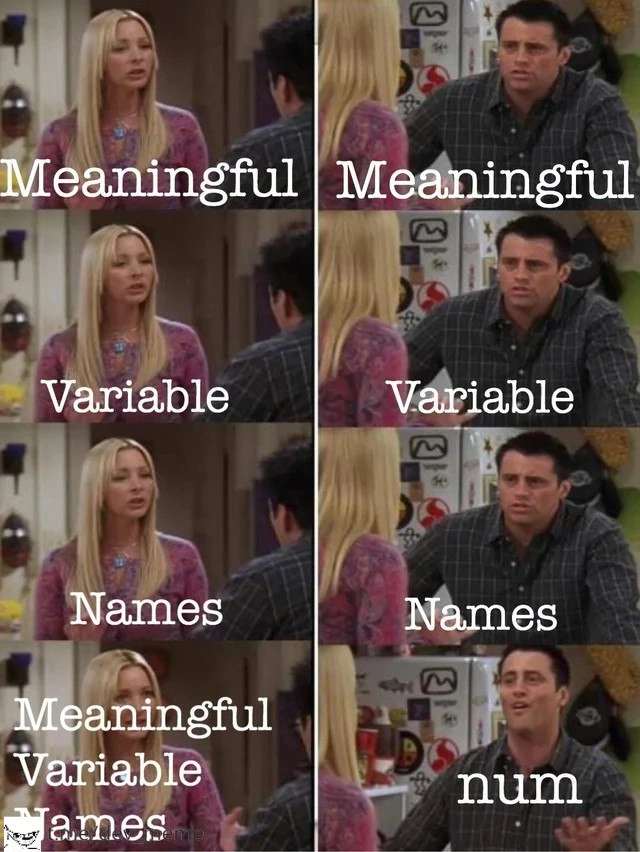
It’s a silly situation, isn’t it? Your mom gave you clear advice to label things meaningfully, and you nodded like “Yeah, sure!” but then you went and did the laziest label possible. This meme is laughing at that kind of situation, but with programmers. In coding, the “toys” label is like naming a variable num – it technically says what’s inside (a number is inside), but it’s so vague that it’s not helpful at all. The meme shows someone saying “I will use clear names, I will use clear names...” and then they name their thing just “num.” It’s funny for the same reason as the toy box story: the person agrees to do the right thing but then does the opposite. We laugh because we recognize that goofy mistake: it’s like saying “Yes, I’ll be organized!” and then calling everything “stuff”. Even if you’re not a programmer, it’s the classic humor of someone not following their own advice, and that contrast is what makes us chuckle.
Level 2: Call It What It Is
Let’s break this down in simpler terms. In programming, a variable is like a box with a name on it that holds some value (a number, text, etc.). When people say “use meaningful variable names,” they mean: label that box in a way that tells you what’s inside. Don’t call the box just "stuff" or "thing" — call it "ageOfStudent" or "totalScore" or whatever fits the actual content. A meaningful name acts like a helpful signpost in your code.
In the meme, "Meaningful Variable Names" is the advice being given. The funny part is that the developer acknowledges this advice (nodding along) but then goes and names his variable simply num. The word num is short for "number," but it’s super vague. Number of what? It’s as if someone asked, "What's inside this box?" and you answered, "Oh, it's a number." That doesn’t really clear things up! This is why num as a variable name is often frowned upon in CodingStandards and CodeStyleGuides. It’s a classic example in NamingConventions discussions of a name that could be more specific.
CodeReview: When developers finish writing some code, usually other developers review it – this is called a code review. They check for bugs, but also for readability and clarity (that’s CodeQuality). A very common piece of code review feedback is “rename this variable to be more descriptive.” If a reviewer sees something like int num; or let data = ...; they’ll likely leave a comment asking, "Can you give this a better name? What number is this? What data?" They do this because in a team setting, code isn’t just for computers – it’s for other humans to read and understand. A CodingStandard (the team’s agreed-upon rules for writing code) almost always has a section that says “use clear, meaningful names for variables and functions.” It’s not about being picky – it’s about preventing confusion later.
Think of it this way: if you have a program that deals with a user’s age, a account balance, and a maximum login attempts, having variables named num1, num2, num3 is going to confuse everyone. Instead, you’d want names like userAge, accountBalance, maxLoginAttempts. Each name instantly tells you what that variable stands for. This is what we mean by meaningful_variable_names: the name reflects the role or content of the variable. When names are too generic (like num or temp or value), it’s considered a minor red flag or code smell. A code smell doesn’t mean the code is broken; it means something might be off or could be improved to make the code cleaner. Vague naming is one of those smells, because it often hints the programmer didn’t fully think through the design or was a bit careless.
Let’s look at a quick example to see why naming matters:
# Ambiguous naming - not clear what these numbers represent
num1 = 7
num2 = 10
result = num1 * num2
print(result) # Output is 70, but what are 7 and 10?
# Improved naming - now it's clear what each value means
width = 7
height = 10
area = width * height
print(area) # Output is 70, and we know it's 7x10 area (like a rectangle)
In the first snippet, num1 and num2 are technically variables, but their names tell us nothing. They’re just two numbers being multiplied; we’re left guessing their purpose. In the second snippet, by using width and height, anyone reading the code can immediately understand why those numbers are being multiplied. The code explains itself. That’s the power of good naming.
Now back to the meme: it’s showing a situation where, despite knowing this principle, a developer doesn’t apply it. The text “Meaningful Variable Names” being repeated is like a teacher or a senior developer stressing this point. The final panel with just "num" is the student (or junior dev) turning around and doing the opposite out of habit or laziness. It’s funny because it’s a bit true — many of us have been in that situation. Maybe you learned about best practices in class or read about them in a CodeStyleGuide, and you intend to follow them... but when you're actually coding, you might slip back into old habits like naming everything num or foo until someone reminds you again. The meme exaggerates it with the sitcom characters to make it obvious and humorous.
So, in summary: meaningful variable names = good (code easier to read!), naming everything num = not so good (code gets confusing). The meme is popular in DeveloperHumor circles because it playfully calls us out on this very human tendency to agree with a rule in theory but forget about it in practice. 😅 Every developer, especially those new to a team, goes through the phase of "Oh right, I should actually do what I said I would do...". Seeing it in meme form with a simple num is a lighthearted reminder of that.
Level 3: Old Habits Die Hard
In this meme, we witness a classic developer irony: everyone agrees on the importance of Meaningful Variable Names, yet the actual code still ends up with a variable named num. The four-panel sitcom format drives the joke home. In the first three panels, the woman on the left (let’s call her the code reviewer or team lead) is essentially spelling out the advice in three chunks: “Meaningful”, “Variable”, “Names”. It’s like hearing a coding standard repeated over and over. Meanwhile, the man on the right (the dev) appears to be nodding along in each panel, as if he’s dutifully acknowledging each word of this sacred mantra. But then comes the punchline in the final panel: instead of completing the phrase “Meaningful Variable Names”, the dev’s side simply shows num. 🤦♂️ It’s a perfect visual gag illustrating the disconnect between what developers say they’ll do and what they actually do.
For seasoned programmers, this scenario is hilariously relatable. We’ve all encountered code reviews with comments like:
Reviewer: “Please rename this
numvariable to something more descriptive.”
Developer: “Sure, good point.”
...and yet in the next commit, there’s still a num or maybe a value lurking in the code. This meme exaggerates that by having the dev literally parrot “Meaningful Variable Names” while still using a one-syllable, context-free name. It’s essentially poking fun at a common CodeReview experience: when devs nod at naming advice but then continue with the same NamingConventions (or lack thereof) they’ve always used. The man’s smug face in the last panel (blurred, but we can imagine it) perfectly captures that “I did a good job, right?” vibe — while everyone else facepalms because num conveys almost nothing.
Why is this so funny (and cringy) to experienced devs? Because NamingThings is famously hard, and we constantly joke about it. There’s an old saying in programming: “There are only two hard things in Computer Science: cache invalidation and naming things.” 🙃 Despite all our CodeStyleGuides and best intentions, we still end up with ambiguous names like temp, data, obj, or the notorious num. It’s a running joke in DeveloperHumor circles precisely because it happens so often. The humor here comes from that shared frustration: after countless team meetings and style guide documents preaching clarity, someone still writes int num;. It’s the CodeQuality equivalent of nodding through a safety briefing then lighting a firework indoors. You know what you’re supposed to do, but old habits die hard.
From an engineering perspective, using a name like num is practically a CodeSmell – a subtle sign that the code might be poorly thought-out or hard to maintain. The name num is as vague as it gets. Is it a number of users? a numerator in a fraction? an ID number? Without reading more of the code, who knows! 🌫️ In contrast, a meaningful variable name acts like a tiny comment embedded in the code. It should describe the variable’s purpose or content, making the code self-documenting. For example, if we see:
int num = 42; // Hmm, 42 of what?
versus:
int maxUsers = 42; // Ah, 42 is the maximum number of users
…the second version instantly tells us what that number represents. With num, a future reader might have to hunt around to figure out its role. And if the code had multiple numbers (which most programs do), then you end up with num1, num2, or other meaningless distinctions. That’s a maintenance nightmare and a classic CodeQuality issue.
The meme gets its comic punch by highlighting how code review feedback can go unheeded in the most absurd way. The repetition of “Meaningful Variable Names” in the images mimics a reviewer or mentor repeating the same advice for the umpteenth time. (You can almost hear the weary tone: “Please... meaningful variable names... we’ve discussed this.” 😅) The final panel’s num is the dev effectively tuning out or reverting to muscle memory. It’s like a student reciting the correct formula in class and then writing the wrong answer on the test. For veteran developers, it’s a facepalm moment we know too well – hence the meme’s popularity in CodingHumor threads.
In truth, why do devs keep doing this even when they know better? Often it’s a mix of convenience, habit, and a bit of laziness. Coming up with good names is surprisingly taxing – it requires understanding what the code is really doing and how it will be used. Sometimes under deadline pressure, a programmer might think, “Eh, it’s just a throwaway variable for now, I’ll call it num and refine later.” But “later” never comes, and that placeholder slips into the permanent codebase. Also, some devs start with a background in competitive programming or math where single-letter variables (i, j, k, x, y) are common and acceptable for quick problems. Transitioning to production code, they have to unlearn that habit. The meme exaggerates it for comedic effect, but it shines light on a real issue: bridging the gap between knowing best practices and actually executing them consistently. And it does so with a laugh, because sometimes humor is the best way to cope with our collective developer shortcomings! 😁
Description
This meme uses the four-panel 'Phoebe Teaching Joey' format from the TV show 'Friends'. In the first three panels, Phoebe patiently says one word at a time ('Meaningful', 'Variable', 'Names'), and Joey repeats each one back to her, seemingly understanding. In the final panel, Phoebe combines the phrase, 'Meaningful Variable Names', but Joey, with a look of misplaced confidence, incorrectly synthesizes the lesson into the single, generic word: 'num'. A small watermark is visible at the bottom of the last panel. The meme humorously critiques a common failure in software development: poor variable naming. It contrasts the best practice of using descriptive names that convey purpose with the lazy, unhelpful shorthand often seen in codebases (e.g., 'num', 'data', 'temp'). For experienced developers, this is a relatable frustration during code reviews, as cryptic names increase cognitive load, obscure logic, and create technical debt, turning simple maintenance into a forensic investigation
Comments
7Comment deleted
Some developers treat variable naming like a startup treats vowels. Why use 'user_account_id' when 'uid' saves precious keystrokes that can be better spent on Stack Overflow?
I spent an hour evangelizing “ubiquitous language” and the next PR still starts with: `int num; // TODO: rename when requirements stabilize`
The same developer who writes a 47-page RFC on naming conventions will absolutely ship `data2_final_FINAL_v3` to production on Friday at 4:47 PM
Every senior engineer preaches 'meaningful variable names' in code reviews, then proceeds to write `i`, `j`, `k`, `tmp`, `data`, `result`, and the ever-popular `num` in their own PRs. We've all been Joey in that final panel - confidently defending our `x` and `temp` variables while knowing full well our future selves will curse us during the 2 AM production incident when we can't remember if `num` is the count, the ID, or the index
DDD slide: “Ubiquitous Language across bounded contexts.” The PR: var num
'num': refactor-proof zombie that survives every IDE rename across 20-year codebases
Style guide says “self‑documenting”; prod says “num” is now in the public JSON, three Kafka topics, and two dashboards - good luck renaming