Escalating Horrors of a New Project
Why is this LegacySystems meme funny?
Level 1: Messy Attic Surprise
Imagine your parent says, “I have a new playroom for you!” You feel excited... until you open the door and see it’s actually a dusty old attic filled with junk. Not only is everything old, it’s also stuff you’ve never seen before – weird toys or tools from long ago that you don’t know how to use. There’s no instruction sheet to tell you what’s what. The person who used to take care of this attic isn’t around anymore to help you. And to top it off, your parent says, “We need you to not only play here, but also clean it up and take care of it now.” Suddenly, that fun invitation becomes a bit scary! You might put on a mask because the attic air is nasty and dusty. Then you put on gloves, because who knows what icky stuff you’re touching. If it seems really unsafe, you might even wish for a full protective suit!
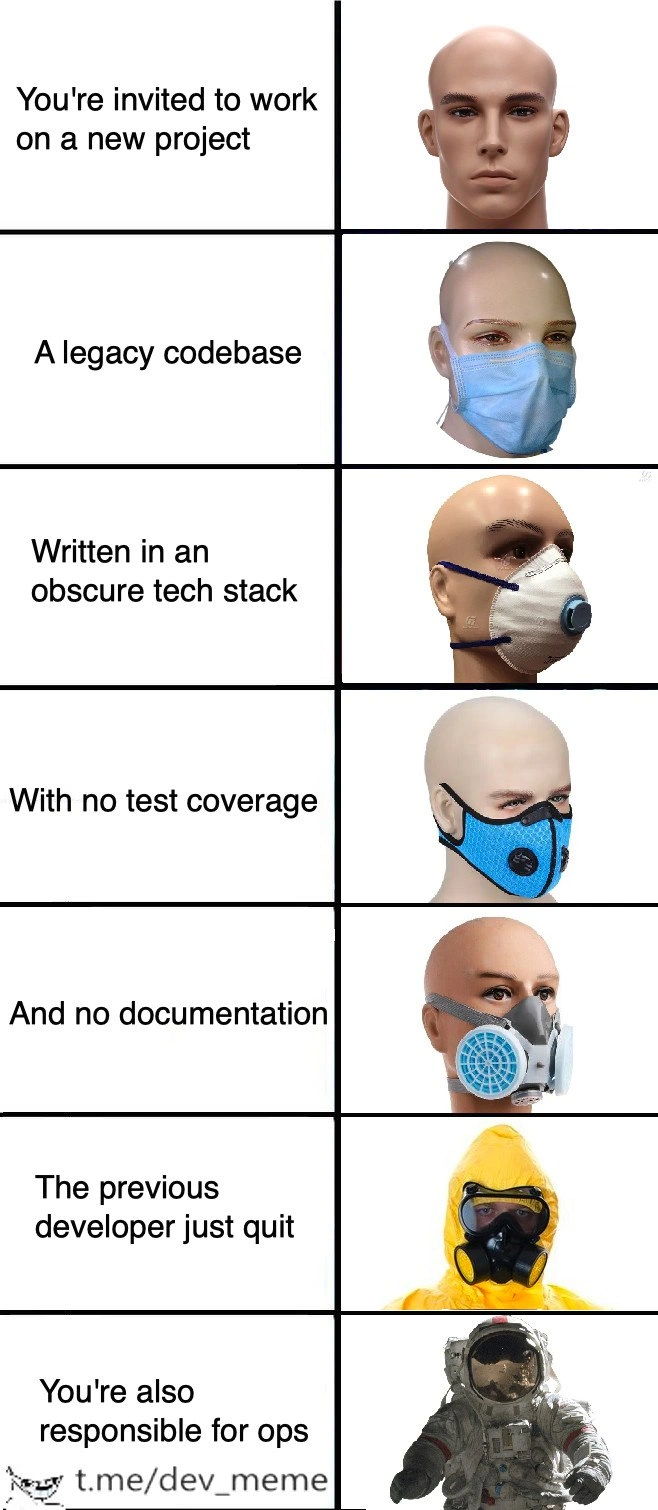
This meme is showing that same idea in a funny way. The developer thought they were getting a cool new project, but it turned out to be an old, messy one full of surprises (and not the good kind). Each time they learn about another problem (no instructions, the helper is gone, now you have more chores), they react by “suiting up” more – just like you would add more gear if a fun adventure turned into cleaning a scary attic. It’s amusing because we understand why they’re doing it: the more problems pop up, the more careful and protected you want to be. The picture of the mannequin ending up in a full space suit is an exaggerated, silly way to say, “Yikes, this is way worse than I thought – I better be extra safe!”
Level 2: Hazardous Onboarding
For a less experienced developer, let’s break down why each part of this scenario is a big warning sign, and how they all stack up to cause panic:
- Legacy codebase: "Legacy" means the code isn’t new at all – it’s an old project that’s been around for years. Instead of a fresh, clean start, you’re dealing with code written by others (who might have left). Often this code was built with older tools or outdated practices. It might work, but it can be messy or fragile due to accumulated technical debt (quick fixes and shortcuts piled up over time). In short, a legacy codebase can be tricky to understand and change, especially if you weren’t there when it was originally made.
- Obscure tech stack: The tech stack is the set of technologies (programming languages, frameworks, databases, etc.) used to build an application. If it’s obscure, it means those technologies are uncommon or dated. For example, maybe the project uses a rare framework or a language hardly anyone uses now. That’s bad news for a newcomer: you won’t find many tutorials or Q&A posts about it, and it might take a long time to learn. It’s like being asked to play a game, but all the rules are in a language you don’t understand. You’ll spend a lot of time just figuring out the basics, which slows down everything and can be really frustrating.
- No test coverage: Normally, developers write automated tests (small programs to check that the code works as expected). "No test coverage" means there are virtually no tests for this code. Without tests, if you change something, you have no immediate way to know if you broke something else. It’s a bit like removing the smoke detectors and seatbelts: you only find out something’s wrong when a disaster happens. For a new developer, this is scary because you have to be extra careful – the code isn’t giving you any hints or safety nets. Every change feels like a risk. This is often joked about in TestingHumor (e.g. developers saying “It compiled, so I guess it works!” with a nervous laugh).
- No documentation: Documentation is any written guide or reference about the code – like a README file, setup instructions, or comments explaining tricky parts. If there’s no documentation, you’re basically flying blind. It’s as if you were given a giant puzzle with no picture on the box. You don’t know the intended design, or even how to start the program in some cases. Newcomers usually rely on documentation to get up to speed, so without it, onboarding becomes a slow scavenger hunt: you read the code itself and try to piece together the purpose of each part. Developers often make jokes in DocumentationHumor about codebases that desperately needed a guide but didn’t have one – it’s a common pain point.
- The previous developer just quit: This means the one person who knew the system best is no longer around. Imagine arriving at a new job and the only trainer or guide you had suddenly isn’t there. In software teams, losing that person is huge. There’s even the term “bus factor” to measure this risk – here the bus factor was 1 (only one person really understood the project), and now it’s 0. For you, it means if you have questions or run into weird issues, that go-to expert is gone. It also raises a little suspicion: maybe the project was so troublesome it drove them away! Regardless, you’re on your own now, which makes everything harder.
- You're also responsible for ops: "Ops" stands for operations – all the work needed to run the software day-to-day on servers, keep it online, and handle issues in production. Many modern teams practice DevOps, where developers take on some ops duties. In this scenario, being responsible for ops means after writing or fixing code, you also deploy it to servers, monitor it, and jump in if it crashes at 2 AM. That’s a lot of extra responsibility, especially for someone new to a messy system. Think of it like being asked not only to drive an old, unreliable car, but also to be the mechanic who repairs it and the emergency roadside service if it breaks down. It can be overwhelming when you’re still trying to get a handle on how the engine works in the first place.
All these factors combine to create a seriously challenging onboarding experience (the process of joining a project). Each of these is a red flag on its own; together they spell out a nightmare. The reason developers find this meme funny is because it exaggerates a situation that’s unfortunately relatable: being thrown into a big mess and having to deal with it. The mannequin head putting on more protective gear in each panel is a visual joke – it’s like saying, “the more I learn about this project, the more protective gear I need!” as each new detail makes the job scarier. If you’re new to software, just know: this is an extreme case! In real life you might not get all these red flags at once (hopefully), but even a couple of them can make a job tough. The meme simply highlights, in a lighthearted way, how developers feel the need to protect themselves (or brace themselves) when dealing with a particularly bad legacy project.
Level 3: Legacy Code Contagion
This meme triggers the battle-hardened developer’s survival instincts by stacking every classic red flag into one scenario, and visualizing the resulting panic with escalating protective gear. For any dev who's been in the industry a while, this situation is like a hazmat incident in software form. Each panel introduces another line from the horror story that is maintaining a nightmare project:
- You're invited to work on a new project: At first, it sounds like an exciting opportunity. But experienced devs know that phrase can be the setup for a bait-and-switch – especially if management is rebranding a maintenance nightmare as a "new project" to attract unwitting volunteers.
- A legacy codebase: Now the truth comes out. "Legacy code" means old, brittle code that’s been around forever (and probably patched by dozens of people). It’s the kind of environment where
// TODO: fix this hackcomments outnumber actual docs, and nobody has refactored anything since the last Olympics. Simply hearing legacy system sets off alarms: expect outdated frameworks, weird hacks, and methods written in 2005 style. - Written in an obscure tech stack: This escalates the danger. Maybe it’s built with a niche language or a custom in-house framework that few developers today recognize. (Looking at you, unreformed COBOL and that one arcane Lisp variant.) An obscure tech stack means you can’t just Google errors or hire new devs easily – the knowledge pool is tiny. It’s like finding out the instruction manual is written in Latin. At this point, a veteran dev knows they're in trouble: they'll be spelunking through ancient forums and source code archives to understand even basic features.
- With no test coverage: Now it’s truly toxic. No test coverage means the codebase has zero automated tests to catch bugs or document expected behavior. Changing anything is like handling volatile chemicals without a fume hood – one wrong move and the whole thing blows up, and you won’t notice until production users (or your pager) start screaming. Tests are a developer’s safety goggles; without them, you’re coding with your eyes closed. In the meme, the mannequin adds a serious respirator here, exactly how a dev feels: better gear up, because nothing is filtering out the bad stuff (bugs) before it hits you. CodeQuality just plummeted, and any remaining optimism flew out the window.
- And no documentation: At this point the project is a full-on biohazard. No documentation means no maps, no guide, no “Hazmat protocol” written down. You’re left deciphering cryptic variable names and untangling spaghetti logic like an archaeologist reading hieroglyphs. The mannequin puts on a big filtration mask now, symbolizing how you wish you had a full face shield to protect from all the unknowns flying at you. For a seasoned dev, no docs is a huge red flag: it means all the critical knowledge about the system is either hidden in the code (if you’re lucky) or vanished with the people who wrote it.
- The previous developer just quit: This is the cherry on top of the disaster sundae. It confirms your fears: the one person who understood this mess has already fled the scene. They quit (perhaps wisely), leaving zero knowledge transfer. In software lore, we talk about the bus factor – how many people can get hit by a bus (or quit) before a project has no one left who knows it. Here, the bus factor was 1 and now it’s 0. The codebase is officially an orphan. The hazmat suit appearing in the meme is perfect: the situation is so toxic you metaphorically need full-body protection to even approach it. It’s not just technical debt anymore; it’s radioactive waste. Many of us have lived this scenario: stepping into a role where the predecessor vanished, and feeling the dread as you realize you’re alone with a potentially explosive system.
- You're also responsible for ops: The final panel’s astronaut suit says it all – we’ve reached astronaut-level panic. Being responsible for ops (operations) means that on top of deciphering and fixing this legacy beast, you also have to deploy it, run it, and keep it alive in production. Congratulations, you’re now the developer and the unwitting DevOps engineer for a system you barely understand. It’s like being told you’re captain of a sinking ship and also the ship’s mechanic. The space suit imagery fits because production feels as hostile as outer space when you have no clue what could go wrong next. As the famous horror tagline might go, “In space (and in prod), no one can hear you scream.” At this stage, a jaded dev’s humor turns very dark – they might joke about needing an actual spacesuit or simply updating their résumé before the inevitable 3 AM emergencies hit.
In summary, the humor lands because each line in this meme is a well-known red flag in software projects, and here they’re coming at you one after another. It’s a cascade of worst-case scenarios. Any one of these issues alone is painful; all of them together is the stuff of legend (the kind of war story veteran engineers share with a shudder). The meme exaggerates it to gallows humor level – the developer’s self-protective gear keeps upgrading panel by panel, perfectly mirroring how our sense of risk skyrockets with each new revelation. It satirizes how some companies casually throw engineers into toxic situations – legacy code contamination – without proper support, then act surprised when developers look ready for a hazmat team. The escalating protective gear is a spot-on visual metaphor for a developer’s escalating anxiety and caution. In real life, of course, you can’t put on an actual hazmat suit to deal with bad code, so devs cope by fortifying themselves with knowledge, writing belated tests, scanning the logs like a Geiger counter, and yes, making dark jokes about the predicament.
Crucially, this meme resonates because it’s too real. Why do scenarios like this happen so often? Because writing tests and documentation is usually the first thing sacrificed under deadline pressure. Because organizations let knowledge silo up in one person, ignoring bus factor until it’s too late. And because in the rush to embrace DevOps (”you build it, you run it”), sometimes companies end up with a developer running something they never built and can’t tame — a perfect recipe for burnout. Seasoned engineers laugh at this meme with a wince of recognition. It’s a funny-yet-painful reminder that technical debt and poor planning can turn a “new project” into a hazardous mission. In the end, humor is how we as developers perform our own kind of psychological PPE: laughing so we don’t cry while wading through the legacy sludge... and praying we remembered to pack our metaphorical hazmat suit.
Description
A seven-panel vertical meme that illustrates a developer's growing dread when joining a new project. Each panel on the left describes a project red flag, while the corresponding panel on the right shows a mannequin head equipping progressively more intense protective gear. It starts with 'You're invited to work on a new project' next to a bare mannequin head. The situation escalates with 'A legacy codebase' (surgical mask), 'Written in an obscure tech stack' (N95-style mask), 'With no test coverage' (sports-style respirator), 'And no documentation' (industrial respirator), and 'The previous developer just quit' (full hazmat suit). The final panel, 'You're also responsible for ops', is paired with a full astronaut suit, signifying a completely hostile and alien environment. A watermark for 't.me/dev_meme' is in the bottom left. The meme is a potent visual metaphor for the compounding layers of technical debt and dysfunction that can make a project hazardous to one's career and sanity, a scenario all too familiar to senior engineers
Comments
7Comment deleted
That's not a job description; it's a containment protocol. The final piece of gear they give you is a resume updated in real-time
Onboarding step 1: inherit monolith with no tests or docs; step 2: get handed root in prod - PPE isn’t for my safety, it’s to contain the blast radius when I grep-and-pray at 3 a.m
The astronaut suit is overkill - you'll need it for the inevitable spacewalk when you discover the entire business logic lives in stored procedures that call other stored procedures through dynamic SQL generated by a COBOL service that nobody mentioned
The real horror isn't the legacy COBOL codebase written by a developer who rage-quit - it's discovering you're now the SRE for a production system with zero observability, no runbooks, and a deployment process that's literally 'SSH into prod and hope.' At that point, you're not just wearing the astronaut suit for protection; you're wearing it because you're now operating in a vacuum where no one can hear you scream during the 3 AM outage
Greenfield per PM, brownfield per git: bus_factor=0, coverage=0%, docs=404; on-call included - because here the runbook is just kubectl exec
The PPE curve perfectly plots tech debt entropy: innocent at sprint zero, singularity by EOD
‘New project’: legacy monolith in an extinct stack, 0% tests, folklore docs, bus factor 0, and you own prod - the runbook is a flight checklist and the change window is a launch window