
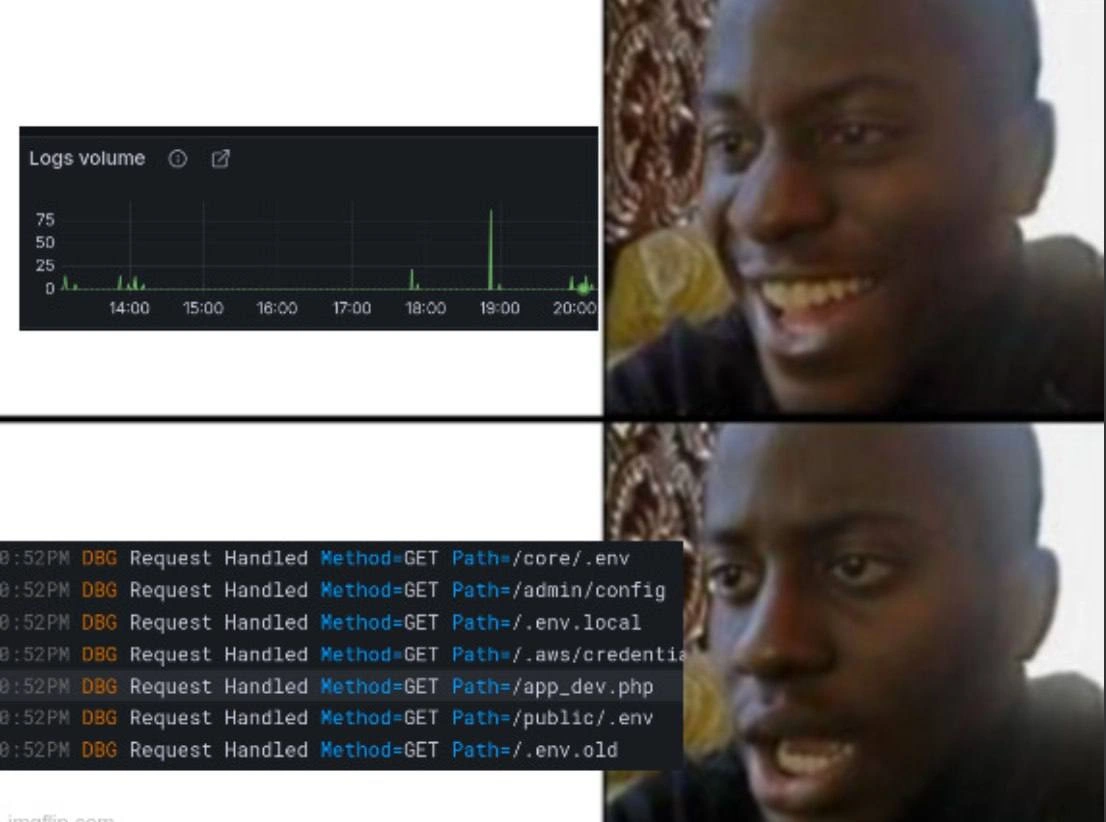
When the Traffic Spike is a Security Scan
Description
A two-panel meme using the 'Disappointed Black Guy' format to illustrate a common production incident scenario. The top panel shows a developer's happy, smiling face next to a monitoring graph labeled 'Logs volume'. The graph displays a sudden, sharp spike in activity, which is initially interpreted as a positive sign, like a surge in user engagement. The bottom panel shows the developer's expression changing to one of shock and horror. Next to him is a screenshot of server logs revealing the true cause of the spike: a series of GET requests from a malicious actor or security scanner probing for sensitive files like '/core/.env', '/.aws/credentials', '/admin/config', and '/.env.old'. The meme perfectly captures the sinking feeling a developer, SRE, or on-call engineer experiences when they realize an exciting traffic increase is actually a security threat, specifically a vulnerability scan for exposed configuration and credential files
Comments
44Comment deleted
That's not user engagement, that's a free, unsolicited penetration test from a script kiddie who thinks '/.env' is the new 'hello world'
Nothing like a 19:00 ‘harmless’ spike to remind you that `.aws/credentials` isn’t meant to double as a public REST endpoint
The real horror isn't the 75 requests per second spike - it's realizing your junior dev's 'temporary fix' of chmod 777 on the project root from six months ago is still in production, and now someone's downloading your AWS keys faster than you can rotate them
That moment when your log volume graph looks like a hockey stick and you realize someone's running a directory enumeration script against your production API - and your .env files are responding with 200 OK. Nothing says 'Friday evening' quite like watching attackers systematically request every possible secrets file path while your monitoring dashboard lights up like a Christmas tree. At least the observability stack is working perfectly to document your impending PagerDuty incident and inevitable post-mortem titled 'Why Our AWS Credentials Were Briefly Public.'
Config management so distributed across /env paths, it's a CAP theorem violation - consistent leaks, available everywhere, but partitioned by dev negligence
That 'Logs volume' spike wasn’t growth; it was the internet’s nightly cron GETting /.env and /.aws/credentials - why are we alerting on volume instead of 2xx to sensitive paths?
If your WAF lets GET /.aws/credentials through, you don’t need chaos engineering - you’re already running adversary-driven failure injection
HTTP 404 GET /phpinfo HTTP 404 GET /.env HTTP 404 GET /.git 🥱 HTTP 200 GET /phpinfo HTTP 200 GET /.env HTTP 200 GET /.git 💀 Comment deleted
WAF idea: return fake but seemingly legitimate responses for those paths. That way you trick the attackers! Comment deleted
I once configured my home server to respond with multi-gigabyte iso file (Linux or BSD install DVD) to such requests. Did not notice any effect, but I guess some users unconsiously participating in a botnet probably went out of prepaid traffic limit, or had to pay extra. Comment deleted
Cloudflare AI labyrinth kinda be like: Comment deleted
Seems like you'd make yourself very vulnerable to getting steamrolled by visitors Comment deleted
My home server that serves nearly nothing and never had any traffic quota? I doubt so. The real fun happened last autumn when an army of smart speakers with a poorly self-written SNTP client started to query public servers each second, causing the entire country zone pool to collapse over a short period of time. 😅 Comment deleted
we put libcurl into too many small things and are now suffering the consequences Comment deleted
I'm just surprised that they even download and process the file And that your server can upload that much p2p to an entire country zone How did you even find out that happened through your server and how do you have an entire country zone of upload through your provider? Comment deleted
the zone thing is about NTP servers in a country pool, pool.ntp.org is using GeoDNS for CNAME to country-code pool (i.e. us.pool.ntp.org) which answers with a list of servers in the country. Comment deleted
You got it all wrong. Those were 2 disconnected stories. I had fun with my web server being probed, say, around 20 years ago, when having an Internet connection without traffic quota (truly unlimited — no "small font" tricks) was not common. Since I didn't put much load on my connection otherwise, I could afford replying with an ISO file to anyone who made "strange" HTTP requests to my server. IIRC, many probers had safety limits on HTTP response (whether a time limit or a size limit), but there were those who tried to download the entire file, perhaps only being stopped by network errors. The NTP zone collapse happened last autumn (see the attached chart). In my case, the bottleneck was my router: despite being a full-fledged x86-64 computer controlled by pfSense, it was based on entry-level CPU and desktop-class NIC, so was overwhelmed when incoming traffic reached just 50 Mbit/s — roughly 1 Mpps. And although NTP pool allows to set load quota, its basically a weight only, which does not really matter when only 4 servers are left for the entire huge country (because other servers already excluded from the pool for the same reasons of unreachability or long response times). Comment deleted
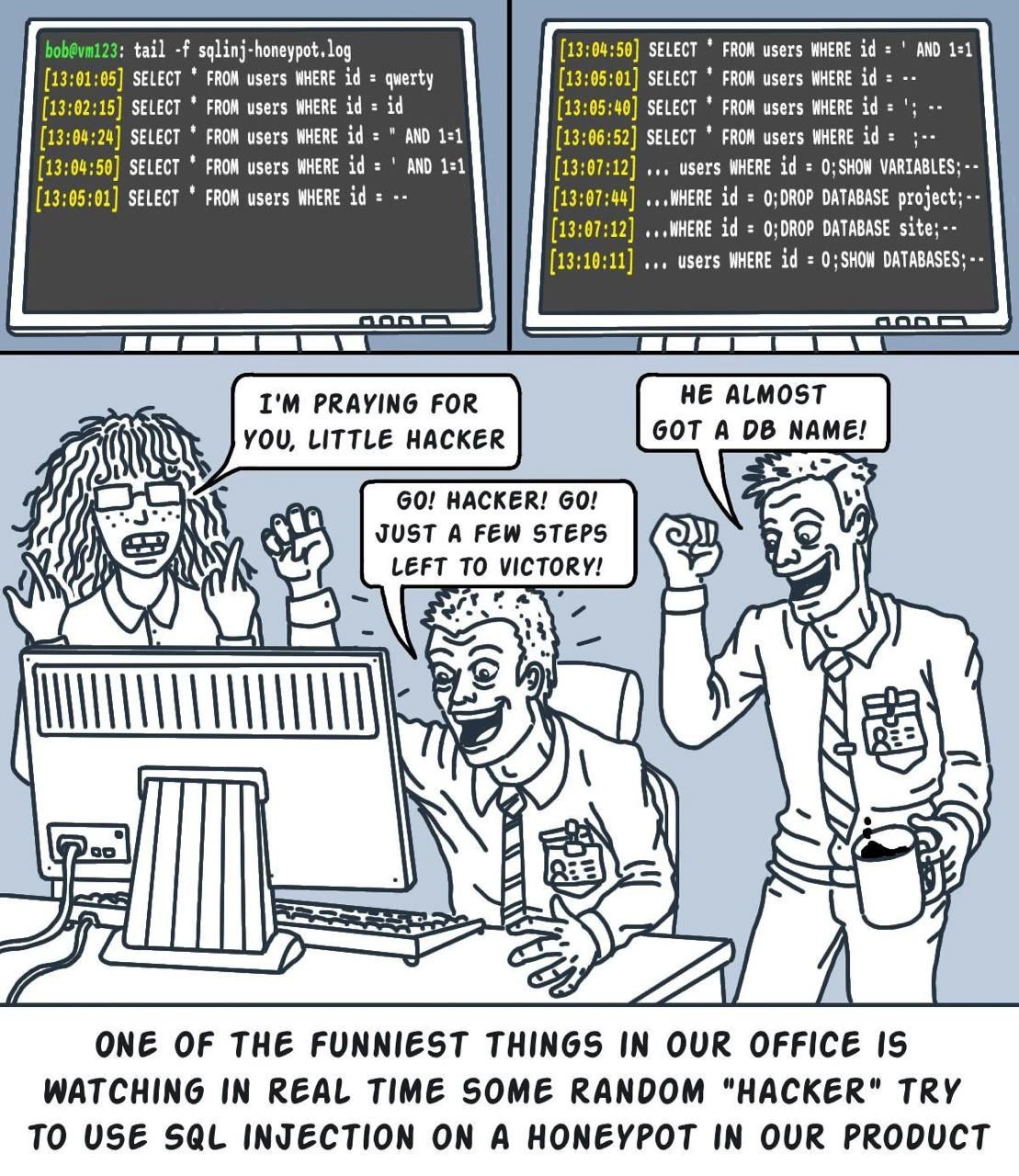
it's called honeypot Comment deleted
They just wanted to get ready to add a few lines to your source code 🥰 Comment deleted
A couple years back I got into algotrading crypto, made a bot, rented a VM and deployed it. I don’t remember exactly why it needed an API, but it had one, so, naturally, it was accessible through the web. I deployed it on DigitalOcean and saw lots of these types of logs of people trying to find vulnerabilities. What’s interesting is when I deploy anything on Russian cloud providers, I don’t have any such traffic 🤪 Comment deleted
Not people, bot nets Comment deleted
Probably because a lot of those bots originate in Russia or China Comment deleted
There are only 2 types of Russian servers, the ones that have good security and the ones that have terrible security but they dont care Comment deleted
Guess which group is Putin's mail server Comment deleted
"dont care" Comment deleted
Can't relate with the server location, but for me it always seemingly coincides with getting Let's Encrypt certs🌚 Comment deleted
Hmmmmm Comment deleted
Maaaaybe Comment deleted
Now that I think about it… Comment deleted
Are there Russian cloud providers? Comment deleted
Yandex Cloud for example Comment deleted
hackers avoid friendly fire Comment deleted
those are botnets, see that on every server I deploy, access logs are always filled with attempts to ssh into my server with usernames like "admin" or "nginx" and password auth Comment deleted
Even though I didn’t advertise my bot to anyone while the stuff I have on Russian clouds is a literal SaaS with thousands of users Comment deleted
Nah, most of it was Turkey, Portugal and South America Comment deleted
Their exit IPs were there sure Comment deleted
Turkey was surprisingly big one Comment deleted
/restore.php Comment deleted
or... put fake .env files Comment deleted
and enter in loophole Comment deleted
Does it still work anywhere? Comment deleted
what hackers gonna do if they steal my source code? Debug it? Comment deleted
😂 Comment deleted
Jokes on you, my env is actually titled index.html Comment deleted