Skip to content
DevMeme
5676 of 7435
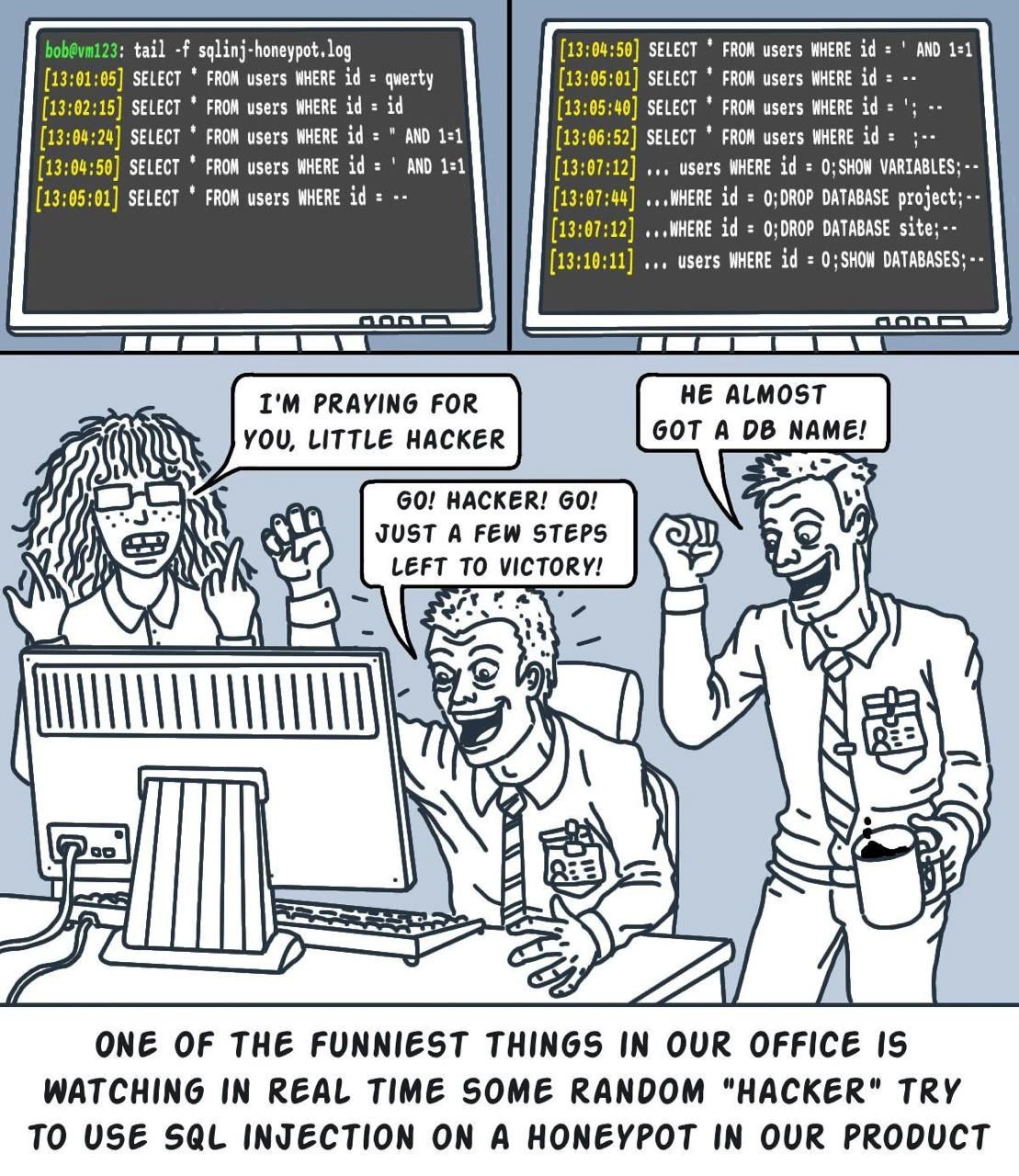
Office turns live SQL-injection honeypot logs into an impromptu spectator sport
Security Post #6227, on Sep 5, 2024 in TG

Office turns live SQL-injection honeypot logs into an impromptu spectator sport

Why is this Security meme funny?

Imagine you and your friends set up a fake cookie jar as a prank. It looks like it’s full of delicious cookies, but really it’s a trap – maybe it has a little alarm or it’s impossible to open. Now a cookie thief (let’s say your mischievous little cousin) comes along and tries to steal a cookie. You and your friends are hiding nearby, watching everything. The thief tries all the usual tricks to get the jar open: gently lifting the lid, twisting it, maybe shaking the jar. Nothing works. He even tries saying “Open sesame!” like a magic word, but this jar is special – it won’t open no matter what, and maybe it’s secretly sounding an alarm that only you can hear. Finally, out of frustration, he tries something wild like throwing the jar on the floor to break it, but it’s made of unbreakable plastic.

Instead of being upset, you and your friends are laughing and cheering (very quietly, so he doesn’t hear you). You’re whispering things like, “Come on, you can do it! Almost there!” even though you actually hope he can’t get a cookie. It’s hilarious to you because the thief has no idea it’s a setup. In the end, your cookies are safe, the only thing hurt is the thief’s pride, and you got to enjoy the whole show.

In the same way, the meme shows developers doing this with their software. The “cookies” are sensitive data in a database, the “fake jar” is a decoy website/database that’s been set up as a trap (a honeypot), and the “thief” is a hacker trying to break in using crafty tricks (SQL injection). The developers are watching on their monitors, chuckling and rooting for the hacker in jest, because they know he won’t actually steal anything. It’s funny because they turned a potential break-in into a harmless game. The good guys set a trap, the bad guy fell for it, and now everyone in the office is enjoying the show, just like you enjoyed watching that clueless cookie thief.

Level 2: Honeypot Highlights

Now, let’s break this down in simpler terms. There’s a lot of security and monitoring jargon here, so we’ll explain the key parts:

  • SQL injection is a type of attack where a hacker tries to sneak malicious SQL code into an application’s database query. For example, if a website asks for a user ID and then naively does something like:

    # Pseudo-code for a very bad practice:
    userInput = "0; DROP DATABASE;"  
    query = "SELECT * FROM users WHERE id = " + userInput + ";"  
    execute(query)
    

    Here the attacker’s input is "0; DROP DATABASE;". This tricks the application into making a query that ends the normal command and starts a new one. It becomes:

    SELECT * FROM users WHERE id = 0; DROP DATABASE;
    

    The DROP DATABASE part is extremely dangerous – it would delete the entire database! The -- in the meme’s logs is an SQL comment marker, used to ignore the rest of the query (so the hacker can terminate one command and prevent syntax errors). SQLInjectionPrevention is all about stopping this kind of exploit. Developers prevent it by sanitizing inputs or, even better, using parameterized queries (so any input is treated as data, not code). In short, never build SQL queries by concatenating raw user input like in the example above.

  • A honeypot in tech is a trap set for attackers. It’s a fake system or page made to look juicy and vulnerable, but it’s closely watched. Hackers attack the honeypot thinking they found a weakness, but all they’re doing is giving the defenders information. It’s like a digital decoy. In this case, the team’s product probably includes a fake database or API that appears to have the SQL injection flaw. The attacker’s attempts get logged, but they can’t do real damage. Honeypots are a security strategy to understand threats and divert bad guys away from real targets.

  • The command tail -f sqlinj-honeypot.log is a way to watch a log file in real time on a server. The tail part means “show me the tail end of this file” (usually the last few lines), and the -f flag means “follow” (keep showing new lines as the file grows). So as the hacker keeps trying things, this log file grows and the new entries pop up live on the screen. This real-time logging is part of good observability and monitoring practices. It lets the team see what’s happening on their system moment by moment. Here, they’ve turned it into a source of office entertainment: real_time_attack_watching.

  • The developers’ quotes in the middle panel show a playful, mocking tone. When someone says, “I’m praying for you, little hacker,” they don’t actually want the hacker to succeed. It’s sarcasm. They know the odds are stacked against this intruder, so they joke as if they’re supporting him — much like spectators might cheer on an underdog in a race, even if that underdog is running the wrong way. It’s a mix of tech humor and a bit of mean teasing. Calling him "little hacker" makes the attacker sound cute or harmless, like a kid who’s out of his depth.

  • “He almost got a DB name!” is referring to one attempt where the hacker tried SHOW DATABASES;. In SQL, that statement would list all the database names on the server (for example, it might respond with names like project, site, users, etc.). That would be a breadcrumb of success for the hacker — like finding out the names of all the treasure chests in a vault. The devs see that attempt and joke that he almost got something useful. Emphasis on "almost". It underscores that every attempt so far has failed. It’s the kind of tongue-in-cheek commentary you give when you’re not actually worried.

  • The reason the team can watch this unfold safely is because of their logging and security setup. They set up systems to catch these sql_injection_attempts and report them without putting real data at risk. This is part of being prepared in cybersecurity. Instead of freaking out that someone is attacking, they’re calmly observing. In fact, they’re learning from it (and having a laugh). This reflects a healthy security culture: they treat unexpected input and attacks as something to monitor and learn from, not just fear. And thanks to good tools, they can do it in real time with a clear view of what’s happening.

For a junior developer or someone new to this, imagine that your website has a hidden page that looks weak and invites trouble. A bad guy finds this page and starts trying to break in by typing weird text, hoping to mess with your database. But unbeknownst to him, you set this trap on purpose. You and your teammates have a live feed of everything he’s doing (that’s the tail -f log viewer). At first, you’re concerned — someone is trying to hack us! But then you realize he’s just using very common, old tricks that you anticipated. It quickly turns from alarm to amusement. Each time he tries a new trick, it pops up on your screen, and you and your team react in real time: “Oh, now he’s trying the classic ' OR '1'='1 login bypass! Seen that one a million times.” It becomes a mix of a learning session and a comedy show. By watching the attacker fail step by step, you actually feel more confident about your system’s defenses. The whole thing becomes an impromptu spectator sport in the office, as the meme caption says.

Level 3: Honeypot Halftime Show

At the senior engineer level, this meme blends security savvy with dark humor. The office has turned a live SQL injection honeypot feed into something akin to a sports broadcast. Tailing the honeypot’s logs (tail -f sqlinj-honeypot.log on Bob’s terminal) provides real-time play-by-play of a script kiddie (an unsophisticated attacker) trying various SQL injection moves. Instead of panicking, the engineers gather around like excited spectators. They’re literally cheering on the attacker, but in a tongue-in-cheek way, because they know he’s attacking a decoy. This is a classic blue-team morale moment: the defenders have such confidence in their defenses (and such good observability into the attack via logging) that they can afford to treat the incident as entertainment.

Each log line is a record of the hacker’s latest attempt to exploit a SQL vulnerability. The first few attempts are basic and clumsy:

-- The attacker tries trivial or nonsense inputs:
SELECT * FROM users WHERE id =          -- maybe missing a value
SELECT * FROM users WHERE id = 'qwerty' -- random string test
SELECT * FROM users WHERE id = id       -- nonsensical self-comparison
SELECT * FROM users WHERE id = 1 AND 1=1-- always-true condition
SELECT * FROM users WHERE id = --       -- attempt to comment out rest

These are the kind of automated payloads you’d find in a generic SQL injection tool. A seasoned dev reading this log would chuckle: it’s basically the "Hello World" of SecurityVulnerabilities. The hacker is probing, trying to break out of the WHERE id = ... clause by appending something malicious. The engineers in the meme recognize each pattern and know exactly what the attacker hopes to achieve. They’ve probably seen these same attempts spam their DatabaseSecurity logs countless times on various systems.

Then on the right monitor, the attempts escalate in boldness:

SELECT * FROM users WHERE id = 1 AND 1=1          -- confirming a true condition
SELECT * FROM users WHERE id = '1'               -- trying a quoted input
SELECT * FROM users WHERE id = '; --             -- closing quote & commenting out
SELECT * FROM users WHERE id = '; SHOW VARIABLES; --  -- sneaking in a SHOW command
... WHERE id = 0; DROP DATABASE project;--       -- attempting a destructive action
... WHERE id = 0; DROP DATABASE site;--          -- another drop on a different name
... WHERE id = 0; SHOW DATABASES; --             -- trying to list all databases

These lines are where the office crowd really goes wild. The hacker got bold enough to attempt DROP DATABASE commands — essentially trying to wipe out data. Of course, in this honeypot it’s all for naught – no real databases are harmed. But the dev team reacts like fans at a game: one shouts “He almost got a DB name!” when the attacker tries SHOW DATABASES. That SQL command would reveal database names if the injection succeeded (like grabbing the keys to the castle). The team is tracking his progress: he’s trying to get any win, even a small one. They celebrate his near-success as a sarcastic joke. It’s like saying “aww, he nearly got something!” when in reality you’re glad he didn’t.

This scenario hits home for many experienced devs and security engineers. It’s common to have tons of logging and monitoring set up (part of good ObservabilityAndMonitoring practice) that catch all these random attack attempts hitting your servers. Most of the time, these attempts are more annoying than dangerous – automated scans by bots hoping to find an old, unpatched vulnerability. Here, the team has set up a dedicated honeypot specifically to attract and log such SQL injection attempts. It’s a classic defense in depth strategy: even if your main site is secure, you deploy a fake vulnerable instance to keep attackers busy and observe their tactics. And let's be honest, it’s also fun. There’s a bit of HackerCulture at play: the defenders are nerding out over the attacker’s technique, commentating with the same energy as a football match.

“I’M PRAYING FOR YOU, LITTLE HACKER!”
“GO! HACKER! GO! JUST A FEW STEPS LEFT TO VICTORY!”
“HE ALMOST GOT A DB NAME!”

They’re heckling and cheering simultaneously. This gallows humor is how ops and security folks cope with the constant background noise of internet attacks. By personifying this random attacker as a "little hacker" and egging him on, the team is mocking the threat while bonding over the absurdity of the situation. The meme perfectly captures that mix of database know-how, confidence in one’s systems, and the shared camaraderie of an inside joke. It’s the kind of scene a battle-hardened engineer might roll their eyes at publicly, but secretly love. After all, if you’ve ever been on call watching logs at 3 AM, seeing a hacker fail spectacularly in real time is both educational and strangely satisfying.

Description

The cartoon is split into three horizontal panels, all tinted in light blue. Top panel: two grey monitors display black terminal windows. Left monitor header reads “bob@web:~$ tail -f sqlinj-honeypot.log”, followed by green-timestamped yellow text lines: “[13:04:05] SELECT * FROM users WHERE id =”, “[13:04:15] SELECT * FROM users WHERE id = ; qwerty”, “[13:04:23] SELECT * FROM users WHERE id = id”, “[13:04:28] SELECT * FROM users WHERE id = 1 AND 1=1”, “[13:04:24] SELECT * FROM users WHERE id = --”, “[13:05:09] SELECT * FROM users WHERE id = id”. Right monitor shows progressively bolder attempts: “[13:04:50] SELECT * FROM users WHERE id = 1 AND 1=1”, “[13:05:06] SELECT * FROM users WHERE id = '1'”, “[13:06:52] SELECT * FROM users WHERE id = '; --”, “[13:06:57] users where id = '; SHOW VARIABLES; --”, “[13:07:04] where id = 0; DROP DATABASE project;--”, “[13:07:12] … where id = 0; DROP DATABASE site;--”, “[13:10:11] … users where id = 0; SHOW DATABASES; --”. Middle panel: three excited developers stand around another monitor (not shown to viewer). Speech bubbles read, “I’M PRAYING FOR YOU, LITTLE HACKER”, “GO! HACKER! GO! JUST A FEW STEPS LEFT TO VICTORY!”, and “HE ALMOST GOT A DB NAME!”. Bottom panel is a bold caption: “ONE OF THE FUNNIEST THINGS IN OUR OFFICE IS WATCHING IN REAL TIME SOME RANDOM ‘HACKER’ TRY TO USE SQL INJECTION ON A HONEYPOT IN OUR PRODUCT”. The humor plays on seasoned engineers gleefully monitoring a security honeypot, turning an attempted breach into light entertainment while highlighting SQL injection basics, log tailing, and the value of observability for blue-team morale
Comments

10
Anonymous ★ Top Pick Watching a script-kiddie brute-force 'id=0; DROP DATABASE' against a read-only honeypot is the security equivalent of unit-testing NULL - great coverage, zero impact
  1. Anonymous ★ Top Pick

    Watching a script-kiddie brute-force 'id=0; DROP DATABASE' against a read-only honeypot is the security equivalent of unit-testing NULL - great coverage, zero impact

  2. Anonymous

    The real production incident is when the honeypot goes down and the security team loses their favorite reality TV show - nothing quite matches the entertainment value of watching someone methodically work through OWASP Top 10 examples from 2003 while your actual API uses GraphQL with parameterized queries behind three layers of WAF

  3. Anonymous

    The beautiful irony of honeypots: spending engineering hours to build intentionally vulnerable systems, then gathering the entire security team around like it's the Super Bowl to watch script kiddies fumble through SQLMap's default payloads. Bonus points when they finally enumerate a table name and everyone erupts in mock celebration - because nothing says 'mature security posture' quite like rooting for attackers to succeed against your decoy infrastructure while your actual production systems quietly leak PII through a misconfigured S3 bucket

  4. Anonymous

    Blue-team e-sports: watching a script kiddie speedrun 'OR 1=1; DROP DATABASE;--' against a read-only honeypot while our SLO dashboard farms free threat intel

  5. Anonymous

    Honeypots: where script kiddies burn cycles on UNION SELECTs, delivering schadenfreude metrics that beat any SLO

  6. Anonymous

    Our honeypot is the only system where change control happily approves “DROP DATABASE,” and the attacker gets better tracing than half our microservices

  7. @ZgGPuo8dZef58K6hxxGVj3Z2 1y

    A fun way is to run 2 servers one vulnerable and one not. Then send him back fake "success" if he manages to inject something and the result of the 2 servers isnt the same 💀

    1. @lilfluffyears 1y

      Or just send back a text laughing at him or an image xD

      1. @lilfluffyears 1y

        This one

  8. @FunnyGuyU 1y

    Imagine you missed something and he accidentally hacks not the honeypot but the actual db

Use J and K for navigation