Skip to content
DevMeme
6100 of 7435
Buggy Code: A Crisis or a Job Creation Program?
Bugs Post #6680, on Apr 24, 2025 in TG

Buggy Code: A Crisis or a Job Creation Program?

Why is this Bugs meme funny?

Level 1: Blocks and Silver Linings

Imagine two kids building a tower out of blocks. When the tower suddenly collapses, the first child covers their face and says, “Oh no, it’s ruined!” They feel sad because all their hard work fell apart. But the second child looks at the pile of blocks and gets a little smile. “Hey, that’s okay,” they say. “Now we get to build it again! Maybe we can even ask a couple of friends to help us — it’ll be even more fun fixing it together!” In this simple story, one kid only sees a problem, while the other kid finds an opportunity in the mess. The fallen tower gives them a new project (rebuilding it) and a chance to involve friends. This is just like the meme’s message: turning an “uh-oh” moment into a “well, at least now we have something to do!” moment. One person sees the disaster, the other finds a bright side.

Level 2: Bugs into Benefits

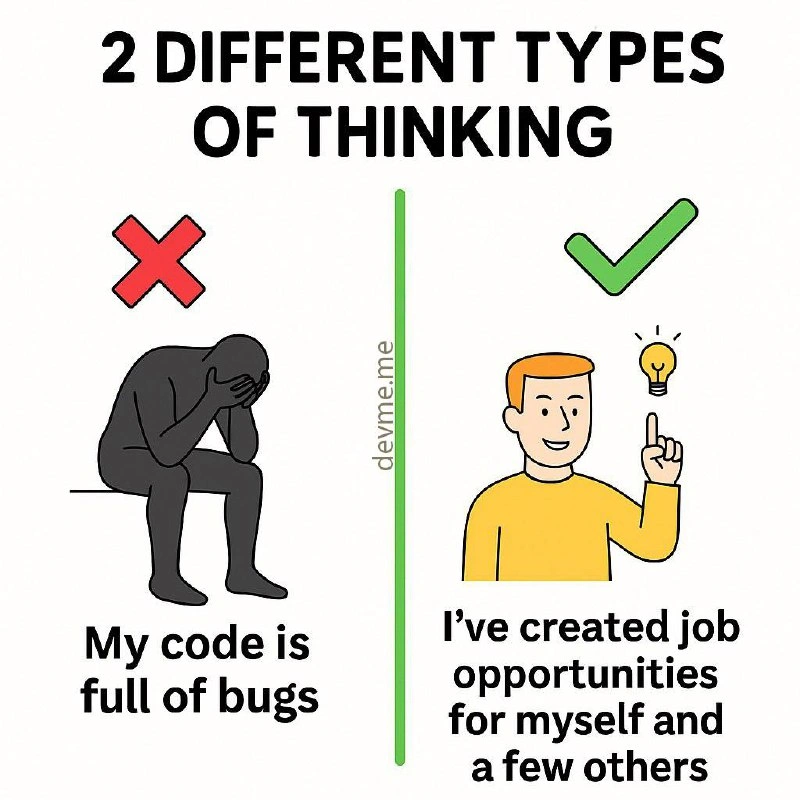
This meme presents a simple idea: turning a problem into an opportunity. On the left side, a developer is upset, saying “My code is full of bugs.” On the right, another developer cheerfully says “I’ve created job opportunities for myself and a few others.” In other words, one person sees a problem (lots of errors in the code), while the other sees those errors as a kind of job security for themselves and their team. It’s the same situation, just two very different ways of thinking about it.

Let’s break down some terms. A bug in software is a mistake or flaw in the code that causes the program to do something wrong or unexpected. For example, a bug might make a game crash when you reach a certain level, or cause a calculator app to give incorrect results for a specific equation. Bugs are usually unintentional – little coding errors or oversights. Fixing bugs (a process called debugging) is a big part of a developer’s day-to-day work.

Now, code quality refers to how well-written and maintainable the code is. High code quality means the code is organized, clear, and behaves as expected. Low code quality means the code might be confusing, poorly organized, or filled with quick-and-dirty solutions. When someone says “my code is full of bugs,” it’s a sign that something is wrong in the codebase – maybe it was rushed, not tested enough, or just very complex. Usually, more bugs imply lower code quality, because a well-structured, well-tested program tends to have fewer things going wrong.

Technical debt is a term developers use to describe the consequences of taking shortcuts in code. It’s an analogy to financial debt. Imagine you have an assignment due and you do a rushed job to submit it on time, telling yourself you’ll fix the details later. In coding, those unfinished fixes and messy parts left in a hurry are “technical debt.” You got the feature out the door quickly (like borrowing time), but now you “owe” the codebase some cleanup and fixes afterward (paying interest). If you don’t pay back this debt by refactoring (which means cleaning up and improving the code without changing what it does), the problems pile up. The code becomes harder to change and tends to produce more bugs down the line, just like unpaid debt gathering interest.

So why would anyone think bugs create “job opportunities”? This is where the joke comes in. In reality, if your code has a lot of bugs, it means there’s a lot of work to do: you’ll be busy finding and fixing those issues. The positive spin in the meme is basically saying, “Because my code is so buggy, I’ll always have a job fixing it (and maybe my friends or coworkers will have jobs because of it too!).” It’s a tongue-in-cheek way to look at a bad situation. Instead of thinking “I failed, this is terrible,” the developer on the right pretends they intentionally did it to guarantee steady work for themselves and others.

For a junior developer or someone new to coding, discovering that your code is full of bugs can be really discouraging. You might worry you did something terribly wrong or that you’re bad at programming. That feeling is exactly what the left side of the meme shows – the person is literally in despair, head in hands, thinking “I messed up completely.” Many of us have been there: say you deploy your first website or release a new feature, and suddenly bug reports start coming in. It feels like getting a test back covered in red marks. The natural reaction is to feel upset or even embarrassed.

Now, an experienced developer or a good-humored team lead might try to cheer you up by joking, “Hey, look on the bright side: we’re not going to be bored — we’ve got plenty of bugs to fix!” That’s basically what the right side character is saying in a more braggy way. It’s not that bugs are truly good, but sometimes humor is used to cope with the stress. The idea of “job security through tech debt” is an inside joke in the software world. It means if a system is badly written or very old (full of technical debt), the company will need people around to constantly maintain and patch it. In a darkly funny way, those bugs are keeping the team employed. It’s similar to a mechanic joking that if every car on the road is always breaking down, they’ll always have customers.

There’s also that classic developer phrase, “It’s not a bug, it’s a feature.” We often say this sarcastically when a user finds something wrong that we didn’t catch – we pretend we meant for it to happen. In the context of this meme, the developer on the right is doing a twist on that idea. He’s essentially saying, “It’s not a bug, it’s a job opportunity.” In other words, each bug in the code isn’t just a failure; it’s also a task that someone will get paid to do (finding and fixing it). By joking that he “created job opportunities,” the developer implies that even his mistakes have an upside: they justify his role and perhaps even the hiring of additional team members to help fix everything.

Of course, no one actually recommends writing bad, bug-ridden code as a career move. In real life, if you deliberately create problems, that can backfire — your project might fail or you could get a reputation for sloppy work. The company isn’t truly happy about a buggy product. The meme is exaggeration for humor. It highlights a common feeling in software teams: after wrestling with a horrendous, bug-filled project, people will jokingly say, “Well, job security, I guess!” It’s a way to laugh it off when you’re knee-deep in a mess. And indeed, if you happen to be the person who knows how to fix that big mess, your manager is likely very keen to keep you around. Many developers become the “go-to” person for a particularly buggy legacy system (an old, inherited software system) simply because they’ve learned all its weird quirks. That familiarity makes them valuable — a bit like being the only plumber in town who knows how to fix an old type of pipe.

The key point for a newcomer is: bugs are normal, and fixing them is part of the job. No software of any real size is perfect. There will always be bugs or things to improve, which means developers will always have something to do. So the meme is taking that normal situation and adding a humorous spin. The first mindset is “Oh no, this is bad,” and the second mindset is “Ha, at least it keeps me employed!” It’s basically a nerdy joke that even our mistakes can have a silver lining. The right-side developer isn’t truly happy that the code is bad; he’s just choosing to laugh about the fact that he’ll be busy fixing it. It’s a funny reminder not to take failures too hard — after all, if everything worked perfectly, we’d have nothing to do!

Level 3: Tech Debt Tenure

The meme contrasts two development mindsets with dark humor: on the left, a programmer laments "My code is full of bugs" (complete despair over poor code quality and mounting errors). On the right, another developer proudly reframes the same situation: "I’ve created job opportunities for myself and a few others," treating those bugs like a feature that guarantees work. This twist on reality is classic developer irony – finding a cynical silver lining in our technical failures.

Why is this so funny to seasoned engineers? Because it hints at an uncomfortable truth: persistent bugs and technical debt can inadvertently become a form of job security. We've all seen it. A codebase riddled with flaws requires constant maintenance, which means the people who know that messy system are perpetually in demand. Instead of panicking "oh no, everything’s on fire!", the right-side character basically says "it’s fine, the fire keeps me warm (and employed)." It's a parody of the coping mechanisms devs use after too many late-night debugging sessions.

In real life, teams drowning in bugs often joke, "Well, at least they’ll keep paying us to fix this!" It’s a positive spin on bugs born from exhaustion. The meme exaggerates this maintenance mode mindset, where every unsolved bug is treated as a guaranteed future work ticket. There’s even a tongue-in-cheek principle among jaded senior devs: if you write code so convoluted that only you can maintain it, you've basically given yourself tenure. Your obscure 10,000-line script might be a nightmare for the company, but hey, they can't fire you — you’re the only one who knows how to keep that beast running. It’s job security through tech debt in action.

As veteran architects grimly observe, “every unrefactored module is a long-term support contract in disguise.” Let a critical piece of software accumulate enough cruft, and the business essentially signs up to keep a developer (or an entire team) on call indefinitely to manage it.

This scenario plays out a lot in enterprise environments. Instead of preventing issues upfront (through proper design and testing), some organizations fall into a reactive cycle: constantly patching bugs as they surface. And ironically, those bug-fix firefights can make the fixers look heroic. There’s a perverse incentive at play: being the firefighter who swoops in to save a broken system at 3 AM often gets you more kudos (and overtime pay) than quietly writing stable code in the first place. Over time, a developer might start to embrace the chaos. They begin to think like the green-checked optimist in the meme: “If everything were perfect, half of us would be out of a job. So a few bugs? Not so bad — they keep the lights on (and my paycheck coming).”

From a career perspective, a codebase crawling with bugs spawns multiple "opportunities":

  • Endless bug-fix sprints: There’s always another critical issue to tackle next week. The Jira board never runs dry.
  • Dedicated support roles: Teams create specialist positions (like “Legacy System Support Engineer” or on-call bug triage duty) just to handle the constant issues.
  • Indispensable knowledge silos: The original author of a fragile module can become indispensable. Only they know the quirky workaround that prevents the entire app from crashing. That’s a recipe for job stability if you’re that person.
  • Consulting windfalls and overtime: External consultants might even be brought in to tackle accumulated bugs and tech debt, and internal devs rack up overtime. The system’s flaws effectively justify extra budget and headcount.

It’s a running joke in software engineering that "it’s not a bug, it’s a feature." This meme riffs on that by implying, "it’s not a bug, it’s a career plan." The humor lands because no one really sets out to write bad code for job security — but in hindsight, it sure can feel that way. Think of those ancient banking systems written in COBOL: they’re full of archaic quirks (some might say bugs “features of their era”), yet banks literally cannot function without them. Result? Any developer who understands that old code has a guaranteed job. In the late 1990s, the infamous Y2K bug in date logic actually turned into a bonanza for programmers — a massive defect that required so much fixing, it created an industry-wide employment surge. A bug that huge was practically an employment program for software folks.

Seasoned devs smirk at this meme because they’ve lived some version of it. Maybe they inherited a project that was a dumpster fire of bugs. Initially they hung their head in despair like the figure on the left, then realized: fixing those bugs would be their life (and livelihood) for the next few years. It’s dark, it’s ironic, but it’s relatable. The cartoon’s left side (red X, head-in-hands) is the engineer in panic mode, and the right side (green checkmark, light-bulb moment) is that same engineer a few deployment crises later, wryly joking “Actually, by not writing perfect code, I've ensured they'll always need me. Clever, right?” In short, one developer’s bug can be another developer’s paycheck.

# Pseudo-code for a career built on bugs:
while system.has_bugs():
    engineer.job_security += 1
    fix_one_bug()
    # On a bad day, fix_one_bug() might introduce two new bugs, extending the loop (and employment) further

In essence, the meme is poking fun at technical debt and bugs as a double-edged sword. Sure, a bug-infested codebase is painful for the team and the users, but the dark punchline is that it can also be viewed as a form of job insurance. It’s a satire of positive thinking: turning a code quality crisis into a recruitment strategy (for yourself!). Senior engineers chuckle because they’ve heard colleagues half-jokingly utter this exact sentiment during crunch time. It’s humor born from the reality that in software, more problems to solve often do translate into continued employment. The code might be sick, but hey, that means the developer gets to stay on as the doctor.

Description

A two-panel comic titled '2 DIFFERENT TYPES OF THINKING' contrasts two developer mindsets. The left panel, marked with a red 'X', shows a dark, silhouetted figure sitting dejectedly with their head in their hands. Below it, the text reads, 'My code is full of bugs'. The right panel, marked with a green checkmark, features a cheerful cartoon man in a yellow shirt, pointing a finger upward as a lightbulb appears above his head, signifying an idea. The text below him says, 'I've created job opportunities for myself and a few others'. A vertical watermark for 'devme.me' runs between the panels. The meme humorously reframes the frustrating experience of writing buggy code as an act of economic stimulus. For senior developers, it's a cynical but relatable joke about how bugs, technical debt, and maintenance cycles create perpetual work, ensuring job security for themselves, their colleagues, and the QA team
Comments

17
Anonymous ★ Top Pick My code doesn't have bugs, it has 'undocumented features' that function as a long-term employment strategy for the maintenance team
  1. Anonymous ★ Top Pick

    My code doesn't have bugs, it has 'undocumented features' that function as a long-term employment strategy for the maintenance team

  2. Anonymous

    Sure, the defect count just triggered the pager again - but think of it as guaranteeing full-stack employment until the next major rewrite that never gets budgeted

  3. Anonymous

    The real 10x engineer writes code so complex and buggy that it takes 10 engineers to maintain it - that's just strategic workforce planning and guaranteed consulting gigs for the next decade

  4. Anonymous

    The real 10x engineer isn't the one who writes perfect code - it's the one who writes code that requires 10x the maintenance budget. Job security through strategic technical debt: when your bugs become your business model

  5. Anonymous

    Enterprise devs know: a 'buggy' monolith isn't failure - it's a self-sustaining ecosystem for endless billable fixes

  6. Anonymous

    We don’t ship defects - we run an incident‑driven hiring model where each stack trace funds 0.1 FTE in SRE, QA, and consulting

  7. Anonymous

    We switched from TDD to HDD - Headcount Driven Development, where every unresolved bug opens a requisition

  8. @hasanboyhk 1y

    "life could be dream"

  9. @gongchanM1 1y

    "i create shitty code datasets to prevent ai getting my job"

  10. Sure Not 1y

    https://www.google.com/search?hl=en&q=how%20to%20destroy%20drones%20with%20magnetron%20from%20a%20microwave

    1. Sure Not 1y

      The IQ barrier is too high, can someone optimize this meme?

      1. dev_meme 1y

        People looking at solar eclipse without protection

      2. @callofvoid0 1y

        Low IQ itself is the answer

        1. Sure Not 1y

          The lucky ones who would get it tho https://youtu.be/zmX7K8noikE?feature=aiwinter

  11. Sure Not 1y

    You know what to do

  12. @FrierenCute 1y

    real boss on the right

  13. @M4lenov 1y

    Sometimes I really do this on purpose. Once you're not intern anymore there's always some place where you can plant bugs and they won't know better it's your fault

Use J and K for navigation