When Pragmatism Silences Dogma in Development
Why is this Testing meme funny?
Level 1: Plan vs Wing It
Imagine you have two friends trying to build a big LEGO castle. One friend is very careful: they follow the instructions page by page, double-checking that each brick is in the right place before moving on. This is like making sure everything is correct step-by-step. The other friend is more impatient and adventurous: they throw away the instructions and start snapping bricks together from their imagination. If a tower they build collapses or a piece doesn’t fit, they just shrug, fix that part on the fly, and keep building. Now, usually, you’d think the careful friend with the instructions would be the leader, right? But in this funny scenario, the impulsive friend who’s winging it turns to the careful friend and says, “Quiet, you! The one who fixes problems as they happen is in charge here.” It’s silly because it’s upside-down from what you’d expect. The kid who usually ignores the rules is acting like the boss, telling the rule-follower to be quiet. That role reversal is the heart of the joke – it makes us laugh because it’s like the class clown shushing the teacher. In simple terms, it’s funny for the same reason it would be funny to see someone who never studies for a test bragging to the straight-A student: “Hush now, I’ve got this!” – unexpected and a bit absurd, but all in good fun.
Level 2: Test First vs Fix Later
Let’s break down the joke in simpler terms. This meme is highlighting two opposite approaches to writing software: Test-Driven Development (TDD) versus what we might jokingly call “error-driven development.” In TDD, a developer writes tests before writing the actual code. A unit test is a small piece of code that checks if a part of your program (a single function or module) works correctly. For example, if you have a function that should calculate an area of a rectangle, a unit test might call calculateArea(3,4) and expect the result to be 12. In TDD, you would write that test first, see it fail (since calculateArea function doesn’t exist or isn’t correct yet), and then write the calculateArea code to make the test pass. The idea is you drive development by the tests: you only write new code when a test demands it. A TDD evangelist is someone who strongly believes in this method and encourages everyone to follow it. They treat writing tests as essential, almost like a religion (hence “evangelist”). When done right, TDD can lead to very robust code with fewer bugs, because you catch problems early, in your own development environment, before the software ever runs for a real user.
On the flip side, the “error-driven developer” takes a very different approach – essentially code first, deal with problems later. This person writes the feature or fix straight away without writing any tests. They then run the program to see what happens. If something breaks or throws a runtime exception (which is an error that occurs while the program is running, like a crash or an uncaught error message), they’ll see it in the console or logs and then go back to fix the code. In other words, they rely on actual failures and debugging to guide them. Often this means using lots of console.log statements (or print statements) to output variables and status at different points in the code, or reading the stack trace when an error occurs. A stack trace is that multi-line error dump you see when a program crashes, listing the sequence of function calls that led to the error – kind of like the footprints of the bug. An “error-driven” coder almost listens to those error messages like they’re clues (hence the funny term “runtime-exception whisperer,” as if they have a special talent for understanding what error logs say). This approach is common when someone is prototyping quickly or debugging something: you write code quickly, and if it fails, the failure tells you what to fix next. It’s more reactive. The downside, of course, is if you don’t test beforehand, bugs might only get caught when the code is already running (possibly in front of a user or in production). That’s why more cautious developers favor writing tests early – it’s proactive vs. reactive.
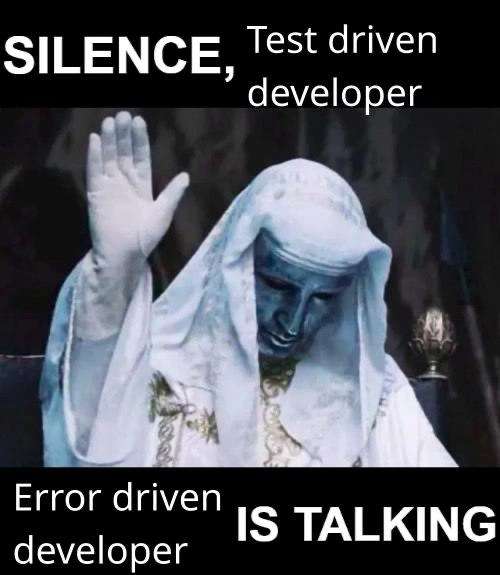
Now, the meme itself shows an image with bold text saying “SILENCE, test driven developer” at the top and “Error driven developer IS TALKING” at the bottom. This format – large white uppercase text on a black border – is a classic meme style for dramatic proclamations (often using Impact font). It’s actually referencing a movie scene (from The Lord of the Rings) where a powerful character silences another by saying something akin to “You have no authority here.” But you don’t need to know the movie; the image basically shows a mystical-looking figure holding up a hand as if to say “Stop. Be quiet now.” In our context, the Error driven developer is that authoritative figure. The joke is that he’s telling the Test driven developer to shut up because “he’s talking now.” This is funny because normally, you’d expect the opposite – usually the person preaching good practices (writing tests) would be the one telling the sloppy coder to listen. Flipping the script like this creates a kind of ironic surprise.
Imagine a team meeting (like a sprint planning session in Agile development) where the team discusses how to implement a new feature. The TDD evangelist might say, “We should write our unit tests first to specify what the code should do, then implement the code.” The error-driven guy might respond, “That’s overkill. Let’s just code the feature and see if it works. If something breaks, we’ll catch it from the error.” In the meme, the second person — the one who just wants to dive in and troubleshoot later — is basically telling the first person to “SILENCE”. It’s like him saying, “Quiet, you overly careful person. Let the risk-taker speak!” 😅 This echoes a kind of TestingHumor in the developer world: people often joke about colleagues who refuse to write tests, calling it “🤠 cowboy coding” or here making up a title like “runtime-exception whisperer” for someone confident in debugging skills. It also highlights a bit of DebuggingTroubleshooting culture: some developers actually enjoy the challenge of chasing bugs with a debugger or logs, almost like a detective game, and might find writing tests beforehand to be boring or slowing them down.
To clarify with a small example, here’s how the two approaches might look in code:
// Error-driven development approach:
function calculateArea(width, height) {
if (!width || !height) {
console.error("Missing parameter!", { width, height }); // log the error
throw new Error("Invalid dimensions"); // let the program crash here
}
return width * height;
}
// Test-driven development approach (using a simple test framework syntax):
describe("calculateArea", () => {
it("returns the product of width and height", () => {
expect(calculateArea(3, 4)).toBe(12); // test that 3x4 gives 12
});
it("throws an error when parameters are missing", () => {
expect(() => calculateArea(3, null)).toThrow(); // test that missing height throws an error
});
});
In the first part (error-driven), the developer writes calculateArea without any tests upfront. They include a console.error and throw an exception if something’s wrong, but they’d only see that by running the code. Essentially, they’d run calculateArea(3, null) somewhere, notice it crashes with “Invalid dimensions,” and that’s how they know there’s a bug to fix or a case to handle. In the second part (test-driven), the developer wrote two tests before fully trusting calculateArea. The tests describe what should happen: one normal case (3×4 should be 12) and one error case (missing a parameter should throw an error). The developer would run these tests and initially the second test might fail if calculateArea wasn’t throwing an error properly. They’d then modify the calculateArea function until all tests pass (for example, adding exactly that check and throw for missing parameters). This way, the bug is caught during development, not at runtime. The contrast is clear: in one approach you verify as you build, in the other you fix as it breaks.
Now back to the meme: it labels the cautious developer as “Test driven developer” and the daring one as “Error driven developer.” The error-driven developer is talking part means that in this joke scenario, the person who codes first and tests later is taking charge of the conversation. It’s exaggerating a real-world friction. Many new developers will encounter this: perhaps you’re taught in school to write tests or at least to carefully plan out code, but then on your first project you meet someone who says “Nah, I just hack something together and run it. If it fails, the error will tell me what to do next.” It might leave you a bit stunned, because it sounds risky! This meme is funny to developers because it captures that shock value and flips it into comedy. DeveloperHumor often comes from these relatable workplace scenarios taken to an extreme.
In summary, the meme uses a dramatic scene to personify two coding philosophies:
- Test-first (TDD): the careful planner who wants proof that code works via unit tests.
- “Error-first” (error-driven): the adventurous debugger who jumps straight into coding and relies on runtime feedback (errors, logs) to adjust.
By telling the test lover to be silent, the meme humorously suggests that in some discussions the “let’s just build and worry later” person ends up dominating. It’s a playful jab at how software teams sometimes sideline best practices due to time pressure or differing beliefs. Anyone who’s struggled between doing things “the proper way” vs. “the fast way” can chuckle at this exaggerated scenario. After all, both testing and debugging are crucial parts of a programmer’s life – this image just jokes about what happens when the balance tips and the debugging cowboy gets to play the hero. 🤠🏆
Level 3: You Have No Tests Here
At first glance, this meme dramatizes the eternal test_first_debate in software teams by flipping the usual power dynamic. We see a robed figure raising a hand authoritatively, captioned with Impact font text: “SILENCE, Test driven developer… Error driven developer IS TALKING.” It’s a techie twist on the famous “You have no power here” scene (a LotR_you_have_no_power_mashup moment), used to parody a common DeveloperStereotypes clash. On one side, the zealous TDD evangelist (the developer who insists on writing tests for everything upfront). On the other, the runtime_exception whisperer (the coder who trusts in letting the code run, listening to whatever errors and stack traces happen at runtime to guide fixes). The humor hits home for seasoned engineers because it inverts who usually “has the upper hand” in discussions about code quality. Typically, the Test Driven Developer is seen as the voice of discipline and best practices in TestingHumor. But here, the error driven developer – who lives by console logs and post-fact debugging – arrogantly silences the TDD pro. 😂 This absurd role reversal pokes fun at real-life tensions in sprint planning meetings and code reviews, where the error-driven quick-fix approach can sometimes win out over careful unit testing, especially under tight deadlines or shaky team culture.
In real-world terms, this scene could play out during sprint planning: The TDD advocate might pipe up, “Let’s budget time for unit tests for this new feature,” only to be interrupted by a battle-worn colleague who scoffs, “No time for that – we’ll handle bugs if they happen.” The meme captures that exact DebuggingFrustration many have felt when quality concerns are dismissed. It’s not just about one person being rude; it’s a commentary on how teams often prioritize speed over safety. The error-driven developer archetype prides themselves on being a runtime_exception_champion – someone who can quickly interpret cryptic stack traces and tame wild bugs under pressure. They might jokingly call this “error-driven development”, wearing it as a badge of honor. Meanwhile, the Test-Driven paladin stands there, unit test scrolls in hand, temporarily stunned into silence by the sheer brazen confidence of the “fix-it-later” philosophy. The meme’s text “Error driven developer IS TALKING” implies “the debugger-wielding cowboy has the floor now.” It’s a perfect satirical snapshot of countless DeveloperExperience_DX war stories: from fiery post-mortem meetings where someone mutters “If only we had tests…”, to code review comments like “Where on earth are the unit tests for this?!”, met with “Relax, it works.”
This cheeky scenario resonates because experienced devs know both sides of this coin. UnitTesting advocates argue that catching bugs early with tests leads to more stable code and better long-term velocity (and fewer 3 AM on-call surprises 🤦♂️). The anti-TDD folks (often sarcastically dubbed “testing is a waste of time” types) counter that “writing tests for simple stuff is overkill” or that unpredictable bugs will happen regardless, so they lean on robust logging and quick debugging skills. The image of a cloaked figure commanding silence is an exaggerated metaphor: it’s as if the chaotic good coder who loves diving into the debugger is saying, “Pipe down, you and your fancy test suites — let the real problem-fixer speak.” Working developers find this hilarious (and a bit painful) because it satirizes a truth: even though Testing should hold weight, the “ship now, patch later” attitude often seizes the spotlight in fast-paced environments. It’s an inversion of quality assurance hierarchy, where the runtime logging sorcerer temporarily outranks the unit test paladin.
To illustrate the contrast, consider how each of these two developers operates day-to-day:
| Test-Driven Developer 🧪 | “Error-Driven” Developer 🔥 |
|---|---|
| Writes unit tests before writing the feature code (follows the “red-green” rhythm) | Writes the feature code first and handles exceptions later (“code now, deal with crashes when they happen”) |
| Sees a failing test as an early warning signal – a chance to fix a bug before shipping | Uses console.log statements and stack traces as the real bug detector – runs the app and watches for error messages to find issues |
| Prefers catching bugs in a controlled environment (on their machine or CI through tests) | Often debugs issues “in the wild,” sometimes even in production (cowboy style) if something breaks for a user |
| Frequently asks in code review: “Where are the tests for this logic?” 😇 | Frequently says in stand-up: “It works on my machine, no need to overthink it.” 😈 |
| Believes more tests = better DeveloperExperience (DX) long-term (fewer surprise breakages) | Believes writing tests upfront slows down initial progress (prefers quick results and fix on fail) |
Notice how the meme boldly mocks the notion that “fast and messy” outranks “slow and steady.” The top text shouting “SILENCE, test driven developer” is dripping with sarcasm precisely because in serious engineering culture, we expect the TDD pro to be respected, not muzzled. It’s riffing on the popular “Silence, X is talking” meme format, which often humorously elevates a usually underestimated character. In this case, the runtime_exception whisperer (the one typically seen as reckless) is crowned the king – at least for this comedic moment. It’s the kind of DeveloperHumor that makes you smirk and maybe remember that senior engineer who proudly said, “Why write tests when we have a perfectly good production environment to test in?” 🙃
Underneath the laughter, there’s a grain of truth that seasoned devs appreciate: writing tests is extra work, and not everyone is convinced it’s worth the trade-off in every scenario. Perhaps the codebase is so volatile or the deadlines so tight that some teams tacitly adopt “error-driven development” as their modus operandi, relying on good debugging skills and quick patch releases. This meme gives a face to that unspoken reality. The Test driven developer character represents the voice of idealism and quality (often recalling principles from Agile and Extreme Programming by folks like Kent Beck), whereas the Error driven developer personifies the pragmatic (or sometimes chaotic) coder who’s confident they can fix anything on the fly. The comedic tension here is relatable to anyone who’s been in those code-review battles and post-mortem discussions: it’s essentially a battle between preventative medicine and emergency triage. And let’s be honest, the emergency room stories (production crashes, hotfix heroics at midnight) often become legend in an engineering org, giving the “runtime exception fire-fighter” a certain renegade prestige. So when the meme shows the error-driven dev demanding silence, it’s capturing that heroic self-image – the one who speaks is the one who swoops in when all the tests in the world didn’t predict a real-world bug. It’s both a celebration and a light roast of the debugging cowboy culture that persists in our industry. No wonder this image hits home: it elegantly wraps up TestingHumor with a sprinkle of cinematic drama, making every experienced dev simultaneously chuckle and cringe in recognition.
Description
A meme featuring a solemn, robed figure with a metallic blue mask, holding up one hand in a gesture demanding silence. White text is overlaid on the image. The top text reads, 'SILENCE, Test driven developer'. The bottom text proclaims, 'Error driven developer IS TALKING'. This meme humorously elevates the chaotic, reactive style of 'error-driven development' - writing code and fixing the resulting errors - over the more structured and idealized 'test-driven development' (TDD) methodology. For experienced developers, the joke resonates because it acknowledges a common reality: while TDD is often preached as the ideal, the practical, day-to-day work of building and fixing software under pressure often devolves into a cycle of running code, seeing what breaks, and debugging the problem. The 'error-driven developer' is portrayed as the one with true authority, forged in the fires of production issues and cryptic stack traces
Comments
29Comment deleted
Test-driven development is great until you inherit a legacy system where the only test is 'does it still make money?' and the only feedback is the compiler screaming at you in thirteen different languages
After twenty years we’ve discovered the real workflow: write no tests, ship, let production throw an exception, THEN retroactively declare it a failing test case - instant TDD compliance!
After 20 years in the industry, I've learned that 'error-driven development' is just production-driven testing with better PR. The real pros know both approaches converge at 3am when the CEO is asking why the payment gateway is returning 'undefined is not a function'
The eternal standoff: TDD practitioners writing tests before code like it's a religious doctrine, while error-driven developers treat production as their integration test environment. One writes `assert(feature.works())` before the feature exists; the other writes the feature, ships it, and learns what 'works' means from Sentry alerts at 3 AM. Both claim their approach is 'pragmatic' - one prevents bugs through discipline, the other discovers them through user feedback. The real joke? They're both right depending on whether you're building a pacemaker or a landing page
We call it EDD: the API contract is negotiated by whatever exception the runtime throws first
TDD architects the cathedral; EDD rebuilds it mid-earthquake while users pray
TDD: red->green->refactor; error-driven: pager->stacktrace->hotfix->postmortem
I wonder, what percentage of devs is actually use TDD in development?) Comment deleted
what's TDD? Comment deleted
Test Driven Development Comment deleted
like writing tests for every piece of code you write? Comment deleted
like writing tests and then writing code to pass them Comment deleted
then you are writing code for the test not test for the code Comment deleted
yes, and it's called TDD Comment deleted
this is shit Comment deleted
Its a PITA, but depends of the developers... if developer made shity tests you will get shity implementation too hahaha Comment deleted
No, the core approach is you first write tests (unit test, if to be precise), and then write code for these tests to pass. Pretty weird approach, for my opinion, and don't understand why it is so praised in the dev community. Comment deleted
Write test before implementation Comment deleted
I only use it for big db migrations. Like to merge some shit and don't fuck up the data. So it's a fast way to do a fixture and then build your migration according to the expected results. Comment deleted
you are right) Comment deleted
might be good for writing libraries Comment deleted
maybe, there are some applications for sure, but i've been studing it in uni and it was so lame Comment deleted
We use customers as testers. Comment deleted
Based 🗿🗿🗿 Comment deleted
REAL DEVELOPER Comment deleted
it is what it is Comment deleted
I don’t mind errors. I’m a scream-driven developer. My debugging process starts when users start screaming! Comment deleted
Like a test where asserte 2+2=5.... Comment deleted
Mother Nature uses Mutation driven development. 😂😂 Comment deleted