
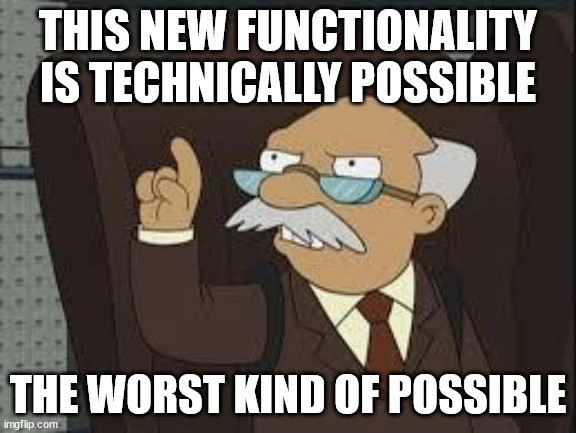
When a feature request is technically possible but practically a nightmare
Description
A meme featuring Professor Farnsworth from the animated show Futurama, with a stern expression, pointing his finger up. The top text reads, 'THIS NEW FUNCTIONALITY IS TECHNICALLY POSSIBLE'. The bottom text reads, 'THE WORST KIND OF POSSIBLE'. This meme format, often called 'Technically Correct,' is used to highlight situations where something is true by a narrow definition but is undesirable or problematic in the broader context. In software development, this captures the dread experienced by senior engineers when a stakeholder or product manager proposes a feature that, while achievable, would introduce significant technical debt, architectural problems, or maintenance overhead. It's the classic conflict between possibility and practicality

Comments
7Comment deleted
Product asks if we can integrate the new payment API. I say it's 'technically possible' - the same way it's 'technically possible' to refactor a legacy monolith using only regex and sed. The outcome is likely a regression-fueled nightmare
“Absolutely, we can ship that feature - just a Kafka mesh, three new bounded contexts, and a sacrificial lamb to the CAP theorem stand between us and ‘technically possible.’”
Yes, we can implement real-time blockchain validation for every mouse click, store all user preferences in a graph database with eventual consistency, and make the entire frontend a single 50MB WebAssembly module compiled from Rust. The PM's eyes are already lighting up
Every architect has lived this moment: when the POC works flawlessly in isolation, stakeholders are ecstatic, and then you realize it requires rewriting half the platform, introduces 3 new failure modes, violates 2 compliance requirements, and the operational runbook will be longer than the codebase. Technically possible? Absolutely. Production-ready? That's a different engineering discussion entirely
Sure, it’s technically possible - we’ll go AP instead of CP, blow the error budget, and rebrand the SLA as YOLO-as-a-Service
Sure, it’s feasible - five microservices, a cron-driven saga, two feature flags, and an SLO that’s technically a suggestion
Like GOTO in a microservices era: feasible, but your distributed tracing will never forgive you