The Old Guard Developer's Last Stand Against Modern Frameworks
Why is this Frameworks meme funny?
Level 1: Too Many Toys
Imagine you have a favorite old toy that you really love to play with. It’s simple and you know exactly how it works. Now picture a bunch of toy salespeople knocking on your door every day. They’re holding the newest, shiniest gadgets and saying, “Hey, come play with these! This one can transform, that one can talk, and we get you a cool new toy every week!” It sounds exciting at first — new toys are fun, right? But after a while, it gets tiring. Every week there’s another new toy with new rules to learn, and you barely got used to the last one. Finally, you get so fed up that you grab your water gun and yell, “Go away! I just want to play with my simple old toys that I already know and love!”
In this story, the fancy new toys are like all those new coding frameworks that keep coming out, and the simple old toys are like using basic tools (just plain HTML, CSS, JavaScript, and PHP) that the developer is comfortable with. The meme is exaggerating how a developer feels when they’re overwhelmed by too many new things being pushed on them — it’s funny because he reacts like an upset kid saying “leave me alone” in a big dramatic way. Even if new toys (or new tools) are cool, sometimes you just want things to stay simple and familiar so you can enjoy playing.
Level 2: New Shiny vs Old Reliable
This meme highlights the tension between modern frameworks and plain old coding with basic tools. Let’s break that down. A framework in software is like a pre-built collection of code and guidelines that helps you build applications in an organized way. For example, React, Vue.js, and Angular are popular frameworks (or in React’s case, a “library”, but let’s say framework for simplicity) for building the front-end of web applications. The front-end is everything a user sees and interacts with in their browser – the buttons, text, forms, and all the dynamic visuals on a webpage. React, Vue, and Angular provide structured ways to build those interactive interfaces more easily than starting from scratch.
On the other hand, Laravel and Symfony (the logo on the door) are frameworks for the back-end. The back-end is the behind-the-scenes part of a website – the server-side code that handles logic, talks to databases, and sends the right data to the front-end. PHP is a programming language commonly used for back-end web development (especially in the classic LAMP stack: Linux servers, Apache web server, MySQL database, and PHP language). Laravel and Symfony are both written in PHP and help developers organize their PHP code better. They come with many ready-made components for common tasks (like user login systems, form handling, database access) so you don’t have to write everything yourself.
In the meme, the frameworks (React, Vue, Angular, Laravel) are like characters trying to convince a developer to use them. They say things like “we make your app scalable, easier to maintain, better to work with in a team, and we bring you new features every week.” These are typical selling points:
- “Scalable” means the app can grow to handle more users or more data easily. Frameworks often claim that their structure will handle growth without falling apart.
- “Easier to maintain” means that it’s easier to fix bugs or add new features later. The framework imposes a consistent structure, so anyone who knows the framework can understand the project. In theory, this avoids the chaos of everyone coding in their own random style.
- “Better to work with in a team” means if a team of developers all use the framework’s patterns, they can collaborate without stepping on each other’s toes. It’s like everyone following the same recipe, so no one is lost.
- “New features every week” refers to how some frameworks or libraries have frequent updates or an ecosystem that’s constantly improving. For example, front-end frameworks often release updates, plugins, and tools regularly to stay current.
Now, those frameworks in the doorway are basically doing a “framework sales pitch.” It’s like they’re saying, “Come out and join us, we’ll make your life easier and your projects better.” This sounds great, especially to newer developers who are told they should learn these frameworks to get a job or build modern apps.
But on the right side, the developer isn’t buying it. He literally says, “I want plain HTML/CSS/JS and PHP back.” HTML, CSS, and JavaScript (JS) are the core technologies of the web:
- HTML is the structure of web pages (the content and elements).
- CSS is the styling (colors, layouts, fonts).
- JavaScript (JS) is what makes web pages interactive (responding to clicks, fetching data without reloading, etc.).
When he says plain HTML/CSS/JS, he means using these directly, without any fancy framework layering on top. And PHP (without a framework like Laravel/Symfony) would mean writing the server logic more directly, using basic scripts to handle requests.
So why would someone not want frameworks if they promise to help? There are a few reasons hinted at in the meme:
Learning Curve and Complexity: Frameworks can be complex. For instance, learning Angular or React means learning a whole set of new concepts (like React’s JSX, components, state, or Angular’s modules, decorators, dependency injection). For a beginner or even an experienced dev who’s new to that framework, it’s a lot of upfront work. In contrast, writing plain HTML or vanilla JavaScript might feel more straightforward for small tasks. The developer in the meme might be overwhelmed by how much there is to learn just to “keep up” with the latest tools.
Constant Change (Framework Churn): Notice the line “new features every week.” This hints at something developers jokingly call “JavaScript fatigue” or framework churn. The front-end world, in particular, has seen frameworks and tools rise and fall very quickly. One year everybody is using one tool, the next year a new one appears. For example, we had a time when everyone used jQuery (a simple JS library), then AngularJS became hot, then React overtook it, then came Vue, and also Angular completely changed (Angular 2+ is a different framework from the original AngularJS). It’s exciting but also tiring. If you just learned one, you might be told “Actually, there’s something better now, learn that instead.” Keeping up with weekly new features or frequent releases can feel like a never-ending homework assignment. The meme exaggerates it with “every week,” but for some libraries, it can really feel that frequent!
Overkill for Small Projects: Not every project is a huge application with millions of users. For a simple website or a personal project, using a big framework might be like using a bulldozer to plant a small flower. It adds a lot of files, setup, and rules. For instance, writing a “Hello World” in plain HTML/JS is just a couple of lines, but doing it in React involves setting up Node, a build tool, JSX, etc. Some developers get frustrated when they feel forced to use a complex tool for a simple job. The person in the meme might be that type – they find joy or clarity in just writing things in a simpler way, especially if the app isn’t that complex.
Nostalgia and Control: The phrase “I want it back” suggests this developer has been around long enough to remember building things the old way. There’s a bit of nostalgia: “Things were simpler when I could just code in PHP and refresh the page.” Of course, that old way had its issues, but humans often remember the good parts fondly. Using plain code means you have full control and you understand everything because you wrote everything. With a framework, sometimes it feels like the framework is doing “magic” behind the scenes. For example, Laravel’s Eloquent ORM automatically maps database rows to objects in code – which is cool, but if something goes wrong, you might not know how that magic works internally. Some folks prefer the transparency of writing their own SQL queries and code, where nothing is hidden.
Framework Evangelists Pressure: In the meme, multiple frameworks are literally at the door urging the developer to “come out.” This can represent peer pressure or community pressure. Developers often encounter colleagues or online communities that enthusiastically push the latest framework (“You’re still using X? You should really use Y, it’s so much better!”). Especially in teams, if the majority wants to adopt a new tool, someone who is comfortable with the old stack might feel cornered. The meme shows an extreme reaction – instead of agreeing, the dev screams “leave me alone!” with a metaphorical shotgun. It’s humor, but it captures that feeling of “I’m tired of being told to rewrite everything every year.”
Let’s identify the characters and tech mentioned, in simpler terms:
Troll face developer: The guy on the right with the big grin is drawn using the “troll face,” a famous Internet meme character used to represent someone who is being intentionally provocative or difficult (often for humor). Here it represents a fed-up developer who is almost cartoonishly anti-framework.
React: A JavaScript library (often called a framework) for building user interfaces, maintained by Facebook (now Meta). It lets developers create reusable UI components and manage a web page’s state effectively.
Vue.js: A progressive JavaScript framework (created by Evan You) for building UIs. It’s known for being approachable and combining some best ideas from earlier frameworks. It’s another tool to build dynamic web front-ends.
Angular: A full-fledged front-end framework originally by Google. There was AngularJS (older version) and now Angular 2+ (completely revamped). It’s known for a comprehensive structure to build large applications, using TypeScript typically.
Laravel: A popular PHP framework for building web applications. It’s known for an elegant syntax and lots of built-in features like authentication, database ORM (called Eloquent), routing, etc. It’s often praised for making PHP development faster and more enjoyable by handling common tasks.
Symfony: Another powerful PHP framework (one of the older ones, actually). Symfony is often seen as more low-level than Laravel; in fact, Laravel uses a lot of Symfony’s components under the hood. Symfony is known for its robustness and flexibility. The door in the meme has the Symfony logo, which suggests the context is a PHP developer’s world. Perhaps the person inside is mainly a Symfony/PHP user.
Laravel Eloquent ORM: This is a part of Laravel. ORM stands for Object-Relational Mapping, which is a technique that lets you interact with the database using objects/classes in your code instead of writing raw database queries. Eloquent provides a convenient syntax to, say, fetch all users from a
Usertable by just callingUser::all()in PHP, for example. Some developers love ORM because it speeds up development, while others find it too abstract and prefer writing their own SQL for clarity and performance. Mentioning Eloquent in the tags suggests the meme resonates with PHP developers who know these tools.Framework vs Plain Code: This is a common debate in programming. “Plain code” means using the core language without additional layers. For front-end, plain code would be just HTML, CSS, and vanilla (pure) JavaScript. For back-end, plain code would be using raw PHP (or whatever language) with maybe small libraries, but not a big structured framework.
Framework Fatigue / Framework Churn: As noted, this refers to the exhaustion from constantly learning new frameworks or dealing with their frequent updates. New developers might experience this as confusion: “Should I learn React or Vue? Everyone is talking about this new thing Svelte now… and what about Next.js or Nuxt?” It’s a lot! The meme’s humor heavily leans on the idea that developers are tired of the endless churn – that feeling of “Can we slow down with the ‘next big thing’? I can’t keep up.”
Backend vs Frontend: These categories were given to clarify that the meme touches on both. The frameworks listed span both sides of web development. React, Vue, Angular are frontend (they run in the user’s browser). Laravel and Symfony are backend (they run on the server). The meme’s joke isn’t just about one side of development, but the ecosystem as a whole. The developer is essentially saying “I’m sick of all frameworks, whether it’s a JS framework on the front or a web framework on the back – I want to go back to basics on both ends.”
So, for a junior developer or someone new to these concepts, what’s the takeaway? The meme uses exaggeration to point out a real feeling: sometimes the tools meant to help you can feel overwhelming. Modern frameworks do provide amazing features and they’re popular for good reasons (big applications with many developers really do benefit from the structure and efficiency of frameworks). But it’s also okay to feel a bit nostalgic or prefer simplicity for certain projects.
Imagine you just learned how to make a basic website with HTML and some PHP, and it works! Then you show it to a friend and they say, “Why didn’t you use React for the front-end and Laravel for the back-end? It would be so much better.” You might feel a bit defensive or exhausted thinking, “Oh no, do I need to redo everything and learn those now?” That’s essentially what’s happening in this comic: the frameworks are the friends/coworkers telling the dev to come out and use the new stuff; the dev is having a dramatic reaction of “No, leave me alone, my way is fine!”
The troll face and shotgun are obviously an exaggeration for comedic effect. Real-life developers solve these disagreements with discussions (or maybe heated arguments online 😅), not shotguns. But the emotional truth is there: the situation can be frustrating and funny at the same time. It’s funny because many developers have felt that exact push and pull. As a newcomer, you might one day feel it too – like, just as you master one thing, here comes another. Don’t worry, it’s a common part of the tech field. The meme just takes that common experience and cranks up the drama for laughs.
Level 3: Evangelists at the Gate
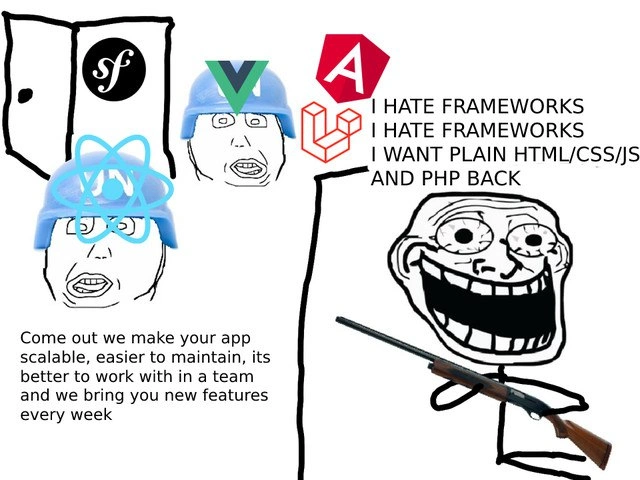
On the left side of this meme, a posse of framework mascots (React’s atom, Vue’s green V, Angular’s red shield, and Laravel’s cube) is literally at the door—Symfony’s door, no less—making a classic framework sales pitch:
“Come out, we make your app scalable, easier to maintain, it’s better to work with in a team, and we bring you new features every week!”
They’re like eager tech evangelists or door-to-door salespeople, each representing a popular web framework, confidently promising the world. In theory, these are all the things modern development tools should deliver. Who wouldn’t want scalability, maintainability, happy team collaboration, and a constant stream of improvements? It’s the standard allure of frameworks: by adopting React, Vue.js, Angular, or Laravel, you gain structure and power that plain code supposedly lacks. Each logo floating in that doorway stands for a framework that’s taken the industry by storm with bold claims and enthusiastic communities.
On the right side, however, reality (or rather, cynicism) strikes back hard. We have the infamous Trollface character — a meme staple for over-the-top, grinning rebellion — drawn as a stick-figure developer brandishing a shotgun. He’s shouting in all-caps rage: “I HATE FRAMEWORKS I HATE FRAMEWORKS I WANT PLAIN HTML/CSS/JS AND PHP BACK!”. This is the battle cry of a developer pushed to the brink by relentless hype. The contrast is hilarious: the polite, cheerful promises of the frameworks versus the developer’s unhinged, almost primal rejection. It’s a tableau of modern dev culture clashes: frameworks vs. plain code, hype vs. fatigue, new-school vs. old-school.
Why would a developer react so aggressively to helpful tools? The humor lies in how painfully relatable that overreaction is to many seasoned devs. We’ve all heard those framework promises a million times, and we’ve learned they often come with fine print. Let’s decode a few of those promises through jaded eyes:
| Framework says… | Seasoned dev hears… |
|---|---|
| “Scalable and robust!” | “Overkill for my simple app, lots of bloat?” |
| “Easier to maintain!” | “Great, another abstraction to learn….” |
| “Better for teamwork!” | “Only if everyone knows this quirky tool.” |
| “New features every week!” | “Frequent updates = constant breakage 😩.” |
Take the “new features every week” line. It’s practically a meme of its own in dev circles. Sure, continuous improvement is nice, but in practice it means an endless churn of versions, changelogs, and deprecated APIs. Today’s web developer often feels like a hamster on a wheel, frantically running to keep up with patch notes and Stack Overflow answers. The meme exaggerates this as “new features every week” – which is only a slight hyperbole for some projects! Experienced engineers know that every weekly update is also a chance for new bugs every week. (If you’ve ever done a Friday afternoon npm update and spent the weekend fixing what broke, you know the pain.) This constant change is known as framework churn, and it’s a major cause of framework fatigue. The troll-faced dev has clearly hit his limit with it. He hears “new features” as “new headaches.”
Now consider “easier to maintain” and “better to work with in a team.” Framework evangelists love these phrases. In theory, a framework enforces consistent structure (like React’s component architecture or Laravel’s MVC pattern), so any developer joining the project can understand it quickly. In theory. But our grumpy developer has likely lived the reality: a codebase so tied to framework-specific patterns and “magic” that only the original evangelist truly grasps it. When that person leaves or the team is under pressure, the abstractions leak – meaning the framework’s hidden complexity starts surfacing as things break. Suddenly, maintaining the app isn’t easier at all; you’re diving into the framework’s internals or scouring GitHub issues to figure out why something called AbstractControllerFactoryBean is null. As for teamwork, frameworks can help avoid bikeshedding basic structure, but they can also spark holy wars: Which framework do we use? Angular or React? Laravel or Symfony? Those debates can split a team just as easily as unify it. The meme’s shotgun-wielding dev embodies the fed-up end of that spectrum: he’d rather tell the team “no frameworks at all” than endure another architecture committee about migrating to the Next Big Thing™.
Scalability is another promise the frameworks dangle. They imply that using them will let your app handle millions of users or be ready for complex features down the road. The troll-faced cynic in the meme might scoff: “My small website doesn’t need Google-scale engineering!” In practice, a simple PHP site with some caching might scale just fine for many projects. The subtext here is over-engineering: adopting a heavyweight framework (and its ecosystem of tooling, like Webpack configs or artisan commands) for a project that might have been a 100 lines of plain JavaScript and PHP. Our meme hero yearns for those leaner days. He’s essentially saying, “Keep your enterprise-grade solutions away, I’m happy with a humble approach that I can fully understand.” This resonates with the old-school KISS principle (“Keep It Simple, Stupid”) that many grey-beard developers swear by. They’ve seen fancy frameworks introduce as many problems as they solve, especially when misused or added unnecessarily.
The presence of the Symfony logo on the door is a delicious little irony. Symfony is itself a powerful PHP framework. So the guy yelling “I want PHP back” is literally holed up in a Symfony fortress while decrying frameworks. What gives? This detail pokes fun at a common phenomenon: developers often hate on other people’s frameworks while being totally fine with their own favorite one. 😅 Perhaps in this story, the dev is a Symfony loyalist who considers Symfony “different” (maybe more stable or low-hype) compared to Laravel or the JavaScript flavor-of-the-month. There’s longstanding rivalry in the PHP world: Symfony vs Laravel often splits the community. Symfony veterans sometimes view Laravel as a flashy newcomer that trades some rigor for convenience (Laravel’s magic like Eloquent ORM vs. Symfony’s more explicit Doctrine ORM setup). Meanwhile, Laravel fans might tease Symfony for being too heavy or enterprise-y. The meme piles all the “cool new” frameworks together as the intruders — including Laravel (PHP’s newer darling) and the big JS frameworks — while the older Symfony is the safe space. It’s a witty nod that even within the backend world, there’s framework fatigue: not everyone wants to jump to Laravel if they’ve been content with Symfony for years. And some go further: they reminisce about coding in straight PHP without any framework at all, just raw include files and SQL queries — simpler, if messier, times.
This nostalgia for plain HTML/CSS/JS and PHP is the crux of the meme. It’s the classic “back in my day” sentiment. The troll-faced developer is basically Grandpa Simpson yelling at the new kids on his lawn. There’s truth under the exaggeration: building web apps used to be a simpler stack (e.g. the LAMP stack: Linux, Apache, MySQL, PHP with some jQuery on the front-end). Sure, it had its own problems (spaghetti code, page reloads for every action, PHP4 quirks, etc.), but many look back on it as more straightforward and predictable. Today’s web apps often involve an explosion of layers: a Node.js build tool, a front-end framework, a state management library, an API layer, a backend framework, microservices, containers... It can feel overwhelming. The meme captures the burnout from constantly learning and re-learning just to keep a basic app up to modern “standards.” When the frameworks outside promise “we bring new features every week,” the subtext is that the app (or the framework itself) is always in flux. Some devs miss when an app, once written, mostly stayed the same unless they themselves chose to add features. Now your tools impose updates on you. It’s as if the frameworks are saying, “Come join us, we’ll change things for you all the time!” and the dev is responding, “No thanks, I’d rather stick with what I know and control.”
Finally, the trollface with a shotgun is an outrageous, darkly funny image. No sane developer literally hates frameworks so much they’d get violent — this is cartoon violence to mirror an internal scream. The shotgun is an Internet-meme way of saying, “Begone! I’m aggressively uninterested.” It’s a comedic exaggeration of frustration. We often joke in dev chats that we want to “shoot down” bad ideas or that we’re “allergic” to certain frameworks; the meme personifies that in a Looney Tunes-esque way. The trollface grin also hints that this is partly trolling for effect. It’s knowingly provocative. Many devs actually use frameworks daily (even the grumpy ones), but the meme speaks to that little troll inside who’s tempted to reply to the next framework evangelism post with “No, just no — give me Notepad and raw code and leave me alone!”
In short, this meme is funny because it’s true — albeit magnified to absurdity. It lampoons the very real weariness developers feel from the constant framework churn in both front-end and back-end. The frameworks come floating in like self-righteous ghosts of progress, and the developer’s had enough; he swings the door open shotgun-first, screaming for the simpler days to come back. It’s a techie twist on the age-old trend where every new generation’s tools annoy the old guard. And after you’ve been woken up at 3 AM by a production outage caused by some “exciting new update”, you too might feel an urge to grab that metaphorical shotgun and tell the fancy frameworks to get off your lawn. The meme just makes that scenario ridiculously literal – and that’s why seasoned developers smirk and nod knowingly (maybe while double-checking if their legacy PHP app is still running just fine).
Description
This is a two-panel rage comic style meme depicting the conflict between modern web frameworks and a purist developer. On the left, several characters representing popular frameworks (React, Vue.js, Symfony, with Angular and Laravel logos nearby) are depicted as soldiers trying to coax someone out of a barricaded room. They say, 'Come out we make your app scalable, easier to maintain, its better to work with in a team and we bring you new features every week'. On the right, inside the room, a defiant Trollface character holds a shotgun, representing the veteran developer. The text next to him screams, 'I HATE FRAMEWORKS I HATE FRAMEWORKS I WANT PLAIN HTML/CSS/JS AND PHP BACK'. The meme humorously illustrates the generational and philosophical divide in web development, pitting the promises of modern, feature-rich frameworks against the desire for the simplicity and directness of 'vanilla' technologies
Comments
7Comment deleted
The frameworks promise scalability and teamwork, but they don't mention the 2GB node_modules directory for a 'hello world' app. The shotgun is for the first person who says 'Just run npm install'
Congratulations, you just replaced your “boring” PHP template with a bleeding-edge JS stack that needed SSR, routing, DI, and an ORM - aka the world’s slowest, test-light re-implementation of Symfony in the browser
The same developer who spent 2009 defending jQuery against "vanilla JavaScript purists" is now maintaining a 50,000-line index.php file and calling it "architectural simplicity."
Ah yes, the classic 'I just want to write HTML' phase - usually hits around year 8 when you've migrated the same codebase through React 14→15→16→Hooks→Concurrent Mode→Server Components, watched Vue 2→3 break half your plugins, survived three Angular rewrites, and realized your 'scalable, maintainable' SPA now requires 47 build tools, 12GB of node_modules, and a PhD in webpack configuration just to render a contact form. Meanwhile, that PHP monolith from 2008? Still running. Still making money. Still doesn't need a CI/CD pipeline that takes 45 minutes to deploy a button color change
React/Angular/Laravel: “We’ll make it maintainable.” Translation: “Budget a sprint per upgrade.” Meanwhile the crusty PHP+HTML behind Nginx scales by adding a second box and keeps printing money
Frameworks scale your bundle to gigabytes; vanilla JS scales your sanity to retirement
Senior take: the ‘no framework’ shop yells about bloat until sprint 3, when router.php, hand‑rolled templates, and global state solidify into a bespoke framework - now you’re on call for Laravel‑but‑worse