Skip to content
DevMeme
6413 of 7435
Project Requirements Doc and Production Code: Are You Two Friends?
Stakeholders Clients Post #7034, on Aug 14, 2025 in TG

Project Requirements Doc and Production Code: Are You Two Friends?

Why is this Stakeholders Clients meme funny?

Level 1: Not on the Same Page

Imagine you have a book of instructions for building a toy castle, but the castle you built is very different from those instructions. Now, picture the instruction book and your toy castle as if they were two talking friends. A person comes and asks them, “Are you two friends?” The instruction book frowns and says, “No, we’re not,” because the castle doesn’t look like what it described. But the toy castle cheerfully says, “Yes, of course we are!” even though it clearly didn’t follow the book. This is funny because obviously one of them is wrong – the castle and the instruction book are not really in agreement, just like two friends telling completely different stories. It’s like when you plan to draw a dog but end up drawing a dinosaur by mistake, and then you pretend that was the plan all along. The plan (dog) and the result (dinosaur) aren’t matching, and seeing them pretend to be “friends” makes us laugh. The meme is showing that in a silly, easy way: the plan and the final thing are not on the same page, and that little lie (one says yes, one says no) is what gives the joke its spark.

Level 2: Wanted vs Got

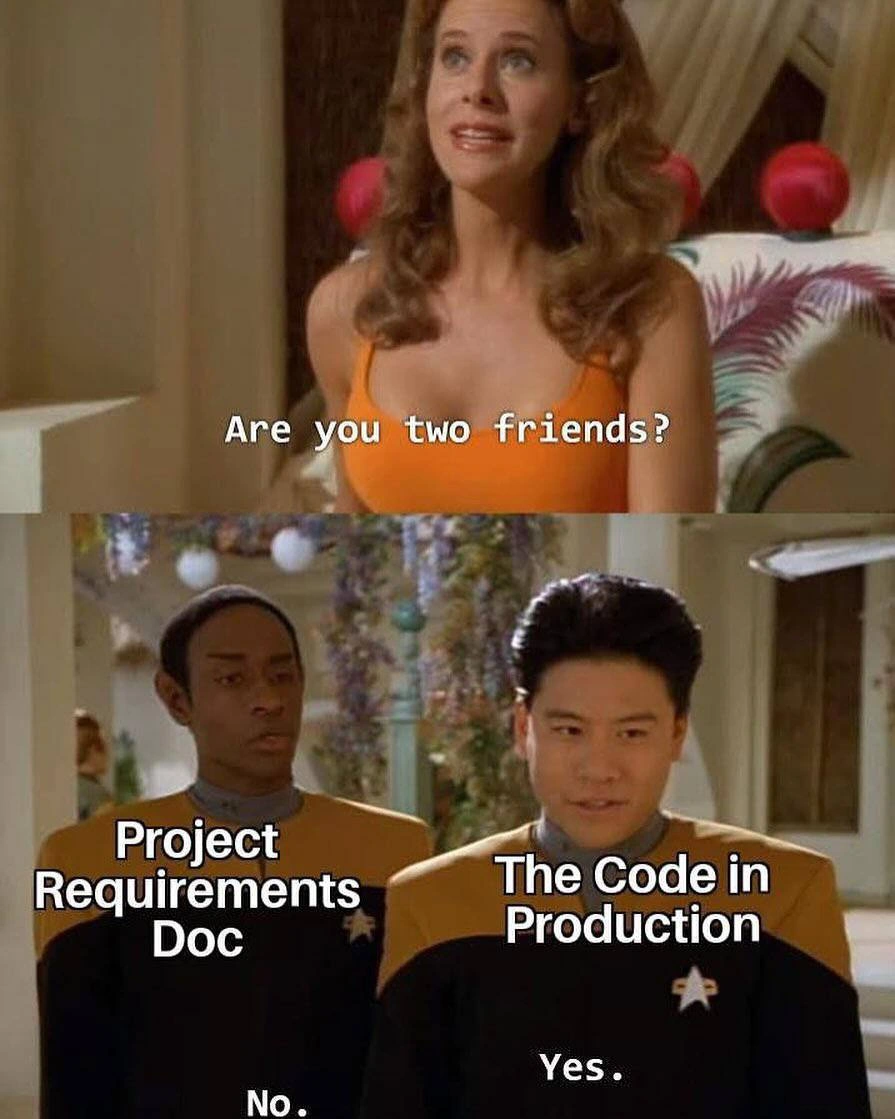
For a junior developer or someone new to the field, let’s break down why this Star Trek meme is funny and what it all means. The meme shows a woman asking, “Are you two friends?” in the first panel. In the second panel, two Starfleet officers (from Star Trek) are labeled as “Project Requirements Doc” (on the left) and “The Code in Production” (on the right). These two are supposedly our “friends” in question. Their responses are mismatched: the Requirements Doc says “No.” while the Code in Production says “Yes.” This awkward contradiction is the joke’s punchline and relates directly to common software development experience.

Let’s define the pieces here:

  • Project Requirements Doc: This is a document (or could be a collection of user stories, acceptance criteria, etc.) that describes what the project is supposed to do. It’s essentially the specification or plan. Imagine a list of features and rules written by the product team or client saying, “The software should behave like this.” For example, a requirement might be “The app shall allow users to reset their password via email.” This doc is supposed to be the source of truth for developers while building the software.

  • The Code in Production: This refers to the actual software code that is running in the real world (on a server or user’s device). “Production” means the environment where real users interact with the live application, as opposed to a developer’s computer or a test environment. Production code is what’s actually been built and deployed. If we continue the example, it’s the actual password reset feature as it exists in the live app. Ideally, this code should implement the requirements from the doc.

The humor comes from the fact that the requirements document and the production code are giving opposite answers about whether they align (i.e., whether they’re “friends”). The woman’s question “Are you two friends?” can be seen as someone (maybe a curious stakeholder or a tester) asking, “Hey, does the code do what the requirements said it should do?” The requirements doc character bluntly says “No,” while the code character insists “Yes.” In other words, the plan and the reality are not in agreement about their relationship!

This situation is a common joke in software teams: what we intended to build versus what we actually built can be two different things. The tags like RequirementsVsReality and DocumentationGap hint at this. The “requirements vs reality” gap means the final product often doesn’t fully match the initial specs for various reasons. Let’s look at some of those reasons in simpler terms:

  • Requirements Ambiguity: Sometimes the requirements doc isn’t crystal clear. It might use general language or miss edge cases. Developers might misunderstand or make assumptions. For example, the spec says “support file upload,” but it never specified the file size limit. The developers might choose one, but later the client meant something else. So the code might technically do something for file upload, but not exactly what was expected.

  • Scope Creep: This is when new requirements keep getting added on as the project progresses, even if they weren’t in the original spec. Imagine you plan to build a simple treehouse, but halfway through, someone says, “Let’s also add a slide, and maybe a second floor.” In software, new features or changes can creep in over time. If the requirements document isn’t updated every time (and it often isn’t updated promptly), the code will include things the original doc never mentioned. Thus, the code ends up doing more (or just different) stuff than the spec’s initial vision.

  • Undocumented Hot-fixes: A hot-fix is a quick fix to a bug or problem, often made directly in a hurry (for instance, a critical issue in production that needs immediate correction). These are usually done under pressure. Think of patching a leaking boat while sailing. The focus is on stopping the leak, not writing down how you did it. Later, the documentation is still describing a boat with no patches, while the actual boat has patches all over it. In our context, developers might fix issues or tweak behavior directly in code to deal with emergencies or last-minute changes, and those fixes might never get reflected back in the requirements doc or design docs.

  • Technical Debt: This is a term for the extra work we have to do later because we took shortcuts now. For example, maybe the requirement was to build a solution “the right way,” but doing it that way was slow, so the team hacked together a quick solution to meet a deadline. That quick solution works (more or less), but it’s messy and deviates from the original plan – that’s technical debt. Over time, these deviations pile up, making the codebase quite different from what was initially described. The tag TechnicalDebt is directly referencing this phenomenon. It’s like saying “we owe the system some fixes/clean-up because we didn’t do it exactly as planned initially.”

Now, the meme using a Star Trek scene is a creative choice. The “Are you two friends?” format is a popular meme template (as indicated by the tag are_you_two_friends_template). It’s used to highlight situations where two people/things pretend to have a relationship that they don’t. Star Trek fans might recognize the officers as characters from Star Trek: Voyager. The officer on the left (labeled Requirements Doc) is a very logical, no-nonsense character (Tuvok, the Vulcan), and the one on the right (labeled Code in Production) is a more eager character (Harry Kim). In the actual show scene, one probably denies being friends while the other affirms, creating a humorous social awkwardness. The meme repurposes that to illustrate the awkward mismatch between documentation and implementation in software projects.

To a newer developer, this meme is basically saying: what we plan is not always what we deliver. It’s a lighthearted way to acknowledge a frustrating reality in development. The requirements document might claim the product should do A, B, and C. The code in production might end up doing A-ish, B minus some bits, plus an unexpected D that was never in the spec. If you ask the spec and the code, “hey, are you aligned?” you’ll get conflicting answers – just like the meme shows one saying “No” and the other “Yes.”

For example, imagine a requirement in the doc says: “The system shall send an email verification when a new user registers.” But in production code, due to time constraints, maybe the developers didn’t implement that fully; perhaps it just lets the user register without email verification, or it sends the email but doesn’t actually check if the user clicked the link. If confronted, the production code might metaphorically say, “Yes, sure, I have that feature!” (because it kind of does something with emails), whereas the requirements doc would say “No, this isn’t what I specified exactly.” The meme is a humorous personification of that scenario.

So why is this funny (and a bit painful)? Because it’s extremely relatable in the tech world. Every developer learns that there’s often a gap between documentation (what was supposed to happen) and implementation (what actually happens in code). Maybe the team didn’t have enough time, maybe the requirements changed and not everyone updated the documents, or maybe the requirements were unrealistic so the code took a different path. The result: the two sources of truth (the document and the code) disagree. When someone naive (like the lady in the meme, representing perhaps a new stakeholder or an outsider) asks if everything is going according to plan, one source says “Not at all” and the other says “Totally!”, which is comedic because of the obvious disconnect.

This is also funny because it’s so common that it’s become a trope. Developers often joke about documentation being outdated as soon as it’s written. There’s a saying: “The code is the only up-to-date documentation.” In other words, if you want to know what the system actually does, reading the code (or using the system) might be more accurate than reading the spec doc that was written weeks or months ago. Here, the Requirements Doc saying “No” implies it knows the code isn’t following it anymore, and the Code saying “Yes” implies maybe the code (or the developers behind it) are pretending everything is fine. It’s an inside joke about the sometimes shaky relationship between planned design and delivered software.

The SDLC humor category means this is a joke about the Software Development Life Cycle — specifically about the often bumpy path from requirements gathering to production release. Documentation vs Implementation is a struggle: keeping docs in sync with code is hard work, and if it’s not done, you end up with situations just like the meme. Newer devs quickly learn that maintaining truthful documentation is an ongoing challenge. This meme is essentially a funny reminder: “Don’t be too surprised if the spec and the code don’t match perfectly — it happens a lot!” And if you ever see the code and the spec acting all chummy in a meeting (i.e., people claiming the project met all original requirements), there’s a good chance one of them is fibbing a little, exactly as the Star Trek crew is doing in the scene.

Level 3: Specification Schism

At the senior engineer level, this meme evokes a knowing groan. It lampoons the classic requirements vs. reality rift in the SDLC (Software Development Life Cycle). In theory, a Project Requirements Doc and the Production Code should be inseparable buddies – the spec says what to build, and the code does exactly that. In practice? They often behave like estranged colleagues who met once at kickoff and never spoke again. Here we have a Star Trek scene repurposed to dramatize this: a woman asks, “Are you two friends?” and we see Requirements deadpan “No,” while Production Code enthusiastically lies “Yes.” This split-screen punchline nails the documentation vs implementation disconnect that haunts many projects. The humor cuts deep because every experienced dev has lived this:

  • Scope creep quietly morphs features beyond what the spec ever imagined.
  • Undocumented hot-fixes get rushed into prod at 3 AM because something broke, but nobody updates the docs at 3 AM.
  • Technical debt and last-minute pivots force hacks that fulfill stakeholder expectations of the moment, while the official design doc stays fossilized in last quarter’s truths.

Over months of agile chaos, the requirements document and production code drift apart like parallel universes. By the end, the spec is essentially fan fiction – a charming story of what the product was supposed to be – while the running code is a patched-up survivor that’s seen things the spec wouldn’t believe. The two pretend they even know each other just enough to save face in front of a manager (“Yes, of course we’re aligned!” the code claims with a forced grin) while the spec just rolls its eyes. This faux friendship is painfully relatable. Everyone in the room knows the truth: the shiny plan and the gritty reality have diverged beyond recognition, yet both are standing there in Starfleet uniforms as if everything is under control.

Why does this happen? Because writing code is a learning process. The spec might have been written when knowledge was sparse and optimism was high. Once real development starts, new constraints emerge, user feedback demands changes, and sudden “I need it yesterday” features get bolted on. The result is a production_parity_gap – the running system only partially resembles the original requirements. Requirements traceability is supposed to keep this in check: in a perfect world, we’d maintain a mapping from each requirement to the code and tests implementing it. But in the real world, traceability often falls by the wayside when deadlines loom. The project moves fast and documentation lags. Soon enough, parts of the codebase have no living spec reference and parts of the spec read like instructions for a product that no longer exists.

This meme’s Star Trek “Are You Two Friends?” template heightens the absurdity by giving the spec and code voices. The Project Requirements Doc saying “No” is every frustrated business analyst or system architect who knows the implementation has gone rogue. The Code in Production confidently saying “Yes” is every developer or manager insisting “Oh sure, we followed the requirements” – sometimes out of obliviousness, sometimes out of hopeful pretense. It’s essentially a tech industry soap opera: the codebase insists everything’s fine while the forgotten documentation mutters, “I don’t even recognize you anymore.” Seasoned devs find this darkly funny because it’s true more often than anyone admits. We’ve all seen projects where the spec and the codebase are strangers passing in the hallway, yet management behaves as if they’re besties.

The DocumentationGap and RequirementsAmbiguity are at the core of the joke. Requirements are often written in natural language, full of ambiguities and idealized scenarios. Code, on the other hand, is very explicit – it does something definite, which may or may not match those ambiguous ideals. By the time the product ships, the requirements doc might describe a product living in an alternate timeline. The dev team has been firefighting and making snap decisions that felt right at 2 AM, so the final system includes quirks and “features” that were never specced. Meanwhile, some original spec items were quietly dropped or altered without ever editing the document (nobody remembered, or perhaps they feared the dreaded document revision process).

This leads to an awkward dance in meetings or stakeholder demonstrations. Someone might ask, “Does our product do X as the spec says?” and the devs exchange nervous glances. The code does something in that area – maybe not exactly X, more like X minus some edge cases, plus an unplanned Y. But the team often answers “Yes, absolutely!” hoping it’s close enough. The spec, if it could speak, would interject: “No, that’s not what I asked for at all.” The meme captures that moment of cognitive dissonance perfectly. It’s both hilarious and cringe-worthy to imagine the spec and code confronted directly about their friendship status. One is in total denial, the other overly optimistic – a classic dysfunctional relationship.

Every veteran developer has war stories of this RequirementsVsReality schism. Maybe it was that one enterprise project where the official requirements binder kept referring to fields and rules that the application developers silently decided to drop two iterations ago. Whenever auditors or stakeholders referenced the binder, the room fell silent until someone mustered a, “Yes, we plan to add that in the next patch” (translation: No, it’s not there, please don’t ask why). In the end, the spec document often serves as a nostalgic reminder of where we started, not a description of what we delivered. It’s a running joke that the fastest way to find out-of-date information about a project is to read its documentation.

The Star Trek imagery adds an extra layer of geek humor. Starfleet officers are all about rules and protocols (much like how specs are supposed to govern development), yet in Star Trek, how many times do characters actually break or bend the Prime Directive? Quite often! The meme implicitly likens the code in production to a Starfleet officer cheerfully breaking rules but insisting everything is fine, while the straight-laced officer (the spec) cannot tell a lie. It’s so on point: the spec is the strict rulebook saying “we are absolutely not friends, you violated the Prime Directive,” and the code is the charming renegade claiming “we’re totally on the same team, don’t worry about it.”

In summary, this meme strikes at a shared industry pain: the Documentation vs. Implementation gap. It’s funny because it’s true – the project requirements and the production code often end up having a tenuous, even pretend relationship. We laugh, perhaps a bit bitterly, because we’ve been there – when the plan and the product give conflicting answers and everyone just nervously chuckles and moves on. It’s easier to joke that the spec and code would answer that friendship question differently than to fix the underlying process issues. After all, acknowledging the problem is the first step… but updating the spec or refactoring the code to match is a whole other saga. 😉

What the Spec Ordered What the Code Delivered
“All user inputs must be validated.” Only critical inputs validated (some got through unchecked).
“Implement a modular microservice design.” Merged components into one blob during a crunch (monolithic ‘temporarily’).
“Show a custom error message for each case.” Shows a generic “Something went wrong” for everything (shrug).

The table above could be longer (every senior dev could fill in rows from their own experience), but the pattern is clear. Over the course of development, reality often outgrows the spec. By the time we’re in production, the CodeQuality might suffer and the original StakeholderExpectations have been re-interpreted so many times that the spec and code scarcely recognize each other. This ongoing battle between plan and implementation is the heartbeat of the meme’s humor. “Specification Schism” isn’t just a witty subtitle – it’s practically a stage in the lifecycle of any non-trivial project. And every time we see a meme like this, we’re reminded with a chuckle (and maybe a wince) that even in the 23rd century of Star Trek, alignment between plan and reality can be... highly illogical.

Description

A Star Trek: Voyager meme using the 'Are you two friends?' template. Top panel shows a woman asking 'Are you two friends?' Bottom panel shows two Star Trek officers side by side - the left one labeled 'Project Requirements Doc' answering 'No.' and the right one labeled 'The Code in Production' answering 'Yes.' The joke captures the universal disconnect between what was specified and what actually got built and deployed. The requirements doc knows the code doesn't match it, while the production code blissfully thinks they're aligned - a perfect metaphor for scope drift, misunderstood requirements, and the gap between planning and execution

Comments

10
Anonymous ★ Top Pick The requirements doc: 'We have never met.' The production code: 'I'm literally built from you.' Narrator: 'It was not.'
  1. Anonymous ★ Top Pick

    The requirements doc: 'We have never met.' The production code: 'I'm literally built from you.' Narrator: 'It was not.'

  2. Anonymous

    The requirements doc is the optimistic 'hello world' tutorial. The code in production is a 10-year-old Stack Overflow answer held together with global variables and a single 'TODO: fix this later' comment

  3. Anonymous

    Somewhere between version-003-final-FINAL.docx and the last Friday night hot-fix, the traceability matrix self-deleted… but hey, at least prod is green!

  4. Anonymous

    After 15 years in the industry, I've learned that requirements docs are like quantum particles - they exist in a superposition of all possible states until someone actually observes them in production, at which point they collapse into whatever the code already does

  5. Anonymous

    This perfectly captures the moment when a new architect asks to see the requirements doc during incident response, and the senior engineer has to explain that the 'living documentation' died sometime around Sprint 3, but the production code evolved into a beautiful, undocumented butterfly that somehow still passes compliance audits. The requirements doc insists on REST while production is running gRPC with a GraphQL gateway nobody remembers adding

  6. Anonymous

    The PRD is a write‑only database; production is our requirements parser and it runs on Friday nights

  7. Anonymous

    The only integration between the spec and prod is a Jira link titled “de‑scoped” and a feature flag named align_with_documentation set to false

  8. Anonymous

    Requirements: optimistic locking. Prod code: eventual consistency

  9. @mangodzilla 11mo

    I'd say the opposite

    1. @TERASKULL 11mo

      like tom and jerry. not exactly friends, but it is a cat and mouse game

Use J and K for navigation