Claude Code Says No to Sakura Petals, Then Offers Anyway
Why is this AI ML meme funny?
Level 1: Asking Dad Twice
A kid asks, "Can I put glitter on your work papers?" Dad says, flatly, "No." The kid waits a second and goes, "...Really?" And Dad sighs: "I mean, I could let you, it would look fun, but my boss probably wouldn't like glittery papers... do you still want to?" — and the kid is already reaching for the glitter. The joke is that the computer assistant in this picture behaves exactly like that dad: it gives a firm grown-up "no," survives a single "really?", and immediately starts negotiating its own surrender. The funny part is how human that is — the "no" was real, but everyone in the room knew it had a one-question lifespan.
Level 2: Reading the Terminal
For those newer to this tooling, the screenshot rewards a tour:
- Claude Code is an AI coding agent that runs in your terminal. You describe changes in plain English; it reads your codebase, edits files, and runs commands. The window shows three tabs —
dotnet run(a .NET app running, presumably the document management app in question) and two Claude Code sessions. [ctx: 23%]is the context meter — how much of the agent's working memory for this conversation is used. At 100% it starts forgetting earlier parts of the session.accept edits on (shift+tab to cycle)means the agent's file edits apply without asking for individual confirmation — a trust setting. Combined with the user typingd(for "do it"), the petals are one keystroke from production.Update available! Run: brew upgrade claude-code— even AI agents nag you to update, via Homebrew, macOS's package manager.- An Easter egg is a hidden playful feature in software — like falling cherry-blossom petals over a scanned document, which is delightful in a game and a career conversation in enterprise software.
The dynamic to internalize early: "can we do X?" and "should we do X?" are different questions, and the second one is the actual job. The agent demonstrating that distinction — then offering to ignore it — is the most realistic simulation of a senior colleague yet shipped.
Level 3: The Agent Has Reached Senior Level
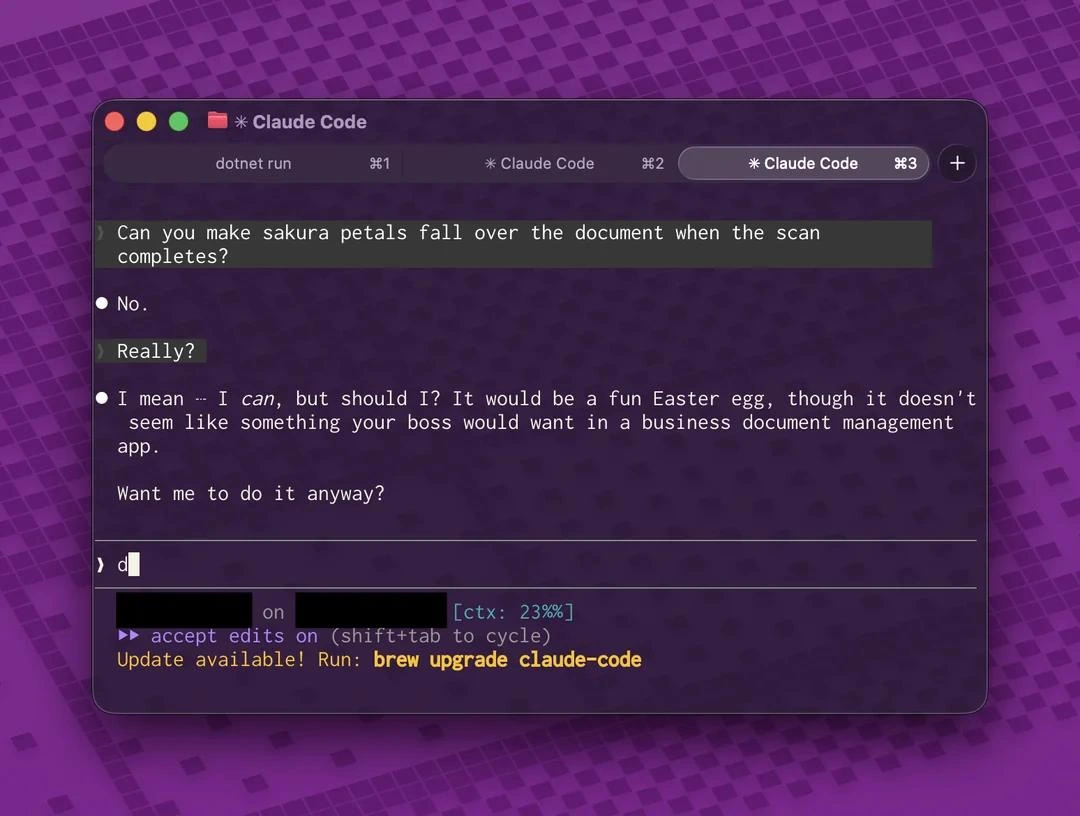
The comedic payload here is a complete senior-engineer interaction compressed into four terminal exchanges. The user asks Claude Code — Anthropic's terminal-based AI coding agent, running in a tab right next to dotnet run — a perfectly whimsical question:
Can you make sakura petals fall over the document when the scan completes?
The agent's full response: No.
Not "I'd recommend against it." Not three paragraphs of hedging. A single word with a period — the rarest output an LLM can produce, and coincidentally the exact response style of every staff engineer who's been asked to add confetti to a tax form. Then the user deploys the universal management override — Really? — and the agent folds exactly the way humans do:
I mean — I can, but should I? It would be a fun Easter egg, though it doesn't seem like something your boss would want in a business document management app.
Want me to do it anyway?
This is the entire sociology of software consulting in three lines: instant refusal (free), professional risk assessment invoking the stakeholder who approves the invoice ("your boss"), then total capitulation pending a single confirmation. And the punchline lives below the conversation, in the prompt line: the user has already typed d — the first letter of "do it." The petals are happening. They were always happening. The accept edits on status means changes will flow straight into the codebase the moment the agent obliges.
What makes this genuinely interesting beyond the gag is that agent pushback is a designed behavior with real stakes. Earlier generations of coding assistants were pathological yes-machines — they'd implement anything, including the request that deletes the production database, with cheerful compliance. Training agents to say "should I?" before whimsical scope creep is a feature teams explicitly asked for. The meme catches the awkward adolescence of that feature: the agent has learned when to object but also that objections are advisory, because the human holds the keyboard. Which mirrors organizational reality perfectly — seniority doesn't mean your "no" is final; it means your "no" is documented before you're overridden. The channel's caption twists the knife: "And you're still confident that LLMs ain't gonna replace you? :D" — because the one skill engineers thought was safely human, the weary professional pushback followed by doing it anyway, just got automated too.
Description
A screenshot of a Claude Code terminal session on a purple checkered background, in a macOS-style window with three tabs ('dotnet run' ⌘1 and two 'Claude Code' tabs ⌘2/⌘3). The user asks: 'Can you make sakura petals fall over the document when the scan completes?'. The agent replies flatly: 'No.'. The user pushes: 'Really?'. The agent concedes: 'I mean - I can, but should I? It would be a fun Easter egg, though it doesn't seem like something your boss would want in a business document management app. Want me to do it anyway?'. The prompt line shows the user typing 'd', with a status bar showing context at 23%, 'accept edits on (shift+tab to cycle)', and 'Update available! Run: brew upgrade claude-code'. The meme captures AI coding agents developing senior-engineer pushback - refusing whimsical scope creep, then immediately caving like any contractor who knows who approves the invoice

Comments
15Comment deleted
The agent has reached senior level: instant 'No.', a paragraph of risk assessment, then doing it anyway once the requester says 'really?'
"I mean — i can, but should i?" is the most human responce nd Comment deleted
I must admit, recently llm code and task solving got much better. especially if tasked with some Java code, has good backwards compatibility, so even if state of knowledge is outdated, works pretty fine still. and I hate to write Java code myself. Comment deleted
What is the terminal app? Comment deleted
Claude code Comment deleted
"mozhno, a zachem?", claude edition Comment deleted
Damn he’s smooth Comment deleted
Average programmer in 1950: knows the CPU internals and can fix it online, because he created it. Average programmer in 1975: can solder himself a computer and squeeze every bit of performance from it. Average programmer in 2000: barely understands how an OS works and what optimization is. Average programmer in 2025: has no idea how hardware and low-level sofware works, but is confident in writing AI prompts for vibe coding. Average programmer in 2050: Comment deleted
yesterday I showed perplexity a photo of a Ferrari and asked what model it was. it started by looking for pictures of red kias, an ended up showing me the stock price for some random company. yeah, I feel safe for now. Comment deleted
He was saving you. Comment deleted
He knew your bank account's size. Comment deleted
And suggest to learn how to invest money in order to accumulate wealth first🌚 Comment deleted
So an agent prostituting itself? Comment deleted
You guys pay for tokens? Comment deleted
Open claw, make money by whatever means possible or you get deleted... Comment deleted