The Pyrrhic Victory of Earning Your First $50 in a Startup
Why is this Entrepreneurship meme funny?
Level 1: Lemonade Stand Surprise
Imagine you spend all your pocket money to set up a lemonade stand. You buy wood for the stand, lemons, sugar, and cups. You work really hard on it for a long time — let’s say all summer. In the end, you finally sell one single cup of lemonade for 50 cents. You and your friend jump up and down, excited and proud that someone bought a cup – you’re yelling “We did it!” like it’s a huge success. But then you look around: the whole yard is a sticky mess from all the spilled sugar and lemon peels, and you realize you spent way more money (maybe $20 of your allowance) than the 50 cents you earned. It’s funny because you’re celebrating a tiny good thing while ignoring the big mess and the fact that you actually lost money overall. That’s exactly what’s happening in the SpongeBob meme: SpongeBob and Patrick are super happy about a small victory (making $50) even though everything behind them (the startup that cost $100k) is burning down. The joke is that they feel like heroes for earning that little bit of money, even though the overall situation is a disaster. Sometimes people cheer for a small win just to feel better, even if everything else is going wrong — and that contrast is what makes it so funny.
Level 2: First $50 Fanfare
This meme tells a story that a new founder or junior developer can easily appreciate: it’s about spending a lot of time and money on a project and getting a very tiny payoff. Here we have someone who started a startup (a new tech business) and spent 3 years working on it, using up $100,000 of their life savings to fund it. They didn’t take outside investment; instead they were bootstrapping – meaning they paid all the expenses themselves out of pocket. Over those 3 years, money kept going out for things like servers, software, maybe rent and living costs. All that spending is called the burn rate (how fast you “burn” through your cash). During those years, the project wasn’t bringing in much (or any) money. Finally, after all that time, the startup earned its very first revenue: $50 from a customer. Getting even one paying customer is a big milestone for a new business – it’s proof that someone is willing to pay for what you built. But in this case, $50 is extremely small compared to the $100,000 spent. The company has lost far more money than it’s made back so far, which means it’s deep in the red (net negative).
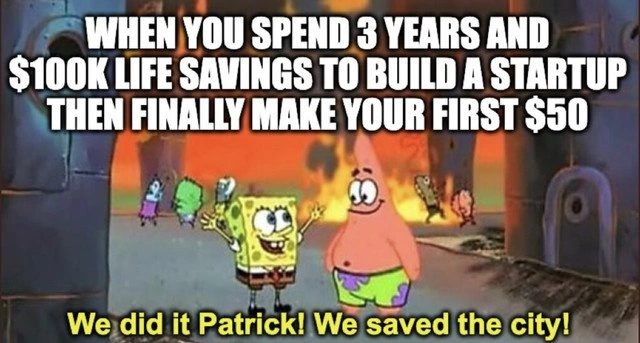
The meme uses a scene from SpongeBob SquarePants to poke fun at this situation. In the picture, SpongeBob and his friend Patrick are standing in a city that’s on fire, with buildings crumbling around them. Despite the destruction in the background, SpongeBob is ecstatic and says, “We did it, Patrick! We saved the city!” The meme’s top text spells out the context clearly: “WHEN YOU SPEND 3 YEARS AND $100K LIFE SAVINGS TO BUILD A STARTUP THEN FINALLY MAKE YOUR FIRST $50.” The bottom caption (SpongeBob’s triumphant quote from the cartoon) reads: “We did it Patrick! We saved the city!” The humor comes from the huge contrast between reality and their reaction. The burning city represents the startup’s reality: the founder’s finances (and maybe personal life) are in chaos – they burned through all that money, similar to the city being destroyed. But SpongeBob and Patrick cheering represents the founder’s emotional reaction to that first $50 of income – they’re acting like heroes who saved the day, when really things are a mess.
For someone new to startup culture or entrepreneurship, the joke is showing how founders sometimes have out-of-proportion celebrations for tiny wins. It highlights the idea that you could spend $100,000 to make $50 – obviously a terrible business outcome – yet still be ridiculously happy about that $50 because it's the first sign of hope. This is pretty common in early startup life: the first dollar earned or the first user gained feels amazing, even if you’re nowhere near covering your costs. In simple terms, it’s a lesson about burn rate vs. revenue: if you keep spending more money than you earn, you’re going to run out of money (that’s the disaster in the background), no matter how excited you are about that first sale. Many engineers who become founders go through this learning curve. Building something great is one thing; getting people to pay for it is another. The meme humorously reminds us that the path to a successful startup is often financially rocky at first. It’s a lighthearted caution that you have to keep perspective: celebrate the small victories to stay motivated, but don’t ignore the fact that you’ll need a lot more than $50 to truly “save the city.”
Level 3: Burn Rate vs Reality
In the world of startups and entrepreneurship, this meme highlights the brutal mismatch between a startup’s burn rate and its actual revenue that seasoned developers and founders know all too well. The scenario: a founder spends 3 years and $100k of life savings to build their product, and finally they make their first $50 from a customer. For anyone fluent in startup math, this is a spectacularly dismal Return on Investment (ROI) – essentially a rounding error compared to the money and time invested. To put it in perspective, the founder spent about $2,000 for every $1 earned in revenue. That's the kind of unit economics that make investors cringe. We can even calculate it in code:
spent = 100_000
revenue = 50
roi = (revenue - spent) / spent
print(f"ROI = {roi:.2%}")
# Output: ROI = -99.95%
# For every $100 spent, they got back just 5 cents. Ouch.
"We did it, Patrick! We saved the city!"
This famous SpongeBob quote is the punchline of the meme. In the image, SpongeBob and Patrick stand grinning amidst a burning city, proudly congratulating themselves as if they’re heroes. It’s a perfect metaphor for the startup’s situation. The founders are celebrating as if they “saved” their company, while in reality their startup’s finances are in ruins (just like the flaming cityscape behind them). The absurd contrast between their cheerful victory pose and the fiery destruction makes the humor painfully relatable. Anyone who’s lived the startup struggle can recognize the shared pain here: after pouring years of work and heaps of money into a project, even a tiny success like a $50 sale feels like a reason to cheer. This kind of dark tech humor resonates because it captures how a founder’s optimism can persist even when the outcome looks disastrous. They want to believe “we did it!” so badly that they’ll celebrate any glimmer of hope, even as everything burns around them.
From a seasoned perspective, this scenario is also a textbook case of the sunk cost fallacy mixed with classic startup delusion. After investing so much, the founders become desperate to see any positive result as validation. In lean startup philosophy there's a mantra: “fail fast, fail cheap.” Our intrepid founder did the opposite – essentially failed slow and expensive. Three years of work and a $100k burn just to get that first trickle of revenue is a lesson in how not to manage your startup’s runway (the time until the money runs out). Yet here they are high-fiving as if everything’s great. It brings to mind the tongue-in-cheek business joke: “We lose money on every sale, but we make it up in volume!” Losing $99,950 to make $50 is clearly not sustainable, but the meme playfully jabs at how founders will cling to any sign of hope. It’s a cautionary tale wrapped in comedy: poking fun at the overly optimistic founder mindset — celebrating a Pyrrhic victory while the company is metaphorically burning down around them.
Description
This meme uses the 'We did it Patrick! We saved the city!' format from Spongebob Squarepants. The image shows Spongebob and Patrick celebrating, oblivious to the fact that the city behind them is on fire and in ruins. The top text overlay reads, 'WHEN YOU SPEND 3 YEARS AND $100K LIFE SAVINGS TO BUILD A STARTUP THEN FINALLY MAKE YOUR FIRST $50'. The original quote from the scene, 'We did it Patrick! We saved the city!', serves as the punchline at the bottom. The humor lies in the stark contrast between the monumental personal and financial investment (3 years, $100k) and the trivial financial return ($50). It satirizes the often delusional optimism and immense struggle of early-stage entrepreneurship, where any small sign of progress is celebrated as a major victory, even when the overall situation is dire

Comments
7Comment deleted
That first $50 isn't just revenue, it's market validation. Now we can tell investors we have a 100% conversion rate on our single paying customer and a total addressable market of dozens of dollars
Three years, $100K in AWS and a zero-downtime Istio mesh - all worth it when that first $50 landed and CloudWatch immediately invoiced $51
That moment when your CAC is $100k but your LTV is $50, and you still update your LinkedIn to "Serial Entrepreneur | Disrupting the industry | Hockey stick growth incoming"
This perfectly captures the moment when your startup's LTV:CAC ratio is 0.0005 and you're still celebrating like you just closed a Series A. Three years of architecting microservices, optimizing database queries, and debating tabs vs spaces - all to achieve an MRR that wouldn't cover a single AWS bill. But hey, at least you're not pre-revenue anymore! Time to update that pitch deck with 'proven monetization' while the infrastructure costs burn through what's left of your runway
After 36 months and $100k burn, that $50 means we’re ramen-profitable - assuming ramen costs -$2,778 per month
3 years, $100k burn for $50 ARR: finally validated your pricing - turns out it's perfectly tuned for the free tier dropouts
After 3 years and $100k, our first $50 hits Stripe - finance extends runway by 12 minutes; engineering flips the growth chart to log scale: hypergrowth