
Valgrind gives up after logging 10,000,000 memory errors in your C app
Description
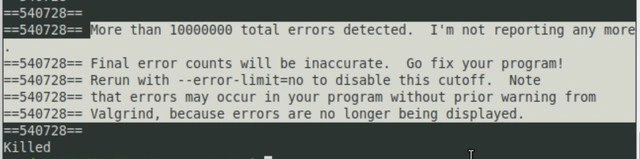
Terminal screenshot with a dark-on-light theme shows Valgrind output. Lines read: "==540728== More than 10000000 total errors detected. I'm not reporting any more" followed by "==540728== Final error counts will be inaccurate. Go fix your program!", "==540728== Rerun with --error-limit=no to disable this cutoff. Note", "==540728== that errors may occur in your program without prior warning from", "==540728== Valgrind, because errors are no longer being displayed." The last shell prompt simply says "Killed." The image captures the moment a memory-debugging tool rate-limits itself, a scenario familiar to seasoned C/C++ engineers who have accidentally sprayed the heap with unchecked writes or wild pointers. It humorously highlights the sheer scale of undefined behavior possible in low-level systems programming and the futility of continuing execution when tooling itself taps out







Comments
7Comment deleted
When your malloc audit is so bad that even Valgrind introduces its own rate-limiter, it’s less a bug report and more a distributed denial-of-sanity
When Valgrind stops counting at 10 million errors, you're not debugging anymore - you're conducting an archaeological excavation of every memory management sin committed since malloc was invented
When even Valgrind rage-quits with 'Go fix your program!', that's not a diagnostic anymore - that's a performance review
When Valgrind hits 10 million errors and just gives up, you know you've achieved something truly special. It's like getting a participation trophy for writing the most creative ways to corrupt memory. At this point, the real question isn't 'what's wrong with my code?' but rather 'what's right with it?' - and the answer is probably 'the #include statements.' This is the software equivalent of a building inspector walking into a house, seeing every wall is load-bearing drywall held up by duct tape, and just quietly backing out while updating their resume
Valgrind's white flag: '10M leaks detected - nuke from orbit, it's the only way to be sure.'
Your malloc/free mismatch is so egregious Valgrind introduced error budgets, and Linux's OOM killer did the final code review
Valgrind taps out at 10,000,000 errors and the kernel says “Killed” - when the bug can DoS your tooling, it’s not a memory leak, it’s an architecture choice