When Teen Text Acronyms Translate to Unexpected C++ Template Jargon
Why is this Languages meme funny?
Level 1: Nerdy Not Naughty
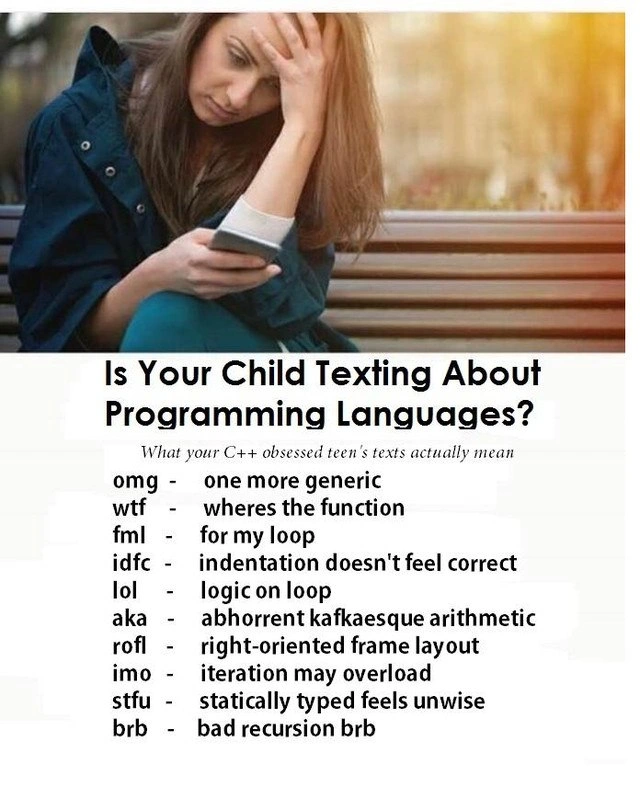
Imagine your mom or dad sees a bunch of weird abbreviations in your texts and gets a little worried. They’re thinking, “Oh no, is this some secret code?!” Now, picture them finding a guide that claims to decode your messages – but instead of anything bad, it turns out you’re just talking about computer stuff! This meme is funny because it’s like a parent panicking over nothing. The teen in the picture looks stressed on her phone, and the big caption jokes, “Is Your Child Texting About Programming Languages?” Normally parents might fear kids are using slang about parties or trouble, but here the twist is the kid is just super into coding. Each small acronym (like OMG, LOL, BRB) is usually something simple you’d say while chatting (like “oh my gosh”, “laugh out loud”, “be right back”). The joke is that the parent thinks those letters mean something about the C++ programming language – for example, they think OMG means “one more generic” (which is a nerdy way to talk about code). Of course, in real life OMG just means someone is surprised! It’s a bit like if a parent found a note where a kid wrote “TTYL” (talk to you later) and the parent worried it meant “Time Travel Yesterday, Literally” or some nonsense. The silly idea that a teenager’s slang is actually secret computer talk makes us laugh. The kid isn’t plotting anything wild; they’re just geeking out. So the humor comes from that mix-up: what looks like mysterious teen lingo is, in this joke, actually even more mysterious programmer lingo. It’s harmless and kind of sweet – the only thing this kid is guilty of is being a total coding nerd!
Level 2: Slang to Syntax
If you’re newer to programming or not steeped in C++ lore, don’t worry – this meme is basically taking texting acronyms (like "LOL", "BRB") and pretending they stand for programming terms instead of their normal meanings. Think of it as decoding a secret teen message, but the decoder ring is set to "programming nerd". The title “Is Your Child Texting About Programming Languages?” is deliberately silly. Normally, parents worry kids might text about parties or use swear words in shorthand. Here, the joke is the kid is so into coding (specifically C++, a notoriously complex programming language) that even their slang is about code. It’s a playful mix-up of language quirks: everyday chat abbreviations vs. C++ technical jargon.
Let’s break down what each acronym usually means, and what the meme says it means in C++-speak. This will help clarify the humor for each one:
| Acronym | Normal Meaning (Texting Slang) | "C++ Obsessed" Meaning (Joke) |
|---|---|---|
| OMG | "Oh my God" (surprise or shock) | one more generic (another generic/template type in code) |
| WTF | "What the f***" (expression of disbelief) | where’s the function (can’t find a function in code) |
| FML | "F*** my life" (frustration or despair) | for my loop (sounds like starting a for loop in code) |
| IDFC | "I don’t f***ing care" (apathy) | indentation doesn’t feel correct (code formatting looks wrong) |
| LOL | "Laugh out loud" (it’s funny) | logic on loop (something’s stuck looping in code logic) |
| AKA | "Also known as" (another name/alias) | abhorrent Kafkaesque arithmetic (absurdly complex math code, tongue-in-cheek) |
| ROFL | "Rolling on the floor laughing" (very funny) | right-oriented frame layout (techno-gibberish about data layout) |
| IMO | "In my opinion" (just my view) | iteration may overload (looping might cause an overload or relates to function overloading) |
| STFU | "Shut the **** up" (rude "be quiet") | statically typed feels unwise (dissing static typing in programming) |
| BRB | "Be right back" (away for a moment) | bad recursion brb (a recursive phrase that calls itself) |
Now, let’s explain some of these C++ terms in simpler words, to see why they’re funny in this context:
C++: First off, C++ is a programming language, one known for being super powerful but also pretty complex. It’s used for building software where performance matters (like game engines, operating systems, etc.). People joke that C++ has so many features (and ways to shoot yourself in the foot) that it can be intimidating. So the idea of a teen being obsessed with C++ is a bit humorous on its own – it’s like a student obsessing over a very hard subject.
Generic: In programming, a generic typically means a function or class that can work with any data type. In C++, generics are done with templates. For example, instead of writing two separate functions to handle
add(int a, int b)andadd(double x, double y), you can write one template that works for any type. Saying “one more generic” (for OMG) suggests adding yet another template parameter or type. It’s funny because OMG is usually an exclamation of surprise, but here it sounds like the teen is eagerly adding generic types to their code template – a very programmer thing to do. The humor is in the mismatch: Oh my God! vs One more generic!.Function: A function is a reusable piece of code that performs a task. “Where’s the function?” (for WTF) sounds like a programmer hunting through code for a missing piece. Normally, WTF is a shocked or angry reaction (“what the heck?!”). The meme twists it to a literal question about code. If you imagine a developer reading someone’s program, scratching their head because a function definition is missing or not where expected, they might mumble “Where’s the function...?”. It captures a common newbie bug or build error (like forgetting to define a function that you declared, leading to linker errors) in a tongue-in-cheek way.
Loop: A loop in coding is a way to repeat instructions until a certain condition is met. A
forloop is a common kind that repeats a set number of times or over a range. So “for my loop” (FML) is literally phrase that could appear in code (e.g.,for myLoopisn’t a real syntax by itself, but it evokes writing a loop). The original FML expresses despair; the code version sounds like someone talking about setting up a loop. It might also subtly hint at the frustration of dealing with loops or being stuck in one, turning “F my life” into a nerdy “ugh, I’m stuck debugging my loop”. It’s a humorous way to turn teen angst into programmer frustration.Indentation: Indentation is how we align code with spaces or tabs to show structure (like which code is inside a loop or if-else). It doesn’t change the program’s result in C++ (the compiler ignores whitespace), but it makes the code much more readable. Many programmers are very particular about indentation style (misaligned code feels as uncomfortable as a crooked picture frame on a wall). In some languages like Python, indentation is actually part of the syntax (if it “doesn’t feel correct,” the program might not run!). “Indentation doesn’t feel correct” (IDFC) is funny because the normal slang means “I don’t care at all,” whereas here the coder absolutely does care – they feel something is off with the code formatting. It’s poking fun at how programmers can be meticulous about things like spaces and indent levels, which is the opposite of teenage apathy. So this particular translation is ironically reversing the meaning: a teen who says IDFC normally wouldn’t give a hoot, but the C++ teen version is basically a perfectionist complaining about code style.
Logic on loop: This phrase (LOL) is not standard jargon, but we can infer it means some logic is looping repeatedly. Maybe the code’s logic got stuck in a loop, causing an unintended repetition. It could also be interpreted as “logic on a loop”, implying perhaps a piece of logic that is placed inside a loop structure. The normal LOL is laughter, but in code context, nobody’s laughing – it hints at a possible infinite loop or a bug where something keeps repeating. It’s a playful way to imagine a developer friend messaging you “LOL” and they actually mean “ugh, my logic is stuck in a loop, I’ve been debugging this for hours” – definitely not the usual use of LOL!
Kafkaesque arithmetic: This one is more of a joke than a real term. Kafkaesque is an adjective derived from writer Franz Kafka, meaning extremely complex, bizarre, or illogical in a nightmarish way. Arithmetic is just math calculations. So “abhorrent Kafkaesque arithmetic” paints a picture of some truly awful, convoluted math in code. There’s no actual C++ feature with that name – it’s exaggerated for humor. It suggests maybe a calculation in code that’s overly complicated or twisted (think of a single giant expression that spans multiple lines and is inscrutable). By saying “AKA” (also known as) equals that mouthful, the meme jokingly implies that something simple was renamed to something ridiculously complex. It’s almost mocking how sometimes programming (especially in C++ templates or tricky code) can make simple things look insanely complicated. While a newbie might not have seen Kafkaesque code yet, the phrase still conveys “some crazy complicated thing” – which is the comedic contrast to the harmless original “also known as.”
Frame layout: In low-level programming, a frame often refers to a stack frame (the portion of memory that holds a function’s local variables and such during execution) or a data frame in some contexts. Layout means how things are arranged. “Right-oriented frame layout” doesn’t correspond to a specific known concept, but it sounds plausibly technical (maybe referring to aligning data to the right in memory, or something to do with right-hand side assembly listing – but frankly, it’s techno-babble for comedic effect). It’s paired with ROFL, which normally indicates something is extremely funny. The humor here is that the meaning given is dry and boring, the complete opposite of rolling on the floor laughing. It also pokes fun at programmer-speak: sometimes we use jargon that looks meaningless to outsiders. A junior dev might not know this term (since it’s not standard), and that’s okay – even many experienced devs will recognize it's a joke. The key is that it sounds like a complex C++ topic, the sort that would make a non-programmer parent totally lost if they tried to read it. It exaggerates how gibberish-like our inside jokes or advanced topics can appear.
Iteration may overload: Here iteration means looping, and overload is a term from C++ that means defining a new behavior for an existing function/operator depending on context. For example, C++ allows function overloading (two functions with the same name but different parameters), and operator overloading (making the
+symbol work for your custom class, for instance). The phrase “may overload” in plain English could also imply “might overwhelm or exceed limits”. In the context of the meme, it’s a bit of a pun that touches both meanings. It’s as if the teen is cautioning: “in my opinion, doing too many iterations (loops) might overload something” – which sounds like something a programmer might half-jokingly text when optimizing code or worried about performance. For a new developer, the takeaway is that they’re mixing a programming concept (overloading functions) with a common word (overload as in overwhelm), making a quirky double meaning. The acronym IMO sets it up like an opinion, which matches how programmers often love to give opinions on what could go wrong in code.Statically typed: This refers to a language where you must declare variable types, and those types are checked at compile time. C++ is statically typed, meaning, for example, if you say
int x = "hello";it won’t even compile because you’re assigning a string to an integer variable. “Feels unwise” suggests the person thinks static typing is not a good idea. This contrasts with dynamically typed languages (like Python or JavaScript) where you don’t declare types explicitly, and a variable can hold any type of value at runtime. The meme’s translation of STFU to “statically typed feels unwise” is funny because it imagines the teen being opinionated about a rather academic topic – type systems. It’s like a parody of a programming hipster who prefers flexible languages and dismisses the venerable C++ approach. For a junior dev, the humor is in imagining a teenager using a very rude texting acronym to essentially say a nerdy statement: “I think using static types is a bad idea.” It’s an improbable sentence to hear in any normal context, which is why it’s amusing. It also winks at real debates programmers have (static vs dynamic typing is a classic discussion when choosing a language).Recursion: This is a concept where a function calls itself in its own definition. Recursion can solve problems by breaking them down into smaller sub-problems of the same type. However, if a recursive function doesn’t have a condition to stop (a base case), it will call itself forever, which is a bad recursion. That usually leads to a program crash or lock-up (often a stack overflow, which, fun fact, is what the website Stack Overflow is named after!). The acronym BRB normally means “be right back,” but here the meme says “bad recursion brb”. Notice how it starts with BRB and ends with BRB again as part of the explanation. That’s a recursive joke! It’s like a definition that never ends because it keeps referring to itself. If you were to expand it fully: BRB = bad recursion brb = bad recursion bad recursion brb = ... and so on, never finishing. For a new programmer, once you learn what recursion is, this is a brilliant little demonstration in joke form. It’s basically a silly example of an infinite recursive loop made out of an acronym. So the meme not only references a coding concept, it demonstrates it in the text. This is often a type of nerd humor – making self-referential or self-infinite definitions (another famous one is the joke definition: “recursion (n): See recursion.”).
In general, what makes this meme funny is the contrast and the specificity. It takes very relatable chat abbreviations and gives them highly unrelatable programmer meanings. If you’re a junior dev or just learning C++, some of these terms might even be new to you – and that’s okay! The meme is exaggerating how a hardcore C++ fan might inject programming talk into every facet of life. It’s highlighting the stereotypes both of texting teens (with their acronyms and slang) and of programmers (with their dense jargon and obsession with details like types and indentation). The list format itself is copying those guides meant for worried parents, but each entry is an absurd mismatch – which is exactly why it’s humorous.
Also, note that some entries are real technical terms (like statically typed, function, loop) that you might encounter as you learn programming, while others are basically made-up or tongue-in-cheek (like that Kafkaesque arithmetic or right-oriented frame layout) meant to sound complicated. This mix adds to the joke because a newbie might scratch their head at a couple of them – you’re experiencing a tiny bit of what a non-coder parent would feel reading this entire thing: “What on Earth does all this mean?!” 😅 But once you understand the pieces, you can appreciate the cleverness.
Remember, the context here is a developer inside joke. It assumes the reader knows both the texting world and the programming world. If you’ve ever seen those posts like “Parents beware: if your kid texts POS it means ‘Parent Over Shoulder’”, you can see how this meme mimics that tone, but instead of revealing sneaky teen behavior, it “reveals” that the kid is just nerding out about C++! In reality, of course, no teen is likely typing IDFC to mean they dislike their code indentation – that’s what makes it so absurd and funny. It’s taking something ordinary and interpreting it in the most extraordinarily geeky way possible. As you continue learning, you’ll probably start catching more of these kinds of technology jokes – the programming community loves puns and double meanings. It’s a fun part of the culture, helping us laugh at the quirks of languages like C++ that we simultaneously love and hate for their complexity.
Level 3: Parental Panic++
At first glance, this meme perfectly parodies those alarmist articles that warn, "Is Your Child Texting About Drugs or Gangs?" – except here the dev community twist is, "Is your child texting about programming languages?". The image shows a teen on a park bench, hunched over her phone with a worried expression. It sets the stage for a tongue-in-cheek scenario: a concerned parent decoding their C++-obsessed kid’s text acronyms. Seasoned developers immediately recognize the humor: everyday texting acronyms like "OMG" or "WTF" get reinterpreted as if the teen’s slang is secretly about C++ templates, code style, and other arcane programming concepts. It’s a collision of dev humor with teen culture, and the result is delightfully absurd. For an experienced programmer, the combo of teen lingo and hardcore C++ jargon is as incongruous (and funny) as finding a <template> tag in a love letter.
The heart of the joke lies in mapping each casual chat abbreviation to an esoteric bit of C++ lore. Imagine a worried parent reading a text like "omg lol stfu brb" and then consulting this spoof "guide" to interpret it. Instead of scandalous meanings, they get a face full of C++ gibberish. "omg – one more generic" instantly evokes C++ generic programming (templates). A senior developer chuckles because they’ve been down that rabbit hole of adding one more template parameter or making one more generic class to handle a new type. C++ templates are powerful but notoriously tricky – and the idea that a teen would text about squeezing in another template specialization is hilariously over-the-top. Next, "wtf – where’s the function" riffs on the exasperated “What the f...!” but turns it into a coder’s frustration: searching a massive codebase thinking “Where’s the function?”. Any programmer who’s lost a definition or chased an undefined reference in linking knows that feeling. This acronym list is essentially a nerdy Rosetta Stone, translating teen SMS speak into what an overly code-obsessed mind might see instead.
Each decoded acronym packs an inside joke known to veteran C++ devs. "fml – for my loop" turns the teen’s despairing “f** my life”* into a mundane code snippet phrase “for my loop”. It’s poking fun at how a coder’s life can revolve around loops and logic even in moments of exasperation. "idfc – indentation doesn’t feel correct" is a gem because it flips the original meaning completely. In slang, “I don’t freaking care” is pure teenage apathy, but the C++ version has the teen obsessing that their code indentation is off. A seasoned coder recognizes this ironic inversion – we do care deeply about indentation and braces lining up. (Heck, entire style wars over tabs vs. spaces have raged in code communities!). The teenager here isn’t rebellious or apathetic at all; they’re an anal-retentive code stylist, fussing that something like a missed space or a misaligned brace in the code “just doesn’t feel correct.” It’s a subtle nod to the inside joke that developers can be very particular about formatting – a far cry from the usual teen nonchalance.
Then we have "lol – logic on loop", morphing “laugh out loud” into something a programmer might say when stuck debugging: “my logic is stuck in a loop.” It’s common dev lingo to talk about being “looped” or having a bug where the program is endlessly cycling, and it slyly implies an infinite loop scenario. A senior dev has probably encountered a rogue while(true) or a recursion without a base case that made them literally not laugh out loud. The transformation of LOL from mirth to a code problem is a wry comment on how a coder’s mind works – always seeing potential bugs and loops everywhere.
The acronym "aka – abhorrent kafkaesque arithmetic" stands out as intentionally over-the-top. Normally "AKA" is “also known as,” something simple and benign. Here it’s blown up into a Frankenstein phrase mixing extreme horror (abhorrent), literary allusion (Kafkaesque referring to Franz Kafka’s bizarre, complex narratives), and plain math (arithmetic). This one isn’t a standard term at all – it’s a caricature of horrendously complex code. A C++ guru might chuckle because it evokes the feeling of staring at an absurd template meta-program or a convoluted expression template that feels nightmarish or Kafkaesque in complexity. In other words, it’s code so convoluted and contrived that it’s practically a dark surrealist joke. Only a language as notoriously intricate as C++ could inspire a phrase like that. It satirizes how non-devs hear our technical talk: to a parent’s ear, “abhorrent kafkaesque arithmetic” might as well be summoning Cthulhu. The meme exaggerates that disconnect for comedic effect – an inside joke about C++’s penchant for complicated arithmetic expressions (perhaps template metaprogramming at compile time) disguised as a harmless acronym.
Moving on, "rofl – right-oriented frame layout" reinterprets “rolling on the floor laughing” as something dry and technical. This one sounds plausible but is almost gibberish – and that’s the joke. It reads like some obscure term a systems programmer might mutter when talking about memory or data alignment (a frame layout could hint at a stack frame or data structure layout in memory). “Right-oriented” isn’t a common qualifier for frame layouts, but it sure makes it sound needlessly technical. The seasoned dev sees this and smirks: it’s a parody of how our jargon can sound to outsiders. To a non-developer parent, “right-oriented frame layout” might sound as alien as a real text slang like “ROFL” sounded to parents in the early 2000s. In fact, a veteran might recall how texting shorthand itself was once bewildering to older folks; now we’re doubling the confusion by turning that shorthand into programmer-speak! The very phrasing here mocks C++’s verbosity and precision. (C++ has things like left-shift and right-shift operators, left/right value references, frame pointers... so it’s mashing that vibe into an acronym). The result is a layered joke: it’s funny even if it means nothing, because the tone is so nerdy-serious contrasted with the original silly meaning of ROFL.
"imo – iteration may overload" cleverly pivots “in my opinion” into a warning straight out of C++ jargon. Overloading in C++ is a real feature: you can have multiple functions with the same name (or even overload operators like + for custom classes). A senior coder knows the term well. Seeing “iteration may overload”, they might think of two things: either the loop (iteration) might overload something (like overwhelm the CPU or cause an overload of output), or it’s a pun that mixing iteration logic could tie into function/operator overloading. It’s a bit ambiguous, but that’s fine – it still sounds like something you’d read in a code review: “Careful, too much iteration may overload the system.” For the meme’s purpose, it’s enough that iteration (a loop) and overload are solid C++ vocabulary. A veteran dev smiles because it’s such an earnest-sounding technical statement shoehorned into a teen text acronym. It highlights how language quirks in programming can double as weird interpretations for normal words.
Now perhaps the crown jewel for experienced devs: "stfu – statically typed feels unwise". The original STFU is a blunt “shut the **** up,” often an angry or joking retort. The meme transforms it into a sly commentary on type systems: “statically typed feels unwise.” This is hilarious to a C++ veteran on multiple levels. First, C++ is famously a statically-typed language (you must declare types for your variables and they don’t change at runtime). So if a C++-obsessed teen is texting “STFU” with this meaning, they’re basically throwing shade at their own favorite language’s feature! It reads like a rebellious teen phase in nerd terms: “Ugh, static typing? So uncool, I prefer dynamic languages, Mom!”. It’s a playful dig at the endless debates in programming communities (static vs dynamic typing, the merits of strict type checking versus flexibility). Seasoned devs have seen these debates flare up on forums and Twitter countless times. This one-liner “statically typed feels unwise” mimics that contrarian hot-take style. It’s as if the teen is saying “Strict type rules? Psh, that’s lame.” The humor is that such an opinion coming from a C++ fanatic is delightfully contradictory – it’s akin to a straight-A student saying doing homework is pointless. The senior dev reading this gets the irony and maybe even remembers their own flirtations with dynamic languages (like Python or JavaScript) after wrangling with C++ compile errors for days. The phrase also has that sarcastic tone which fits the original STFU’s spirit (a bit of an eye-roll and “whatever” attitude). In short, it’s an inside joke about programming language preferences disguised as teen snark.
Finally, "brb – bad recursion brb" is the punchline that likely made every experienced programmer snort with laughter. On the surface, it’s the least assuming: “be right back” becomes “bad recursion brb”. But unpack it: it’s a self-referential acronym definition – it literally includes “brb” again at the end. This is a classic geek humor move, referencing the concept of recursion (when a function calls itself). A bad recursion is one that doesn’t have a proper exit condition, meaning it will call itself forever. The joke here is exactly that: the acronym explanation recursively includes itself, so it never truly finishes explaining. It’s like an infinite loop of definition – a perfect simulation of what happens in code with a recursive bug. Veteran devs have a special appreciation for this because it’s clever and meta. It reminds them of humorous acronyms like GNU (which famously stands for “GNU’s Not Unix!”, a recursive acronym in tech). It’s also winking at the real danger of a recursion gone wrong: an infinite recursion will crash your program (stack overflow) or at least never return – just like the phrase "bad recursion brb" leaves you hanging waiting for completion that never comes. The double "brb" is both the start and end of the message, looping infinitely. This level of humor – an Easter egg that only those who know recursion will get – gives the meme extra cachet among developers. It’s the kind of clever detail that a programmer’s inside joke thrives on.
All together, the list satirizes both teenager texting culture and C++’s notorious complexity. An experienced developer recognizes how absurd it is to imagine a teen using these in actual messages (most teens text "omg lol bbq idc" not “one more generic, logic on loop...”). That absurdity is the point: it’s a nerd fantasy, where even teen slang bows to the almighty programming language. The meme exaggerates the (cplusplus_obsession) to the point of silliness – which is why it’s funny. There’s also a bit of self-deprecating truth: as developers, sometimes we do find ourselves seeing technology everywhere. We read normal words and our brain autocorrects to code terminology (ever see “Java” on a coffee sign and immediately think of the language?). Here it’s texting acronyms that get the code treatment. This resonates with devs who have accidentally answered a casual "LOL" with "lots of logs" or some other nerdy interpretation in their head.
In the broader context, there’s a gentle poke at generational misunderstanding. The meme’s faux-subheading “What your C++ obsessed teen’s texts actually mean” mimics those scare-mongering parental guides. In reality, rather than secret party codes, our hypothetical teen is using programming language abbreviations. The humor is that the “translations” provided are more bewildering (to an average parent) than the original acronyms! Any parent who isn’t tech-savvy would find “abhorrent kafkaesque arithmetic” far more concerning (or confusing!) than a plain old “aka”. It highlights the gap between those in the know (developers, or DevCommunities insiders) and those outside. Seasoned devs love this kind of joke because it flatters our niche knowledge – we get it, even if it would look like total nonsense to others. It’s relatable because many of us have had to explain to a non-tech friend or relative what our jargon means. This meme just takes that to a comic extreme.
In sum, the meme synergizes language quirks from two worlds: texting slang and C++ code-speak. Experienced programmers appreciate how each acronym is a little puzzle or pun – some referencing legitimate C++ concepts like templates, loops, static typing, and others simply exaggerating how convoluted code can sound. It’s an inside joke buffet. The more you know about C++, the more layers you peel back: you laugh at the surface absurdity, then maybe smirk again realizing “bad recursion brb” is a recursive acronym, and nod knowingly about static typing debates and template headaches. The meme also gently teases C++ for being the kind of language where phrases like “one more generic” or “right-oriented frame layout” feel like they could almost be real. (C++ has such a rich history of hair-pulling features that nothing sounds too outlandish!) Ultimately, it’s a celebration of coding humor – finding geeky fun in everyday life. The next time someone texts "OMG", a true C++ veteran might just grin and think, “One more generic? Sure, why not add another template parameter!” before reality kicks back in. That shared mental double-take is exactly what this meme is playing on.
Description
Photo-style meme shows a teenage girl on a park bench, head partially obscured, looking at a smartphone. Below the image, large bold heading reads “Is Your Child Texting About Programming Languages?” followed by the sub-heading “What your C++ obsessed teen’s texts actually mean.” A list then re-interprets common texting abbreviations as C++ terms: “omg - one more generic, wtf - wheres the function, fml - for my loop, idfc - indentation doesn't feel correct, lol - logic on loop, aka - abhorrent kafkaesque arithmetic, rofl - right-oriented frame layout, imo - iteration may overload, stfu - statically typed feels unwise, brb - bad recursion brb.” The humor comes from mapping everyday chat slang to esoteric C++ concepts like templates, recursion, and type systems, poking fun at how language nerds see code everywhere. Seasoned developers will recognize the inside joke about C++’s complexity while appreciating the parody of parental panic articles
Comments
7Comment deleted
Relax, Mom - when your kid texts “omg” they’re not swearing, they’re warning the build server that one more generic will push template instantiation depth past 1024 and turn the linker into a space heater
Wait until she discovers her kid's commit messages are just "fix", "update", and "asdfasdf" - suddenly those cryptic texts will seem like Shakespeare compared to their actual documentation habits
The 'brb = bad recursion brb' entry has no base case - much like the teen's template metaprogramming, it only terminates when the parent's patience overflows
When your teenager says 'brb' and you're not sure if they're coming back or if they've just written a recursive function that calls itself indefinitely - either way, you're waiting a while and might need to force quit the conversation
Relax: “omg” means “one more generic” - the gateway to compile times measured in coffee refills and a “brb” when overload resolution yields a 10k‑line template error
If your kid texts “omg wtf fml,” relax - it’s C++ for “one more generic” SFINAE’d the overload and now the for-loop compiles into 10k lines of template errors
Stfu until that dynamic-typed monolith bites back at scale - then static wisdom hits like a type checker in prod