Every code optimization ever: shaving milliseconds until you’re a skeleton
Why is this Performance meme funny?
Level 1: Never-Ending Race
Imagine you want to be the absolute fastest kid getting to the ice cream truck. You start trying a bunch of tiny shortcuts to save a few seconds – cutting through a yard, then trying a different street, then another shortcut – each one might save just one second. But while you’re busy constantly changing your path to shave off a second here and a second there, the ice cream truck has already come and gone. You spent so much time trying to be perfectly fast that you actually ended up really late. The joke in the meme is like that: a programmer keeps fine-tuning their code to make it a teeny bit faster, until so much time passes that they practically turn into a skeleton at the keyboard. It’s funny (and a bit silly) because sometimes trying to be ultra-efficient can actually be a huge waste of time!
Level 2: Just a Few More ms
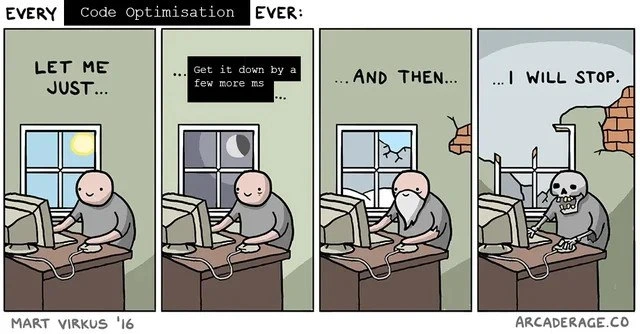
This meme is all about performance optimization and how programmers can sometimes go overboard with it. In the comic, a developer says "Let me just get it down by a few more ms" – here ms stands for milliseconds, which are thousandths of a second. Shaving off a few milliseconds means making the code run a tiny bit faster. At first, that sounds great: who wouldn’t want their program to be quicker? Micro-optimizations are those little changes in code (like tweaking a loop or using a slightly more efficient operation) that can save a bit of time. The joke is that the developer keeps doing this over and over, obsessively trying to eliminate every last millisecond of delay.
As the panels progress, you see day turn to night and then to many days and nights — the sun and moon outside the window keep changing. The programmer grows a long white beard, and by the final panel he’s a skeleton still hunched over the keyboard. This visual gag shows that he’s spent practically a lifetime continually optimizing the code. He keeps thinking, "Just one more tweak and then I’ll stop," but he never actually stops. It’s like he’s stuck in an endless loop of optimization (a playful reference to a code loop that never breaks out). Developers have a phrase “premature optimization” to describe trying to optimize code too early or more than necessary. In simpler terms, if you spend huge amounts of time to make something that’s already fast just a teeny bit faster, you might be wasting your effort. The comic exaggerates this to make it funny – of course no real programmer literally turns into a skeleton from coding, but it pokes fun at how you can feel like you aged a hundred years while chasing tiny improvements. The message to newer developers is clear: yes, making code efficient is good, but don’t let optimization become an addiction. There’s a point where the returns get so small that it’s not worth spending days (or your sanity) just to brag that your loop runs 2ms faster.
Level 3: Optimizing to the Bone
For seasoned developers, this comic hits painfully close to home. It satirizes the performance optimization rabbit hole that many of us have fallen into: endlessly tweaking code to save just a few more milliseconds. The humor comes from how relatable this scenario is. We’ve all seen someone (maybe ourselves!) spend a late night trying to squeeze out an extra 1% speedup that no real user would ever notice. In the first panel, the character chirps "Let me just..." as he begins an optimization. By the second panel (now midnight), he’s mumbling "...get it down by a few more ms" – classic tunnel vision on micro-optimizations. Fast-forward to panel three and he’s aged into a gray-bearded guru still saying "...and then...". One optimization leads to the next, and he keeps promising himself just one more. Finally, in the fourth panel, he’s literally a skeleton at the keyboard declaring "...I will stop." It’s an absurd exaggeration of a real developer habit: not knowing when to stop fine-tuning.
The term “premature optimization” often gets thrown around in senior engineering circles for exactly this kind of situation. It means trying to optimize code too early or beyond what’s practical. This meme plays on that concept by pushing it to a comical extreme – the developer’s entire career passes by in pursuit of marginal speed improvements. The stark imagery of the aging developer (from a normal coder, to an over-caffeinated night owl, to an old sage, and finally to a skeleton) is the punchline about the cost of obsession. It implies that while you’re busy perfecting that function’s runtime from 50ms down to 45ms, the world (and your project timeline) might crumble around you. Seasoned devs chuckle (and cringe) because they remember being stuck in this endless loop of optimization: pouring hours into shaving off microseconds. Sure, sometimes every millisecond matters – say in a high-frequency trading system or a real-time game engine – but in most projects there’s a point of diminishing returns. Beyond that point, each micro-tweak eats up a huge amount of developer effort for negligible benefit (often making the code more complex or brittle in the process). The comic uses dark humor to convey an unwritten rule of programming: focus on fixing the big, obvious slow parts first, and know when “good enough” is truly good enough.
Level 4: Chasing the Last Millisecond
This meme humorously exaggerates the concept of premature optimization and the diminishing returns of micro-level code tuning. In theoretical terms, even if you keep shaving off a few milliseconds (ms) from a program’s runtime, you eventually hit hard limits defined by algorithmic efficiency and physical constraints. Computer science has formalized this idea: Amdahl’s Law tells us that the maximum speedup of a system is limited by the portion you haven’t optimized. For instance, if 95% of your program’s execution time is already efficient and you spend your life optimizing the remaining 5%, the absolute best overall improvement you might see is around 5% – no matter how perfectly you optimize that small part. Each successive change yields diminishing returns, asymptotically approaching a performance ceiling.
The meme’s skeleton coder is a darkly comic symbol of this phenomenon. It echoes the famous caution by Donald Knuth: “Premature optimization is the root of all evil.” Knuth’s decades-old advice implies that obsessively tuning low-level details without evidence of a real bottleneck is often a misallocation of effort. In theoretical computing, big gains come from improved algorithmic complexity (for example, switching from a quadratic $O(n^2)$ solution to a faster $O(n \log n)$ approach) rather than from hand-tweaking tiny constants. There’s also an interplay with modern hardware – things like CPU branch predictors, cache hierarchies, and instruction-level parallelism can make manual micro-tuning unpredictable. Sometimes an "optimization" might even backfire, causing more cache misses or branch mispredictions that slow things down. Chasing the last cycle of performance often demands deep knowledge of these system internals, and even then the final gains might only be measurable with specialized tools.
This extreme pursuit of speed at the cost of time is almost a paradox. By the time you’ve made your code run one millisecond faster, real-world technology (faster processors, smarter compilers, new frameworks) or changing project needs might have overtaken your work. Yet it’s oddly mesmerizing to keep pushing closer to zero runtime, like a Zeno’s paradox of performance: always halving the remaining slowness but never quite reaching instant. The developer turning into a skeleton visualizes reaching that theoretical limit – the optimization horizon where any further gains are negligible – and humorously suggests that the coder’s life was literally consumed in the process.
Description
Four-panel comic with a caption across the top that reads "EVERY Code Optimisation EVER:". Panel 1 shows a bald developer at a desktop PC in daytime; speech bubble: "LET ME JUST…". Panel 2 shows the same developer at night under moonlight saying "… Get it down by a few more ms". Panel 3 is daytime again, the developer now has a long white beard and says "… AND THEN…". Panel 4 shows the room partially crumbled and the coder has become a skeleton still typing, finishing the sentence with "… I WILL STOP." Artist credit "MART VIRKUS ’16" appears bottom left; site "ARCADERAGE.CO" bottom right. Visually, the constant window time changes and the developer’s aging illustrate how obsessing over micro-second performance tweaks can consume an entire career, poking fun at the diminishing returns of code-level performance optimization familiar to senior engineers

Comments
7Comment deleted
Hand-unrolled loops, cache-aligned structs, branch predictor hints - shaved 4 µs off the hot path just in time for the biz team to add a 400 ms SaaS call upfront; my skeleton says it was totally worth it
Meanwhile, the database is still doing full table scans because nobody ever added that index from the Q3 planning meeting
He saved 4ms per request and spent 40 years - at that exchange rate, the optimization amortizes sometime after the heat death of the universe, which is at least O(1)
This perfectly captures the senior engineer's dilemma: you know that shaving 3ms off a function that runs once per user session has zero business impact, you understand Amdahl's Law intimately, you've read all the profiling best practices... and yet there you are at 4 AM, convinced that if you just inline this one more function call, restructure this loop one more time, or switch to a slightly more cache-friendly data structure, you'll achieve optimization nirvana. The real optimization was the sleep schedule we destroyed along the way. Remember: premature optimization is the root of all evil, but so is the 'just one more tweak' optimization at 3 AM when you've already achieved 95% of theoretical maximum performance
Two sprints to shave 3 ms off p50; Amdahl’s Law and the p99 SLO still turned me into the skeleton
Knuth nailed it: premature optimization is the root of all evil - and skeletal remains
“Just a few more ms” - aka the onboarding phrase for a lifetime retainer with Amdahl’s Law, p99 tail latency, and benchmarks that only ever look fast on your laptop