
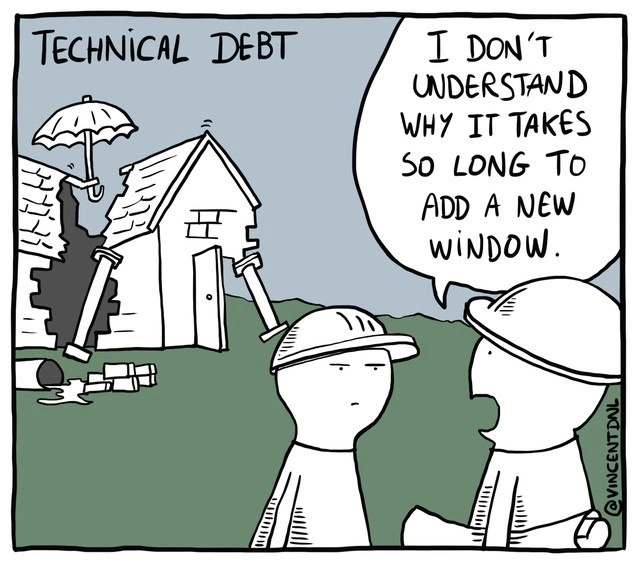
Explaining Technical Debt with a Dilapidated House
Description
A single-panel comic titled 'TECHNICAL DEBT' that serves as a visual metaphor for the software development concept. In the background stands a decrepit white house with a crumbling roof patched by a small umbrella, collapsing walls propped up by precariously angled pillars, and leaking pipes. The entire structure is on the verge of collapse. In the foreground, two cartoon figures wearing hard hats are in conversation. One figure, presumably a manager or client, is shown complaining with a speech bubble that reads, 'I DON'T UNDERSTAND WHY IT TAKES SO LONG TO ADD A NEW WINDOW.' The other figure, representing the engineer, stares back with a tired, deadpan expression, silently contemplating the impossible task of modifying the fragile structure without causing it to fall apart. The comic humorously and effectively illustrates how years of accumulated quick fixes and poor architectural decisions (technical debt) make even seemingly simple changes a slow, complex, and risky endeavor

Comments
7Comment deleted
The PM wants to add a window. I have to explain that the 'wall' is actually a load-bearing JPEG and the foundation is just three levels of unsupported regex
“Adding the window is easy - the hard part is replacing the load-bearing singleton service, the duct-taped Bash cron that passes for a build, and the 2008-era ORM that thinks SQL injections are a feature.”
The window installation is actually the easy part - it's the three-week archaeological dig through undocumented load-bearing spaghetti that determines which walls won't collapse when you touch them
This perfectly captures the eternal struggle of explaining to stakeholders why 'just adding a feature' to a legacy system takes three sprints. Sure, we could nail that window onto the collapsing wall - but when the whole house falls down because we didn't address the foundation, the umbrella won't save us. Every senior engineer has lived this conversation: 'It's just a simple CRUD endpoint!' they say, not seeing the 15-year-old monolith held together by deprecated libraries, circular dependencies, and the tears of developers past
Adding a window is trivial - the hard part is shoring up the load-bearing global state so the monolith doesn’t collapse during the PR
“Just add a window” - sure, once we refactor the load-bearing abstraction, decouple the shared database, and retire the three cron jobs from 2009 that think the wall is their API
Because the 'temporary' umbrella hack from sprint zero is now load-bearing architecture